If you’re constantly asking yourself, "why am I so hard on myself?" you’re not alone. That harsh, nagging voice in your head is often a misguided attempt by your brain’s threat system to keep you safe from failure or judgment. It’s a deeply ingrained habit, not a personal flaw, and understanding its roots is the first step toward changing the conversation.
The Constant Battle with Your Inner Critic
Living with a relentless inner critic is exhausting. It feels like a constant battle where you are both the attacker and the attacked, leaving you feeling drained, anxious, and stuck. Every mistake gets magnified, every success is brushed aside, and the pressure to be perfect becomes overwhelming. This internal monologue isn't just unpleasant; it actively shapes your reality, hitting your confidence, relationships, and overall wellbeing.
This struggle is incredibly common. In the UK, this pattern of harsh self-judgement is closely linked to rising mental health challenges, particularly among young adults. Research from 2023 highlighted that a staggering 16.1% of 17-year-olds reported high psychological distress. The 12-month prevalence of self-harm—a behaviour often driven by an intense inner critic—was at an alarming 24.1%.
Why Is This Battle So Difficult to Win?
The reason this fight feels so draining is that your inner critic often disguises itself as a motivator. It whispers that being hard on yourself is the only way to achieve your goals, avoid mistakes, and earn respect from others. This creates a powerful internal conflict: you desperately want the criticism to stop, but you're afraid of what might happen if you let your guard down.
This guide is designed to help you step off that battlefield. We’ll explore where this critical voice comes from—not as a source of blame, but as a source of understanding. By looking at your inner critic through the lens of Compassion Focused Therapy (CFT), you can begin to see it not as an enemy to be defeated, but as a part of you that is trying—albeit clumsily—to keep you safe.
The goal isn't to silence your inner critic completely. It’s about learning to listen without automatically believing its harsh judgements and, most importantly, cultivating a kinder, more supportive inner voice to guide you instead.
Throughout this guide, we'll give you a clear path forward with practical, evidence-based strategies to quiet the noise and build a more compassionate relationship with yourself. A great first step in this journey is learning how to let go of negative thoughts and create space for a calmer mind.
So, Where Does This Inner Critic Actually Come From?
If you’re wondering why you're so hard on yourself, the first place we need to look is the very architecture of your brain. That nagging, critical voice isn't some kind of character flaw or a personal failing. It’s actually a direct product of what we in Compassion Focused Therapy (CFT) call our 'tricky brain'—a mind brilliantly designed for survival, but not necessarily for happiness.
Evolution has handed us a powerful negativity bias. Think about our ancestors on the savannah. The one who spent their time scanning for threats—a predator hiding in the bushes, a subtle change in the weather—was far more likely to survive and pass on their genes than the one who was just blissfully enjoying the sunset. That very same survival mechanism is wired into your brain today, which is why it has such a tendency to cling to negative information.
This ancient wiring directly feeds the cycle of self-criticism, as you can see in the relationship between your brain's threat system and your inner critic.
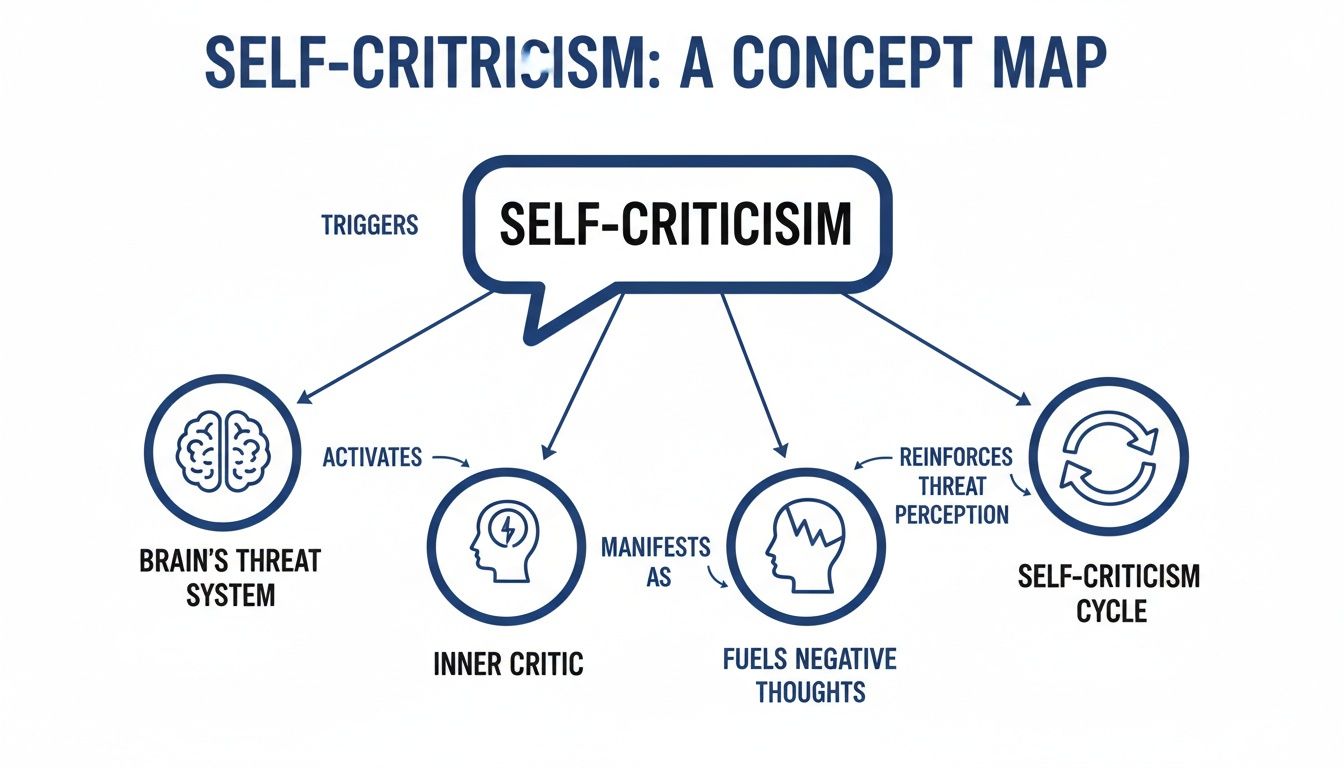
When our threat system is working overtime, it pours fuel on the fire of the inner critic. This can easily trap us in a relentless loop of harsh self-judgement.
Your Three Emotional Systems
Our brains are constantly trying to balance three core emotional regulation systems. When one of these systems gets dialled up too high, it can throw everything else out of whack, creating the perfect storm for self-criticism to take over.
- The Threat System: This is your brain's alarm bell. Its job is to spot danger and fire off feelings like anxiety, anger, and disgust to keep you safe. When it's overactive, you end up living in a state of high alert, constantly on the lookout for what might go wrong.
- The Drive System: You can think of this as your engine. It's the part that motivates you to seek out resources, chase goals, and pursue rewards. It’s all about the feelings of excitement, desire, and accomplishment.
- The Soothing System: This is your brain's safe harbour. It’s connected to feelings of contentment, safeness, and connection. This system gets switched on when we feel cared for and at peace, and its main job is to calm the threat system down.
For so many of us who struggle with being hard on ourselves, the threat system is stuck in overdrive while the soothing system is barely ticking over. Your brain is essentially stuck in protection mode, and it starts using the inner critic as its go-to tool.
The inner critic is, in essence, your threat system talking to you. It uses harsh, critical language to try and 'scare' you into avoiding mistakes, social rejection, or failure, because it mistakenly believes this is the best way to keep you safe.
This is such a crucial insight. It reframes your inner critic from a malicious bully into a misguided bodyguard. It's trying to help, but its methods are clumsy, outdated, and frankly, pretty harmful. Grasping this is the first real step in learning how to work with shame and self-criticism more effectively, a central aim of our work in Compassion Focused Therapy.
How Biology and Biography Forge Your Critic
It's not just about biology, though. Our unique life experiences—our biography—are what program these biological systems to operate in the way they do. Your brain is constantly learning from your past to try and predict your future.
Here’s a simple analogy: think of your brain as the computer hardware that evolution provided (the three emotional systems). Your life experiences are the software that gets written and installed on it.
- Early Childhood Experiences: If you grew up with highly critical parents, demanding teachers, or were bullied by your peers, your threat system quickly learned that the world can be a harsh and judgemental place. In response, your brain developed an internal critic to find your own flaws before anyone else could, believing this would somehow shield you from external attack or rejection.
- High-Pressure Environments: This programming can be reinforced later in life, too. Working in a cut-throat industry or studying in a rigorous academic setting can have the same effect. In these contexts, mistakes can feel like they have huge consequences, training your brain to become hyper-vigilant and fiercely self-critical to keep you performing at a high level.
When you mix an ancient, threat-focused brain with the pressures of modern life, you get a perfect storm. It’s no wonder so many of us feel like we're constantly at war with ourselves.
Realising this isn't about making excuses; it's about having an explanation. It helps to lift that layer of shame we often feel for being self-critical in the first place. You can start to see it not as a fundamental part of who you are, but as a learned pattern—and any pattern that has been learned can be changed.
The Hidden Costs of Constant Self-Criticism
It’s a common belief, isn’t it? That being hard on yourself is what keeps you sharp, what stops you from getting complacent. Many of us secretly think our inner critic is the driving force behind our success. But this internal drill sergeant isn’t a harmless motivator; it’s quietly taking a heavy toll on your wellbeing.
Far from being a source of strength, constant self-criticism is more like a slow, steady leak in a car tyre. It gradually drains your mental, emotional, and even physical resources, leaving you depleted and less able to handle whatever life throws your way. Over time, this pattern doesn't just hold you back—it can lead to serious consequences.

The Emotional and Psychological Fallout
That persistent, nagging voice telling you you’re not good enough is utterly exhausting. It’s not just a feeling; it’s a direct assault on your mental health. This trend is clearly reflected in national data. Between April 2022 and March 2023, the Office for National Statistics found that 23.4% of UK adults were experiencing high levels of anxiety—a figure that has remained stubbornly high since before the pandemic. Self-criticism is a major player in this landscape of unease, as you can see in these national wellbeing findings on ons.gov.uk.
When that internal negativity is left to run wild, it creates the perfect breeding ground for a host of psychological struggles.
- Increased Anxiety and Depression: Self-criticism is a known risk factor for both anxiety and depression. It keeps your brain’s threat system on high alert, constantly flooding your body with stress hormones like cortisol and adrenaline.
- Impostor Syndrome: The inner critic is the voice of impostor syndrome. It’s the one whispering that your successes are just flukes and it’s only a matter of time before you’re exposed as a fraud.
- Chronic Burnout: Relentless self-judgement is mentally draining. It forces you to operate under immense stress, sapping your energy reserves and pushing you straight towards emotional and physical exhaustion.
Being relentlessly hard on yourself isn't the path to high performance. It's the fast track to burnout, creating a cycle of stress and exhaustion that actively undermines your ability to succeed.
The Self-Criticism Vicious Cycle
One of the sneakiest things about self-criticism is the vicious cycle it creates. This loop doesn't just make you feel bad; it actively sabotages your efforts and then uses your stumbles as proof that its harshness was justified all along.
Here’s a breakdown of how it usually works:
- Harsh Self-Judgement: It starts with a critical thought ("I can't mess this up," or "This has to be perfect"). This instantly flicks the switch on your body's stress response.
- Impaired Performance: When you're stressed, your brain doesn't work as well. Your focus narrows, your memory gets shaky, and your creativity plummets. This makes mistakes far more likely.
- Mistake or Perceived Failure: Because you're performing under duress, you inevitably make a mistake or fall short of the impossibly high bar you've set for yourself.
- "Proof" for the Critic: Your inner critic then pounces on this. "See?" it says. "I told you you weren't good enough. You need me to be even harder on you next time."
This loop tricks you into thinking that self-criticism is essential. You start to believe the problem isn't the criticism itself, but that you just weren't listening to it closely enough.
Draining Your Core Resources
Think of your mental and emotional energy like a bank account. Every moment you spend berating yourself, replaying mistakes, or worrying about the future is a withdrawal. Self-compassion, on the other hand, is a deposit.
Chronic self-criticism leaves you in a state of perpetual overdraft. You have fewer resources left for problem-solving, creative thinking, building relationships, or simply enjoying your life. Realising that this inner voice is not a motivator but a major barrier is the first, crucial step toward reclaiming your energy. It’s time to stop paying the hidden costs and start investing in a new, more supportive way of being with yourself.
How to Practice Meaningful Self-Compassion
Understanding why you're so hard on yourself is a massive step forward. But insight alone doesn't change the habit. Real, lasting change happens when we move from knowing to doing.
This is where we roll up our sleeves and intentionally cultivate a kinder inner voice. The goal isn't to wage war on your inner critic or silence it overnight—that's an impossible fight. Instead, we're going to build up a new, more supportive internal ally, one that can stand beside you when things get tough.
The following practices, drawn from Compassion Focused Therapy (CFT), are designed to do just that. Think of them not as quick fixes, but as powerful exercises for retraining your brain. They work by actively engaging your body’s soothing system, which helps to calm that overactive threat response we've been talking about and create a genuine sense of inner safety and warmth.

Soothing Rhythm Breathing to Calm Your Threat System
When your inner critic launches an attack, your body responds as if you're facing a real, physical threat. Your heart races, your breathing gets shallow, and your muscles clench. It's exhausting.
Soothing Rhythm Breathing is a foundational practice designed to directly counteract this physiological stress response. It’s like sending a direct message to your brain that says, "It's okay. You are safe."
This simple act activates the parasympathetic nervous system—your body's natural "rest and digest" mode. By deliberately slowing your breath, you dial down the threat system and create a calm, stable base from which you can respond to your critic with a bit more wisdom and a lot less fear.
How to Practice It
- Find a Comfortable Posture: Sit upright in a chair, with your feet flat on the floor and your back supported. Let your hands rest gently in your lap.
- Slow Your Breath: Gently slow your breathing down to a rhythm that feels comfortable and natural. A good starting point is about five or six breaths per minute—maybe a gentle inhale for a count of four, and a gentle exhale for a count of six.
- Find the Rhythm: The key is finding a smooth, flowing rhythm. Don't force it or strain. The aim is a breath that feels deeply soothing and calming.
- Practice for 3-5 Minutes: Set a timer and just focus on this gentle rhythm. When your mind wanders (and it will!), just gently guide your attention back to the sensation of your breath.
Why It Works: This practice is a direct line to your soothing system. By changing your physiology from a state of threat to a state of calm, you create the mental space you need to engage with self-critical thoughts without getting swept away by them.
Developing Your Compassionate Self
Now, let's build an inner resource. Your compassionate self is an imaginary version of you that embodies all the qualities you'd want in a perfect mentor or friend: wise, strong, warm, and completely non-judgemental.
Creating this internal figure gives you a powerful ally to turn to when your inner critic is shouting. It’s about building an internal source of strength and kindness that you can access anytime, anywhere. This isn’t about pretending to be someone you're not; it's about tapping into the compassionate qualities you already have, but perhaps haven't been directing towards yourself.
How to Practice It
- Imagine the Qualities: What would your ideal compassionate self be like? Think about what qualities would be most helpful.
- Wisdom: They understand the struggles of life and the tricky nature of our evolved brains.
- Strength and Courage: They can tolerate distress and aren't afraid of difficult emotions. They can sit with pain.
- Warmth and Kindness: They have a deep, unwavering commitment to being helpful and supportive, not to condemn.
- Bring It to Life: What would this version of you look and sound like? Imagine their facial expression, the tone of their voice, their posture. Make the image as vivid as you can.
- Step Into the Role: Now, imagine embodying these qualities yourself. Feel that wisdom, strength, and warmth flowing through you. From this compassionate perspective, how would you speak to the part of you that is struggling?
You can explore a wealth of exercises and deepen your understanding of these techniques by reading more about the foundations of self-compassion. This practice is central to building a robust and caring inner world.
Compassionate Letter Writing
This is one of the most powerful exercises for fundamentally changing your relationship with your inner critic. It involves writing a letter to yourself from the perspective of that compassionate self you just developed. The practice helps you reframe a specific situation where you've been beating yourself up, offering understanding where you’d normally give yourself judgement.
So often, our inner critic drives us towards unhealthy coping mechanisms. Learning to approach these behaviours with kindness is a crucial step. For instance, understanding emotional eating as a coping mechanism helps you see it not as a character flaw, but as a misguided (and very human) attempt to self-soothe. Compassionate letter writing can help you address behaviours like this with kindness instead of shame.
How to Practice It
- Identify a Struggle: Think of something you've been criticising yourself for recently. It could be a mistake you made, a perceived failure, or a quality you dislike about yourself.
- Embody Your Compassionate Self: Take a few moments to connect with that wise, kind part of you. You might use Soothing Rhythm Breathing for a minute or two to get grounded first.
- Write the Letter: From this compassionate perspective, write a letter to yourself about the struggle.
- Express Understanding: Start by acknowledging the pain and difficulty. "I know how much you're hurting right now because…" or "I see how tough this has been for you…"
- Offer a New Perspective: Gently reframe the situation without judgement. "It makes total sense that you reacted that way, given how much pressure you were under."
- Provide Support: What would your compassionate self say or do to help? "What might be one small, kind thing you could do for yourself right now?"
Remember, these practices aren't about eradicating self-criticism. They're about building something stronger alongside it. By consistently engaging your soothing system and practising these compassionate exercises, you can fundamentally change your internal landscape, transforming the answer to "why am I so hard on myself?" into a new story of self-acceptance and care.
Right, so we've covered the theory and done some of the groundwork exercises. But knowing what self-compassion is and actually living it day-to-day are two very different things. The practices we've discussed are a bit like training in the gym – they’re essential for building strength. Now, it's time to take those skills out onto the playing field of your actual life, whether you're at the office, at home, or anywhere in between.
The real aim here is to shift from structured, deliberate practice to a more automatic, compassionate response when things get tough. It’s about learning to catch, question, and ultimately change that critical inner voice the moment it pipes up. The goal is to transform your internal monologue from a source of constant stress into a source of genuine support. This doesn't happen overnight, of course, but with small, consistent steps, you can make self-compassion your new default.
Catching Critical Thoughts in the Moment
First things first: you just have to notice. Your inner critic is incredibly quick and often works just under the radar of your conscious mind. Learning to spot its voice is a skill, and like any other skill, it gets stronger the more you practise. Think of it like trying to tune an old radio; at first, all you get is static, but if you listen carefully, you can start to pick out the specific frequency of your inner critic.
You might hear it pop up when you make a small mistake, when someone gives you feedback, or even when you just catch a glimpse of yourself in the mirror. That all-too-familiar jab of shame, anxiety, or frustration is often your cue that the critic has grabbed the microphone. When you catch it, you don't need to get into a fight. Just acknowledge its presence. "Ah, there's that critical voice again." This simple act creates a tiny but crucial bit of breathing room between you and the thought.
Designing Behavioural Experiments
Your inner critic is absolutely full of dire predictions and rigid rules about what you must do to be safe or successful. It loves to say things like, "If I take a break, I'll fall behind and everything will fall apart," or "If I speak up in this meeting, everyone will think I’m an idiot." Behavioural experiments are a brilliant way to gently put these beliefs to the test in the real world.
Imagine you're a friendly scientist, simply investigating your own mind. You're not trying to aggressively prove the critic wrong; you're just curious and gathering a bit of data.
Example Experiment: Testing the "No Breaks" Rule
- Identify the Belief: "I have to work non-stop, or I won't get everything done and people will think I'm lazy."
- Formulate a Hypothesis: "If I take a scheduled 15-minute break this afternoon to go for a walk, my productivity for the rest of the day might actually improve, and it's unlikely anyone will even notice, let alone criticise me."
- Run the Experiment: Go and actually take the break. Pay attention to how you feel before, during, and after.
- Review the Data: Did the sky fall in? Were you fired? Or did you perhaps return to your desk feeling a bit clearer and more focused?
These small experiments give your brain new evidence. They demonstrate to your internal threat system that the catastrophes your critic predicts often don't happen, which slowly but surely helps to loosen its grip.
A Note for Professionals and Leaders
If you manage a team, the way you treat yourself sets the tone for the entire group. When leaders are openly self-critical, they can unintentionally foster a culture of fear—one where mistakes are hidden and burnout becomes almost inevitable. On the flip side, when you model self-compassion, you cultivate psychological safety.
Why does your inner critic feel so relentless, beating you up for every tiny flaw? This pattern has deep roots, and its consequences are starkly visible across the UK, where self-criticism is a key driver of a growing mental health crisis among young people. The National Inquiry into Self-harm among Young People estimates that about 1 in 15 UK youths self-harm, which translates to roughly two students in every secondary school classroom. You can read the full report to grasp the scale of this issue.
As a leader, you can actively push back against this trend within your own organisation by embracing compassionate practices:
- Acknowledge Your Own Mistakes Openly: When you get something wrong, talk about it without harsh self-blame. Frame it as a chance to learn something.
- Encourage Proper Rest and Boundaries: Actively discourage a culture of overwork by taking your own breaks and holidays—and by respecting your team's time outside of work.
- Respond to Setbacks with Curiosity, Not Blame: When a project hits a roadblock, the question should be "What can we learn from this?" not "Whose fault is this?"
By applying these strategies, you start to close the gap between abstract exercises and your lived, moment-to-moment reality. You teach your own brain—and the people around you—that kindness isn't a weakness. It's the very foundation of resilience and long-term success.
Common Questions About Your Inner Critic
As you start learning to work with that harsh inner voice, it’s completely normal for questions and doubts to pop up. Your inner critic, after all, is a master of the "what ifs" and "buts." Let's walk through some of the most common hurdles people face, giving you clear, straightforward answers to help you move forward.
If I Stop Being So Hard on Myself, Won't I Just Become Lazy?
This is, without a doubt, the biggest and most deeply ingrained fear we come across. And it makes perfect sense. Your critic has probably spent years convincing you that its harshness is the only thing keeping you on track.
But here’s the thing: the evidence points in the exact opposite direction. Relentless self-criticism is a huge driver of procrastination and burnout. It cranks up the fear of failure so high that it can become paralysing, making it incredibly difficult to even start something.
Self-compassion isn’t about letting yourself off the hook; it’s about creating the psychological safety you need to actually grow. Think of it like the difference between a supportive coach and a harsh drill sergeant. The sergeant might get short-term results through fear, but it's the coach who builds long-term resilience, motivation, and a genuine love for the game.
Time and again, research shows that self-compassion is linked to increased resilience and what psychologists call mastery motivation—the inner drive to learn and improve just for the sake of it. When you know a mistake won't be met with a barrage of internal abuse, you're far more willing to take on new challenges and learn from what happens.
Is Self-Compassion Just an Excuse for My Mistakes?
It’s easy to mix up self-compassion with self-pity or making excuses, but they couldn't be more different. Self-pity traps you in a passive "poor me" mindset, while making excuses is about avoiding responsibility.
Self-compassion, on the other hand, is an active and accountable way of being. It gives you the strength to face your mistakes head-on, but without that crushing layer of shame. It creates the mental space to say, "Okay, I really messed that up, and it feels awful. But making mistakes is a universal part of being human. What can I learn from this so I can do better next time?"
This is the key to genuine personal development. It helps you learn from your missteps instead of being defined by them.
How Long Will It Take to Stop Being So Self-Critical?
Look, changing a mental habit you've been practising for years—or even decades—is a gradual process. It’s a lot like building physical strength. You wouldn't go to the gym once and expect to see huge muscles the next day.
The goal isn't to completely silence your inner critic. Remember, it’s part of our brain's ancient threat-detection system. The real aim is to change your relationship with it.
With consistent practice of the exercises in this guide, you’ll start to notice small but meaningful shifts. Maybe you’ll catch the critical voice a bit sooner. Maybe its words won't have the same painful sting. Over time, you build up the voice of your compassionate self, making it stronger, louder, and easier to turn to. Eventually, that compassionate voice becomes your new, more helpful guide. This shift is particularly helpful for those who find self-criticism fuelling feelings of inadequacy, a common feature you can learn more about in our guide to understanding imposter syndrome.
When Should I Seek Professional Help?
While the tools here are powerful and can make a huge difference, they aren't a substitute for professional support, especially when self-criticism is severe.
You should strongly consider seeking therapy if your inner critic:
- Is tangled up with significant depression, anxiety, or past trauma.
- Seriously gets in the way of your daily life, your work, or your relationships.
- Leads to thoughts of self-harm or feelings of hopelessness.
- Feels completely overwhelming, and you feel stuck no matter what you try.
A therapist, particularly one trained in an approach like Compassion Focused Therapy (CFT), can offer personalised guidance. They can help you navigate the deeper roots of your self-criticism in a safe, structured environment, helping you build a truly resilient and compassionate mind.
At Dr Chris Irons, I offer specialised therapy, coaching, and training rooted in Compassion Focused Therapy to help individuals and leaders overcome the cycle of self-criticism. If you're ready to build a kinder, more supportive relationship with yourself, explore how we can work together at https://drchrisirons.com.