Therapy for performance anxiety isn’t about learning a few breathing exercises; it’s about using structured, proven strategies to get to the root of what’s happening in your mind and body. Through powerful approaches like Cognitive Behavioural Therapy (CBT) and Compassion Focused Therapy (CFT), you can learn to rewire those unhelpful thought patterns, calm your nervous system when it matters most, and build genuine, lasting confidence.
Why Performance Anxiety Is More Than Just 'Nerves'

Ever felt your heart hammering against your ribs, palms slick with sweat, and your mind wiping itself completely blank just before a big presentation or an important meeting? It’s easy to brush this off as just a case of "stage fright." But what you're experiencing is something much deeper—a complex and very human response.
Let's be clear: this isn't a sign of weakness. It’s your brain’s ancient, hard-wired threat system kicking into overdrive.
Think of it like having an incredibly sensitive smoke alarm in your head. When the stakes are high—whether you’re a leader making a tough call, an artist stepping into the spotlight, or an athlete at the starting line—that internal alarm can mistake the pressure of being watched for a real and present danger.
This misfire triggers your fight-or-flight response, flooding your system with adrenaline and cortisol. Suddenly, you're wrestling with a racing pulse, trembling hands, and shallow breathing, all while your mind is hijacked by worst-case scenarios. This is a powerful biological reaction, and it’s precisely why telling yourself to "just relax" rarely works. You can't reason with an alarm that's already blaring.
The Role of Your Inner Critic
This physical surge is almost always joined by a harsh inner critic. This is the voice that magnifies your fear of failure, judgment, and embarrassment. It whispers doubts, replays past stumbles, and fuels a nasty cycle of shame and self-criticism that can feel impossible to break free from.
This internal pressure cooker is incredibly common and often gets tangled up with feelings of inadequacy. When that critical voice gets loud enough, it can easily spiral into what many people know as imposter syndrome—that nagging feeling that you don't deserve your success and are about to be found out. We explore this link more in our guide on imposter syndrome.
And this isn't just an individual struggle; it's a growing issue in the workplace. A 2023 analysis revealed that anxiety is now the top reason UK workers seek mental health support, with 31% of employees citing it as their main concern—a figure that's jumped by over a third since 2019.
How Performance Anxiety Shows Up in Different Roles
To really get a handle on performance anxiety, you have to recognise how it shows up in different areas of your life. The symptoms aren't just in your head; they manifest physically, mentally, and in your actions. The table below illustrates how these signs can look different depending on the situation, helping you to spot your own patterns.
| Symptom Type | Public Speaking Example | Athletic Competition Example | Leadership Role Example |
|---|---|---|---|
| Physical | Dry mouth, trembling voice, sweating, nausea, rapid heartbeat. | Muscle tension, shaking hands, stomach cramps, shortness of breath. | Headaches, tight shoulders, fatigue, digestive issues. |
| Cognitive | "My mind is going to go blank." "Everyone will see I'm a fraud." | "I can't make a mistake." "I'm going to let the team down." | "If I make the wrong call, it’s all my fault." "They’ll see I’m not up to the job." |
| Behavioural | Over-preparing slides, avoiding eye contact, rushing through the talk. | Avoiding certain plays or moves, rituals, poor decision-making. | Procrastinating on key decisions, avoiding difficult conversations, micromanaging. |
Recognising these patterns is the first step. It helps you see that you're not just 'nervous'—you're experiencing a predictable set of responses to a perceived threat.
Performance anxiety is fundamentally a threat response. Your brain perceives social evaluation as a danger to your status and safety, activating ancient survival circuits that are poorly suited for a modern boardroom or stage.
Sports psychologists confirm how anxiety often underpins performance difficulties, showing that this goes far beyond simple nerves. The moment you realise that your experience is a normal (if unhelpful) biological reaction, you can start to shift your perspective. You’re not broken—your threat system is just working a little too hard. And that’s something you can learn to manage.
Proven Therapeutic Strategies to Regain Control
Trying to overcome performance anxiety with willpower alone is a bit like trying to hold back the tide. It’s exhausting and, ultimately, not very effective. A far better approach is to use a structured method that actually retrains your brain’s response to pressure.
The good news? There are several well-established, evidence-based therapies that do exactly this. These aren't just quick fixes; they're powerful toolkits for building lasting confidence and helping you get back to doing what you love.
Think of these strategies as different specialists you might see for a complex problem. One helps you rewire your thinking, another helps you face your fears head-on, and a third teaches you to make peace with uncomfortable feelings. Let’s break down what that looks like in practice.
Cognitive Behavioural Therapy
Cognitive Behavioural Therapy, or CBT, is often the first port of call for anxiety, and for good reason. It’s built on a straightforward idea: our thoughts, feelings, and behaviours are all tangled up together. If you can change the unhelpful thought patterns, you can change how you feel and what you do.
Imagine you're a detective investigating your own mind. CBT gives you the skills to spot the specific negative thoughts—what therapists call “cognitive distortions”—that are pouring fuel on your anxiety. These are thoughts like, “I’m going to forget everything and completely humiliate myself,” or the all-or-nothing thinking of, “If this presentation isn’t perfect, I’m a total failure.”
Once you’ve got a handle on these thoughts, the next step is to challenge them. Is it really 100% certain you’ll humiliate yourself? What’s a more likely, more balanced outcome? This isn’t about pretending everything is fine; it’s about developing a more realistic perspective that drains the power from those anxiety-fuelling thoughts.
CBT helps you dismantle the internal story that anxiety builds. It teaches you to question the frantic ‘what ifs’ and replace them with a grounded ‘what is,’ pulling you back into reality instead of fear.
Exposure Therapy
While CBT tackles your thoughts, Exposure Therapy gets straight to the heart of your behavioural response to fear: avoidance. The principle is simple but incredibly powerful. By gradually and safely confronting the situations you fear, you can actually desensitise your brain's threat response. It’s like slowly getting used to cold water instead of diving straight into an icy lake.
A therapist will help you create a "fear ladder," a list of performance-related situations you rank from least to most terrifying. For someone with a fear of public speaking, it might look something like this:
- Rehearsing a speech alone in your room. (Low anxiety)
- Recording yourself giving the speech. (Mild anxiety)
- Presenting to a trusted friend. (Moderate anxiety)
- Giving a short, informal talk to a few colleagues. (High anxiety)
- Delivering the full presentation in a formal meeting. (Peak anxiety)
You then work your way up the ladder, one step at a time, at a pace that feels manageable. With each step, your brain learns a vital lesson: the catastrophe you feared doesn't actually happen, and the anxiety eventually fades. This process, known as habituation, fundamentally retrains your nervous system.
Acceptance and Commitment Therapy
Finally, we have Acceptance and Commitment Therapy (ACT), which takes a different tack entirely. Instead of trying to fight or eliminate anxious thoughts, ACT teaches you to simply notice them without getting tangled up in them. The aim isn't to stop the thoughts, but to stop them from calling the shots.
ACT uses mindfulness to help you observe your anxious thoughts and feelings from a distance. You learn to see them for what they are—just temporary mental events, not undeniable truths. This creates just enough psychological space for you to choose your actions based on your values, even with anxiety along for the ride. If you're looking for practical ways to manage the pressure of a big speech, you can find helpful strategies for overcoming speech anxiety that fit perfectly with these principles.
This approach can feel incredibly liberating. It shifts the goal from the impossible, “I must not feel anxious,” to the achievable, “I can perform well while feeling anxious.” For many, that small change makes all the difference.
Tackling the Inner Critic with Compassion Focused Therapy
Sometimes, even after working with powerful tools like CBT or Exposure Therapy, something just doesn't shift. You might be able to challenge your anxious thoughts on a logical level, but there's a deeper, more painful feeling of shame or not-quite-good-enough that just won't budge. This is usually the work of a relentless inner critic, and it's precisely where Compassion Focused Therapy (CFT) comes in with a completely different angle.
CFT is built on a simple but game-changing idea: our brains didn't evolve to make us happy. They're ancient survival machines, fine-tuned over millennia to spot threats and keep us out of danger. This idea of the ‘tricky brain’ helps explain why we're so naturally good at self-criticism. At its core, that critical voice is a misguided attempt by our threat system to ‘correct’ us, hoping to prevent failure or social rejection.
Understanding Your Three Emotional Systems
To get a handle on this tricky brain, CFT gives us a map of our three core emotional systems. Think of them as different operating modes, each with a very specific job. When you're wrestling with performance anxiety, it's almost always because these systems are out of whack.
-
The Threat System: This is your internal smoke detector. Its job is to spot danger and fire off feelings like anxiety, anger, or disgust to get you to react. With performance anxiety, this system is on a hair trigger, constantly scanning for the slightest hint of judgment or the possibility of failure.
-
The Drive System: This is your engine, the part of you that pushes you to achieve things, chase goals, and feel that buzz of excitement. It’s essential for getting things done, but when it’s in overdrive, it can fuel perfectionism and tie your entire sense of self-worth to what you accomplish.
-
The Soothing System: This is your internal safe harbour, responsible for feelings of calmness, connection, and contentment. It’s where you rest and recover. For many people who struggle with a harsh inner critic, this system is often massively underdeveloped.
Performance anxiety is often the perfect storm of a screaming threat system and a neglected soothing system. Your mind is constantly yelling "DANGER!" but it doesn't have the internal toolkit to calm itself down. CFT offers a direct way to start building up that soothing system.
Cultivating an Internal Compassionate Coach
The real heart of CFT is learning to deliberately cultivate a compassionate part of yourself—an inner coach who is wise, strong, and genuinely supportive. This isn’t about plastering on some flimsy positive affirmations. It’s about building a robust internal resource that can stand up to your inner critic and offer you real comfort when you need it most.
Think of it this way: your inner critic is like a panicked coach screaming from the sidelines, pointing out every tiny mistake and predicting disaster. That kind of pressure only makes you more tense and more likely to stumble. A compassionate coach, on the other hand, would offer encouragement, remind you of your strengths, and know how to soothe you when you feel overwhelmed.
"Compassion is not a feeling of pity for yourself or others. It is the courage to see the messiness of being human, the courage to be with suffering, and the wisdom to know what is needed." – Dr. Kristin Neff
By developing this compassionate part of yourself, you start to relate to your anxiety in a new way. Instead of being completely swallowed by it, you learn to treat yourself with the same kindness and understanding you’d offer to a friend who was struggling. This is incredibly powerful because it gets right to the heart of the shame that so often fuels performance fears. When you can address that underlying shame and self-criticism, the healing can finally start from the inside out. For a deeper look at this, you can learn more about how CFT helps you heal from shame and self-criticism.
How CFT Works in Practice
A CFT therapist won't just talk with you; they’ll guide you through specific exercises designed to actively switch on and strengthen your soothing system. These are experiential practices that literally begin to build new neural pathways in your brain.
You might do guided meditations to build a rich image of your "compassionate self," practice "soothing rhythm breathing" to bring your nervous system back into balance, or learn to generate compassionate thoughts the moment your inner critic rears its head. The goal is to make self-compassion an accessible, almost automatic response, not something you have to white-knuckle your way towards.
Ultimately, therapy for performance anxiety using CFT isn’t about trying to get rid of anxiety for good. It’s about building an inner world where your anxiety is no longer the loudest voice in the room. It’s about equipping you with a kind, powerful, and resilient internal ally, ready to have your back when the pressure is on.
Actionable Techniques to Calm Your Nervous System
Knowing the theory is one thing, but having practical tools to calm your body and mind when the pressure hits is what really makes a difference. The goal isn't just to talk about performance anxiety; it's to give you ways to actively manage your nervous system in the moment.
Think of these techniques as a way to hit the brakes on the fight-or-flight cycle and deliberately switch on your body's natural relaxation response.
This is all about balancing our three core emotional systems: the threat system (our alarm), the drive system (our accelerator), and the soothing system (our brakes).
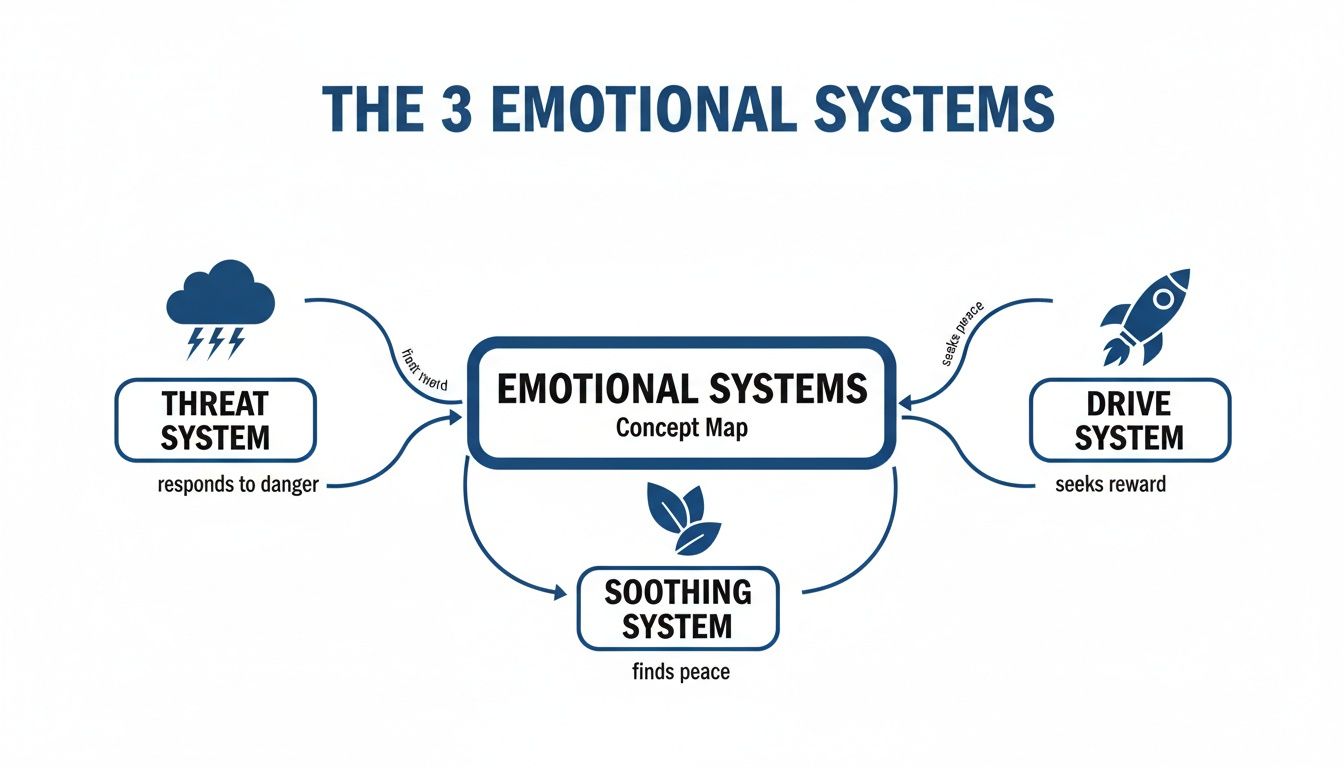
Performance anxiety flares up when the threat system is in overdrive and the soothing system has been neglected. The following techniques are designed to restore that balance.
Practice Soothing Rhythm Breathing
When anxiety spikes, your breathing naturally becomes shallow and quick. This sends a danger signal straight to your brain, fuelling the fire. Soothing Rhythm Breathing is a powerful way to cut that signal off by activating your parasympathetic nervous system—your body’s built-in braking system.
It’s surprisingly simple:
- Find a comfortable spot, sitting or lying down. Let your eyes close if it feels right.
- Gently slow your breathing right down, aiming for about five or six breaths per minute. A slow, steady inhale for a count of four or five, followed by an equally gentle exhale for the same count, usually does the trick.
- Bring your full attention to the feeling of your breath. Notice the air coming in, your chest or belly rising and falling.
- Adopt a warm, kind intention. As you breathe, imagine your breath itself is soothing and calming as it moves through you. Stick with it for at least three to five minutes.
This works because slow, deep breathing is the physiological opposite of a panic response. It’s a direct message to your brain that says, “We are safe. You can stand down.”
Develop Your Compassionate Self
During high-stakes moments, our inner critic often grabs the microphone and turns up the volume. A central practice in Compassion Focused Therapy is to cultivate a different voice—your ideal compassionate self. This isn't just wishful thinking; it's an imaginative exercise to build an internal source of strength, wisdom, and genuine support.
This isn't about inventing a fictional character. It's about accessing and strengthening the compassionate qualities you already have inside you. You're building an inner mentor who is always on your side.
To get started, take a moment to imagine an ideal compassionate figure. What qualities would they have?
- Wisdom: They get it. They understand that life is hard and that struggling is part of being human.
- Strength: They are grounded and confident. They can handle distress without getting swept away by it.
- Warmth and Kindness: They have a genuinely caring, non-judgemental presence.
Once you have a sense of this figure, imagine them looking at you with that kindness, offering the support you need. With practice, this exercise starts to build new neural pathways, making it much easier to tap into self-compassion when your inner critic rears its head.
This kind of inner work is especially vital in the UK, where anxiety is a widespread issue. Research shows that younger, high-achieving individuals aged 16 to 29 are the most likely to report anxiety. In 2022/23, a staggering 37.1% of women and 29.9% of men reported high levels of anxiety, showing how performance pressures can intersect with other factors. You can dive deeper into the data on anxiety statistics in the UK.
Write a Compassionate Letter to Yourself
After a tough performance or a perceived failure, the inner critic loves to have a field day, replaying every mistake. Writing a compassionate letter to yourself offers a structured way to process what happened without getting sucked into a shame spiral.
You simply shift your perspective from self-criticism to unconditional support.
Let’s take an example: Imagine you stumbled over your words during a big presentation at work. You feel humiliated.
Later that day, you sit down and write a letter as if you were writing to a dear friend who went through the exact same thing. It might sound something like this: “I know how much that presentation meant to you, and it’s completely understandable that you’re feeling so disappointed right now. It takes real courage to stand up there in front of everyone. Remember that one stumble doesn’t erase all your hard work or define your competence.”
This practice actively rewires your automatic response to setbacks. You’re teaching your brain to meet challenges with self-support instead of self-attack.
Right, let’s pull back the curtain on what therapy for performance anxiety actually looks like, day-to-day. Deciding to start can feel like a huge step, and it's often the 'not knowing' what happens next that holds people back.
So, let's walk through the journey together. Think of this as a rough guide to the process, from that first tentative session to the moment you feel equipped to handle the pressure on your own.
The First Few Conversations: Getting to Know You
Your first session or two is all about the initial assessment. Now, that sounds a bit formal, but it’s really just a conversation. It's a chance for you and your therapist to start sketching out the landscape of your anxiety together. This isn't a test; it's a collaborative deep dive.
We’ll explore what’s been going on for you. We’ll talk about the specific situations that trigger that knot in your stomach, what happens in your body and mind, and how it’s affecting your life and career. Most importantly, we'll get clear on what you want to change. What does 'better' look like for you?
This is your space to share your story without judgement. It’s also the bedrock for building a strong therapeutic relationship – and that trust is absolutely essential for any of the real work to begin.
Creating Your Personalised Map
After those initial chats, your therapist will work with you to piece everything together into what we call a 'formulation'. Forget jargon—think of it as a personalised map or a blueprint of your anxiety. It connects the dots between your past experiences, your core beliefs about yourself, and the anxious patterns you're stuck in today.
This map helps us make sense of it all. It answers the questions that have probably been swirling around your head: "Why this? Why me? Why now?" It gives us a shared understanding and becomes our guide for the rest of the therapy. This isn't a static document, either; we’ll come back to it and tweak it as you learn more about yourself.
A good formulation is incredibly empowering. It takes anxiety from being this big, confusing, overwhelming cloud and turns it into a logical, understandable pattern. And once you can see the pattern, you can start to change it.
The Active Work: Putting Theory into Practice
With our map in hand, we move into the active part of therapy. This is where we roll up our sleeves and get to work. It’s a hands-on process that goes way beyond just talking about your feelings.
This is where you’ll learn and practise new skills, tailored specifically to your map. One session might involve grabbing a whiteboard to challenge those catastrophic 'what if' thoughts. In another, we might practise a specific breathing technique to calm your nervous system, or even role-play an upcoming presentation you’re dreading. Your therapist is like a coach, guiding you through these exercises until they feel natural.
A huge part of this happens between sessions. We call it homework, but it's not about essays or exams. It's about taking what you're learning and applying it to your real life. That could mean keeping a thought diary, committing to a five-minute mindfulness exercise each morning, or taking one small, manageable step towards a goal you’ve been avoiding.
Measuring What Matters: Building Real-World Skills
So, how do you know if it's working? Progress isn't about finding a magic 'cure' or never feeling nervous again. That's not a realistic goal. Instead, it’s about building self-management skills.
Success is knowing you have the tools to handle the nerves when they show up. It's the confidence that you can manage the inner critic and recover more quickly from a setback.
We track progress by looking at real-world changes. Are you saying yes to opportunities you used to turn down? Is that critical inner voice a bit quieter? Do you feel less derailed by a mistake? Ultimately, the goal of therapy for performance anxiety is to help you become your own therapist—to leave you with a toolkit of lifelong strategies for navigating pressure with resilience and, crucially, a bit more self-compassion.
Finding the Right Therapist for Performance Anxiety

Starting therapy for performance anxiety is a huge move, and let’s be honest, the connection you build with your therapist is probably the single most powerful ingredient for change. Finding the right person isn't just a box-ticking exercise of checking qualifications; it's about finding someone you genuinely click with, who gets your specific struggles.
Think of them as your guide. It's vital you choose someone who makes you feel safe, heard, and properly supported. You’re looking for a professional who not only has the right expertise but who can also create a collaborative space where you can do your best work.
Key Credentials to Look For in the UK
When you’re searching for a therapist in the UK, a few key credentials can give you peace of mind. They’re a quality mark, showing a therapist meets strict professional and ethical standards, so you know you're in capable hands.
Keep an eye out for professionals registered with these established bodies:
- HCPC Registration: The Health and Care Professions Council (HCPC) is the official regulator for practitioner psychologists. Any clinical or counselling psychologist you see must be HCPC registered.
- BABCP Accreditation: The British Association for Behavioural and Cognitive Psychotherapies (BABCP) is the main organisation for CBT. A BABCP-accredited therapist has proven they meet the gold standard for this type of therapy.
Finding a therapist with experience in anxiety is a great start. But if your performance anxiety is all tangled up with a harsh inner critic or deep-seated shame, finding someone who also specialises in compassion-based approaches can be a game-changer.
Questions to Ask a Potential Therapist
Most therapists are happy to offer a short, free consultation call. This is your chance to interview them and get a real feel for how they work. Don't be shy about asking direct questions—it’s the best way to see if they're the right fit for you.
Here are a few smart questions to have ready:
- How do you specifically approach treating performance anxiety?
- What's your experience with compassion-focused therapy or similar approaches?
- Could you describe what a typical session with you might look like?
- How do you help people who are struggling with a really powerful inner critic?
Their answers will tell you a lot about their style and expertise. And remember to trust your gut. A strong therapeutic relationship is often built on that initial feeling of connection. If you're just starting to explore your options, getting a sense of the different therapy and coaching services available can be a really helpful first step.
Your Questions About Performance Anxiety Therapy, Answered
If you’re thinking about therapy for performance anxiety, it’s completely normal to have a few practical questions. Getting some clear, straightforward answers can make taking that next step feel much less daunting. Let's look at a few of the most common ones.
How Long Does Therapy for Performance Anxiety Usually Take?
This is one of the first things people ask, and the honest answer is: it really depends. There's no one-size-fits-all timeline. How long you'll be in therapy depends on you, the severity of the anxiety, and the approach we take together.
For instance, a highly structured therapy like CBT might wrap up in 12-20 sessions. But if we’re exploring deeper-rooted issues of shame and self-criticism, something we often do with Compassion Focused Therapy (CFT), that can take longer. The goal there is to build real, lasting change, not just a quick fix.
A good therapist will be upfront about this from the start. We'll talk about a potential timeframe in our first few sessions and check in on your progress regularly. The real aim isn't just to quiet the symptoms, but to give you skills that will serve you for life.
Is Medication a Must for Treating Performance Anxiety?
Medication can be a useful tool for some, but it’s definitely not a requirement for everyone. For many people, therapy on its own is more than enough to get a handle on performance anxiety and move past it.
In some situations, though, a GP or psychiatrist might suggest medication as part of the plan:
- Beta-blockers are sometimes used to manage those very specific physical symptoms, like a racing heart or trembling hands right before a big presentation.
- Antidepressants (SSRIs) might be considered if there's a more persistent, underlying anxiety that’s been around for a while.
Ultimately, the choice to use medication is a personal one. It’s a conversation to have with a qualified medical professional who can walk you through the pros and cons for your specific situation.
Can I Get Over Performance Anxiety Without a Therapist?
You can certainly make a good start. There are some fantastic self-help resources out there – books, apps, and even the techniques we’ve talked about in this article. Just building a bit more self-awareness and learning to be kinder to yourself can be incredibly powerful.
But when the anxiety is severe enough to really get in the way of your career, your well-being, or just your overall quality of life, working with a professional is the best way forward. Therapy offers a structured, supportive space to dig into the deeper stuff safely.
A therapist brings expert guidance and tailored strategies to the table. That kind of dedicated support can make a world of difference, helping you navigate the tricky emotional territory and achieve a much more profound and lasting sense of confidence.
At Dr Chris Irons, we specialise in helping people overcome that inner critic and build genuine confidence through Compassion Focused Therapy. If you’re ready to change your relationship with anxiety, you can learn more about our therapy and coaching services.