At its heart, mindful self-compassion is about turning the kindness you’d naturally show a good friend back towards yourself, especially when you’re struggling. It's about meeting your own feelings of failure or inadequacy with warmth, not hostility.
It’s about recognising that to be human is to be imperfect. And it’s about learning to hold your difficult feelings with a sense of perspective, so they don’t completely take over. It’s a powerful skill that builds genuine emotional resilience and inner strength.
The Three Pillars of Mindful Self Compassion
Think about it. When a friend calls you up, distraught after making a big mistake, what’s your first instinct? You wouldn't launch into a lecture about their failings. You’d offer comfort, perspective, and a reminder that everyone messes up. Mindful self-compassion is simply learning how to turn that same supportive instinct inwards.
This isn’t about letting yourself off the hook or wallowing in self-pity. Far from it. It’s a practical, trainable skill for navigating life's inevitable bumps with more grace and a whole lot less harsh self-judgement. This practice is built on three core ideas that work together, forming a stable inner resource when you need it most.
This diagram shows how these three pillars—Self-Kindness, Common Humanity, and Mindfulness—are completely interconnected.
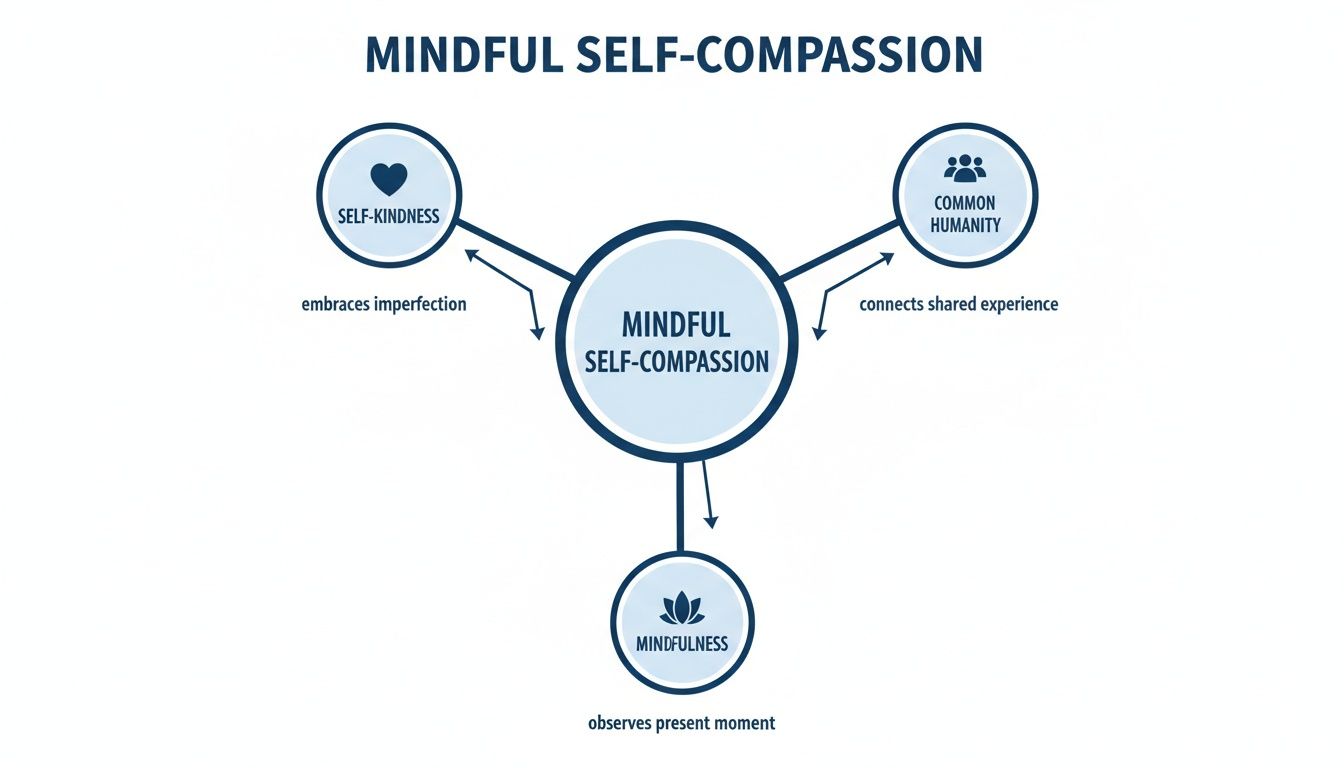
As you can see, they aren't separate steps but a unified whole, each one reinforcing the others to help you build a more compassionate relationship with yourself.
Let's break down exactly what these three components look like in practice and how they contribute to our resilience.
The Three Pillars of Mindful Self Compassion
| Component | What It Means in Practice | How It Builds Resilience |
|---|---|---|
| Self-Kindness | Actively being warm and understanding with yourself when you're in pain, rather than getting angry or critical about your failings. | It stops the cycle of self-criticism, which often makes bad situations worse. Kindness soothes and comforts, providing emotional support. |
| Common Humanity | Realising that suffering and personal failures are a universal part of the human experience—everyone goes through this stuff. | It counters the feeling of isolation that pain can bring. Knowing you're not alone in your struggles normalises the experience and connects you to others. |
| Mindfulness | Observing your painful thoughts and feelings without judgment, suppression, or exaggeration. It’s about balanced awareness. | It creates the mental space needed to avoid being swept away by negativity, allowing you to respond to your suffering with wisdom and kindness. |
By weaving these three elements together, we create a powerful buffer against the internal damage caused by self-criticism and shame.
H3: Self-Kindness Versus Self-Judgement
The first pillar, self-kindness, is a conscious choice. It's the active practice of treating yourself with warmth when you're suffering, failing, or feeling like you just aren't good enough. It means intentionally pressing pause on that relentless inner critic that loves to kick you when you're down.
Imagine you drop a plate and it shatters. The inner critic might scream, "You're so clumsy!" Self-kindness offers a different voice, something gentler like, "Oops, that's a pain. It’s okay, it was just an accident." The goal isn't to ignore what happened, but to shift the tone of your internal dialogue from hostile to supportive.
H3: Common Humanity Versus Isolation
Next up is common humanity. This is the simple but profound realisation that suffering and feeling inadequate are part of the shared human condition. It’s the understanding that everyone struggles.
When we fail or feel hurt, our immediate reaction is often to feel deeply alone, as if we’re the only person in the world to ever feel this way. Common humanity is the antidote to this isolating feeling. It reminds us that our imperfections are what connect us, not what set us apart.
This perspective shifts our thinking from a painful "Why me?" to a much more connected, "Just like me, others feel this way too." It helps to normalise our difficulties and shrinks that terrible sense of aloneness that so often comes with pain.
H3: Mindfulness Versus Over-Identification
The final pillar is mindfulness. This means adopting a non-judgmental, receptive awareness of our thoughts and feelings as they are, without trying to fight them or run away. In the context of self-compassion, mindfulness is what allows us to hold our pain in a balanced way.
We don't ignore our suffering, but we don't dramatise it either. Mindfulness helps us avoid "over-identification"—that state where we get so tangled up in our negative emotions that we become the emotion. By taking a more measured, observational stance, we can acknowledge our pain without letting it define us, creating just enough space to respond with kindness.
The Science Behind Self Compassion
It's easy to think of mindful self-compassion as a soft, intuitive practice, but its benefits are actually grounded in some pretty compelling science. What began as a concept tucked away in Buddhist psychology has made a credible, well-researched leap into modern therapy and mental health care. It's a classic story of ancient wisdom meeting evidence-based practice.
This didn't just happen overnight. This shift is the result of years of rigorous academic work asking a simple question: can treating ourselves with kindness when things get tough create real, tangible change? The answer, across study after study, has been a resounding yes.

The practice has been shown to tangibly cut down stress, improve how we manage our emotions, and even bring about a physiological state of calm. This isn't just a comforting idea anymore; it's a powerful, proven tool for boosting our mental wellbeing.
From Niche Concept to Mainstream Practice
Mindful self-compassion has found particularly fertile ground here in the UK. The Mindful Self-Compassion (MSC) programme, developed by pioneers Kristin Neff and Christopher Germer, really took off from the mid-2010s onwards. Its growth was fuelled by dedicated training, thriving teacher networks, and formal research.
This momentum was championed by leading UK institutions, which helped cement its credibility. Universities like Exeter, Oxford, and UCL have all evaluated the MSC programme, adding serious weight to its claims.
Having that validation from such respected institutions has been absolutely crucial. It helped translate complex academic findings into clear, understandable benefits, pulling self-compassion out of the realm of misconception and into its rightful place as a cornerstone of psychological health. To get a deeper handle on this, our guide on self-compassion is a great next step.
Reducing Stress and Building Resilience
One of the best-documented benefits of mindful self-compassion is its effect on stress and anxiety. When we hit a setback, our brain's threat system—the old "fight-or-flight" response—kicks into high gear. Lashing out at ourselves with harsh self-criticism is like pouring petrol on that fire, amplifying feelings of panic and distress.
Self-compassion does the complete opposite. By consciously bringing in self-kindness and a sense of common humanity, it activates the body's self-soothing system. This system is all about feelings of safety, connection, and calm.
Instead of escalating the threat response, self-compassion helps to regulate it. This creates an internal environment where you can manage difficult emotions without becoming overwhelmed by them, building genuine emotional resilience over time.
This isn't just in your head; it has measurable physiological effects. The practice helps to calm the nervous system right down, laying a foundation for much greater emotional stability.
The Proven Benefits of a Kinder Inner Voice
Research consistently shows a powerful link between higher levels of self-compassion and better mental wellbeing. The evidence paints a very clear picture.
People who regularly practice self-compassion tend to experience:
- Lower levels of depression and anxiety: By quieting the inner critic, self-compassion dials down the rumination and harsh self-judgement that often feed these conditions.
- Greater emotional regulation: It gives you the tools to face difficult emotions with balance, rather than trying to suppress them or getting swept away.
- Increased motivation and personal growth: It’s a myth that self-compassion leads to laziness. In reality, it’s linked to a greater desire for self-improvement and the resilience to bounce back from failure.
- Healthier lifestyle choices: People with higher self-compassion are more likely to look after themselves by exercising, eating well, and engaging in other health-promoting behaviours.
This growing body of evidence confirms that mindful self-compassion is far more than a passing wellness trend. It's a scientifically-backed practice that offers a reliable path towards building a kinder, more balanced, and resilient relationship with yourself. When you understand the science, you can really start to appreciate the profound power of turning kindness inward.
Of course. Here is the rewritten section, crafted to sound completely human-written and natural, following the style and tone of the provided examples.
How Self-Compassion Rewires Your Brain and Body
Mindful self-compassion is so much more than a comforting thought or a bit of positive self-talk. It’s a powerful practice that creates real, measurable changes in your mind and body. What you’re actually doing is learning to actively calm your body’s threat response system—that primal ‘fight or flight’ instinct that so often fuels feelings of anxiety and stress.
When you learn to respond to your own suffering with kindness instead of criticism, you are quite literally rewiring your physiological and neurological responses to difficulty.
This isn't just a nice idea; it's a biological process. Think about what happens when you make a mistake. The typical response is a flood of stress hormones like cortisol. But when you practice self-compassion, you activate your brain's caregiving circuits instead. This is the very same system that lights up when we care for a child or a close friend, and it releases soothing hormones like oxytocin.
This shift has a profound, calming effect. It moves you from a state of self-attack to one of self-soothing, creating an internal environment of safety and support. Over time, this practice builds new neural pathways, making kindness your default response rather than criticism.
Taming the Threat System
At the heart of this transformation is the interplay between two key parts of your nervous system: the sympathetic and the parasympathetic. A simple way to think of them is as your body's accelerator and brake pedals.
- The Sympathetic Nervous System (The Accelerator): This is your threat response. When you perceive danger—whether it's a real physical threat or the perceived threat of failure and judgement from your inner critic—it kicks into high gear. Your heart rate increases, your breathing quickens, and you're flooded with adrenaline, preparing you to fight or flee.
- The Parasympathetic Nervous System (The Brake): This is your 'rest and digest' system. It’s what promotes a state of calm, slows your heart rate, and helps you feel safe and connected. Mindful self-compassion is a direct and effective way to engage this system.
When you practice self-compassion, you are intentionally applying the brakes. Simple gestures like placing a hand over your heart or using a warm, gentle tone with yourself send signals of safety straight to your brain, activating the parasympathetic nervous system and calming the storm of the threat response.
The Physical Evidence of a Calmer State
The impact of mindful self-compassion isn't just a subjective feeling of calm; we can actually measure it. A growing body of research shows tangible physiological changes that occur even with brief practices.
A significant UK laboratory trial involving 135 participants demonstrated this perfectly. Researchers found that even a brief, 11-minute guided self-compassion exercise produced objective physiological shifts. Participants showed a reduced heart rate, lower skin conductance (a key marker for stress), and increased heart-rate variability—all clear indicators of a more relaxed, resilient nervous system. You can explore the full findings in this UK study on self-compassion's physiological effects.
This research powerfully illustrates that mindful self-compassion is not simply a mental exercise. It is a potent practice that directly improves your physical and psychological health, helping you build a stronger, more resilient foundation against stress, anxiety, and depression.
By understanding how these simple acts of kindness rewire your brain and body, you can appreciate the profound power you have to change your relationship with yourself. Each moment of self-compassion is a step towards building a nervous system that is less reactive to stress and more attuned to care and recovery.
It’s a practical, evidence-based path to not just feeling better, but fundamentally being better to yourself from the inside out. This makes it an invaluable skill for anyone looking to navigate life’s challenges with greater strength and peace.
Simple Self Compassion Exercises You Can Try Today
Understanding the theory behind mindful self-compassion is one thing, but actually weaving it into the fabric of your life is where the real change begins. The good news is, you don’t have to wait for a crisis to start. These are simple, practical exercises you can use anytime and anywhere, helping you build a foundation of self-kindness, one moment at a time.
The goal here isn't perfection; it's simply practice. Think of each exercise as a small opportunity to pause, check in with yourself, and respond to your own struggles with the warmth and support you deserve.

The Self Compassion Break
This is perhaps the most fundamental exercise in mindful self-compassion. The Self-Compassion Break is a quick, three-step mental process you can call upon in any moment of difficulty. It’s designed to bring all three core components of self-compassion online right when you need them most.
Here’s the rundown:
-
Acknowledge the Pain (Mindfulness): The first step is just to notice that you're having a hard time. You might say to yourself, "This is a moment of suffering," or more simply, "This really hurts." It’s about being present with your pain without layering on any judgement.
-
Connect with Common Humanity: Next, gently remind yourself that suffering is a universal part of life. You could think, "Struggling is a part of being human," or "I'm not alone in this; other people feel this way too." This simple step is a powerful antidote to the feeling of isolation that often comes with pain.
-
Offer Yourself Kindness: Finally, bring in a gesture of kindness. You might place your hands over your heart, give yourself a gentle hug, or just say, "May I be kind to myself in this moment."
This whole sequence can be done in under a minute and acts like an emotional first-aid kit, offering immediate comfort and a shift in perspective when you feel swamped by stress or self-criticism.
Using Soothing Touch for Comfort
Physical touch is one of our most primal ways of communicating care and soothing distress. Think about how a parent’s hug can calm a crying child. In the same way, your own supportive touch can activate your body's parasympathetic nervous system, which helps foster feelings of safety and calm.
This practice is wonderfully straightforward. The next time you feel stressed, anxious, or self-critical, just try one of these gestures:
- Hand on Heart: Gently place one or both hands over the centre of your chest, feeling the warmth and gentle pressure.
- Cradling Your Face: Cup your hands on your cheeks, as you might for a dear friend, giving yourself a sense of warmth and containment.
- Gentle Hug: Cross your arms and give yourself a soft, comforting hug.
The intention is what matters most here. You are signalling to your body, "I am here for you. You are safe." It’s a direct, non-verbal way to provide the comfort your nervous system craves, especially when your mind is racing with critical thoughts.
Finding Your Compassionate Voice
Our inner critic often has a very distinct tone—it might be harsh, cold, or sarcastic. A key part of mindful self-compassion is to intentionally cultivate a different kind of inner voice: one that is warm, supportive, and wise.
Imagine how you would speak to a friend who was struggling with the exact same problem you're facing. What words would you choose? What tone would you use?
Now, try turning that same voice inward. It might feel a bit awkward at first, but with practice, it becomes much more natural. You can start by simply asking yourself: "What do I really need to hear right now?" Maybe it’s a message of reassurance, a bit of encouragement, or simply permission to feel whatever you're feeling. For anyone wanting to dive deeper and really develop this skill, an online self-compassion course can offer structured guidance and support.
These exercises are just a starting point. Beyond these, exploring other engaging approaches, like these mindfulness activities for adults, can enrich your practice and overall well-being. The key is to find what resonates with you and to practise it consistently, building a kinder, more compassionate relationship with yourself, one moment at a time.
Navigating Common Challenges and Misconceptions
Starting a mindful self-compassion practice can feel a bit like learning a new language. It’s often completely foreign. For many of us, our default setting is a harsh inner critic, so turning towards ourselves with kindness can feel awkward, unnatural, or even completely undeserved.
It’s crucial to know that these feelings are a normal part of the process. They aren't a sign you're doing it wrong.
One of the most stubborn myths I come across is the idea that self-compassion is just a form of self-pity or a get-out-of-jail-free card for laziness. People often worry that if they stop being so hard on themselves, they'll lose all motivation and let everything slide. The research, however, consistently shows the exact opposite is true.
Self-criticism doesn't motivate; it paralyses. It leads to a fear of failure that fuels procrastination and anxiety. In contrast, self-compassion creates the emotional safety net we need to take risks, learn from our inevitable mistakes, and bounce back with real resilience. It fuels our drive not with fear, but with a genuine desire to be well.

Unpacking Common Myths
Let's clear up a few common stumbling blocks that can get in the way of building a practice that actually sticks.
-
Myth 1: Self-Compassion Is Selfish. Far from it. Caring for yourself is actually a prerequisite for being able to genuinely care for others. When your own emotional reserves are empty, you have very little left to give. Self-compassion is what refills your cup, preventing burnout and, ultimately, improving your relationships.
-
Myth 2: It Means Weakness. I’d argue that true strength lies in the ability to face your own suffering with courage and kindness. Self-criticism is often just an old, unhelpful avoidance tactic, whereas self-compassion requires you to turn towards your pain with bravery.
-
Myth 3: It’s Just Self-Indulgence. This isn't about ignoring your responsibilities to sit on the sofa eating ice cream all day. Mindful self-compassion is about asking, "What is the most caring and helpful thing I can do for myself right now?" Sometimes that means rest, but often it means taking difficult but necessary steps for your long-term health and growth.
The Challenge of Backdraft
Sometimes, when you first offer yourself a little kindness after years of self-criticism, the response can be overwhelming. This experience has a name: "backdraft." Think of it like this: when firefighters open a door to a burning room, the sudden rush of oxygen can cause the flames to roar out. In the same way, opening your heart to compassion can sometimes bring a wave of long-suppressed pain, grief, or shame rushing to the surface.
This can be a really confusing and difficult experience, but it’s actually a sign that the practice is working. It means you are finally creating a safe enough internal space for these difficult emotions to be seen, felt, and healed.
If you experience backdraft, the key is to be gentle. You might need to take the practice in smaller doses, perhaps focusing on soothing physical gestures or just a few kind words. It’s also important to remember that deep-seated feelings of shame and self-criticism often require support. You can learn more about how Compassion Focused Therapy can help you heal from these powerful feelings.
Navigating these bumps in the road is simply part of the journey. By understanding these common misconceptions and normalising that initial awkwardness, you can persevere and build an authentic practice that becomes a profound source of strength and resilience in your life.
Who Practices Mindful Self Compassion
While mindful self-compassion is a fundamentally human practice, open to absolutely anyone, it’s worth taking a moment to look at who is currently showing up, especially in formal training and research. Looking at these patterns doesn't define who the practice is for; rather, it gives us an honest picture of the existing evidence and shines a light on where there's room to grow.
It helps us see the progress we’ve made and, just as importantly, the work that still needs to be done.
When we look at the landscape, one particular trend becomes clear. A great deal of the formal research into Mindful Self-Compassion (MSC) programmes, both here in the UK and internationally, reveals a noticeable gender imbalance. Study after study reports a significant majority of female participants, and that fact inevitably shapes our current understanding of how these practices are being received.
This isn't to say that mindful self-compassion is only for women, of course. It simply reflects who is being recruited for studies and, perhaps, broader societal norms around who feels comfortable seeking support for their emotional wellbeing. The good news is the community is actively working to bridge this gap, finding new ways to encourage more men and people of all gender identities to explore these valuable skills.
A Closer Look at UK Demographics
Drilling down into UK-based research gives us a clearer picture. While studies on general meditation sometimes show a more balanced gender split, those focused specifically on MSC often tell a different story. This data isn't a judgement—it's a really valuable observation about accessibility and outreach.
For example, some UK studies have reported a very high proportion of female participants, in some cases as high as 88.5% in certain training groups. The average age of participants often lands somewhere in the 30s and 40s. These patterns—a predominance of women and an average age in middle adulthood—are pretty consistent with what researchers are seeing in MSC studies across the globe. You can read the full research on UK meditator demographics here.
Understanding this landscape is crucial. It allows practitioners and teachers to ask important questions about how to make mindful self-compassion more approachable and accessible to diverse populations, ensuring everyone feels they have a place in this practice.
Expanding the Reach of Self Compassion
The goal is simple: to make these genuinely helpful practices available to everyone, regardless of their age, gender, or background. Acknowledging the current demographic trends is the first, essential step towards creating more inclusive and welcoming spaces for all.
There’s a real, ongoing effort to:
- Tailor language and examples to resonate with a broader audience, including men who may not have been exposed to this kind of inner work before.
- Highlight the benefits that speak to universal human struggles, like dealing with stress, performance anxiety, and building resilience.
- Encourage diverse leadership within the teaching community to better reflect the people we hope to serve.
By being transparent about who is currently in the room, we can work more effectively to open the door much wider. The real power of mindful self-compassion is found in our shared humanity, and the mission is to make sure that invitation is heard and felt by all.
A Few Common Questions
When you first start exploring mindful self-compassion, a few questions almost always pop up. That’s completely natural. Shifting away from a lifetime of self-criticism towards a kinder inner world is a big change, so it's normal to have some practical queries. Let's walk through some of the most common ones I hear.
How Is Self-Compassion Different From Self-Esteem?
This is a really important distinction to make, and it gets to the heart of why self-compassion is so much more reliable.
Think of self-esteem as conditional. It’s often based on how well we're doing, how we look, or how we measure up against others. When things are going great, our self-esteem soars. But the moment we fail or get rejected, it can plummet, leaving us feeling completely worthless. It’s a rollercoaster.
Mindful self-compassion, on the other hand, is unconditional. It's a steady, stable source of inner kindness that’s there for you no matter what—especially when you fail or feel like you're not enough. It’s about being a good friend to yourself, which builds a much more resilient and genuine sense of self-worth that doesn't depend on what anyone else thinks.
What If I Don’t Feel I Deserve Compassion?
This is probably the single most common hurdle people face, and it's completely understandable. If you’ve lived with a powerful inner critic for years, the idea of deserving kindness can feel foreign or even wrong.
The key thing to remember is that you don’t have to feel deserving to begin.
Mindful Self-Compassion is a practice, not a feeling you have to conjure up first. You can start with something as simple as placing a hand over your heart. This small physical gesture can directly soothe your nervous system, bypassing that critical voice in your head. Over time, the practice itself helps build the feeling of worthiness.
Think of it as an action you take, regardless of the thoughts swirling around. The feeling that you deserve it often follows the practice, not the other way around.
How Long Does It Take to Notice the Benefits?
This really varies from person to person. Some people tell me they feel an immediate sense of calm or relief after just one short exercise. And the research backs this up—even brief moments of practice can create measurable physiological shifts, moving us into a more relaxed state.
For those deeper, more lasting changes in how you relate to yourself and navigate life’s storms, consistency is what truly matters. Regularly practising over several weeks is where you'll likely start to see significant, sustainable shifts in your well-being and resilience. It's the cumulative effect of all those small, consistent moments of self-kindness that ultimately builds a truly compassionate inner ally.
Are you ready to stop battling your inner critic and build a more resilient, supportive relationship with yourself? At Dr Chris Irons, I offer expert coaching and Compassion Focused Therapy to help you navigate life’s challenges with greater kindness and strength. Start your journey towards self-compassion today.