Ever had that sinking feeling that you’re about to be found out? That your successes are just a fluke, and it’s only a matter of time before everyone realises you have no idea what you’re doing?
If that sounds familiar, you’ve likely brushed up against imposter syndrome. It’s that persistent, nagging inner voice convinced that you aren’t as competent as everyone seems to think you are, shadowed by a constant fear of being exposed as a fraud.
So, What Is Imposter Syndrome, Really?
Imagine you’ve just been promoted. Instead of feeling proud, you’re gripped by panic. You’re sitting in a meeting, heart pounding, utterly convinced that you’ve somehow tricked everyone into believing you’re qualified. This is the heart of imposter syndrome—an intense, internal feeling of being a phony, even when all the evidence points to your skills and achievements.
It’s like you’re wearing an invisible mask, terrified that any moment it could slip and reveal the “real” you—someone you believe is completely undeserving. This isn’t just a bout of low self-esteem or a healthy dose of humility; it's a deep-seated pattern of thinking that systematically dismisses and discounts your own accomplishments.
And if you feel this way, you're in good company. This is a widespread challenge in the UK, cutting across all professions. A YouGov survey commissioned by Indeed found that a staggering 58% of UK employees—that’s nearly three in five people—have grappled with these feelings of self-doubt and fraudulence at work.
Healthy Doubt vs. Pervasive Fraudulence
It’s really important to draw a line between imposter syndrome and normal, healthy self-reflection. A little bit of self-doubt is a good thing; it keeps us humble, grounded, and motivated to keep learning. Imposter syndrome, however, cranks that doubt up to an extreme. It twists constructive self-assessment into a constant, anxious state of feeling like a fake.
"Imposter syndrome describes a core belief that we're not as bright or competent or talented as others perceive us to be. The insidious thing about this feeling is it individualises suffering, making you believe it’s a personal flaw that comes from within."
Healthy self-reflection means you can see your weaknesses but still recognise and value your strengths. Imposter syndrome is different. It acts like a filter, blocking out all the evidence of your competence and shining a spotlight only on what you perceive as your flaws. Every new challenge feels less like an opportunity and more like a final exam where you’re about to be exposed.
- Constructive Self-Doubt: "I'm not sure how to approach this task, so I'll ask for guidance and learn."
- Imposter Syndrome: "I don't know how to do this, and when they find out, they'll realise they hired the wrong person."
To help clarify this distinction, let's break down the key differences.
Imposter Syndrome vs Healthy Self-Reflection
| Characteristic | Imposter Syndrome | Healthy Self-Reflection |
|---|---|---|
| Response to Success | Attributes success to external factors like luck, timing, or tricking others. | Acknowledges personal effort, skill, and contribution to success. |
| Focus of Thought | Ruminates on perceived failures and inadequacies, ignoring strengths. | Balances recognition of weaknesses with an appreciation of strengths. |
| Reaction to Feedback | Rejects positive feedback as disingenuous; internalises negative feedback as proof of fraudulence. | Accepts both positive and constructive feedback as a tool for growth. |
| Emotional State | Characterised by persistent anxiety, fear of exposure, and a sense of being a phony. | Involves temporary self-doubt that motivates learning and improvement. |
| View of Challenges | Sees challenges as threats that will reveal incompetence. | Views challenges as opportunities to learn, develop, and test abilities. |
Seeing these two side-by-side makes it clearer. Healthy doubt pushes us forward, while imposter syndrome holds us back, trapping us in a cycle of fear.
Understanding this difference is the first crucial step. It helps you begin to see this feeling for what it is: a common psychological pattern, not a reflection of your actual abilities or some deep character flaw.
Recognising the Five Types of Imposter Syndrome
Understanding what imposter syndrome means is one thing, but figuring out how it actually shows up in your own life is a whole different ball game. That nagging feeling of being a fraud isn’t a one-size-fits-all experience; it wears different masks for different people. Researcher Dr Valerie Young did us all a huge favour by identifying five distinct patterns, or "types," that really get to the heart of the specific internal rules driving these feelings.
Pinpointing your own type can be a massive breakthrough. It takes you from that vague, unsettling sense of not being good enough to having a clear map of the triggers and beliefs holding you back. This kind of self-awareness is the bedrock for building strategies that will genuinely work for you.
You can think of it like this: the core feeling of being a fraud is the root, but it branches out into persistent self-doubt and anxiety, creating a really stressful cycle.
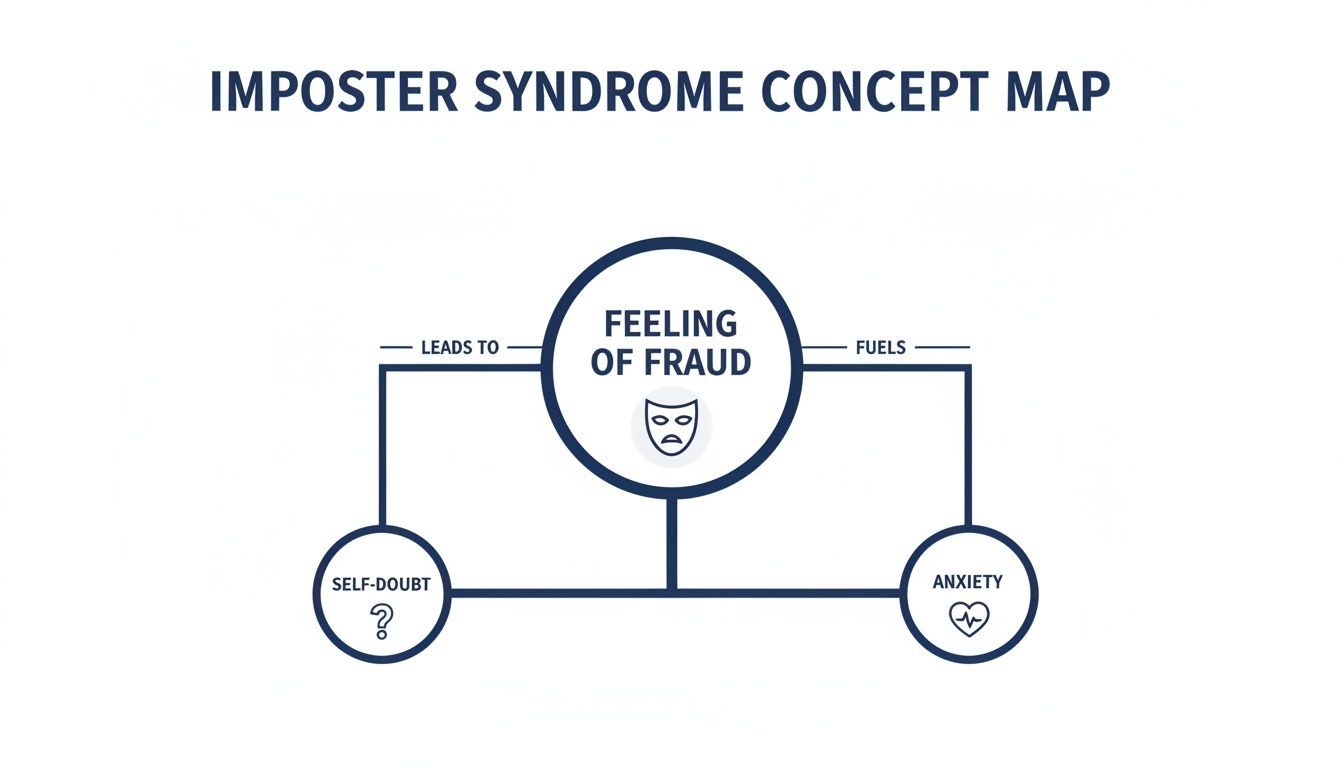
This image shows it perfectly. It's not just an intellectual problem about competence; it's a deeply emotional ride where self-doubt pours fuel on the fire of anxiety.
The Perfectionist
For The Perfectionist, it’s not what you achieve, but how you achieve it. Success only counts if the journey was absolutely flawless. A single typo in a report that gets rave reviews can be enough to trigger intense feelings of failure.
These are the people who set impossibly high standards for themselves and then, when they inevitably fall short, feel swamped by shame. This isn't a healthy drive for excellence; it's a rigid, all-or-nothing belief that anything less than perfect is proof that they're a complete fraud.
The Expert
The Expert gauges their worth by how much they know. They are on a never-ending quest for more training, more certifications, more knowledge, convinced they'll be "found out" if there's a single gap in their expertise.
Even with decades of experience under their belt, they might baulk at applying for a job if they don't meet 100% of the criteria. For them, there’s always one more course to take or one more book to read before they can finally feel like they belong.
This type perfectly illustrates a core tenet of imposter syndrome: the feeling that no amount of external validation or qualifications can ever silence the internal voice of doubt.
The Soloist
The Soloist lives by the rule that true competence means going it alone. To them, asking for help is the ultimate admission of failure. It's a clear sign you’re not up to the job. So, they’ll often refuse assistance, even when it would make their work easier and the outcome better.
This mindset is a direct path to burnout. They shoulder immense burdens to prove their worth, operating from a strict internal rulebook that says, "If I had to ask for help, then I didn't really achieve it myself."
The Natural Genius
This type grew up believing that if you're truly good at something, it should come easily. If they have to work hard or struggle to learn a new skill, they take it as proof that they aren't a "natural" at all—and therefore, must be an imposter.
Often, they were praised for being "smart" or "talented" as children and internalised the idea that competence shouldn't require effort. When a real challenge comes along that demands grit and persistence, they feel a deep sense of shame, thinking a true genius wouldn't have to try this hard.
The Superhuman
The Superhuman feels they must be a star performer in every single role they play: the perfect professional, the flawless parent, the ever-present partner, the supportive friend. They believe they should be able to juggle it all without ever dropping a ball.
When they inevitably struggle to keep all those plates spinning, they feel like a total fraud. Their perfectionism isn't just confined to their job; it spills across every area of their life, leading to chronic exhaustion and a persistent, crushing feeling of inadequacy.
Understanding Who Gets Imposter Syndrome and Why
That feeling of being a fraud doesn’t just pop up out of nowhere. It's almost always a deeply personal reaction to the world around us—the pressures we face and the environments we’re in. While anyone can feel like an imposter from time to time, these feelings tend to really take hold in high-stakes, competitive fields where success is hard to pin down and criticism feels like a constant.
Think of it like a plant. For a plant to grow, it needs the right kind of soil. In the same way, imposter feelings often sprout in environments that serve up the perfect mix of high pressure, constant evaluation, and vague standards for what ‘good enough’ actually looks like. This helps explain why some professions seem to be breeding grounds for it.
Environments That Fuel Self-Doubt
Fields like law, medicine, academia, and the creative arts are common hotspots. In these worlds, your performance is perpetually under a microscope, and success can feel incredibly subjective. One person’s creative masterpiece is another’s total failure, creating fertile ground for self-doubt to take root and flourish.
This isn’t just a hunch. A national UK study highlighted just how much specific industries can amplify these feelings of inadequacy. The research found that a staggering 86.96% of professionals in creative arts and design reported experiencing imposter syndrome. Law wasn't far behind, at 74.36%. The main culprits? Self-doubt (38.17%) and criticism (23.37%), which really drives home the powerful link between our surroundings and our inner experience. You can dig into the full breakdown of UK industry findings on Funding Guru.
Imposter syndrome is often a normal reaction to an abnormal environment. It's a sign that the system you're in may be demanding perfection, fostering intense competition, or failing to provide clear, supportive feedback.
Personal Triggers and Psychological Roots
Beyond the day job, certain life events are notorious for kicking off a bout of feeling like a fraud. These moments usually involve a step up in responsibility or visibility, which can wake up a dormant inner critic you didn't even know you had.
Common triggers include:
- Starting a new job or role: Being the new person in an unfamiliar environment can make you feel like you have to prove yourself all over again from square one.
- Receiving a promotion: Instead of feeling like a reward, the increased responsibility can feel more like a bigger stage on which to fail spectacularly.
- Becoming a parent: The immense pressure to be a "perfect" parent can trigger deep-seated feelings of inadequacy that you've never had to confront before.
These external events often hook into deeper psychological patterns. Personality traits like perfectionism and a tendency towards harsh self-criticism can lay the groundwork early in life. When you combine those traits with a high-pressure environment, you’ve got a perfect storm for imposter syndrome to brew, linking any achievement with intense shame and anxiety. Grasping this connection is the first step to realising these feelings are a response, not a fundamental flaw in who you are.
The Tangible Costs of Feeling Like a Fraud

Imposter syndrome is so much more than just a fleeting moment of self-doubt. It's a persistent, internal struggle with very real, measurable consequences that quietly chips away at your career, your well-being, and your potential.
This isn't just a feeling you carry around in your head; it's a hidden tax on your life.
When you’re utterly convinced you’re a fraud, your behaviour naturally starts to shift. You might pour countless extra hours into preparing for a simple presentation, all driven by a deep-seated fear of being exposed. This constant need to over-deliver isn't just diligence—it's a direct route to burnout.
The Career Impact of Persistent Self-Doubt
The fear of not being perfect can lead to a kind of paralysing procrastination. You might put off starting a crucial project simply because the pressure to deliver something flawless feels completely overwhelming. It's a vicious cycle: the longer you wait, the more of a fraud you feel, and the harder it becomes to even begin.
This has a profound effect on how a career unfolds. I see it all the time—people who are more than qualified actively steering clear of incredible opportunities.
- Turning down promotions: The thought of more responsibility can feel like being on a bigger stage, with a brighter spotlight searching for your flaws. So, you might say "no" to a role you absolutely deserve.
- Avoiding leadership roles: How can you possibly guide others when you feel so incompetent yourself? That’s the thinking that keeps brilliant people from stepping up to lead.
- Hesitating to share ideas: You stay silent in meetings, convinced your contribution isn't valuable enough, letting valuable insights go unspoken.
When imposter syndrome takes the wheel, it steers you away from the very opportunities that would prove your competence. It's a self-sabotaging cycle fuelled by a deep-seated fear of being "found out."
The Bottom Line for Businesses and Individuals
This internal battle has a surprisingly quantifiable impact. In the UK, the productivity drain is staggering, with some workers losing up to 10 full days a year in lost output. The stress it generates leads to more sick days, and for 26% of people who leave their jobs, these feelings are a contributing factor. You can learn more about the stark financial impact of imposter syndrome and its effect across UK workplaces.
These aren't just numbers. For businesses, they represent lost innovation, decreased productivity, and higher staff turnover. For individuals, they represent missed chances and the heavy emotional toll of living with persistent shame and self-criticism.
Understanding the powerful link between shame and self-criticism is a vital first step towards healing. By framing these outcomes as tangible costs, we move imposter syndrome from a vague, personal feeling to a clear problem that demands a real solution.
How to Overcome Imposter Syndrome with Self-Compassion
Knowing what imposter syndrome is and how it works is one thing, but knowing how to do something about it is another. This is where we shift from understanding to action. And one of the most powerful, evidence-based ways to do that is by cultivating self-compassion, a cornerstone of Compassion Focused Therapy (CFT).
Let's be clear: this isn't about letting yourself off the hook or wallowing in self-pity. Think of self-compassion as a practical tool designed to soothe your brain’s overactive threat system—that primal part of you that keeps you stuck in a loop of anxiety and self-criticism. It’s about actively retraining your mind to respond to your own struggles with the same warmth and support you’d instinctively offer a friend.
The Three Pillars of Self-Compassion
Self-compassion isn't just a vague, fluffy concept. It’s a skill built on three distinct, actionable components. Learning to put them into practice can fundamentally change your relationship with self-doubt and that nagging inner critic.
-
Self-Kindness vs. Self-Judgement: This is about making a conscious choice to be gentle and understanding with yourself when you’re having a hard time, instead of meeting your pain with cold, harsh criticism. When you mess up, self-kindness allows you to acknowledge your own hurt without burying yourself in shame.
-
Common Humanity vs. Isolation: Imposter syndrome absolutely thrives on the belief that you’re the only one who feels like a complete fraud. Common humanity is the crucial realisation that suffering and feeling inadequate are part of the shared human experience. You’re not alone in this; everyone feels this way sometimes.
-
Mindfulness vs. Over-Identification: This involves learning to observe your negative thoughts and feelings without getting completely swept away by them. Mindfulness gives you the space to step back and recognise thoughts like "I'm a failure" or "They're going to find me out" for what they are—just mental events, not objective truths.
Self-compassion provides a powerful antidote to the harsh self-criticism that drives imposter feelings. It soothes the threat-focused mind and builds an inner resource of safety and encouragement, allowing you to face challenges without being overwhelmed by fear.
Putting Self-Compassion into Practice
So, how do you bring these ideas to life? It starts with simple, repeatable exercises.
To practice self-kindness, try the "what would you say to a friend?" technique. The next time your inner critic goes on the attack, just pause. Write down what you would say to a close friend in the very same situation. Now, try turning those kind, supportive words toward yourself.
To connect with our common humanity, a simple reminder can work wonders. Just tell yourself, "This is a moment of struggle. Struggle is a part of life for everyone." This small phrase can break the isolating spell of feeling uniquely flawed. For a deeper dive, you can learn more about how to practice self-compassion in your daily life.
As you begin to embrace self-compassion and challenge that inner critic, it also helps to have some practical strategies for coping with anxiety in your toolkit. These complementary skills build a strong defence against the emotional turmoil that imposter syndrome often stirs up, paving the way for a calmer, more confident mindset.
Building a Practical Toolkit for Lasting Confidence

While self-compassion lays the emotional groundwork for challenging imposter syndrome, real, lasting change happens when you pair it with practical, consistent action. It’s about building a personal toolkit of strategies that give you something tangible to do when those feelings of inadequacy creep in. Think of these as your go-to techniques, designed to be simple enough to use in the moment and empowering enough to give you back a sense of control.
One of the most powerful first steps you can take is to start an 'accomplishment log'. This is just a dedicated space—a simple notebook or a document on your computer—where you get into the habit of writing down your wins, both big and small. The next time your inner critic pipes up and insists you’re a fraud, this log becomes your book of evidence, a concrete reminder of your actual competence.
Shifting Your Internal Narrative
From there, you can start to actively reframe those negative thoughts as they happen. When a thought like, “I only got this job because I got lucky,” pops into your head, you can learn to challenge it directly. Ask yourself, “Okay, but what skills and effort did I actually put in to get here?” This simple act interrupts the automatic, unhelpful pattern of dismissing your own achievements.
Another incredibly effective strategy is to break the cycle of isolation. Sharing what you’re feeling with a trusted mentor, a supportive colleague, or a good friend can be so validating. More often than not, you’ll find out they've felt the exact same way, which is a powerful antidote to the belief that you are uniquely and hopelessly flawed.
At its core, getting a handle on the negative meaning imposter syndrome gives to your successes is really about dismantling perfectionism. By adopting a 'good enough' mindset, you give yourself permission to complete tasks and celebrate your progress without being paralysed by impossibly high standards.
These tools all work together, slowly building a more resilient sense of confidence. If you're looking for more ideas on how to build out your own methods, it's worth exploring how to develop a personalised toolkit of behavioural strategies and lifestyle adjustments, as many of the principles can be adapted for various internal challenges.
And for those who want to dive deeper into the therapeutic frameworks that inform these tools, there is some excellent on-demand Compassion Focused Therapy training available for professionals and individuals who are keen to learn more.
Still Got Questions About Imposter Syndrome?
To round things off, let's tackle a few of the most common questions that pop up when people start to unpack the idea of imposter syndrome. My hope is that these answers bring some clarity and show that while these feelings are tough, they are absolutely something you can work with.
Is Imposter Syndrome a Recognised Mental Health Condition?
The short answer is no. You won’t find ‘imposter syndrome’ listed as a formal diagnosis in the big clinical handbooks like the DSM-5. Instead, it’s understood as a psychological phenomenon—a deeply felt internal experience.
However, and this is a big ‘however’, it very often walks hand-in-hand with recognised conditions like anxiety and depression. A good therapist can help you work through these feelings directly, even without an official diagnostic label.
Can Imposter Syndrome Ever Be a Good Thing?
It's a tricky one. Some people find that a little touch of imposterism keeps them on their toes, pushing them to stay humble and motivated. The real issue is one of balance.
When those feelings start to spiral, become overwhelming, or stop you from taking chances you know you should, they’ve crossed the line from helpful to harmful. The goal isn’t to completely wipe out self-doubt—a little is normal—but to stop it from being the one in the driver's seat.
How Do I Know If I Need Professional Help?
If that feeling of being a fraud just won't go away, if it’s causing you real emotional pain, or if it’s actively holding you back from your goals, then reaching out for support is a great next step.
Listen to that inner critic. If its voice is poisoning your work, your relationships, or your general wellbeing, a professional can give you the right tools and strategies to build a more solid, lasting sense of confidence.
At Dr Chris Irons, we specialise in helping people just like you, from individuals to leaders, move beyond the grip of self-criticism and build genuine confidence using Compassion Focused Therapy. If you’re ready to stop feeling like an imposter and start building a kinder, more balanced relationship with yourself, I invite you to explore how we can work together at https://drchrisirons.com.