So, what is leadership coaching, really? At its heart, it's a dedicated, one-on-one partnership designed to help you sharpen your skills, build resilience, and stay focused on what truly matters. It’s a confidential, structured space for you to wrestle with your toughest challenges and unlock your potential.
What Is Leadership Coaching and Why Does It Matter?
Think of your career as a challenging expedition. You've got a map (your goals) and a destination in mind (what success looks like for you), but the terrain is full of unexpected obstacles and uncharted territory.
A great leadership coach is like a seasoned guide who has walked this path before. They don’t carry you up the mountain. Instead, they equip you with the right tools, help you spot the safest routes, and support you in finding the inner strength to keep climbing.
This is a world away from generic training seminars or passively sitting through a webinar. It's an active, collaborative process built entirely around you.
A great leadership coach helps you see what's possible, not just what's probable. They hold up a mirror, allowing you to recognise your blind spots and leverage your greatest strengths in a way that feels authentic and powerful.
A Strategic Investment in Your Growth
Today's business world demands so much more than technical skill. It calls for emotional intelligence, adaptability, and the ability to inspire your team, especially when things feel uncertain. This is exactly why so many organisations are turning to leadership coaching as a core part of their development strategy.
The numbers tell a compelling story.
In 2023, UK organisations poured an estimated £7.5 billion into leadership development, a clear sign of its importance. It's no surprise that top-performing firms are leading the charge, with 18% of their L&D professionals naming leadership skills as their number one priority for the future. With demand projected to climb by 8% annually, businesses are scrambling to prepare their top talent for the challenges ahead.
This investment isn't just about fixing problems; it's about proactively building your capacity as a leader. Coaching helps you:
- Navigate Complexity: From managing hybrid teams to driving innovation, a coach gives you a trusted sounding board to work through difficult decisions.
- Build Resilience: Leadership can be a lonely road. Coaching provides a confidential space to manage stress, sidestep burnout, and process the immense pressures of the role.
- Enhance Self-Awareness: Real leadership starts with understanding yourself. Coaching helps you identify the internal barriers, like self-criticism or imposter syndrome, that might be holding you back.
How Is Coaching Different from Other Support?
It’s crucial to understand how leadership coaching stands apart from other forms of professional development. While all are valuable, they each have a distinct purpose. Mentoring, for example, is usually about a senior figure sharing their experience and advice. Therapy often focuses on healing past wounds to improve your overall mental well-being.
Leadership coaching, on the other hand, is firmly forward-looking and action-oriented. It's all about closing the gap between where you are now and where you want to be professionally. To truly grasp the essence and impact of this powerful development tool, you may want to explore leadership coaching further.
The table below breaks down these differences to help you see where coaching fits into the bigger picture.
Leadership Coaching vs Other Development Methods
While there's overlap, each method serves a unique and important function. Here’s a quick comparison to help you decide what's right for you.
| Method | Primary Focus | Approach | Best For |
|---|---|---|---|
| Leadership Coaching | Performance & Potential | Question-driven, goal-oriented, future-focused | Achieving specific professional goals, enhancing leadership skills, and overcoming performance barriers. |
| Mentoring | Guidance & Wisdom | Advice-giving, sharing experience, relationship-based | Gaining industry-specific knowledge, navigating organisational culture, and career path guidance. |
| Therapy | Mental Health & Healing | Explores past and present, addresses emotional patterns | Managing mental health conditions, processing trauma, and improving overall psychological well-being. |
| Training | Skill Acquisition | Content delivery, instruction, group-based | Learning specific, replicable skills (e.g., project management, software use) in a structured format. |
Ultimately, choosing the right support depends on your specific needs, but coaching offers a uniquely personalised and goal-driven path to growth. This guide will show how integrating psychological principles—especially self-compassion—can help you address deep-seated challenges and foster a more confident, effective, and sustainable leadership style.
Adopting the Compassionate Leader Mindset
To get beyond simply managing tasks and start truly inspiring people, leaders need a deeper, more resilient internal framework. This is where principles from Compassion Focused Therapy (CFT) offer a powerful blueprint—not for therapy, but for a more effective and sustainable way of leading.
Adopting a compassionate mindset isn't about being ‘soft’. It’s about being smart, strategic, and profoundly human.
Think of a leader as an architect designing a skyscraper. They could focus only on the impressive height and gleaming exterior, but the entire structure is at risk if the foundation is weak. In leadership, self-compassion is that foundation. Without it, your ability to support your team, make clear-headed decisions, and withstand pressure will eventually start to crumble.
This is all about sharpening your skills, building genuine resilience, and maintaining focus, even when the pressure is on.
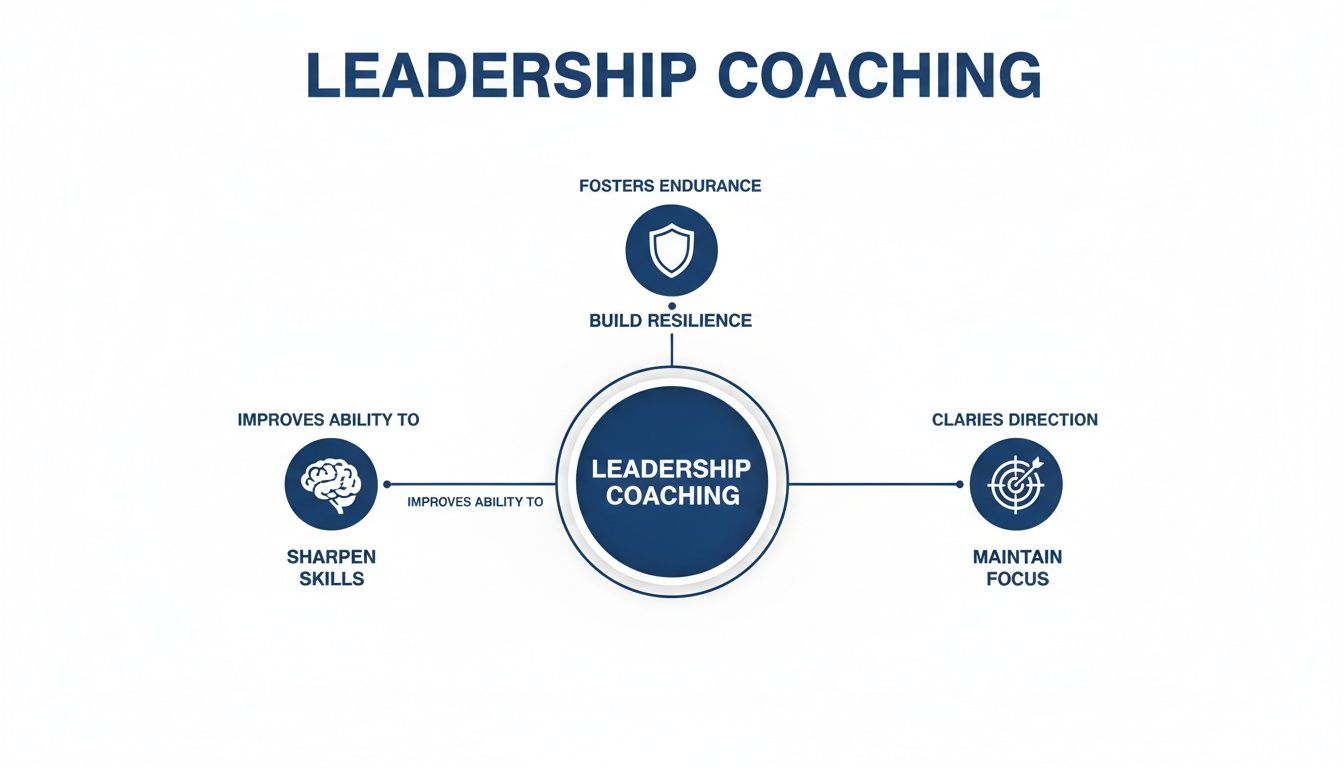
Each of these benefits grows from a leader's ability to first manage their internal world before they can effectively guide their external one.
Understanding the Three Flows of Compassion
The compassionate leader's mindset is built on three interconnected 'flows'. When they are balanced, they create a powerful cycle of psychological strength and interpersonal effectiveness. But when one gets blocked, it throws the others off kilter, often leading to burnout, disconnection, and ineffective leadership.
-
Compassion for Others: This is the flow most people think of when it comes to leadership. It’s about showing empathy, supporting your team’s growth, and creating a psychologically safe environment where people feel valued and understood. A leader who is strong here builds trust and genuinely motivates their team.
-
Receiving Compassion from Others: For many high-achievers, this is the toughest one. It means being open to feedback, accepting support without seeing it as a weakness, and allowing yourself to be guided by your team's insights. When a leader can receive compassion, they foster a culture of real collaboration and mutual respect.
-
Compassion for Yourself (Self-Compassion): Here it is—the foundational flow. This is your internal defence against burnout, imposter syndrome, and that nagging inner critic. Self-compassion is about treating yourself with the same kindness and understanding you’d offer a respected colleague when you make a mistake or face a setback.
“Self-compassion is not a luxury; it is a strategic necessity for modern leadership. It fuels the resilience needed to navigate complexity and the clarity required to make tough decisions without being driven by fear or anxiety.”
Without this internal anchor, the other two flows just aren't sustainable. A leader who is relentlessly self-critical will struggle to genuinely support others without eventually feeling drained or resentful. For a deeper look, you can explore more about compassionate leadership coaching and how it works in practice.
Turning Compassion into Action
So, how does this psychological framework actually show up in the day-to-day reality of leading a team? It’s about small, intentional shifts that add up to a significant impact.
-
From Threat to Clarity: When leaders are driven by threat-based emotions like anxiety or fear of failure, their judgement gets clouded. They might start to micromanage, avoid difficult conversations, or make reactive decisions. A compassionate mindset helps regulate these emotions, creating space for clearer, more strategic thinking. The question shifts from, "What if I fail?" to, "What can I learn from this?"
-
Building Genuine Psychological Safety: A leader who extends compassion to their team does more than just say, "My door is always open." They actively listen, acknowledge challenges without pointing fingers, and create a space where calculated risks are encouraged. This is how you actually foster innovation and high performance.
-
Modelling Resilience, Not Perfection: The self-compassionate leader shows their team that it’s okay to be human. By acknowledging their own mistakes with grace rather than harsh self-judgment, they model a healthy response to failure. This gives their team permission to do the same, building a more resilient and honest culture.
Adopting this mindset is a core part of effective leadership coaching. It shifts the focus from merely doing to being—being a leader who can sustain their energy, inspire their team, and lead with both strength and humanity.
Overcoming the Inner Hurdles to Great Leadership
We often think exceptional leadership is all about mastering external strategies—market analysis, team management, visionary roadmaps. But the truth is, the toughest battles are usually the ones fought inside our own heads.
These inner hurdles—a relentless inner critic, chronic stress, or that nagging feeling of being a fraud—are the unseen saboteurs of success. They quietly chip away at your confidence, cloud your judgement, and pave the way for burnout.
But what if you could turn these challenges into sources of strength? This is precisely where compassionate leadership coaching comes in. It offers practical, proven ways to rewire that internal monologue, handle pressure with grace, and lead from a place of genuine authenticity.

Taming Your Inner Critic
Picture this: you’re about to walk into a high-stakes board meeting. Suddenly, a familiar voice whispers, “You’re not ready. They’re all going to see you don’t really know what you’re doing.” That’s the inner critic, and for most leaders, it’s a constant, unwelcome companion.
This harsh internal narrator isn’t a motivator; it's a performance killer. It triggers your body's threat response, making it incredibly difficult to think clearly and access your best self when you need it most.
A compassionate approach isn’t about trying to crush this voice into silence. Instead, it’s about understanding its (often clumsy) intention—usually, it’s trying to protect you from the perceived threat of failure or embarrassment. Coaching helps you cultivate a much more useful inner voice: the inner compassionate coach.
- The Inner Critic screams: "Don't you dare mess this up. One mistake and your credibility is shot."
- The Inner Compassionate Coach responds: "This is a big moment, so it's natural to feel the pressure. You've done the work, you know your stuff. Just focus on connecting and getting your key points across."
This isn't about letting yourself off the hook. It’s the difference between beating yourself up over a mistake and calmly asking, "Okay, what can I learn from that for next time?"
Navigating Imposter Syndrome
That feeling of being a fraud, of waiting for the other shoe to drop when everyone finally ‘finds you out’, is what we call imposter syndrome. It’s a close cousin of the inner critic and is surprisingly rampant among high-achievers. In fact, studies suggest up to 82% of people have felt this way at some point.
Think of a newly appointed CEO who, despite a stellar track record, secretly believes they just got lucky. They live in a state of quiet panic, attributing every win to chance and working themselves to the bone to avoid being exposed.
CFT-informed coaching dismantles this by helping you:
- Normalise the Feeling: Realise that this is a common human experience, not a character flaw.
- Look at the Evidence: Methodically review your skills and accomplishments to build a case against the fraudulent narrative in your head.
- Shift Your Focus: Move your attention from maintaining a perfect facade to embracing growth and learning.
This helps you build an internal anchor of self-worth that isn’t dependent on the next round of applause. For anyone wanting to dig deeper, there are some fantastic resources available to help you start overcoming imposter syndrome with these compassionate techniques.
Managing Chronic Stress and Burnout
The weight of leadership is immense. Without the right tools, the constant pressure can easily slide into chronic stress, which degrades decision-making, harms your health, and is a one-way ticket to burnout. Too many leaders are stuck in a permanent state of high alert, running on adrenaline.
Compassionate leadership coaching gives you techniques to consciously switch off this threat system and activate your body's natural soothing system. The goal isn't to avoid stress—that’s impossible. It's to get better and faster at recovering from it.
By learning to manage your internal state, you stop being a victim of your circumstances and start becoming the architect of your response. This is the foundation of sustainable, high-impact leadership.
Even simple, practical exercises can make a world of difference. Taking just two minutes before a difficult conversation to do some soothing rhythm breathing can lower your heart rate and bring your rational mind back online. You enter the room calm and clear, not tense and reactive.
Ultimately, these aren't "soft skills"; they are core strategic competencies. A leader who can manage their inner world is simply better equipped to innovate, inspire, and lead with unshakeable confidence.
How to Choose the Right Leadership Coach
Deciding to bring a leadership coach on board is a big move, but actually finding the right one can feel like looking for a needle in a haystack. The market is absolutely flooded with options, so you need to go in with a clear head and a solid list of questions.
The UK coaching scene is booming. A quick search on LinkedIn will show you over 370,000 coaching professionals. This explosion is being driven by the record 890,500 new businesses that kicked off in 2023-24, creating a massive demand for expert guidance.
In fact, the number of active coaches is expected to more than double from 71,000 in 2019 to 167,300 by 2025. For leaders, this means you’re spoiled for choice, but it also means you have to be extra sharp in your selection. The perfect coach for you will really depend on your specific goals, the nuances of your industry, and—most importantly—the internal battles you're trying to win.
Know When You Need a Coach
The first step is simply recognising when the time is right. While good coaching can always add value, there are certain moments in a leader's journey when it becomes almost essential.
It might be time to find a coach if you're:
- Stepping into a bigger role: The skills that got you here probably won’t be enough to guarantee your success in the next chapter.
- Wrestling with persistent team issues: If you’re dealing with low morale, high turnover, or endless conflict, a coach can help you see the patterns you’re missing.
- Feeling stuck or heading for burnout: When you feel like you're just treading water and your inner critic is running the show, an outside perspective is a game-changer.
- Navigating a massive organisational shift: Leading a team through a merger, acquisition, or major restructure takes a level of resilience and skill that’s tough to muster alone.
A great coach doesn’t just hand you the answers. They ask the questions that help you uncover your own answers, empowering you to lead with more clarity, confidence, and authenticity.
This is where a coach with a background in psychology or a framework like Compassion Focused Therapy (CFT) can make a real difference. They are uniquely skilled at helping you get to the root of internal roadblocks—like imposter syndrome or a harsh inner critic—that often fuel those external leadership challenges.
Critical Questions to Ask a Potential Coach
Once you’ve shortlisted a few potential coaches, that initial 'chemistry check' is your opportunity to interview them. Remember, this is a two-way street; you're figuring out if they're a good fit, and they're doing the same with you. To make an informed decision, it's helpful to understand the various platforms and resources for coaches that shape their practice and professional growth.
Go into that conversation prepared with questions that dig deeper than the surface. Here’s a little checklist to get you started:
- What’s your coaching philosophy? What model do you use? You want to hear an approach that clicks with you. Is it all about performance metrics, or do they see the whole person?
- Tell me about your experience with leaders who’ve faced [insert your specific challenge here]. Ask for real-world examples related to things like imposter feelings, managing difficult teams, or navigating a career crossroads.
- How do you measure success? A good answer will cover both the tangible business outcomes and the internal shifts in your mindset and confidence.
- What are your qualifications? Look for credible certifications, but also see if they have a background in psychology, organisational behaviour, or something similar that adds depth.
- What does an engagement with you actually look like? Get clear on the practicalities—session frequency, duration, and what's expected of you between your meetings.
Ultimately, the best leadership coaching relationship is built on a foundation of trust and psychological safety. Pay close attention to your gut feeling during the call. Do you feel heard and understood? Do they challenge you in a way that feels respectful and constructive? That feeling is often your most reliable guide.
Of course. Here is the rewritten section, crafted to sound like an experienced human expert, following all your specific instructions.
The Tangible Returns of Leadership Coaching
While the internal shifts in mindset and confidence are profound, leadership coaching isn’t just some feel-good exercise. It's a strategic investment designed to produce concrete, measurable results for the business. The connection is direct: when a leader learns to manage their inner world more effectively, their external impact on their team and the organisation improves dramatically.
This isn't about vague promises; it's about connecting the dots between personal growth and professional performance. A more compassionate, self-aware leader creates a ripple effect that touches every corner of the business, translating into tangible returns you can see on the balance sheet.

From Internal Shifts to External Wins
The true value of this work becomes crystal clear when you see how a leader's internal development fuels external success. These aren't abstract concepts; they are real-world scenarios that play out in organisations every day, driving significant improvements in performance, retention, and innovation.
Consider these powerful examples:
- Improved Team Performance: A leader who learns to quiet their harsh inner critic becomes far more skilled at delivering constructive, motivating feedback. Instead of projecting their own self-judgment onto their team, they can guide performance from a place of clarity and support. The result? A clear boost in team morale and productivity.
- Higher Employee Retention: A leader who understands how to cultivate psychological safety creates an environment where people feel genuinely valued and respected. This drastically reduces team turnover, saving the company significant costs associated with recruitment, hiring, and training new staff.
- Greater Innovation: When a leader fosters a culture where it’s safe to take calculated risks and learn from failure, they unlock their team's creative potential. This kind of environment is a breeding ground for new ideas, better processes, and the kind of genuine innovation that can give a business a critical competitive edge.
The Financial Case for Coaching
These operational improvements translate directly into financial gains. The payoff for a smart investment in leadership development can be huge. In fact, every pound spent can deliver an average return of £7, with the most effective programmes hitting a return on investment of between £3 and £11.
The results often appear quickly, with leadership coaching yielding measurable ROI within just 3 to 12 months. Some UK firms report gains of 29% in the first quarter alone and up to 415% annually. In certain cases, executive coaching ROI has soared as high as 788%, with one financial services client slashing decision-making times by an incredible 45% in just four months. You can explore more of these powerful leadership development statistics on quarterdeck.co.uk.
Investing in your leaders is one of the highest-leverage activities an organisation can undertake. A single leader's growth can elevate the performance of an entire department, driving results that far outweigh the initial coaching investment.
A Real World Case Study
Let's look at an anonymised but typical example. A director at a fast-growing tech company was brilliant strategically but struggled with micromanagement, driven by a deep-seated fear of failure. Their team was becoming disengaged, and a key project was falling badly behind schedule.
Through coaching, the director learned to manage their anxiety and trust their team. They shifted from controlling every tiny detail to empowering their direct reports.
The results were transformative. Within six months:
- Team engagement scores increased by 30%.
- The stalled project was successfully launched, coming in ahead of the revised schedule.
- Voluntary turnover in their department dropped to zero for the following year.
This is the tangible proof that leadership coaching isn't an expense—it’s a powerful driver of business success.
Taking the Next Step in Your Leadership Journey
We've covered a lot of ground in this guide, and if there's one thing to take away, it's this: modern leadership is less about having all the answers and more about how you manage your own inner world. Lasting, effective leadership isn't built on a flawless track record, but on the quiet strength to navigate your internal landscape with clarity and courage.
The real journey begins when you accept that those inner hurdles—the nagging self-criticism, the shadow of imposter syndrome—aren't signs of weakness. They're simply part of the human experience, and they're things you can absolutely work through. Building self-compassion isn't a fluffy 'nice-to-have'; it's a core competency. It fuels sharper decision-making, shores up your resilience, and helps you forge real connections with your team. Honestly, it's a strategic advantage.
So, Where Do You Go From Here?
Ready to put this into practice? What you do next really depends on where you are right now and what you want to achieve. Here’s a simple breakdown to help you get started.
-
For CEOs and Senior Executives: Your focus is likely on legacy and impact. A good first step is a confidential chat to see how a more compassionate approach to leadership can help with the big stuff—managing board dynamics, preventing your own burnout, or building a more resilient culture across the whole organisation.
-
For Emerging Leaders and Professionals: You're probably focused on building a rock-solid foundation for the future. Start by getting really honest with yourself: what's the main thing holding you back? Is it that harsh inner critic? That feeling that you're not really good enough? Exploring a coaching partnership could give you the exact tools you need to build that unwavering self-belief.
True growth as a leader happens when you stop trying to manage an image and start genuinely understanding yourself. The most powerful investment you can ever make is in the self-awareness to lead with authenticity, courage, and compassion.
This isn't just about hitting your next professional target. It's a commitment to creating a way of leading that's not only more effective, but more fulfilling and sustainable for the long haul. Why not take that first step today?
Your Questions About Leadership Coaching, Answered
It’s completely normal to have questions when you’re thinking about professional development. Let's clear up some of the most common queries I hear about leadership coaching, especially when we start weaving in the psychological and compassionate side of things.
Think of this as a way to demystify the process and see how this kind of focused partnership can really fuel your growth, both as a leader and as a person.
How Is Leadership Coaching Different from Therapy?
This is a great question, and the distinction is important. While both are incredibly valuable, they work towards different ends. Therapy is often the space to explore mental health conditions and look back at past events to heal and improve your overall well-being. It’s about understanding the roots of emotional patterns.
Leadership coaching, on the other hand, is almost always forward-looking and performance-driven. The main goal is to help you hit specific career targets, sharpen your professional toolkit, and become more effective in your current role.
But here’s where my approach is a bit different. By bringing in principles from Compassion Focused Therapy (CFT), we can bridge that gap. We use proven psychological tools to help you tackle the internal roadblocks—like a harsh inner critic or a nagging sense of imposter syndrome—that are directly holding back your professional success.
How Long Does a Typical Coaching Engagement Last?
Most of the time, a leadership coaching engagement will run for about six to twelve months. That’s usually the sweet spot for building a strong, trusting relationship, really digging into the core challenges, and giving you enough time to practise and embed new habits in your daily work. We’d typically catch up every two to four weeks to keep the momentum going.
But it’s not set in stone. Sometimes a shorter, more focused engagement of three or four months is perfect if you have a very specific goal, like gearing up for a big presentation or navigating a tricky transition. On the flip side, some senior leaders find it useful to keep a coach on retainer long-term, as a confidential sounding board and strategic partner.
A coaching engagement isn't about creating dependency; it's about building your capacity. The goal is to equip you with the internal resources and skills to continue your growth long after the formal coaching relationship ends.
Can This Coaching Style Really Improve Business Results?
Absolutely. A compassionate approach to leadership isn't a "soft skill"—it’s a powerful strategic advantage. When a leader learns to practise self-compassion, they become more resilient. They make clearer, better decisions under pressure because they aren’t being hijacked by their internal threat system.
That inner strength then ripples outwards. A leader who is secure in themselves is far better equipped to create genuine psychological safety for their team. And the data on this is clear: psychological safety is directly linked to higher employee engagement, more innovation, and lower staff turnover.
When you foster an environment where your team can speak up, share ideas, and take calculated risks without fear, you unlock a huge amount of creativity and collaboration. This drives real, measurable improvements in both morale and the bottom line. It turns out that leading with humanity is also just good business.
Ready to overcome your inner critic and lead with greater confidence and impact? Dr Chris Irons offers specialised leadership coaching grounded in the proven principles of Compassion Focused Therapy. Learn more and book an introductory call today.