To stop overthinking, the goal isn't to silence your mind completely. That's impossible. Instead, it's about shifting from endless, circular analysis to taking small, compassionate actions. It’s about learning to spot when productive thought sours into a draining mental loop, and then using simple grounding techniques to pull yourself back to the present moment. This approach helps you calm your brain’s threat system without piling on more self-criticism.
The Overthinking Trap: Why Your Mind Won't Switch Off
Ever found yourself replaying a minor mistake from work for hours? Or dissecting every single word of a brief conversation, spiralling into a vortex of "what if" scenarios about the future?
If that sounds familiar, you've been caught in the overthinking trap. This isn't just deep, productive thinking; it's a destructive cycle of rumination (dwelling on the past) and worry (fretting about the future) that leaves you feeling utterly stuck and exhausted.
Many of us fall into this pattern believing that if we just think hard enough, we can solve any problem and head off any potential pain. But overthinking almost always does the opposite. It blows problems out of proportion, drains our energy, and paralyses us, preventing any meaningful action.
Why Your Brain Gets Stuck
From a compassionate perspective, overthinking isn't a personal flaw or a sign of weakness. It's often a clue that your brain's threat detection system is working overtime. It’s simply trying to protect you by anticipating every possible danger, but it’s stuck in overdrive. This gets magnified when our internal self-soothing system isn't well-developed, making it incredibly hard to calm down once the mental chatter kicks in.
It's a pattern that has become alarmingly common. The latest Adult Psychiatric Morbidity Survey found that a staggering 22.6% of adults in England now live with common mental health conditions, a significant jump from 18.9% in 2014, with overthinking being a key symptom.
This cycle of repetitive, negative thought can create real-world challenges:
- Decision Paralysis: You analyse so many options and outcomes that you become completely unable to make a choice.
- Emotional Distress: Constant worry and self-criticism ramp up feelings of anxiety and sadness.
- Strained Relationships: Over-analysing interactions can easily lead to misunderstandings and unnecessary conflict.
- Burnout: The sheer mental energy required to keep the overthinking engine running is immense and, frankly, unsustainable.
Overthinking can also be a central feature of what’s known as imposter syndrome—that persistent feeling that you’re a fraud and will be "found out" at any moment. If this feels uncomfortably close to home, learning to manage those feelings of being an https://drchrisirons.com/imposter-syndrome/ can be a huge relief.
Productive Thinking vs. Overthinking
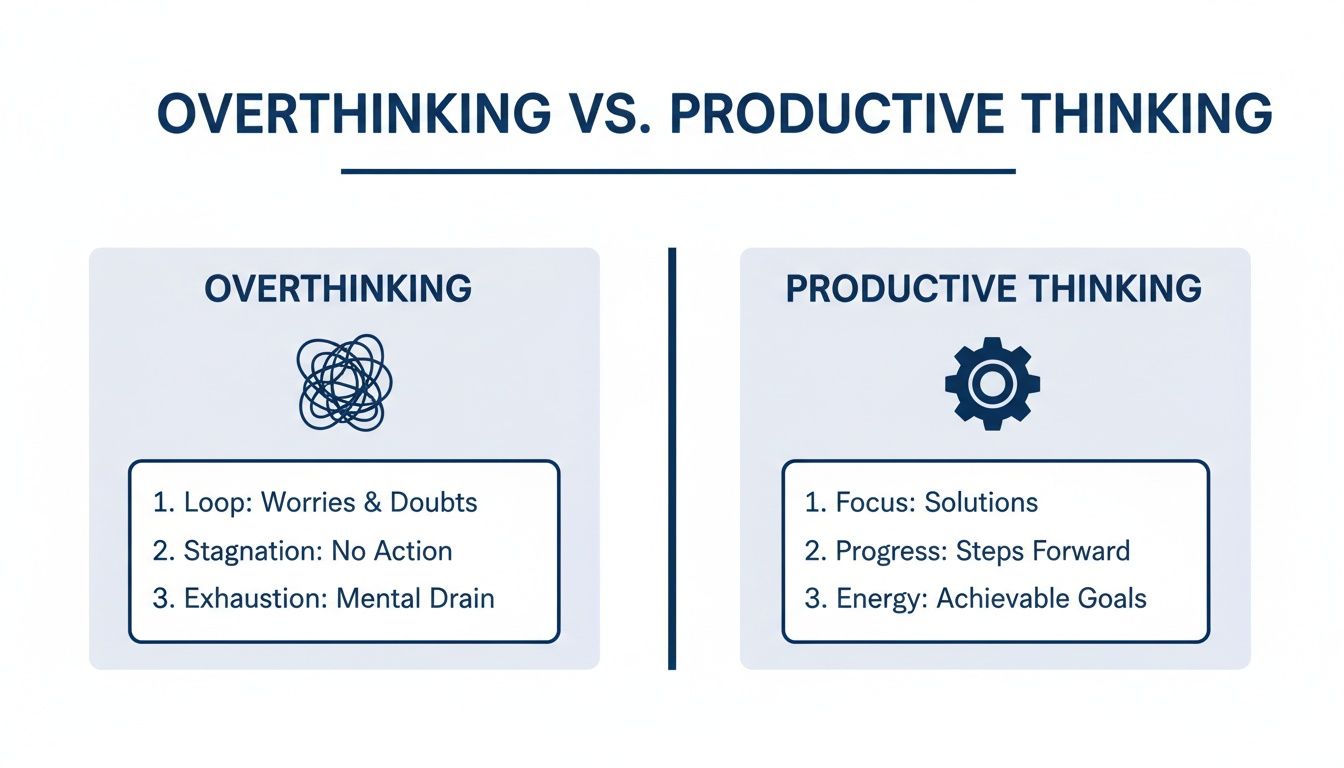
Learning to tell the difference between productive problem-solving and destructive overthinking is a game-changer. Productive thinking is focused on solutions, it’s time-bound, and it moves you towards action. Overthinking, on the other hand, is repetitive, fuelled by emotion, and leads to inaction and yet more distress.
To help you spot the difference in your own mind, here's a quick comparison.
Overthinking vs. Productive Thinking
| Characteristic | Productive Thinking | Overthinking (Rumination/Worry) |
|---|---|---|
| Focus | Solution-oriented, asks "How can I solve this?" | Problem-focused, gets stuck on "Why did this happen?" |
| Outcome | Leads to action, clarity, and progress. | Leads to inaction, mental fog, and feeling stuck. |
| Emotion | Feels empowering, proactive, and hopeful. | Feels distressing, anxious, and helpless. |
| Timeframe | Forward-looking and constructive. | Stuck in the past (rumination) or a feared future (worry). |
| Perspective | Acknowledges the problem but focuses on what's controllable. | Magnifies the problem and obsesses over uncontrollable factors. |
The main difference is movement. Productive thinking moves you forward; overthinking keeps you stuck, spinning your wheels in the same mental mud.
This infographic clearly illustrates the difference between the two.
If your mind often struggles to switch off, you might find specific strategies on how to stop overthinking anxiety particularly helpful. Simply recognising this pattern is the first, most crucial step towards breaking free.
The goal isn't to stop thinking altogether, but to stop the thoughts from controlling you. It's about learning to acknowledge them with kindness and then gently guiding your focus back to what truly matters.
Grounding Yourself in the Present Moment
Overthinking has a nasty habit of yanking you out of the only place you can ever really live: right now. It drags your mind back to replay old conversations or throws you into a future full of worst-case scenarios. The goal isn’t to wrestle these thoughts into submission, but to gently guide your awareness back home to the present moment. That’s the whole point of grounding.
When your mind starts spiralling, your body is usually right there with it. Your sympathetic nervous system—the body's "fight or flight" alarm—kicks into high gear. Grounding techniques are brilliant because they use your senses to interrupt this chain reaction. They activate your parasympathetic nervous system, which is your body’s built-in calming mechanism, helping you feel more settled and back in the driver's seat. Exploring some practical grounding techniques for anxiety can be a great way to find immediate relief when your thoughts feel overwhelming.
This isn’t about just telling yourself to "be more mindful." It's about using tangible, physical anchors to pull your attention out of the mental storm and back to the safety of the here and now.
Using Your Senses: The 5-4-3-2-1 Method
One of the most powerful and straightforward grounding exercises out there is the 5-4-3-2-1 method. It’s so effective because it forces your brain to switch gears from abstract worry to concrete sensory information. Best of all, you can do it anywhere, anytime you feel that familiar spiral begin.
Here’s how it works:
- Notice 5 things you can SEE. Let your eyes wander and silently name five things in your environment. It could be the deep blue of your mug, a crack in the pavement, the pattern on a colleague's shirt, a cloud drifting by, or a speck of dust catching the light. Don't just list them; really look at them.
- Acknowledge 4 things you can FEEL. Tune into the physical sensations you’re experiencing right now. Maybe it’s the texture of your jeans against your skin, the cool surface of the desk under your hands, the solid support of the chair beneath you, or the feeling of a light breeze on your face.
- Listen for 3 things you can HEAR. Pay close attention to the soundscape around you. You might pick up on the distant hum of traffic, the ticking of a clock, birds chirping outside your window, or even the quiet rhythm of your own breathing.
- Identify 2 things you can SMELL. This one can sometimes be tricky, so just notice what’s there. Can you smell the faint aroma of your coffee? The scent of hand soap? The fresh, clean smell after a rain shower? If you can’t smell anything obvious, just notice the neutrality of the air you’re breathing.
- Notice 1 thing you can TASTE. Bring your awareness to your sense of taste. Perhaps there’s a lingering flavour from your lunch or a cup of tea. If not, just notice the natural taste inside your mouth or the sensation of your tongue resting on your palate.
This simple exercise essentially hijacks the overthinking process by demanding your brain’s full attention, anchoring you firmly in your present physical reality.
A Real-World Grounding Scenario
Picture this: you have a massive presentation in an hour. Your mind is off to the races: “What if I forget everything? What if they hate my ideas? I’m going to completely bomb this.” Your heart is pounding, and your hands feel clammy. This is the perfect moment to ground yourself.
Instead of getting swept away by the panic, you pause and run through the 5-4-3-2-1 technique:
- See: The silver clip on your pen, the bright green of a plant in the corner, a framed photo on the wall, the light streaming through the window, and the textured fabric of your chair.
- Feel: The solid floor beneath your feet, the smooth glass of your phone screen, the warmth coming from your laptop, and the soft knit of your jumper.
- Hear: The low hum of the office air conditioning, a co-worker’s laugh down the hall, and the gentle tapping of your own fingers on the desk.
- Smell: The faint scent of paper from your notebook and the last traces of your morning tea.
- Taste: The slightly minty flavour from the toothpaste you used hours ago.
By the time you finish, you’ll likely find your breathing has slowed and the sharp edge of panic has softened. The anxious thoughts might still be lingering in the background, but they’ve lost their immediate, suffocating power over you.
Grounding doesn't make the source of your stress disappear. What it does is give you back the power to choose how you respond. It carves out a small pocket of calm, a space from which you can think more clearly and act with intention instead of panic.
Another simple but powerful technique is 'thought dropping'. When you notice a thought, you just acknowledge it without getting tangled up in it—"Ah, there's that worry again"—and then visualise it gently dropping away, like a single leaf floating down a stream. This practice helps you create distance from your thoughts, reminding you that you are the observer of the storm, not the storm itself.
Developing Your Inner Compassionate Self

When you’re stuck in a cycle of overthinking, it can feel like you're fighting a battle inside your own head. But what if one of your most powerful allies was already in there with you? This is your Compassionate Self—that inner source of wisdom, strength, and warmth that we all have access to.
It’s the part of you that can offer a comforting hand when your inner critic is shouting, and provide a steady anchor when anxious thoughts threaten to pull you under.
This isn't about slapping on a fake smile or pretending everything's perfect. Far from it. It’s about intentionally nurturing an internal ally that can stand by you, especially when you mess up or feel completely overwhelmed. When overthinking is driven by a sense of threat, the compassionate self brings a profound sense of safety and soothing.
Developing this part of yourself means learning to generate feelings of kindness and support from within. Think of it as building an internal safe haven you can always retreat to, no matter how chaotic things get.
What Is the Compassionate Self?
If you were to imagine the perfect mentor, coach, or friend, what qualities would they have? I’d bet they’d possess three core things:
- Wisdom: A deep understanding of life's struggles and the perspective to know that mistakes are simply part of being human.
- Strength: The resilience and courage to face distress without falling apart.
- Warmth: A genuine, non-judgmental kindness and a sincere desire to see you thrive.
Your compassionate self embodies these very qualities. It’s the part of you that can view your struggles with real understanding, lend you the courage to face what’s hard, and offer the warmth needed to soothe your own distress.
Cultivating this inner resource is a cornerstone of Compassion Focused Therapy (CFT). For over 20 years, experts like Dr Chris Irons have shown how building this internal soothing system helps people navigate shame, anxiety, and imposter syndrome—all notorious drivers of overthinking. You can dive deeper into the principles of self-compassion and how they work.
This approach is so potent because it directly counteracts the brain’s threat-based, fight-or-flight responses. By learning to befriend yourself, you can dial down the critical chatter that fuels so much worry. It’s a practice that has helped everyone from therapy clients and healthcare professionals to top-level CEOs find a calmer way of being.
Connecting with Your Inner Ally
Tuning into your compassionate self isn’t a passive thought; it's an active practice. Visualisation is one of the most powerful ways to start building that connection and making it feel real.
Give this simple exercise a try:
- Find a quiet spot. Get comfortable, either sitting or lying down, and take a few gentle breaths to settle your body and mind.
- Bring compassion to mind. Think about what wisdom, strength, and warmth really feel like.
- Imagine your compassionate self. What form does it take for you? Maybe it's an older, wiser version of yourself. It could be a warm, glowing light, a strong and gentle animal, or just a feeling of a benevolent presence nearby. There's no right or wrong here.
- Listen to its voice. What is the tone of your compassionate self? Is it calm, steady, kind?
- Feel its presence. Let yourself rest in its warm, supportive energy for a few moments. Feel that sense of safety and care.
Doing this regularly helps create a tangible, accessible resource within your own mind. The more you practise, the easier it becomes to call on this part of yourself when the overthinking spiral starts.
The goal isn't to invent something new, but to access and strengthen a capacity for compassion that you already have. It’s about turning the volume up on your inner wisdom and turning it down on your inner critic.
From Self-Criticism to Compassionate Reframing
Once you start getting a feel for your compassionate self, you can use it to actively reframe the harsh, self-critical thoughts that keep you stuck.
Let's imagine a new team leader whose project has just hit an unexpected snag. They're drowning in imposter syndrome, and their overthinking mind is having a field day.
- Inner Critic: "See? I knew I wasn't cut out for this. Everyone probably thinks I'm a fraud. I've completely failed the team."
This kind of thinking only digs the hole deeper, making it impossible to problem-solve. But what if they brought their compassionate self into the picture?
Taking a moment to breathe, the leader visualises that wise, strong, and warm part of themselves and asks for its perspective.
- Compassionate Reframe: "Okay, this is tough, and it's completely understandable to feel disappointed. Setbacks like this are a normal part of leading, not a sign that I've failed. What's one small, supportive step I can take right now to help the team and learn from this?"
See the shift? The compassionate reframe doesn't deny the difficulty. It validates the feeling, normalises the struggle, and gently nudges the focus towards a kind, constructive action. This is the heart of learning how to stop overthinking—not by battling your thoughts, but by meeting them with a more powerful and supportive voice.
Challenging Your Thoughts with Kindness

If you've ever tried to wrestle your overthinking mind into submission, you know it's a losing battle. Arguing with or suppressing those racing thoughts is like trying to win a shouting match with your own echo—it just gets louder.
There’s a much more effective path, and it involves changing your relationship with your thoughts entirely. It’s about meeting them with gentle curiosity rather than aggression. This is where we learn to challenge them with kindness.
This isn't about pretending negative thoughts don't exist or slapping a layer of toxic positivity on top of them. It’s about seeing them for what they are: mental events, not undeniable truths.
Practising Cognitive Distancing
One of the most powerful first steps is a technique we call cognitive distancing. It's a bit like taking a mental step back from your thoughts so you can observe them without getting hopelessly tangled up in their story. Instead of being in the thought, you become the person noticing the thought.
I often ask clients to imagine standing on the bank of a river. Their thoughts are like leaves floating by on the current. Some leaves are pleasant, others are painful. Your only job is to watch them drift past—not to jump into the river and grab at every single one.
You can put this into practice immediately by reframing your internal monologue:
- Instead of, "I'm going to fail this presentation," try noticing, "I'm having the thought that I'm going to fail this presentation."
- Rather than getting stuck in, "I'm so awkward," you can observe, "My mind is telling me a story about being awkward right now."
That tiny shift in wording creates a crucial bit of space. It’s a gap between you and the thought, and in that gap, the thought starts to lose its power. You’re reminded that you are not your thoughts.
A thought is just a thought. It’s a fleeting mental event, not a command you have to obey or a fact you have to believe. Giving yourself this distance is the first step to reclaiming your peace of mind.
Asking Compassionate Questions
Once you’ve created a little breathing room, you can start to gently question the thought. The key here is to do it from the perspective of your compassionate self. The goal isn't to prove the thought wrong in a courtroom drama, but to explore it with a warm, curious, and non-judgemental attitude.
The next time a difficult thought pops up, just pause and ask yourself a few questions:
- What would my compassionate self say about this? This question is brilliant because it immediately invites wisdom and warmth into the conversation.
- Is this thought coming from a place of fear or a place of wisdom? Overthinking is almost always rooted in our threat system, in fear. Simply naming that helps you see the thought's true motivation.
- What is this thought trying to protect me from? You’d be surprised how often even the harshest self-criticism is a misguided attempt to keep you safe from failure, embarrassment, or rejection. Seeing its (flawed) intention can soften its sharp edges.
This process of gentle inquiry helps you get to the roots of your shame and self-criticism. If you'd like to explore this more, we have a guide on how Compassion Focused Therapy can help you heal. By engaging with your thoughts this way, you begin to rewire your brain’s default response from self-attack to self-support.
Unfortunately, mental health struggles are not evenly distributed. In more deprived areas, for instance, rates of common mental health conditions can reach 26.2% compared to 16.0% in more affluent areas. While access to treatment is improving, many people still struggle to find the support they need, which makes learning these kinds of self-help skills so vital.
Using a Compassionate Thought Record
To make this process more concrete and less abstract, I often recommend a simple tool inspired by therapeutic practice: a Compassionate Thought Record. It just helps you walk through the steps of identifying and reframing a thought in a structured way. Grab a notebook and create four columns.
Here’s a real-world example of how it might look.
| Trigger | Automatic Thought & Emotion | Compassionate Questions | Compassionate Reframe |
|---|---|---|---|
| My boss gave me some constructive feedback on a report I wrote. | Thought: "I'm so useless at my job. I can't do anything right."
Emotion: Shame, anxiety (feeling about an 8/10 intensity). |
"Is this thought coming from wisdom or my threat brain?" (Definitely threat/fear).
"What would my kindest friend say to me right now?" (That I'm being way too hard on myself). |
"Getting feedback is a normal part of learning and doing a job well. It doesn't mean I'm useless; it means I'm growing. It's okay to feel a bit disappointed, but I can handle this with kindness." |
Working through a record like this does more than just make you feel better in the moment. Think of it as a form of mental training. Each time you practise it, you are strengthening the neural pathways for self-compassion, making it easier and more natural to stop overthinking everything in the future.
Taking Action to Break the Overthinking Cycle
Overthinking is a master of paralysis. It convinces you that the only way out is to think even more, trapping you in a miserable loop of analysis and avoidance while the world carries on without you.
The most powerful way to break this spell isn't with yet another thought. It’s with action.
Taking even the smallest step forward shifts your focus from the chaotic, noisy world inside your head to the real, tangible world outside. It's in the outside world where you actually have influence. Every little action proves to your anxious brain that you can cope and that you don't need every single variable figured out before you can move.
This is the whole idea behind an incredibly effective technique called behavioural activation. It flips the usual script. Instead of waiting until you feel motivated to do something, you act your way into feeling better.
Schedule a Specific Worry Time
One of the best behavioural tools is to contain your overthinking rather than letting it bleed into every corner of your day. This is where a dedicated "worry time" comes in.
I know, it sounds completely counterintuitive. Why on earth would you schedule time for something you want to stop doing?
Because it puts you back in control. Instead of being ambushed by anxious thoughts 24/7, you're giving them a specific, contained appointment. You're the one calling the shots.
Here’s how you can put it into practice:
- Pick a time and place. Set aside a 15-minute slot in your day. It helps to keep it at the same time each day, but the golden rule is this: don't schedule it right before bed.
- Postpone your worries. When a worry or an anxious thought pops up outside of this window, acknowledge it and then mentally shelve it. You could say to yourself, "Thanks, brain. Noted. I'll deal with this at 4:30 PM."
- Use your worry time. When your appointment arrives, sit down and let yourself worry, ruminate, and overthink for the full 15 minutes. Scribble it all down in a notebook if it helps. When the timer goes off, you stop. That’s it. Close the book and move on.
This simple routine teaches your brain that there’s a proper time and place for worry. Over time, this massively reduces its urgency and power throughout the rest of your day. You’re no longer at its mercy.
Take One Small, Valued Step
When you're completely overwhelmed, the idea of taking action can feel like being asked to climb a mountain. The trick is to ignore the mountain. Just focus on the very next step right in front of you.
The goal isn’t to solve the entire problem at once. It's simply to reconnect with something that feels meaningful.
This is where knowing your values is a game-changer. What truly matters to you? Is it connection with others? Creativity? Learning something new? Health? A small action driven by your values is far more powerful than just ticking off a random task.
For example, if you're overthinking a work project to the point of total paralysis:
- Instead of: “I have to finish this entire report.” (Which feels impossible).
- Try: “I will spend 10 minutes organising my research notes.” (This taps into a value like progress or order).
Or if you're stuck ruminating on a tricky social interaction:
- Instead of: “I need to fix this friendship.” (Which is vague and huge).
- Try: “I will send a simple text asking how my friend's day was.” (This is a small step toward the value of connection).
Your brain desperately wants certainty, but what your well-being truly needs is engagement. Taking one small step in a direction that matters to you is how you reclaim your power from the grip of overthinking.
The link between what we do with our bodies and how we feel in our minds is incredibly strong. Statistics show that people with limiting physical health conditions are more than twice as likely to experience mental health issues (32.9% versus 12.6% for those without).
Taking deliberate action, whether it’s a short walk or a small creative task, is a potent antidote to the rumination that fuels so much distress. You can find out more about the connection between physical and mental health in the latest reports.
Frequently Asked Questions About Overthinking

As you start putting these compassionate strategies into practice, it’s only natural for questions or sticking points to come up. In fact, it’s an expected—and welcome—part of the journey.
Let’s tackle some of the most common queries I hear, with some practical advice to help you keep moving forward.
What If These Techniques Feel Awkward or Inauthentic at First?
This is a big one. When you first try compassionate self-talk or a grounding exercise, it can feel a bit strange, especially if your inner critic has been running the show for years. Don’t worry, that’s completely normal.
Think of it like learning a new skill—a musical instrument, a language. It’s never going to feel natural right out of the gate. The key is consistency over intensity. Your brain has some very well-worn neural pathways for overthinking; you’re now gently carving out new, kinder routes.
So, start small. Even just a few minutes of compassionate breathing or a single grounding exercise each day is a massive win. That feeling of authenticity will grow with practice as your brain gets used to this new, more supportive way of relating to yourself.
How Can I Tell the Difference Between Overthinking and Productive Planning?
A brilliant question, because the line can definitely feel blurry sometimes. The real difference comes down to the feeling behind the thought process and, most importantly, the outcome.
-
Productive planning is all about solutions. It’s constructive and moves you towards taking action, even if the topic is a difficult one. It’s geared towards answering, "What’s one small thing I can do right now?"
-
Overthinking, on the other hand, is repetitive and gets stuck on the problem. It’s that familiar loop of worst-case scenarios that never actually leads to a solution. Instead, it just leaves you feeling drained, anxious, and completely stuck.
Here's a quick test you can use. Just ask yourself: "Has thinking about this for the last 10 minutes brought me any closer to a helpful action, or do I just feel worse?" The answer usually tells you everything you need to know.
How Long Until I Start to See a Difference?
Learning to manage overthinking is a practice, not a magic fix. There isn't a universal timeline, but from my experience, many people start to notice small, positive shifts within a few weeks of consistent effort.
Often, the very first change you'll see is simply your awareness. You'll start catching yourself in an overthinking loop much quicker than before. This itself is a huge step forward! It’s this moment of recognition that gives you the chance to intervene with a grounding technique or a compassionate reframe.
The best advice I can give is to be patient and kind with yourself. Celebrate the small wins, like noticing your thoughts spinning or choosing to take a few deep breaths instead of letting them spiral. Real, lasting change is built from all these small, compassionate moments, one on top of the other. It's just like building physical muscle; your inner compassionate muscle gets stronger with gentle, consistent repetition.
Are you ready to build a kinder, more balanced relationship with yourself? At Dr Chris Irons, I offer Compassion Focused Therapy and personal coaching to help you overcome self-criticism and manage difficult emotions. Learn more at https://drchrisirons.com and start your journey today.