Learning how to self-soothe is about intentionally tapping into your body's own calming system when you're feeling overwhelmed. It's a compassionate skill, a way of gently guiding yourself from a place of threat or anxiety to one of safety and contentment. This isn't about ignoring what's wrong; it's about building the internal resources to handle it.
We'll be exploring techniques grounded in real psychology, like mindful breathing, sensory grounding, and kind self-talk, to make this happen.
What Self-Soothing Actually Means

When we hear "self-soothing," it's easy to picture bubble baths or diving into a tub of ice cream. And while there's a place for comfort, the concept, especially from a Compassion Focused Therapy (CFT) perspective, runs much deeper.
It's not about distracting yourself or pushing difficult feelings away. Think of it as a courageous act of self-care, aimed squarely at regulating your emotional state from the inside out.
To really get why this matters, we have to look at how our brains are wired. We're all equipped with three core emotional systems that helped our ancestors survive. The problem is, modern life—with its deadlines, notifications, and social pressures—triggers these ancient systems in ways they were never designed for.
Understanding Your Three Emotional Systems
Our internal world often feels like a tug-of-war between different drives and feelings. Recognising which system has taken the driver's seat is the first, crucial step toward consciously choosing a kinder, more balanced response.
Here's a quick look at the three core emotional regulation systems from Compassion Focused Therapy to help you identify what's happening internally.
Understanding Your Three Emotional Systems
| System | Core Feeling and Function | Common Modern Triggers |
|---|---|---|
| Threat System | Protection & Safety: Triggers anxiety, anger, fear, and disgust to alert you to danger. | An urgent email, a critical comment on social media, conflict with a loved one, financial worries. |
| Drive System | Achievement & Reward: Motivates you with excitement and ambition to seek resources and goals. | Chasing a promotion, hitting a fitness target, the "high" of a successful project, wanting more "likes." |
| Soothing System | Contentment & Connection: Creates feelings of calm, safeness, and peace. Releases oxytocin. | A warm hug, feeling understood by a friend, quiet moments of reflection, genuine kindness. |
These systems are meant to work in harmony, but for many of us, life becomes a frantic ping-pong match between the Threat and Drive systems. We’re either anxious about what might go wrong or relentlessly chasing the next goal, leaving our Soothing System neglected and underused.
Learning to self-soothe is about deliberately giving this third system the attention it deserves. It’s how we find our balance.
Self-soothing isn't a sign of weakness; it's a fundamental human skill for managing distress. It is the practice of consciously shifting our internal state from one of threat to one of safety, which is essential for mental well-being and resilience.
The Foundations of Soothing
Believe it or not, our capacity for self-soothing starts the moment we're born. When a caregiver responds to a baby's cries with warmth and comfort, they are externally activating the baby's own soothing system. These repeated experiences help the infant's brain wire itself for internal regulation later on.
This early learning process is absolutely vital. A UK study on infant sleep, for example, found that babies who showed self-resettling skills at five weeks were far more likely to sleep for longer stretches by three months. An impressive 66.7% of these little self-soothers slept for over five hours straight, compared to just 38% of those who hadn't yet developed the skill. It really highlights how foundational this ability is for lifelong emotional regulation. You can explore the full study on early self-soothing behaviours here.
If those early experiences of being soothed were inconsistent, or maybe just not there, it can feel much harder to access that calm, safe place as an adult.
But here’s the good news: this is a skill. And like any skill, it can be learned and strengthened at any point in your life. The next sections will walk you through practical, evidence-based techniques to do just that.
Find Your Calm with Soothing Rhythm Breathing

If you’re looking for a simple, powerful place to start with self-soothing, this is it. Soothing Rhythm Breathing is a cornerstone practice in Compassion Focused Therapy (CFT) for one simple reason: it works directly with your body's physiology. This isn't about wrestling with your thoughts; it's about sending clear, deliberate safety signals to your nervous system.
The goal here isn't to force yourself to relax. That can often backfire. Instead, you're gently inviting your body to shift gears from its threat response (that familiar fight-or-flight feeling) to its soothing system. This technique helps activate your parasympathetic nervous system—think of it as your body's built-in brake pedal—which slows your heart rate and fosters a genuine sense of calm.
Like learning any new skill, it might feel a bit awkward at first. That's perfectly okay. The aim is practice, not perfection.
The Science Behind a Slower Breath
When we feel anxious or threatened, our breathing naturally gets faster and shallower. It's a brilliant survival mechanism, prepping us to react to danger. The problem is, in our modern lives, this ancient alarm system is often triggered by an overflowing inbox or a critical thought, not a physical threat.
By intentionally slowing down your breath, you send a direct message back to your brain: “I am safe.” You are consciously overriding the alarm signals. This simple act can reduce levels of the stress hormone cortisol and boost feelings of well-being, creating a positive feedback loop that makes it easier to self-soothe over time.
This isn't just a quick fix. It's about fundamentally re-wiring your baseline response to stress. Every time you practise, you're strengthening the neural pathways linked to calm and safety.
How to Practise Soothing Rhythm Breathing
Let's walk through the actual practice. You don't need a special cushion or complete silence—you can do this at your desk, on the bus, or just before a difficult conversation. The real key is finding a rhythm that feels good for you.
- Find a Comfortable Position: Start by sitting upright in a way that feels supportive but not rigid. Lying down is also a great option if that’s more comfortable for you. Let your shoulders drop away from your ears.
- Place a Hand on Your Heart or Stomach: This simple act of physical touch brings an element of warmth and self-compassion into the mix. It also gives you tactile feedback, letting you feel the gentle rise and fall of your chest or belly with each breath.
- Breathe In Slowly: Take a slow, gentle breath in through your nose. Don't try to fill your lungs to their absolute limit; just aim for a comfortable, easy inhalation.
- Exhale Even More Slowly: This is the most important part. Breathe out gently, either through your nose or mouth, making your exhale just a little bit longer than your inhale. Imagine you're releasing tension with every out-breath.
Your breath is an anchor to the present moment. By focusing on its rhythm, you give your racing mind a gentle, reliable point of focus, pulling you away from anxious thoughts about the past or future.
Finding a count that works for you can be helpful. A great starting point is breathing in for a count of four and out for a count of six. But if that feels strained, adjust it. Maybe in for three and out for five feels better. The specific numbers don't matter nearly as much as the gentle, slow rhythm and the slightly longer exhale.
Adding Depth to Your Practice
Once you feel comfortable with the basic rhythm, you can start to layer in other elements to deepen the soothing effect. These additions help engage your mind in a kind and supportive way.
- Imagine Warmth: As you breathe out, imagine a feeling of warmth spreading from your hand through your chest. You might visualise this warmth gently dissolving any tension or distress.
- Use a Soothing Tone: Internally, you could say to yourself "calm" on the inhale and "release" on the exhale. The key is to use a mental tone that feels kind and gentle, not demanding or critical.
- Focus on the Sensation: Pay close attention to the physical sensations of breathing. Notice the feeling of the air moving through your nostrils, or the slight pressure and movement of your hand. This helps keep your mind grounded in the present.
Remember, the moment you realise your mind has wandered is a moment of success. It’s an opportunity to gently and kindly guide your attention back to your breath without any judgment. This simple act of returning is the core of the practice and a powerful lesson in how to self-soothe with genuine compassion.
Use Your Senses to Ground Yourself

While Soothing Rhythm Breathing gets to work on your body's internal state, sensory grounding does the exact opposite: it pulls your attention outwards.
When your mind is stuck in a loop of anxious thoughts, fixating on the past or worrying about the future, deliberately focusing on your senses is an incredibly powerful way to anchor yourself right here, right now.
Think of it as a mental reset. By gently guiding your awareness to what you can see, hear, touch, smell, and taste, you interrupt that anxious feedback loop. You aren’t trying to fight the thoughts off; you're just shifting your focus to something more tangible and immediate.
The 5-4-3-2-1 Technique: A Practical Walkthrough
One of the most effective and widely-used grounding exercises is the 5-4-3-2-1 method. It’s brilliant because it requires no special equipment and can be done anywhere, from a packed train carriage to a quiet office. The key is to approach it with a sense of gentle curiosity, not as another task to tick off a list.
Let’s imagine you’re at your desk, feeling that familiar wave of overwhelm as a deadline looms. Your heart is racing, and your mind is already jumping to the worst-case scenario. Here’s how you can discreetly use this technique to find your feet again:
-
Notice FIVE things you can see. Look around you and mentally name five objects. But don't just list them; notice a specific detail about each. The deep blue of my pen… the way the light catches my screen… a tiny crack in the paint on the wall… the grain of the wood on the desk… that wilting leaf on the office plant.
-
Acknowledge FOUR things you can feel. Bring your awareness to the physical sensations of touch. You might notice the cool, smooth surface of the desk under your forearms… the texture of your jumper against your skin… the solid pressure of your feet on the floor… the slight weight of your watch on your wrist.
-
Listen for THREE things you can hear. Tune in to the sounds around you, both near and far. It could be the low hum of your computer… the sound of distant traffic… the quiet rhythm of your own breathing.
-
Identify TWO things you can smell. This one can be subtle. Lean in and notice the faint scent of coffee from your mug or the clean smell of the hand soap you used earlier. If you can't smell anything specific, that’s fine—just notice the neutral scent of the air itself.
-
Focus on ONE thing you can taste. What’s the taste in your mouth right now? Maybe it's the lingering flavour of your morning tea, or just the neutral taste of your own mouth. You could even take a sip of water and focus entirely on that simple sensation.
By the end of this exercise, you’ve guided your mind through fifteen distinct sensory experiences. You've effectively pulled it out of the abstract, spiralling world of worry and back into the concrete reality of the present.
This principle of creating a safe, present-moment awareness is fundamental to emotional regulation at all stages of life. The need for a soothing environment to feel secure is deeply ingrained in our biology.
UK research on infant sleep safety highlights just how important a soothing environment is. It was found that 75% of daytime SIDS cases occurred when infants were alone, whereas room-sharing can help them settle. This idea of creating a safe, proximate space for regulation is perfectly mirrored in adult self-soothing practices like sensory grounding, which helps us establish an internal feeling of safety to counteract feelings of isolation and threat. You can discover more insights about the importance of a soothing environment in early development.
Adapting Grounding for Different Situations
The 5-4-3-2-1 technique is a fantastic template, but its real power comes from adapting it to your own needs and your immediate environment. You don't always have to go through all five steps. Sometimes, just focusing on one sense is enough to bring you back.
Here are a few creative alternatives for different real-world scenarios:
-
Touch: Keep a smooth "worry stone" in your pocket to rub during a stressful meeting. At home, wrap yourself in a heavy, weighted blanket to feel secure and contained. Pay attention to the simple sensation of warm water running over your hands as you wash them.
-
Smell: Carry a small vial of essential oil like lavender or a sachet of dried herbs. Take a moment to properly inhale the rich aroma of your morning coffee. Step outside and just notice the smell of rain on the pavement.
-
Taste: Keep a strong-flavoured mint or a single square of good-quality dark chocolate on hand. Savour it slowly, paying full attention to how the flavour changes and develops.
-
Sound: Create a calming playlist designed for focus or relaxation. If you're in a noisy place, noise-cancelling headphones can create a welcome pocket of quiet. You could even just focus on a single, repetitive sound, like a ticking clock.
-
Sight: Look out of a window and watch the clouds drift by. Focus on the intricate details of a plant or a piece of art. Mindfully organise a small part of your desk, focusing on the simple act of creating visual order.
The goal here is to find what works for you. Experiment with different sensory inputs to discover what feels most grounding and calming in those moments of distress. It's all about building a personalised toolkit for self-soothing that you can rely on, no matter where you are.
We’ve looked at soothing your body with your breath and grounding your mind with your senses. Now, we get to the very heart of Compassion Focused Therapy: learning to self-soothe by changing the tone of your inner world.
This isn’t about slapping on a layer of forced positivity or pretending pain doesn’t exist. Far from it. It’s about intentionally cultivating an inner voice that is warm, strong, and wise—a reliable ally you can turn to when things get tough.
What’s so powerful about this practice is that it works with your brain's own wiring. When you imagine receiving kindness or bring to mind a compassionate ideal, you're actually activating the same neural pathways that light up when you experience genuine care from someone else. You are deliberately engaging your own soothing system, and like any skill, it gets stronger with practice.
Why Your Inner Critic Can Be So Loud
If you live with a harsh inner critic, you know just how exhausting it can be. That voice often has its roots in our early experiences, where we might have learned, directly or indirectly, that being tough on ourselves was the only way to stay safe or be successful.
Over time, this self-criticism becomes a deeply ingrained, automatic habit. It constantly triggers our threat system, flooding us with feelings of shame and inadequacy. Creating a compassionate voice is the direct antidote. It offers an internal source of safety and encouragement right when you need it most. This whole process is really about building a new, kinder habit to replace the old one.
Creating Your Compassionate Self
Your "Compassionate Self" is an idealised image you create in your mind. Think of it as a mental tool—a figure that embodies the qualities you’d find most helpful when you're struggling, giving you a way to access feelings of warmth, strength, and non-judgement on demand.
Let’s walk through how to build this image. Find a quiet spot where you can have five to ten minutes to yourself.
- Imagine the Quality of Wisdom: What would deep, gentle wisdom feel like? This isn't about having all the answers. It’s about holding a broad, accepting perspective on life’s inevitable struggles.
- Embody the Quality of Strength: Picture a quiet, resilient kind of strength. Not aggressive or forceful, but grounded and courageous—like a deep-rooted mountain that can withstand any storm.
- Feel the Quality of Warmth: Envision a profound, unconditional warmth and kindness. This is a deep commitment to being supportive and wanting to alleviate suffering, both for yourself and for others.
Now, try to bring these qualities together. What would a being who embodies all of them look like? What’s their facial expression? How would they stand or sit? What would their voice sound like? You might even give this ideal version of your compassionate self a colour, a texture, or a gentle sound.
The goal here is to create an image that feels genuinely soothing to you. There’s no right or wrong way to do this.
"Your compassionate self is an internal safe base. It’s the part of you that can look upon your suffering with kindness and courage, offering exactly the support you need, precisely when you need it."
Once you have a sense of this compassionate figure, imagine turning its kind attention towards yourself. Allow it to look at your struggles, your pain, and your self-criticism with complete acceptance and a genuine desire to help. This simple act of redirecting compassionate attention inward can be an incredibly powerful way of learning how to self-soothe. If you'd like to dive deeper into this, you might find it helpful to explore the core principles of self-compassion.
Common Hurdles and How to Navigate Them
It’s completely normal for this practice to feel a bit difficult or unnatural, especially at first. That's all part of the process.
- "I Can't Visualise Anything!" Don't worry if a clear picture doesn't appear. Lots of people find visualisation tricky. Instead, focus on the feeling of these qualities. What does warmth feel like in your body? What is the sensation of strength? Your intention is what matters most.
- "It Feels Fake or Silly." This is often the inner critic trying to protect its old territory. Acknowledge that thought gently ("I notice a thought that this feels silly") and then kindly guide your focus back to your compassionate image.
- "I Don't Deserve Compassion." This is a painful but very common feeling, usually rooted in shame. If this comes up, simply allow your compassionate self to be with that feeling of unworthiness. Let it offer warmth and understanding without trying to fix or argue with it.
Remember, this is a developmental skill. A foundational study on infant sleep found that while only 17.4% of 3-month-olds were effective self-soothers, this number jumped to 61.9% by 6 months. This shows that self-soothing is something we learn and cultivate over time. The practice of compassionate imagery is the adult equivalent—it's how you intentionally build the self-soothing 'muscle' that you can rely on for years to come.
Turn Soothing Thoughts into Real Actions
Developing that kind, inner voice is a huge step, but self-soothing doesn't stop with our thoughts. The next, vital part of the process is translating that internal kindness into real, tangible behaviours. This is where self-compassion moves from an idea into an active, felt experience in your life.
Taking action is what bridges the gap between a compassionate mindset and meaningful change. When you follow a kind thought with a kind action, you’re sending a powerful message to your nervous system that you are genuinely safe and cared for. It reinforces all the internal work you're doing and makes the feeling of being soothed much more concrete.
Creating Your Personalised Soothing Kit
A really practical way to put this into practice is by creating a 'soothing kit' or a 'self-compassion toolkit'. It’s essentially a personal collection of items you’ve specifically chosen to engage your senses and help bring you back to a place of calm. The trick is to have it ready to go before you feel overwhelmed.
Just think about what gives you a simple, gentle sense of comfort. Your kit could be a physical box you keep at home or even a small bag you carry with you.
Here are a few ideas to get you started, organised by sense:
- Touch: A small tube of your favourite hand cream, a soft piece of fabric like velvet or silk, a smooth 'worry stone', or a weighted lap pad.
- Smell: A little vial of a calming essential oil like lavender, a sachet of chamomile, or a familiar scent that brings back happy memories.
- Sound: A dedicated calming playlist on your phone with noise-cancelling headphones can create your own quiet space, wherever you are.
- Taste: A special herbal tea bag, a strong-flavoured mint, or a single square of really good dark chocolate.
- Sight: A photograph that makes you smile, a beautiful postcard, or just a small object you find visually pleasing.
Having these items on hand means that when you notice your threat system kicking in, you can immediately reach for something supportive instead of getting swept away in the spiral of distress. For more ideas on how to manage daily pressures, have a look at these 10 Gentle Ways to Find Your Calm and Cope with Stress.
From Self-Criticism to Compassionate Action
The most powerful moments to practise this are often when your inner critic is at its loudest. The goal isn't to silence the critic, but to notice the harsh thought, gently reframe it with the compassionate voice you've been cultivating, and then—crucially—choose a helpful, kind action.
This table shows a few real-world examples of how you can make that shift. Notice how the action is always a small, achievable step designed to offer immediate support, not to fix the whole problem at once.
From Self-Criticism to Compassionate Action
| Instead of This Self-Critical Thought | Try This Compassionate Reframe | Followed by This Compassionate Action |
|---|---|---|
| "I'm such an idiot for making that mistake." | "That was a difficult moment, and it’s okay to feel disappointed. What do I need right now?" | Make a cup of tea and take a five-minute break away from your desk. |
| "I'll never get all of this done. I'm a failure." | "This feels overwhelming. It's understandable to feel this way. Let's just focus on one small part." | Write down just one priority to focus on for the next 25 minutes and ignore the rest for now. |
| "Why can't I just cope like everyone else?" | "Everyone struggles sometimes. This is a moment of suffering. How can I be kind to myself in this moment?" | Place a hand over your heart, take three soothing breaths, and offer yourself a moment of stillness. |
Choosing compassion is a process, and this simple flowchart can help you visualise the path from noticing that inner critic to actively building a response rooted in warmth, strength, and kindness.
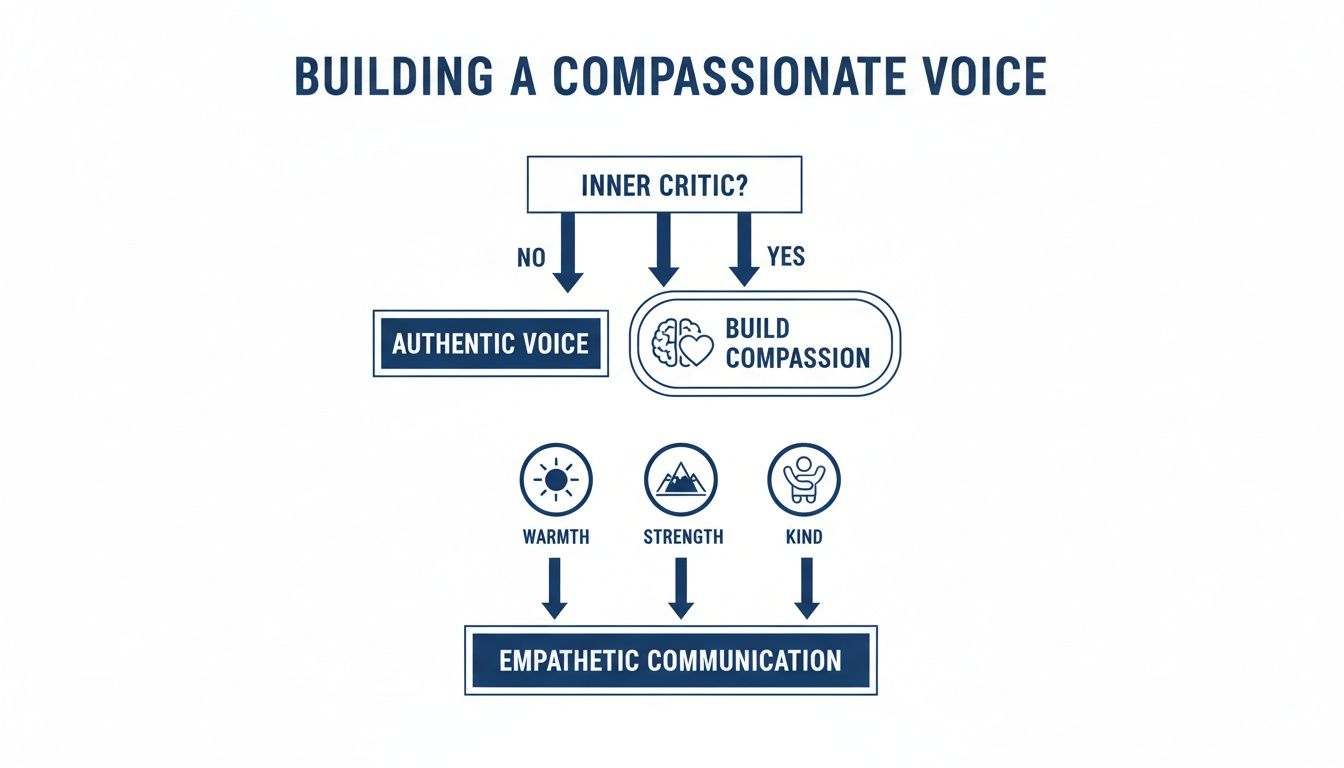
The key insight here is that responding to self-criticism isn't just a single thought—it's a deliberate practice of choosing a more supportive path and embodying its qualities.
The smallest act of self-kindness can be a radical act of self-support. It's about consciously choosing to treat yourself with the same care and respect you would offer to a dear friend who is struggling.
Choosing these small, supportive actions over and over again is how you truly learn to self-soothe in a way that sticks. You're not just thinking differently; you are actively rewiring your response to distress. With each compassionate action, you build a more reliable foundation of inner safety and care that you can return to anytime you need it.
Knowing When Self-Soothing Isn't Enough
The techniques we’ve explored are powerful, genuinely effective tools for navigating day-to-day distress and building up your emotional resilience. Honestly, learning how to soothe yourself is a fundamental life skill.
But, and this is crucial, it's just as important to recognise when these strategies aren't enough. They aren't a substitute for professional mental health care when you're facing challenges that feel persistent or completely overwhelming.
Think of self-soothing as vital first aid for your emotional world. It can absolutely calm you in a tough moment and help you navigate choppy waters. But if you feel like the storm just won't let up, it might be time to call in a skilled navigator.
Signs You May Need More Support
Recognising the limits of self-care isn’t a failure. Far from it. It’s actually an act of profound self-compassion—it’s about truly understanding what you need and taking courageous steps to meet those needs.
It might be time to consider reaching out to a professional if you consistently find yourself experiencing any of these:
- Persistent Overwhelm: That feeling of constantly treading water, where even small stressors feel totally unmanageable.
- Disruption to Daily Life: Your emotional state is getting in the way of your work, your relationships, or even just your ability to take care of basic daily tasks.
- Lack of Relief: You're consistently practising self-soothing techniques, but you're finding little to no lasting improvement in your mood or anxiety levels.
- Deep-Rooted Issues: You have a sense that your struggles are connected to something deeper, like past trauma, deep-seated shame, or long-standing patterns of self-criticism.
Seeking professional help is not a sign that your self-soothing efforts have failed. It is the next compassionate step, acknowledging that some challenges require a guide to navigate safely and effectively.
A qualified therapist can offer a safe, non-judgemental space to explore the roots of what's causing you pain. Therapeutic approaches like Compassion Focused Therapy (CFT) are specifically designed to help people work with these kinds of difficult emotions. You can learn more about how CFT can help you heal from shame and self-criticism in a supportive, guided environment.
In some situations, professional guidance on medication management for mental health can also be a vital piece of the puzzle, working hand-in-hand with therapy. The most important thing is to take that first step and reach out.
Common Questions About Self-Soothing
When you first start exploring how to soothe yourself, it's completely normal for a few practical questions to pop up. Having some answers ready can help you stick with it, especially when you hit those inevitable bumps in the road.
How Long Does This Take to Work?
It’s human nature to want a quick fix, isn't it? But think of self-soothing less like a magic pill and more like a muscle you build over time. The goal isn't to feel perfectly calm overnight, but to notice gradual, meaningful shifts.
Maybe you’ll find that a difficult moment feels just a tiny bit less overwhelming than it used to. That's a win. Be patient with yourself. Every time you practise your Soothing Rhythm Breathing or try a grounding technique, you're literally strengthening the pathways in your brain for calm and safety. The key is to start small and celebrate the effort you're putting in.
What If I Feel Silly Doing These Exercises?
Feeling awkward, resistant, or even a bit daft is an incredibly common reaction. I hear this all the time. Your brain is so used to its old, familiar patterns that intentionally slowing down to, say, place a hand on your heart can feel completely alien at first.
My advice? Instead of judging that feeling, just notice it with a bit of gentle curiosity. You don't have to force anything. Maybe start with the one technique that feels the least strange to you. The more you practise, the more natural and genuinely effective these skills will become. For some extra guidance, you can find many helpful Compassion Focused Therapy resources to support your practice.
Can I Use These During a Panic Attack?
Yes, absolutely—but with a slight change in focus. When you're in a moment of really acute distress, like a panic attack, your mind isn't in a place for complex visualisations. Your one and only priority is to anchor yourself in the present moment as quickly and directly as possible.
The most powerful tools during high-intensity anxiety are sensory-based. Focus on what you can physically feel, see, or hear right now. Press your feet firmly into the floor, clutch a cold object, or start naming five blue things you can see in the room.
It’s also crucial to remember that while these techniques are a fantastic support, they don't replace professional care for severe anxiety. Having a safety plan in place and knowing when to reach out for immediate help is vital.
At Dr Chris Irons, I offer therapy and coaching grounded in Compassion Focused Therapy to help you build a kinder relationship with yourself. Explore how we can work together at https://drchrisirons.com.