Ever felt like you're your own worst critic? That no matter how much you tell yourself to be kinder, that harsh inner voice just won't quit?
You’re not alone. This exact struggle is the reason Compassion Focused Therapy (CFT) even exists. It's a therapeutic model developed by Professor Paul Gilbert specifically for people wrestling with deep-seated shame and self-criticism. CFT doesn't just talk about being kind to yourself; it uses a blend of evolutionary psychology, neuroscience, and mindfulness to help you build an inner sense of compassion and safety from the ground up.
The Origins of Paul Gilbert’s Compassion Focused Therapy
Professor Paul Gilbert, a clinical psychologist, noticed something fascinating—and frustrating—in his practice. Many of his clients could logically grasp the ideas behind cognitive behavioural therapy. They understood their negative thoughts weren't rational, but they couldn't feel any different. The reassurance just didn't land. Their inner critic was still running the show.
This wasn't a personal failing. Gilbert realised he was seeing a pattern, especially in people who had experienced neglect or abuse. Their brains' systems for soothing and self-reassurance were simply underdeveloped, a direct result of their life experiences.
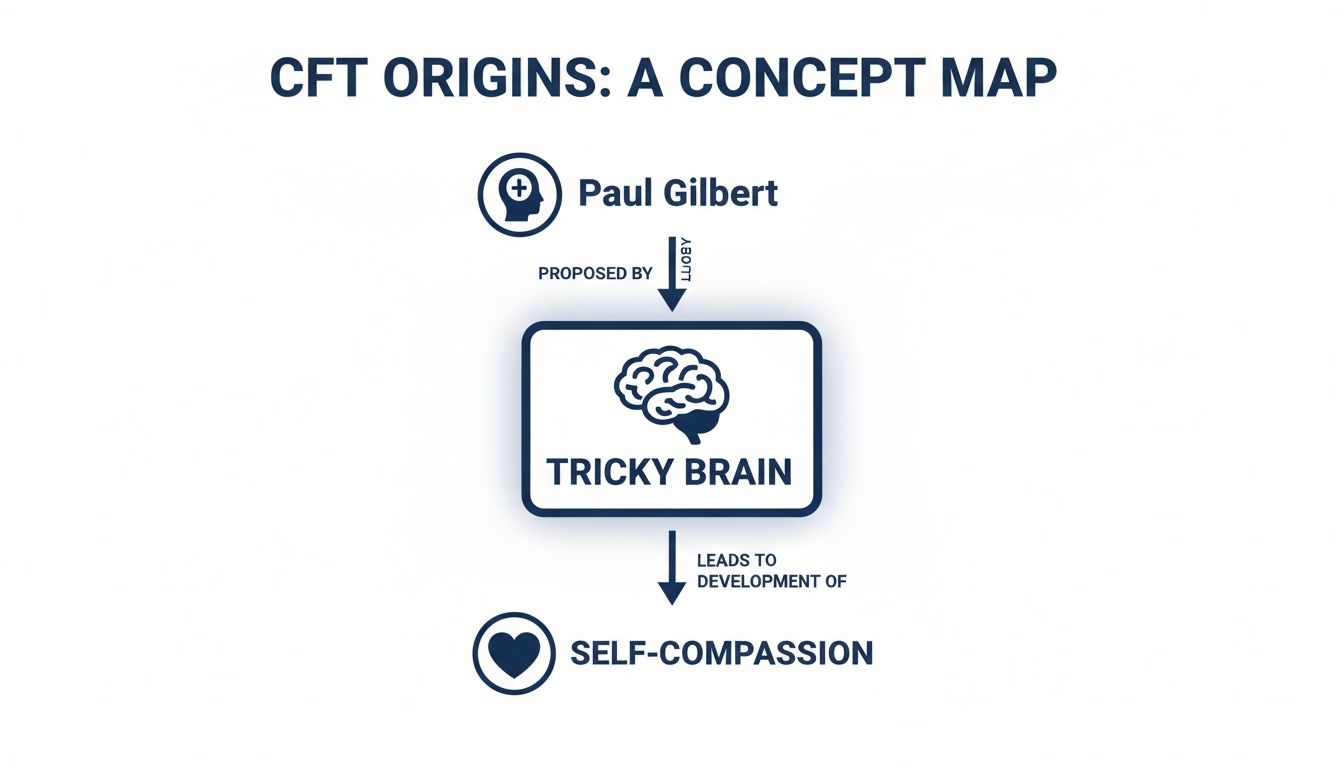
This crucial insight led him to develop a new way of thinking. He started talking about our "tricky brain"—an organ brilliantly designed for survival, but not necessarily for happiness. It's wired to spot threats, which means it often defaults to self-blame and criticism as a misguided way to keep us safe.
A New Way to Tackle Self-Criticism
Instead of just fighting negative thoughts, CFT works by activating a completely different part of our emotional system. It’s not about ignoring pain. It’s about cultivating the strength, wisdom, and courage to meet our difficulties with genuine kindness. Think of it like building a muscle—CFT gives you the exercises to strengthen your capacity for compassion.
- It explains the 'why': CFT helps you understand that your self-critical thoughts aren't your fault. They’re often a product of our evolutionary drive to survive.
- It builds inner resources: The goal isn't just to silence the critic, but to develop a compassionate inner voice that can soothe, encourage, and support you.
- It’s emotionally focused: At its heart, CFT is about cultivating feelings of safeness, warmth, and reassurance to counterbalance the constant sense of threat and shame.
Paul Gilbert pioneered this approach at the University of Derby in the early 2000s. The initial signs were very promising. An early pilot study at Kingsway Hospital in Derby found that participants saw major reductions in depression, anxiety, and shame. In fact, depression scores fell by an average of 40%. Since then, other leading figures in the field, like Dr Chris Irons, have been essential in expanding the research and application of CFT.
Understanding Your Three Emotional Systems
At the very heart of Compassion Focused Therapy is a profound idea from its founder, Professor Paul Gilbert: our brains are not our fault. They’re a product of millions of years of evolution, designed with one primary mission—to keep us alive. This ancient wiring, which Gilbert affectionately calls our “tricky brain,” is brilliant at spotting threats but, frankly, not so great at making us feel happy and safe in the modern world.
This survival-first design means we are all naturally wired for things like anxiety and self-criticism. Think about it: when something goes wrong, our brain’s instant, gut reaction is to find the danger. Sometimes, that danger gets identified as us. This isn't some kind of personal failing; it’s a built-in feature that helped our ancestors survive. The trouble is, today it can leave us feeling stuck in a painful loop of shame and self-blame.
The journey of CFT starts with understanding this. Once we grasp that our brain is just doing its evolutionary job, we can start to build a kinder, more compassionate relationship with ourselves.
The Three Systems of Affect Regulation
To help us get a handle on our complex emotional world, CFT gives us a wonderfully simple map: the three systems of affect (or emotion) regulation. Imagine these as three core emotional "gears" in your mind, each with a very specific purpose. The secret to emotional wellbeing isn't about getting rid of any of them, but about learning to bring them into balance.
Let's break them down.
-
The Threat System: This is your internal alarm bell. Its job is to detect and respond to danger, flooding you with feelings like anxiety, anger, and fear to get you ready to fight, flee, or freeze. It's the system that screams "Watch out!" when a car pulls out in front of you.
-
The Drive System: This is your engine. It's the part of you that gets you out of bed, pushing you to seek out resources, achieve goals, and pursue things that bring a sense of reward. It’s fuelled by feelings of excitement, desire, and wanting.
-
The Soothing System: This is your system for rest, connection, and contentment. It’s activated when you feel safe, cared for, and connected to others. It’s linked to feelings of calm, peace, and reassurance—a sense that everything is okay.
In our fast-paced, high-pressure world, most of us spend our days ricocheting between the Threat and Drive systems. We’re either on high alert, scanning for problems, or relentlessly chasing the next goal. This relentless hustle often leaves the Soothing system neglected, like a muscle we’ve completely forgotten how to use.
Below is a table that summarises these three systems, their functions, and how they show up in our day-to-day lives.
The Three Affect Regulation Systems in CFT
| System | Primary Emotion/Feeling | Evolutionary Function | Modern Day Example |
|---|---|---|---|
| Threat System | Anxiety, Anger, Fear | To detect and respond to danger for survival. | Worrying about a work deadline; feeling anxious in a social situation. |
| Drive System | Excitement, Motivation, Wanting | To seek out resources, mates, and opportunities. | Working hard for a promotion; feeling excited about a holiday. |
| Soothing System | Calm, Contentment, Safeness | To promote rest, recovery, and social bonding. | Feeling peaceful after a hug; enjoying a quiet cup of tea. |
Looking at this table, it becomes clear how an imbalance can easily take hold.
When we’re caught in a spiral of harsh self-criticism, our Threat system is in overdrive, treating our own perceived flaws as if they were life-threatening dangers. This constant internal alarm keeps us exhausted and cuts us off from any feelings of peace or contentment. If you recognise this pattern in yourself, you might find it helpful to read more about how compassion focused therapy can help you heal from shame and self-criticism.
The goal in CFT is not to eliminate threat or drive, but to deliberately cultivate and strengthen the soothing system. It is this system that acts as the antidote to the relentless stress and self-criticism our tricky brains can generate.
Why Balance Is So Crucial
This imbalance explains so much about why many of us feel constantly anxious or unfulfilled. When the Threat system is in charge, life feels like a never-ending battle. When the Drive system runs wild, we chase one achievement after another, only to end up burnt out and never truly satisfied.
The Soothing system is the key to bringing everything back into equilibrium. It's more than just thinking nice thoughts; it’s the physiological foundation of compassion. When we learn to activate it, we actively calm our nervous system, reduce stress hormones like cortisol, and create a genuine feeling of inner safety and security.
This is where CFT becomes incredibly practical. It offers specific exercises designed to stimulate and strengthen this vital system. By learning to consciously engage our Soothing system, we can start to manage our tricky brain, rather than being managed by it. This creates the space we need to heal, grow, and discover a much kinder way of living with ourselves.
Putting CFT into Practice with Key Exercises
Understanding the theory behind Paul Gilbert's Compassion Focused Therapy is one thing, but the real change happens when we start putting these ideas into action. CFT isn’t just about thinking differently; it’s about actively training our minds and bodies to cultivate a sense of safeness and calm. Think of this section as your practical toolkit, filled with core exercises designed to fire up your soothing system.
These techniques are a bit like physiotherapy for the mind. Just as you’d perform specific exercises to strengthen a muscle, these practices are designed to build your capacity for compassion. They take direct aim at the emotional systems we've talked about, helping to counterbalance the overactive threat system that so often fuels our self-criticism.

Soothing Rhythm Breathing
One of the simplest yet most profoundly effective techniques in the CFT toolkit is Soothing Rhythm Breathing. This exercise is a direct line of communication to your nervous system, sending it a clear signal that you are safe and it's okay to slow everything down. When we’re stressed or self-critical, our breathing tends to become shallow and rapid, which keeps our threat system on high alert. This simple practice intentionally reverses that process.
The whole point is to find a breathing rhythm that feels genuinely calming and grounding for you. There's no single "right" way to do it; it’s about discovering what works for your own body.
Here’s a simple guide to get you started:
- Find a comfortable spot, either sitting upright or lying down. Let your eyes gently close if that feels right for you.
- Slow your breathing down, aiming for a pace that’s a little deeper and slower than your normal rhythm. Counting to four or five on the inhale and the same on the exhale is a great place to start.
- Imagine the breath flowing in and out smoothly, without any jarring stops or pauses. The key is creating a seamless, gentle flow.
- Try on a gentle smile or a kind facial expression. It might feel a bit strange, but this small physical shift can actually influence your emotional state, helping to activate your soothing system.
- Keep it going for a few minutes, focusing only on the rhythm and the sensation of your breath. If your mind wanders (and it will!), just gently guide it back.
This isn't just a relaxation trick; it's a physiological intervention. By slowing your breath, you activate the parasympathetic nervous system—the body's natural "rest and digest" mode—which directly counteracts the "fight or flight" response of the threat system.
Creating a Compassionate Image
Another cornerstone of Paul Gilbert’s Compassion Focused Therapy is using imagery to bring feelings of warmth, strength, and safeness to life. Our minds are incredibly responsive to images. A scary image can trigger our threat system in an instant, and thankfully, a compassionate one can do the exact opposite, activating our soothing system.
This exercise is all about creating your ideal compassionate figure in your mind. This could be a person, an animal, a scene in nature, or even just a feeling of warm light. The aim is to create something that embodies the qualities you need most at that moment.
Just ask yourself, what would my ideal compassionate figure be like?
- Wisdom: They would be wise, understanding life's struggles without an ounce of judgement.
- Strength: They would be strong and courageous, able to sit with distress without being swept away by it.
- Warmth: They would be deeply kind, with a genuine commitment to your wellbeing.
Once you have this image, you can practice bringing it to mind whenever you feel distressed. Imagine this figure looking at you with kindness, offering the support and reassurance you need. Over time, this becomes a powerful internal resource you can turn to anytime, anywhere.
Compassionate Mind Training Exercises
Beyond breathing and imagery, Compassionate Mind Training (CMT) involves a whole range of practices aimed at actively cultivating a kinder inner voice. One of the most effective is compassionate letter writing. This exercise is a brilliant way to step outside of your own self-critical mindset and try on a more supportive perspective.
Give this a go: try writing a letter to yourself, but from the perspective of your compassionate image.
- Acknowledge your struggle: Start by describing the difficulty you’re facing with real kindness and validation. Something like, "I know you're feeling completely overwhelmed at work, and it makes perfect sense that you're so stressed."
- Offer understanding: Write about the situation without any blame or criticism. Acknowledge that life is hard and that it's not some personal failing that you're struggling.
- Provide encouragement: Offer words of support, focusing on your strengths and best efforts, no matter how small they seem.
- Suggest helpful actions: Think about what might genuinely help you in this situation—not as a demand, but as a kind and gentle suggestion.
This practice can feel a bit odd at first, but it is a powerful way to retrain your brain. You are actively creating new neural pathways, making that compassionate voice stronger and more automatic. To dig deeper into this, you can find some fantastic insights on the practice of self-compassion from leading experts in the field.
How CFT Compares to Other Therapies
If you’ve dipped your toe into the world of therapy before, you’ve almost certainly heard of Cognitive Behavioural Therapy (CBT). It’s a hugely influential and effective approach, so it’s natural to wonder where Paul Gilbert’s Compassion Focused Therapy fits into the picture. Although CFT has its roots in CBT, it asks a fundamentally different question, and that takes it down a very different path.
Getting your head around this difference is really the key to figuring out if CFT is right for you. It’s not about one being “better” than the other. Think of it more like having a well-stocked toolkit; different problems call for different tools. For struggles that are deeply tangled up in shame and self-criticism, CFT offers a unique and powerful way forward.
The main fork in the road is how each therapy approaches difficult thoughts. A traditional CBT approach is brilliant at helping you identify, challenge, and reframe unhelpful or irrational thoughts. It’s like being trained to be a skilled debater, armed with logic and evidence to dismantle the claims your inner critic makes.
CFT, on the other hand, takes a step back from the debate. It works from the understanding that for many of us, especially those with a relentless inner critic, simply arguing with a thought just doesn’t cut it. Why? Because the underlying emotional tone remains hostile.
You can win a logical argument with yourself all day long, but if the emotional climate inside your mind is one of threat and self-blame, you'll still feel awful. CFT’s primary goal is to change that emotional climate from one of threat to one of safeness and compassion.
A Tale of Two Approaches
Let’s use an analogy. Imagine your mind is a courtroom and a self-critical thought pops up: "I'm a total failure because I made that mistake at work."
-
A CBT approach steps in like a sharp-witted defence lawyer. It would cross-examine the thought: "Where’s the evidence for that? Can you recall times you've succeeded? Is it truly realistic to expect perfection?" The goal here is to prove the thought is factually incorrect and swap it for a more balanced one.
-
A CFT approach takes on the role of a wise and compassionate judge. It first acknowledges the pain the thought is causing, perhaps saying, "It sounds like you're feeling really hurt and disappointed right now." The first step is to create a feeling of internal safeness, maybe through some soothing breathing or by bringing a compassionate image to mind. Only then, from that place of kindness, does it explore the situation with wisdom, not confrontation.
The focus shifts entirely from the content of your thought to your relationship with it. Instead of just changing what you think, CFT helps you change how you feel while you're thinking it.
Compassion Focused Therapy (CFT) vs Cognitive Behavioural Therapy (CBT)
This core difference in philosophy shows up in the techniques and focus of each therapy. While both are valuable, they target different aspects of our psychological experience. CFT places a unique emphasis on our evolutionary psychology and our built-in emotional systems.
The table below lays out some of the main distinctions between the two.
| Aspect | Compassion Focused Therapy (CFT) | Cognitive Behavioural Therapy (CBT) |
|---|---|---|
| Primary Goal | To cultivate feelings of safeness, warmth, and compassion to regulate threat-based emotions like shame and self-criticism. | To identify and change unhelpful patterns of thinking and behaviour that contribute to psychological distress. |
| Focus on Thoughts | Changes the emotional relationship to thoughts by creating a compassionate internal environment. | Challenges the logical validity and content of thoughts to restructure them into more balanced alternatives. |
| Core Problem | An imbalance in emotional systems, particularly an overactive threat system and an underdeveloped soothing system. | Distorted or irrational cognitive patterns (cognitive distortions) and maladaptive behaviours. |
| Key Techniques | Soothing rhythm breathing, compassionate imagery, compassionate letter writing, and developing the "compassionate self." | Thought records, behavioural experiments, exposure therapy, and Socratic questioning. |
| Underlying Theory | Rooted in evolutionary psychology, neuroscience, and attachment theory, focusing on our "tricky brain." | Based on the cognitive model, which posits that thoughts, feelings, and behaviours are interconnected. |
Ultimately, deciding between them often comes down to the nature of your struggle. For specific anxieties, phobias, or habit-breaking, CBT’s structured, logical approach can be incredibly effective. But for those deep, painful, and persistent feelings of shame, inadequacy, and self-hatred, CFT provides the tools to build the inner foundation of kindness that true healing requires.
Does CFT Actually Work? Exploring the Evidence
It’s one thing to read about the ideas behind Paul Gilbert's Compassion Focused Therapy – they often feel deeply intuitive. But the crucial question is always: does it actually work?
The answer is a clear and resounding yes. CFT isn't just a collection of nice ideas; it's a robust, evidence-based therapy with a growing body of clinical research showing it delivers real, measurable change.
From its very beginnings in the UK, CFT has been put through its paces in all sorts of settings. Time and again, studies have shown its power to help with mental health struggles, especially those tangled up with shame and a harsh inner critic. People who engage with CFT don't just report feeling a bit better; research shows significant reductions in depression, anxiety, and feelings of not being good enough.
Even more importantly, they get better at reassuring and soothing themselves. This is because CFT is designed to work with our underlying physiology. By intentionally activating our soothing system, we learn to regulate our threat system, calming the body’s entire stress response. This isn’t about a temporary patch; it’s about fundamentally rewiring our relationship with our own minds.
A Measurable Impact in the UK
The evidence is particularly compelling from specialised programmes here in the UK, where CFT has been used to tackle some really complex psychological challenges. The results prove just how adaptable and powerful it is, well beyond the traditional therapy room.
Since it was formalised back in 2009, its influence has exploded. The Compassionate Mind Foundation in Derby has trained over 4,000 UK professionals, a testament to its growing reputation.
And this isn't just about popularity; it's backed by some seriously impressive data.
- A clinical case study in a UK juvenile detention facility implemented a CFT-based programme. The result? A remarkable 52% reduction in psychopathic traits.
- In a completely different setting, a pilot programme in UK schools led to a 55% increase in self-compassion scores among students and a 28% decrease in bullying reports.
You can dig into the full details of these findings by exploring the research into CFT's efficacy in juvenile populations on the Derby University repository.
These aren't just dry statistics. They represent profound, life-altering shifts in wellbeing and behaviour. They show that by teaching people how to cultivate an inner sense of safety and kindness, we can start to heal some of the most difficult psychological issues we face as a society.
Validating a Kinder Approach
For both therapists and anyone seeking help, this solid evidence base provides real assurance. It confirms that the journey into self-compassion isn't a "soft" option, but a powerful, scientifically-backed strategy for healing. The data consistently points to one clear conclusion: learning to be kinder to ourselves is one of the most effective things we can possibly do for our mental health.
What makes the evidence for Paul Gilbert's Compassion Focused Therapy so compelling is its sheer consistency. Study after study reveals the same pattern: as a person develops their compassionate mind, their levels of shame and self-attack go down. At the same time, their capacity for kindness and self-support grows.
This creates a positive feedback loop that builds genuine emotional resilience over time. The research confirms that CFT gives us the tools not just to cope with distress, but to actively build a more secure and supportive inner world.
Finding CFT Resources and Support in the UK

Deciding to explore Paul Gilbert's Compassion Focused Therapy is a brilliant first step. But knowing where to turn for the right support can feel like a challenge. The good news is there's a real wealth of high-quality resources right here in the UK, whether you’re looking for a therapist or just want some self-help materials to get you started.
Your best bet is to start at the source. The Compassionate Mind Foundation, based in Derby and founded by Gilbert himself, is the central hub for everything CFT. Their website is packed with useful stuff, from a directory of accredited therapists to free audio exercises you can try today.
Finding a Qualified Therapist
When you're ready for professional support, it's so important to find someone with specific training in CFT. This isn't just a tick-box exercise; it means they'll have a proper grasp of its unique ideas, like the three emotional systems model, and know how to apply them effectively.
Here’s where you can begin your search:
- Professional Directories: The Compassionate Mind Foundation's own directory is the go-to place for practitioners who have completed accredited training.
- Specialist Practitioners: Many of the leading figures in the field, like Dr Chris Irons, offer one-to-one therapy and professional training deeply rooted in authentic CFT.
- NHS Services: This can be a bit of a postcode lottery, but more and more NHS trusts are starting to offer CFT. It’s always worth having a chat with your GP to see what might be available in your local area.
A great CFT therapist does more than just listen. They’ll actively guide you through practices like compassionate imagery and soothing rhythm breathing, helping you build that inner strength to stand up to your inner critic.
Essential Books and Self-Help Materials
If you'd rather dip your toes in on your own, a good book can be an excellent guide. The work of Paul Gilbert and other key authors really brings the theory to life, offering practical ways to start developing a more compassionate mind.
I’d recommend starting with these cornerstones:
- The Compassionate Mind by Paul Gilbert: This is the foundational text. It introduces all the core ideas of CFT in a way that’s easy to understand and connect with.
- Living Like Crazy by Paul Gilbert: A more recent book where he explores mental health through that unique compassionate, evolutionary lens.
- CFT Made Simple by Russell L. Kolts: Just as the title says, this is a wonderfully straightforward guide that breaks down the key techniques and concepts.
These resources are a fantastic launching pad for anyone in the UK ready to see what this powerful and kind approach has to offer.
Of course. Here is the rewritten section, crafted to sound like an experienced human expert in Compassion Focused Therapy, following the provided style and guidelines.
Your Questions About Compassion Focused Therapy
As we get to the end of this guide, it’s completely normal for a few practical questions to pop up. Getting your head around the core ideas of Paul Gilbert's Compassion Focused Therapy is one thing, but understanding how it all works in the real world is just as crucial. Let's tackle some of the most common queries I hear.
Think of this as tying up the loose ends. My aim here is to clear up any lingering uncertainties you might have, so you feel confident and ready for whatever you decide to do next.
Is CFT Just for Depression and Self-Criticism?
It’s true that CFT first took shape to help people struggling with deep-seated shame and a really harsh inner critic. And it works brilliantly for that, as it gets right to the heart of the emotional systems driving those feelings. But over the years, we've seen just how far its principles can reach.
Today, CFT is used to help with a much wider range of difficulties:
- Anxiety Disorders: By beefing up our soothing system, CFT helps dial down the overactive threat system that keeps anxiety running high.
- Eating Disorders: It’s incredibly helpful for addressing the intense shame and self-attack that so often go hand-in-hand with struggles around food and body image.
- Trauma: It gives you the tools to build a sense of inner safety and sturdiness, which you need to process traumatic memories without feeling completely overwhelmed.
- Relationship Difficulties: Learning to bring compassion to yourself and others can fundamentally shift the way you connect with people.
At its core, if a psychological issue is being fuelled or made worse by self-criticism, CFT offers a powerful and direct way through it.
How Long Does Therapy Usually Take?
This is a classic "how long is a piece of string?" question, because CFT is always shaped around the person in front of me. There’s no fixed, one-size-fits-all schedule. For some people, a shorter burst of around 12 to 20 sessions is enough to get a real handle on the core skills and feel a significant shift.
For others, especially when we’re working with difficulties that have deep roots in early life, taking a longer-term view is often more helpful. The real goal is always to create meaningful, lasting change, not just a quick fix. Therapy tends to wrap up when you feel you’ve got the tools and confidence to carry on building your compassionate mind on your own.
Can I Actually Do These Techniques by Myself?
Yes, absolutely. One of the best things about CFT is how practical the exercises are. While having a trained therapist to guide you is invaluable, you can definitely start practising and feeling the benefits on your own.
The secret ingredient is consistency. It's a bit like training a muscle at the gym; the benefits of compassionate mind training build up with regular practice. Simple exercises like soothing rhythm breathing or bringing a compassionate image to mind can create real, lasting changes in your brain and nervous system over time.
A great starting point is to dive into self-help books, find some guided audio exercises online, or explore other resources. This kind of self-led practice can be a powerful journey in itself, and it also works as a fantastic companion to formal therapy, helping you go deeper and weave compassion into the fabric of your daily life.
If you're ready to see how Compassion Focused Therapy can help you build a kinder, more supportive relationship with yourself, Dr Chris Irons offers expert therapy, coaching, and training. You can discover a path away from self-criticism and towards genuine inner warmth by visiting https://drchrisirons.com.