We often hear that compassion means "to suffer with", but honestly, that translation barely scratches the surface. It can make compassion sound like a passive, heavy feeling of pity, when in reality, it's an active, engaged, and courageous response to suffering.
So, What Does Compassion Actually Mean?
To get to the heart of what compassion is, we need to move past simple dictionary definitions and into the real world. It isn’t just about noticing that someone is having a hard time; it’s about feeling a genuine motivation to step in and help.
Think of it like the mindset of a first responder. They see the emergency, of course—that's the first step. But what truly defines their role is the commitment to intervene, to do something constructive to ease the suffering. This active quality is precisely what sets compassion apart from its cousins, empathy and sympathy, which are so often confused.
It’s Not a Feeling, It’s an Action
True compassion unfolds in a few distinct steps. It always starts with awareness—actually noticing that someone is in pain. This is usually followed by a feeling of concern or warmth, which often involves empathy. But the final, crucial step is the desire to act.
"Compassion is not a relationship between the healer and the wounded. It's a relationship between equals. Only when we know our own darkness well can we be present with the darkness of others." – Pema Chödrön
This commitment to action is what makes compassion a skill you can build, not just a fleeting emotion. It takes real strength to turn towards difficulty instead of looking away, and a good dose of wisdom to figure out what kind of help is actually helpful.
To make this a bit clearer, let's break down the core components of compassion. This framework will be helpful as we go deeper into the topic.
The Core Components of Compassion
This table sums up the essential ingredients that come together to create genuine compassion.
| Component | Description |
|---|---|
| Awareness | The cognitive part: simply noticing and recognising that suffering is present, either in yourself or in someone else. |
| Concern | The emotional response: feeling a sense of care and warmth for the person who is struggling. |
| Motivation | The intentional piece: having the desire and the will to do something to help reduce the suffering. |
| Action | The behavioural response: taking wise, helpful action to support the person in pain. |
As you can see, compassion is a rich, multi-layered process. It engages our minds, our hearts, and our willingness to act for the good of others (and ourselves).
Compassion, Empathy, and Sympathy: What's the Difference?
We often use the words compassion, empathy, and sympathy almost interchangeably in everyday conversation, but in reality, they describe very different ways of responding to someone's pain. Teasing them apart isn't just an academic exercise—it's crucial for understanding why compassion, in particular, has such a unique power to create real change, both for others and for ourselves.
Let’s explore this with a simple, relatable scenario. Imagine a close friend rings you up and tells you they’ve just lost their job.
Three Ways to Respond
Your gut reaction in that moment will likely fall into one of three categories, each playing a distinct role and leading to a different kind of interaction.
-
Sympathy is when you feel for someone. A sympathetic response would be something like, "Oh, that’s terrible. I’m so sorry that happened to you." You’re expressing care from a distance, acknowledging their bad news without necessarily getting pulled into their emotional state. You recognise their pain, but you remain a supportive observer.
-
Empathy is when you feel with someone. Empathy pulls you a step closer. You might say, "I can only imagine how anxious and scared you must feel right now." Here, you’re trying to connect with their emotional world, tapping into your own experiences of fear or uncertainty to feel their distress alongside them.
This is where compassion enters the scene, taking things one crucial step further. It's a journey that starts with noticing and feeling, but it’s defined by a commitment to act.
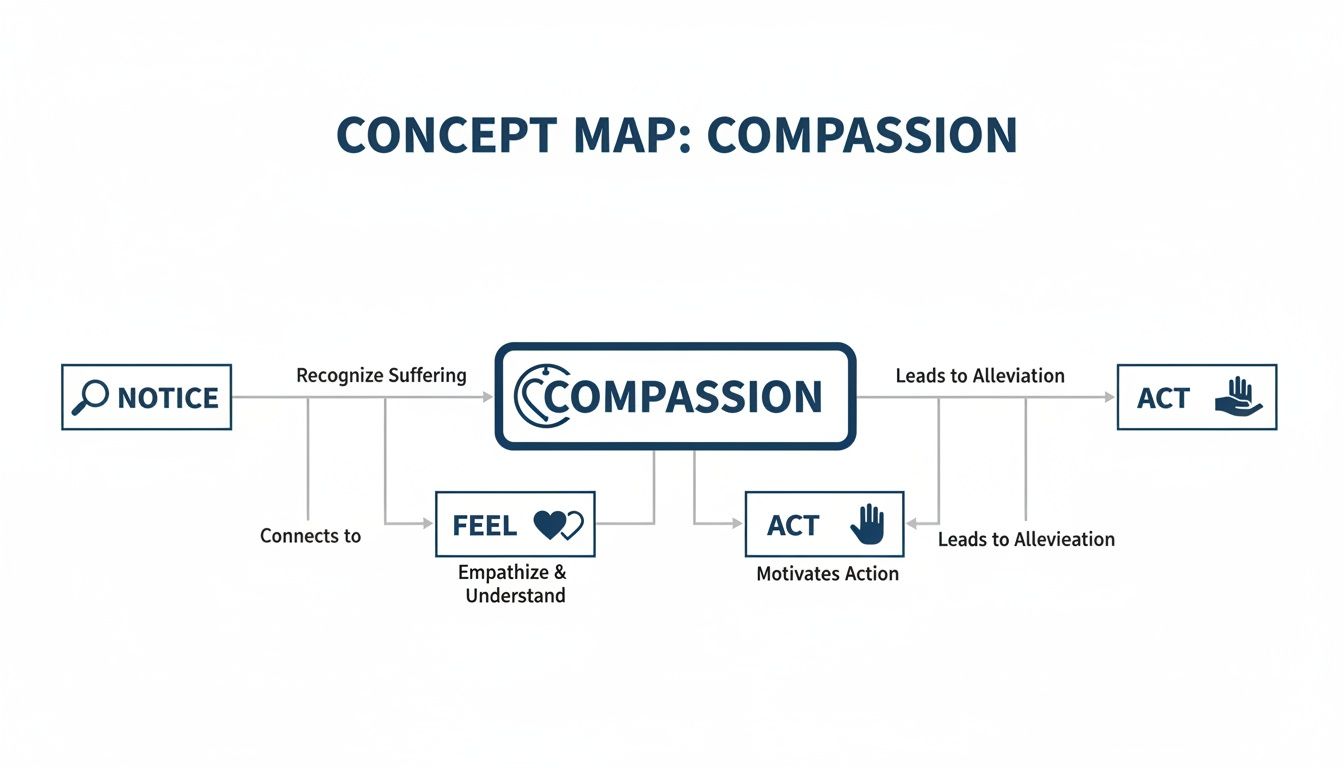
As this map shows, it’s the action that truly completes the circle of compassion.
Compassion is Action in Motion
So, we arrive at the fundamental quality that separates compassion from its cousins: compassion is the desire to act.
It moves beyond feeling for someone (sympathy) or with someone (empathy) and instinctively asks, "What can I do to help?" In our job-loss scenario, a compassionate response sounds like this: "That's so tough. Would it help if I came over this weekend to update your CV with you? Or we could just sit down with a coffee and look over some job listings together."
Compassion is not just a feeling. It’s a motivation that directs our behaviour towards alleviating suffering. It combines the feeling of empathy with the desire to help.
This is a really important distinction. Empathy, while a beautiful human quality, can be incredibly draining. When we absorb another person’s distress without a clear outlet, it can easily lead to emotional burnout.
Compassion, on the other hand, is often energising. It gives us a constructive way to channel those feelings. By focusing on a helpful action—no matter how small—you shift from being overwhelmed by shared pain to becoming a source of practical support.
None of this is about ranking these emotions. Sympathy and empathy are vital parts of our human experience. But recognising that compassion includes the active ingredient of wanting to help is what turns a passive feeling into a powerful force for connection and healing.
To make these distinctions crystal clear, here’s a simple side-by-side comparison.
Compassion vs Empathy vs Sympathy
| Concept | Core Meaning | Your Role | Example Action |
|---|---|---|---|
| Sympathy | Feeling for someone | An observer offering comfort | Saying, "I'm so sorry for your loss." |
| Empathy | Feeling with someone | A participant sharing emotion | Feeling their sadness and distress alongside them. |
| Compassion | Moved to help someone | An active agent of support | Asking, "What can I do to help you through this?" |
This table neatly sums it up. While sympathy and empathy are about acknowledging and sharing feelings, compassion is the impulse that turns that emotional connection into meaningful action.
The Science Behind a Compassionate Mind
Compassion is far more than just a warm, fuzzy feeling or a ‘soft skill’. It’s a sophisticated psychological process, hardwired deep into our biology. When we experience or express compassion, our brains light up in fascinating ways, revealing a powerful neurological network designed for caring, connection, and keeping ourselves on an even keel.
This isn't just theory—it’s something we can actually see happening in the brain.
Neuroscientific studies show that compassion gets specific brain regions buzzing with activity. We're talking about the prefrontal cortex (our inner CEO, responsible for decision-making and managing emotions) and other areas linked to empathy and parental care. In short, when you feel compassion, you're firing up some of the most advanced systems your brain has for understanding others and regulating your own responses.

This completely changes how we should think about compassion. It's not some fixed trait that you either have or you don't. It’s a skill. And like any skill, it can be intentionally trained and strengthened, much like a muscle.
Tapping Into Your Brain's Three Systems
The pioneering work of psychologist Paul Gilbert, founder of Compassion Focused Therapy (CFT), gives us a brilliant map for understanding this. He explains how our brains are constantly shifting between three main emotional systems:
- The Threat System: Think of this as your brain's alarm bell. It’s designed to spot danger and trigger feelings like anxiety, anger, and disgust to keep you safe. Absolutely vital for survival.
- The Drive System: This is what gets you out of bed in the morning. It motivates you to seek out rewards, chase goals, and find resources. It's the source of excitement, ambition, and the pleasure of achievement.
- The Soothing System: This is where we find feelings of contentment, safety, and connection. It’s switched on when we feel cared for and secure. This system is the neurological home of compassion.
The problem is, many of us get stuck in the threat system. We’re overwhelmed by stress, swamped by anxiety, or bogged down by self-criticism. When that happens, our soothing system often gets knocked offline. This is where practising compassion comes in.
By intentionally cultivating compassion, we are directly stimulating our soothing system. This activation helps to down-regulate the threat system, creating a sense of calm and psychological safety. It’s like applying a neurological brake to our runaway stress responses.
This isn't just about feeling a bit better in the moment; it’s about fundamentally rebalancing our entire emotional state. When we activate the soothing system through compassion, our brains release oxytocin—often called the "bonding hormone"—which ramps up feelings of trust and connection while dialling down fear.
This is exactly why developing a compassionate mind is so crucial for mental health. It gives us a direct, biologically-grounded tool to manage difficult emotions and counteract the relentless chatter of our inner critic. By learning to be more compassionate towards others and ourselves, we are actively reshaping our own neural pathways for greater resilience and well-being.
For anyone looking to dive deeper, you can find a wealth of information on self-compassion practices and their benefits.
Exploring Compassion in Modern Society
While we can get a good handle on the science of compassion, its place in the wider world often feels a lot messier. Most of us, if asked, would probably say we’re compassionate people. Yet, there's a nagging feeling for many that society as a whole is becoming less caring. It’s a strange and uncomfortable gap between how we see ourselves and the world we live in.
So, what's driving this feeling? It’s hard to ignore the growing social and political divides that seem to constantly push us to focus on what separates us, rather than what we all share. When public conversation gets harsh, it can easily feel like that basic human instinct to care for one another is on the wane, even if it’s still alive and well in our own homes and with our friends. This clash between our private values and the public mood is one of the real challenges of our time.
The Compassion Paradox in Numbers
This isn't just a feeling in the air; the data actually backs it up. A fascinating national survey really threw this disconnect into sharp relief. Back in 2019, while a massive 92% of British adults saw themselves as compassionate, a hefty 60% felt that Britain had become a less caring place over the last decade. It points to this idea that while we hold on to compassion as a personal ideal, we’re just not seeing it reflected back at us in society. You can dig into the full details in the Kindness Report from Action for Happiness.
What I find really interesting is what the analysis found predicts higher levels of compassion. It wasn't about money or social status. Instead, things like being younger, female, and living in a larger household were much stronger indicators. This suggests that it’s our social connections—our bonds with others—that really fuel a compassionate outlook, not material success.
This gap between how we see ourselves and how we see society leaves us with a critical question: Are we failing to turn our private feelings of compassion into public action, or are we simply not noticing the compassionate acts that happen all around us every day?
Getting to grips with this paradox is the first real step toward closing that gap. It forces us to ask how we can better translate our personal capacity for compassion into something that shapes a kinder community. By remembering just how important social connection and our shared humanity are, we can start to build a society that doesn't just talk about compassion, but actually puts it into practice. The goal is simple: to make the compassion we feel on the inside more visible on the outside.
Why Compassionate Care Is Vital in Healthcare
In healthcare, compassion used to be seen as a nice-to-have, a soft, optional extra. Not anymore. Now, it’s rightly understood as a fundamental part of effective treatment. The journey it took from a background concept to a central pillar of patient care, especially within the NHS, marks a profound shift in what we believe good healthcare truly is.
This change wasn't just a slow evolution; it was kickstarted by a crisis that forced a difficult, but necessary, national conversation.
The turning point was the 2013 Francis Report, an inquiry into the systemic failings at the Mid Staffordshire NHS Foundation Trust. The report sent shockwaves across the UK, detailing appalling lapses in care and pinning the blame on one core problem: a profound lack of compassion. This wasn't just about clinical mistakes. It was a failure of basic human kindness that left patients suffering needlessly.

The fallout was immediate and far-reaching. The inquiry embedded the very meaning of compassion directly into healthcare policy, training, and professional standards across the NHS. It became a powerful, real-world case study in how a deeper understanding of compassion could transform a vital public service from the inside out.
From Report to Reality
The impact of this shift is easy to see. Mentions of the word ‘compassion’ in the British Nursing Index rocketed from just 6 references in the 1980s to 1,645 in the 2010s. That’s a staggering 274-fold increase. It shows just how quickly an idea, when powered by real-world events, can become woven into the fabric of a profession.
This renewed focus brings tangible benefits for everyone involved. For patients, compassionate care leads to:
- Improved Health Outcomes: Simply feeling cared for can lower stress, which in turn helps the body heal.
- Greater Trust: Compassion builds a stronger bond between patient and practitioner, leading to better communication and willingness to stick to treatment plans.
- Enhanced Patient Experience: It ensures people are treated with dignity and respect, even in their most difficult moments.
For healthcare professionals, practising compassion is a powerful antidote to burnout. By focusing on connection and helpful action—rather than just absorbing a patient's distress—caregivers can find more meaning in their work and protect their own emotional wellbeing.
Of course, true compassion must also recognise the diverse needs of patients, which is why culturally inclusive compassionate care is so important in modern healthcare settings.
Ultimately, the story of compassion in the NHS makes one thing clear: it isn't just an emotion. It’s a crucial clinical skill—one that directly contributes to safety, recovery, and human dignity.
Simple Ways to Cultivate More Compassion
Knowing what compassion is intellectually is one thing, but actually feeling and practising it is another. The good news is that your capacity for compassion is like a muscle – the more you work it, the stronger it gets. And you don’t need hours of training. All it takes are a few simple, intentional exercises woven into your day.
The techniques I'm about to share come straight from mindfulness and Compassion Focused Therapy (CFT). They’re designed to be incredibly accessible but surprisingly powerful. They work by directly engaging your brain's soothing system, which helps you handle stress better and build a kinder mindset toward yourself and everyone else.
Soothing Rhythm Breathing
One of the fastest ways to calm your internal threat system is to simply focus on your breath. Soothing rhythm breathing is a foundational exercise for a reason: it works.
- Find a comfortable spot where you can sit upright but feel relaxed.
- Breathe in slowly through your nose for a count of about four, feeling your belly expand.
- Breathe out gently through your mouth for a count of about six, making your exhale just a little longer than your inhale.
- Keep this rhythm going for a few minutes. Just focus on that gentle pace and the sense of calm it brings.
This simple act sends a signal of safety straight to your nervous system, making it much easier to shift into a compassionate state of mind.
This simple breathing exercise is a cornerstone of CFT. It gives you an immediate tool to dial down feelings of anxiety or anger, creating the psychological space needed for compassion to emerge.
Loving-Kindness Meditation
This is a classic practice for a reason. It's all about intentionally generating feelings of goodwill and warmth, starting with yourself and then extending that circle outwards.
Find a quiet moment and silently repeat a few simple phrases. You could try:
- "May I be safe."
- "May I be happy."
- "May I be healthy."
- "May I live with ease."
Once you've offered this kindness to yourself, bring to mind a loved one and extend the same wishes to them. Then, try it with a neutral person, and eventually, even someone you find difficult. This practice is a powerful way to broaden your circle of care. Seeing how these ideas apply in the real world, for example through compassionate parenting strategies, can bring the practice to life.
Quieting Your Inner Critic
Our own self-criticism is often the biggest roadblock to compassion. A brilliant first step to softening that harsh inner voice is to get to know it through journaling.
For anyone looking to go deeper here, exploring resources on self-compassion can offer some invaluable guidance. These tools are all about helping you build the kind, supportive inner world that compassion needs to thrive.
Common Questions About Compassion
As we start to dig into what compassion really means, a few common questions and myths tend to pop up. It’s important to clear these up, because they can seriously get in the way of us being able to embrace a more compassionate mindset. So, let's tackle some of the biggest ones head-on.
One of the most stubborn myths is that compassion is a sign of weakness. Honestly, the complete opposite is true. Genuine compassion requires tremendous courage and strength. It asks us to turn towards suffering when our first instinct is probably to look away, and it demands the wisdom to act without getting completely swamped ourselves. It's a hallmark of deep emotional resilience, not fragility.
Can You Be Too Compassionate?
This is a great question. While compassion itself is a healthy, vital part of being human, trying to live it out without any boundaries can lead straight to burnout—what's often called 'compassion fatigue'. This is something I see a lot in caring professions, or with people looking after loved ones.
The secret is to balance compassion for others with self-compassion. This isn't about being selfish; it's about being sustainable. It means:
- Recognising your own emotional and physical limits.
- Setting healthy boundaries to protect your energy.
- Actively doing things to replenish your own resources, so you can keep on caring.
Think of it this way: this balance ensures your compassion is a renewable resource, not one you just use up and deplete.
Self-pity often isolates you, making you feel like the only one who has ever struggled this way. In contrast, self-compassion connects you to others by recognising that imperfection and hardship are universal parts of the human experience.
This distinction is absolutely crucial. Self-compassion is about treating yourself with the same kindness you'd offer a good friend. It's a supportive, constructive mindset that helps you navigate life's challenges with a bit more grace. If you want to understand how this plays out in therapy, you can learn how Compassion Focused Therapy can help you heal from the grip of shame and self-criticism. It offers support without judgement, which is far more helpful than getting stuck in self-pity.
At Dr Chris Irons, I focus on helping individuals and professionals develop these exact skills. If you're ready to build a kinder, more resilient relationship with yourself and overcome self-criticism, explore how Compassion Focused Therapy and coaching can support your journey.