Let's be honest, self-esteem isn't just a fluffy, feel-good concept. It’s the very bedrock of how you see yourself—your deep, gut-level belief in your own value and ability to handle life. It's the quiet, steady anchor that holds you firm when challenges hit and allows you to truly own your successes.
Why Building Real Self-Esteem Matters Now

Think of your self-esteem as the foundation of a house. When that foundation is solid, the whole structure can weather storms and stand strong for years. But if it's cracked and shaky, even a small tremor can feel like it might bring the whole thing down.
In much the same way, healthy self-esteem gives us the resilience to navigate life. It’s not about arrogance or thinking you’re perfect. Far from it. It's about a quiet, internal acceptance of your whole self—strengths, struggles, and all.
The Core Components of Self-Esteem
To really get to grips with self-esteem, we need to understand what it’s built on. These aren’t separate tick-boxes but interconnected pillars that create a healthy relationship with yourself.
- Self-Worth: This is the core belief that you are valuable just as you are, period. It isn't tied to your job, your looks, or what others think of you. It's an unconditional feeling of being 'enough'.
- Self-Acceptance: This is about making peace with all of you—the good, the messy, and everything in between—without beating yourself up. It means you can look at your flaws with kindness instead of criticism.
- Self-Competence (or Self-Efficacy): This is your trust in your own ability to figure things out, learn, and cope. It’s the inner confidence that, whatever life throws at you, you can handle it.
Grappling with low self-esteem is an incredibly common, and painful, experience. Yet so often it's dismissed or misunderstood. Millions of people live with a relentless inner critic whispering in their ear, chipping away at their confidence and joy, and making it so much harder to go after what they want in life.
Self-esteem is the disposition to experience oneself as being competent to cope with the basic challenges of life and of being worthy of happiness. It's a fundamental human need that affects our ability to function.
This internal battle is mirrored in wider trends. In the UK, average personal well-being ratings, which are closely tied to self-esteem, have been falling. For the year ending March 2023, life satisfaction dropped to 7.45 out of 10, and 23.4% of adults reported high anxiety levels—a significant increase from pre-pandemic figures. You can explore the full well-being data from the ONS to see the bigger picture. These numbers point to a collective struggle.
The first step is simply recognising that your struggle is real and valid. This guide is here to move beyond the usual platitudes and offer genuinely compassionate, evidence-based ways to build a stronger, more supportive relationship with yourself.
Understanding Your Inner Critic and Its Origins
Ever notice that nagging voice in your head, the one that’s quick to point out a mistake or whisper that you’re not quite good enough? That's your inner critic. It’s like an internal narrator that loves to magnify flaws, downplay successes, and hold up a distorted measuring stick to compare you with others. More often than not, this voice is the engine driving low self-esteem. But it didn't just pop up out of the blue.
The inner critic is a learned thought pattern. Its roots typically wind back to our earliest experiences, where we soaked up messages—both spoken and unspoken—about our worth. These could have come from family dynamics, difficult times at school, or the constant hum of societal pressure telling us that our value was conditional, hanging on our performance, how we looked, or how well we pleased others.
Your Brain Is Not Your Fault
This is where Compassion Focused Therapy (CFT) offers a refreshingly blame-free perspective. It introduces us to the idea of our ‘tricky brain’—an organ that evolved for survival, not necessarily for happiness. Our brains are hardwired with a negativity bias, constantly scanning the horizon for threats. To our ancient brain, social threats like rejection, failure, or criticism can feel just as life-threatening as a predator in the bushes.
Your inner critic is essentially your brain's threat system in overdrive. It’s trying to protect you by pointing out every potential flaw before someone else gets the chance. It’s operating under the mistaken belief that if it’s harsh enough with you, it can shield you from the pain of external judgement and disappointment.
To really get a handle on this, CFT breaks down our emotional world into three core regulation systems that are always in flux:
- The Threat System: Think of this as your internal alarm bell. It’s responsible for feelings like anxiety, anger, and disgust and is designed to keep you safe. When your inner critic is running the show, this system is highly active.
- The Drive System: This is your get-up-and-go engine, motivating you to chase goals and seek rewards. It’s what gives you that buzz of excitement and accomplishment. The trouble is, when it’s not balanced with a sense of self-worth, it can easily fuel perfectionism and burnout.
- The Soothing System: This is where we find our capacity for contentment, connection, and calm. Rooted in feelings of safeness and care, this is the system we need to intentionally activate to quieten the threat system and build genuine, lasting self-esteem.
Low self-esteem is what happens when the threat system is constantly blaring and the soothing system is left underdeveloped. You can learn more about how CFT works to heal the wounds of shame and self-criticism by helping us rebalance these internal systems.
How Low Self-Esteem Hides in Plain Sight
Low self-esteem is a real master of disguise. It rarely announces itself with a straightforward thought like, "I don't like myself." Instead, it shows up masked as other, more familiar struggles that can quietly take over your life.
Take, for instance, a high-achieving professional who, from the outside, looks like she has it all figured out. Internally, she’s crippled by imposter syndrome, living with a constant fear that she’s a fraud and will be exposed at any moment. Every success is chalked up to luck, while every tiny mistake feels like definitive proof of her inadequacy. This isn’t just a lack of confidence; it’s a deep-seated self-esteem issue. Her inner critic has convinced her that her worth is entirely dependent on her performance, locking her into a relentless cycle of anxiety.
This pattern is particularly common among women. In the UK, a staggering 85% of women report not believing they are attractive, with this feeling being most acute for those aged 35-54. This isn’t just about appearance; it's a statistic that points to much deeper issues with self-esteem that can fuel self-criticism and avoidance, impacting everything from personal relationships to professional ambitions.
Understanding where your inner critic came from isn't about blaming your past. It's about developing compassion for yourself—recognising that these patterns were learned as a way to cope and survive.
Once you start seeing these connections, you can begin to pinpoint the true source of your struggles. Realising that your perfectionism, chronic anxiety, or people-pleasing tendencies are symptoms of an overactive threat system—rather than personal failings—is the first, most crucial step towards healing.
It helps shift the question from "What's wrong with me?" to "What happened to me, and how can I support myself now?" And that, right there, is where the journey to building authentic self-esteem truly begins.
Recognising the Signs of Low vs Healthy Self-Esteem
Figuring out the difference between low and healthy self-esteem isn't like passing a test. It's more like learning to read the internal weather patterns that shape your day-to-day life.
One feels like navigating a constant storm with a harsh inner critic at the helm. The other is like having a compassionate, steady ally by your side, even when the seas get rough. Learning to spot these signs in your own thoughts, feelings, and actions is a powerful first step. It shifts the focus from self-judgement to self-awareness, creating the space needed for real change.
Life with a Harsh Inner Critic
When low self-esteem is in the driving seat, the world often feels like a hostile place full of potential threats. Your inner critic is constantly on high alert, interpreting just about everything through a lens of personal inadequacy.
This internal dynamic often shows up as:
- Difficulty accepting compliments: A kind word feels uncomfortable or even suspicious because it clashes with the negative story you hold about yourself.
- Intense fear of failure: Mistakes aren't seen as learning opportunities but as solid proof of your fundamental flaws. This, of course, makes you hesitant to try new things.
- Constant comparison to others: You frequently measure yourself against other people and almost always come up short, fuelling feelings of envy and dissatisfaction.
- People-pleasing tendencies: Your sense of worth becomes so tangled up in external approval that you struggle to set boundaries or say "no" for fear of rejection.
This persistent self-criticism can feel incredibly isolating, but its origins are often rooted in common, very human experiences.
This infographic shows how our inner critic is often shaped by a combination of early life experiences, societal pressures, and even the basic wiring of our brains.
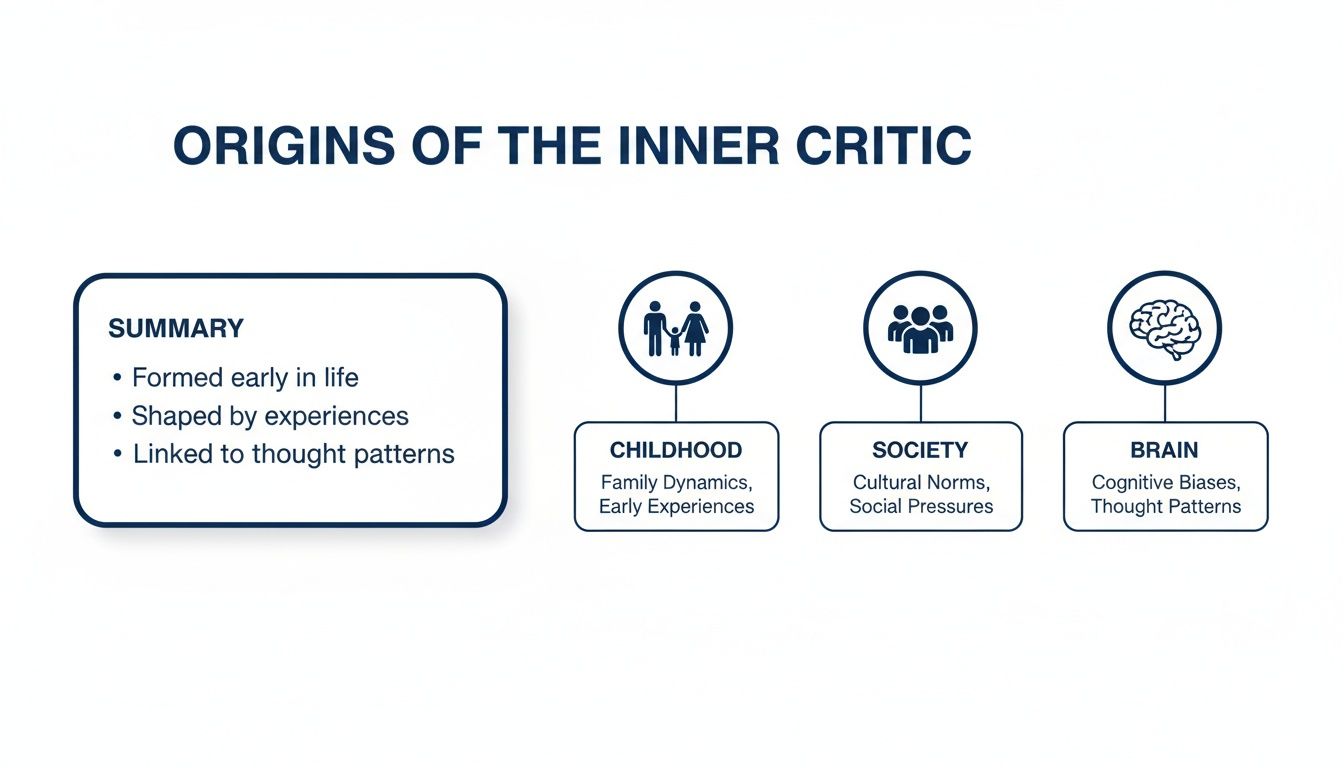
Understanding these influences helps us realise that the inner critic is a learned pattern—not some unchangeable, fundamental part of who we are.
Life with a Compassionate Ally
On the flip side, healthy self-esteem isn't about being perfect or never feeling self-doubt. It’s about cultivating an inner ally who treats you with the same kindness and understanding you’d offer a good friend. This internal relationship provides a stable foundation of self-worth that you can rely on.
Living with this compassionate inner voice looks quite different. For instance, you might notice a nagging feeling of being a fraud despite your accomplishments, a classic sign of low self-esteem. You can learn more about how this connects to imposter syndrome and what to do about it.
Healthy self-esteem doesn’t mean the absence of an inner critic. It means you have a stronger, kinder voice that knows how to respond to it with compassion and perspective.
To make these differences crystal clear, let's look at how each mindset might show up in common, everyday situations. This little comparison can help you spot which patterns feel more familiar in your own life.
Low Self-Esteem vs Healthy Self-Esteem
Here’s a look at how different internal worlds can lead to vastly different reactions to the exact same event.
| Situation | Response with Low Self-Esteem | Response with Healthy Self-Esteem |
|---|---|---|
| Receiving constructive feedback at work | "I knew I wasn't good enough. They've probably realised I'm a fraud." (Internalises criticism as a personal failing). | "Okay, that's useful information. I can see how to improve that for next time." (Separates the feedback from personal worth). |
| A friend cancels plans last minute | "They probably don't really want to see me. I must have done something to annoy them." (Assumes personal rejection). | "That's a shame, I was looking forward to it. I hope everything's okay with them." (Assumes external circumstances). |
| Trying a new hobby and struggling | "I'm so useless at this. I should just give up now before I embarrass myself further." (Sees initial difficulty as a sign of incompetence). | "This is harder than I thought, but that's normal when you're learning something new. I'll give it another try." (Views struggle as part of the process). |
Seeing these responses side-by-side really highlights the profound impact that your level of self-esteem has on how you interpret and react to life. Recognising your own patterns is the first step toward consciously choosing a more self-supportive path.
Actionable Steps to Build Your Self-Esteem

Understanding where low self-esteem comes from is one thing, but now it’s time to get our hands dirty. Building a healthier relationship with yourself is an active, ongoing process. Think of it like tending to an inner garden; you have to patiently pull out the weeds of self-criticism and plant the seeds of kindness and genuine self-support.
You’ve probably heard well-meaning advice like "just think positive," but that rarely works. It completely misses the powerful emotional systems at play. Instead, we’re going to explore some practical, evidence-based exercises from Compassion Focused Therapy (CFT).
These techniques aren't about forcing yourself to think happy thoughts. They're about training your brain to access its own soothing system, which helps to quieten that inner critic and foster a real, lasting sense of self-worth.
Activating Your Compassionate Mind
At the heart of this work is learning how to activate what CFT calls your compassionate mind. This is the part of you that holds qualities like wisdom, strength, and warmth. It’s a powerful inner ally you can learn to call on, especially when your threat system is firing on all cylinders and your inner critic is shouting the loudest.
A brilliant way to start is by consciously developing a compassionate self-image. This isn’t about pretending to be someone you’re not; it’s about connecting with a wiser, kinder part of yourself that’s already in there. You can think of it as creating an inner mentor or guide.
Here’s a simple exercise to get you started:
- Imagine Your Ideal Compassionate Self: Close your eyes for a moment. If you were to imagine a perfectly compassionate friend or mentor, what qualities would they have? Think about things like deep wisdom, quiet strength, non-judgement, and genuine warmth.
- Visualise This Self: Now, give this image a form. It could be an older, wiser version of you, a calm and gentle animal, or even just a warm, coloured light. What it looks like is less important than the feeling it brings up.
- Embody the Qualities: Spend a few moments imagining what it would feel like to be this compassionate self. How would you hold your body? How would you breathe? What kind of expression would be on your face?
- Ask for Guidance: From this compassionate viewpoint, think about a small difficulty you're currently facing. What would your compassionate self say to you about it? Listen for words of encouragement and kindness, not criticism.
Doing this regularly helps create new neural pathways in your brain. It gives you a reliable internal resource to turn to, strengthening your ability to soothe yourself and build your self-esteem from the inside out.
Calming Your Threat System with Breathing
When self-criticism hits, your body often reacts as if there's a real, physical threat. Your heart might start racing, your breathing can become shallow, and your muscles tense up. Before you can even begin to reason with that inner critic, you need to calm your body down.
Soothing Rhythm Breathing is a straightforward yet incredibly powerful way to activate your body’s soothing system and send a signal to your brain that you are safe.
The goal isn't to fight your anxious thoughts, but to create a state of inner calm from which you can respond to them with wisdom and compassion instead of fear and reactivity.
Here’s how to do it:
- Find a Comfortable Position: Sit upright in a chair with your feet flat on the floor.
- Slow Your Breathing: Gently slow your breathing down, aiming for about five or six breaths per minute. A simple way is to inhale for a count of four and exhale for a count of six.
- Breathe into Your Belly: Place a hand on your stomach and focus on breathing deeply, feeling your hand rise and fall. This is diaphragmatic breathing, and it directly stimulates the vagus nerve, which helps promote relaxation.
- Maintain a Gentle Smile: Softening your facial muscles into a slight, gentle smile can subtly shift your emotional state, reinforcing that sense of calm and safety.
Try this for just a few minutes whenever you feel overwhelmed by self-critical thoughts. It's a foundational skill that creates the mental space needed for other compassionate practices to take hold. Building these skills is especially crucial during life's big transitions. Research on UK adolescents shows that higher self-esteem at age 11 acts as a powerful buffer against the sharp drop in well-being often seen by age 14.
These exercises are just starting points. Learning more about the principles of self-compassion can give you a deeper understanding of why these techniques are so effective. To put these ideas into action, you might find resources like these effective self-esteem worksheets incredibly helpful.
Remember, every single time you choose a compassionate response over a self-critical one, you are actively rewiring your brain and building a more resilient, authentic sense of self.
Applying Your New Skills in Real-World Scenarios
Learning these new techniques is a fantastic start, but the real test comes when you step back out into the world. It’s in the messy, unpredictable moments of day-to-day life that your ability to be a compassionate ally to yourself truly matters. This is where theory becomes practice, and your internal work starts to create tangible changes in how you actually navigate your life.
Building self-esteem isn’t just about feeling better; it’s about responding differently. It's about having a completely new set of tools to bring to those situations that used to automatically trigger that familiar spiral of self-criticism and anxiety.
Let's walk through some common scenarios to see how you can put these skills into action right when you need them most.
Handling Criticism at Work
Imagine you’ve just received some unexpected, critical feedback on a project you poured a lot of heart and soul into. Your stomach drops, and that familiar, harsh inner voice immediately pipes up.
-
The Self-Critical Response: Your threat system flares into high alert. The inner critic goes on the attack: "I knew it wasn't good enough. I'm a failure, and now everyone knows it." A hot flush of shame washes over you. You avoid eye contact with your manager and spend the rest of the day replaying the criticism, feeling smaller and less competent with every loop.
-
A Compassionate Alternative: You feel the sting of disappointment and acknowledge it. But instead of letting the critic take over, you take a moment. You consciously engage in some Soothing Rhythm Breathing to calm your threat system down. Then, you activate your compassionate self, thinking, "Okay, this is tough to hear, and it's normal to feel disappointed. But this feedback isn't a verdict on my worth; it's about this one task. What can I actually learn from this?" You approach your manager later to clarify the points, turning a moment of potential shame into a genuine opportunity for growth.
Navigating Social Anxiety
You're at a social gathering where you don't know many people. That old, creeping anxiety begins to surface, whispering that you're awkward and that everyone is secretly judging you.
The compassionate mind doesn't demand that you become the life of the party. It simply offers you a kind and steady presence, allowing you to be yourself without the need for constant self-evaluation.
-
The Self-Critical Response: The inner critic whispers its usual poison: "Don't say anything stupid. Everyone else here is so much more confident than you are." You find yourself in a corner, glued to your phone, feeling completely isolated. You end up leaving early, convinced you made a terrible impression and reinforcing the tired old belief that you're socially inept.
-
A Compassionate Alternative: You acknowledge the anxiety without judging it. "It's understandable to feel nervous in a new group," your compassionate self reminds you. "My job here isn't to impress everyone; it's just to be present and kind." You focus on one small, manageable goal: have one brief, friendly conversation. By shifting the focus from performance to connection, you lower the stakes and allow yourself to engage more authentically. You build your confidence one real interaction at a time.
Bouncing Back from a Setback
Let's say you've been working on a personal goal—like a new fitness routine—and you have a bad week where you miss several sessions. The temptation to just give up feels overwhelming.
-
The Self-Critical Response: "See? I have no discipline. I always do this. There's no point in even trying anymore." That all-or-nothing thinking takes over. One small slip-up becomes a catastrophic failure, a reason to abandon the entire goal, which only confirms your negative beliefs about yourself.
-
A Compassionate Alternative: You meet the lapse with understanding, not blame. "Okay, this week didn't go as planned, and that's frustrating. But one off-week doesn't erase all the progress I've already made." You get curious instead of critical. You ask yourself, "What got in the way this week, and what support do I need to get back on track tomorrow?" This response builds resilience and reinforces the crucial idea that your self-worth is not dependent on being perfect.
Each of these scenarios shows that building self-esteem is an active, moment-by-moment choice. It’s about learning to pause, calm your threat system, and consciously choose a supportive, compassionate response over a habitual, self-critical one.
Knowing When to Seek Professional Support
While all the strategies we’ve talked about are fantastic tools for building yourself up, sometimes they just aren't enough on their own. And that’s okay. Realising you might need to bring in a professional isn’t a sign of failure; it’s actually a sign of incredible strength and an act of profound self-care.
If your struggle with low self-esteem is starting to seriously get in the way of your day-to-day life, that’s a clear signal to reach out. Maybe it’s affecting your performance at work, making it hard to maintain healthy relationships, or just leaving you feeling constantly overwhelmed by a barrage of self-critical thoughts.
Therapy vs. Coaching: What’s the Difference?
When you decide it’s time to get some help, you’ll generally find two main paths open to you: therapy and coaching. Understanding what makes them different is the key to figuring out which one is the right fit for you.
- Therapy is a clinical approach that often focuses on healing. A therapist can help you dig into the deep roots of your low self-esteem, process difficult past experiences, and treat any co-occurring mental health conditions, like anxiety or depression.
- Coaching is typically more forward-looking and action-oriented. A self-esteem coach will work with you to set and smash specific goals, build your confidence, and change the behavioural patterns that are holding you back, with a focus on your present and future.
Both can be incredibly effective, but they really do serve different purposes. Think of it this way: therapy often delves into the why behind your feelings, while coaching concentrates more on the how of moving forward.
Acknowledging that your internal battle is affecting your external world is the first step toward getting the right help. If low self-esteem consistently holds you back, professional guidance can provide the structure and support needed for a real breakthrough.
Making an Informed Choice
Choosing the right professional is a big decision, and it’s one worth taking your time over. For some, understanding the role of a psychiatric mental health practitioner can be crucial, especially if you think medication might need to be part of the picture.
Ultimately, whether you choose therapy, coaching, or another form of support, the end goal is the same. It's about finding a dedicated ally who can offer expert guidance, hold you accountable, and provide a safe space for you to build a stronger, more compassionate relationship with yourself.
As we get to the end of this guide, let's explore some of the questions and roadblocks that often pop up when people start working on building their self-esteem. Getting some clarity on these can really help you move forward with more confidence.
The journey towards a better relationship with yourself is naturally going to be full of questions and maybe a bit of uncertainty. So, let’s tackle these head-on.
Is Building Self-Esteem the Same as Being Selfish?
This is a really common, and important, question. The short answer? Not even close.
Healthy self-esteem is all about self-acceptance and self-kindness. It's about recognising your own inherent value as a human being—flaws, struggles, and all. It’s not about feeling superior to anyone else.
Arrogance, on the other hand, is often a sign of deep insecurity. It comes from a constant, nagging need to prove yourself. Genuine self-esteem brings a quiet inner confidence that doesn't need external praise or constant comparison to others to survive.
Compassion Focused Therapy, in particular, really nurtures this sense of 'common humanity'. It’s a powerful reminder that we are all in this together, which naturally connects us to other people rather than setting us above them.
How Long Does It Take to Genuinely Improve Low Self-Esteem?
I wish I could give you a magic number, but improving self-esteem is a gradual process, not an overnight transformation. It’s about patiently and kindly unlearning patterns of self-criticism that might have been with you for years, even decades. So, the timeline is different for everyone.
With consistent practice of compassionate mind training exercises, most people start to notice small, but meaningful, shifts within a few weeks or months. The real magic ingredients here are patience and consistency. Remember to celebrate the small wins along the way. Think of it like building any important relationship; it needs time, care, and effort to truly flourish.
Can I Improve My Self-Esteem If I Had a Difficult Childhood?
Yes, you absolutely can. While difficult early experiences can leave a powerful and painful blueprint for low self-esteem, it is entirely possible to heal and build a new, more supportive inner world.
Therapies like CFT are specifically designed to help you understand how your past experiences have shaped your 'tricky brain'. More importantly, they give you the tools to develop new, compassionate ways of relating to yourself. It might take more dedicated effort, and getting professional support from a therapist can be incredibly helpful in these situations. But the crucial thing to remember is this: your past does not have to dictate your future self-worth.
At Dr Chris Irons, I specialise in helping individuals and professionals use Compassion Focused Therapy to move beyond self-criticism and build genuine self-worth. If you're ready to start building a kinder, more supportive relationship with yourself, take a look at my CFT therapy, coaching, and training options.