That nagging voice in your head? The one that’s quick to point out every mistake and catalogue every flaw? It isn't just a bad habit you need to break. For many of us, that inner critic is actually a deeply ingrained survival strategy.
Think of it as a misguided attempt by your brain to keep you safe. Its job is to spot your faults before anyone else can, hoping to shield you from the sting of external judgment or failure. It's like having an overzealous bodyguard who thinks the best way to protect you is to rough you up first.
Understanding Your Inner Critic
That harsh internal monologue isn't a sign of a character flaw. It's a pattern, often learned years ago—maybe in childhood—that your mind mistakenly believes is essential for motivation and safety.
The problem is, this internal bodyguard can become so relentless that it keeps you locked in a state of constant, low-grade stress. It stops you from taking healthy risks, trying new things, or even just sitting back and enjoying what you’ve achieved.
Many people confuse this destructive voice with constructive self-reflection, but they are worlds apart. Healthy reflection is about looking at a mistake with curiosity and asking, "What can I learn from this?" Harmful self-criticism, on the other hand, is all about blame and attacking your sense of self-worth. It’s the difference between thinking, “Right, I can prepare better next time,” and telling yourself, “I’m a complete failure for even trying.”
Why Positive Thinking Is Not a Cure
This is why simply trying to "think positive" or slap on a few affirmations rarely works in the long run. It’s a bit like painting over a damp patch on the wall without fixing the leaky pipe behind it. Sooner or later, the problem will bleed through again.
To genuinely soften that critical voice, we have to start by understanding its original purpose with a bit of empathy.
This critical voice didn’t just appear out of nowhere. It developed for a reason—perhaps it was trying to help you avoid punishment, win approval from others, or push you to succeed in a demanding environment. Seeing its origin is the first step toward showing it compassion instead of constantly battling against it.
This compassionate approach isn’t about silencing the critic. It’s about acknowledging its (perhaps clumsy) protective intentions and gently updating its strategy. You're not trying to fire your internal bodyguard, but to retrain it—transforming it from a harsh judge into a more supportive, helpful guide.
The Broader Impact on Well-being
If you’re wrestling with this, you are far from alone. This internal struggle has a huge, measurable impact on our collective well-being. Here in the UK, a growing number of adults are reporting poor personal well-being, a state that is strongly linked to this kind of self-critical thinking.
In fact, data shows that nearly one in four adults reported high levels of anxiety in 2022–23. These aren't just abstract numbers; they highlight a powerful connection between a harsh inner critic and wider mental health challenges. You can explore more of this data on the Office for National Statistics website.
Just realising that this is a shared human experience, not a personal failing, is a powerful part of the healing process. This guide is designed to give you a clear path forward, helping you shift from a place of self-judgment to a more balanced and compassionate relationship with yourself. It's a journey that takes patience, but the rewards are profound.
Pinpointing Your Inner Critic's Signature Style
It’s one thing to notice you have an inner critic; it’s another to understand precisely how it operates. That's where the real power to change lies. Self-criticism isn't some single, monolithic beast—it shows up in different ways, with different voices and intentions. Before you can soften that voice, you first need to figure out which version has taken up residence in your mind.
Most often, the critical voice takes one of two primary forms: the voice of inadequacy or the voice of self-attack. While they both hurt, they work in surprisingly different ways and cause their own unique kind of psychological damage. Knowing which one you're dealing with is the key to choosing the right path toward self-compassion.
This flowchart sheds light on a crucial point: self-criticism often starts as a misguided attempt by our brains to protect us or push us to improve. It’s a survival strategy gone wrong.
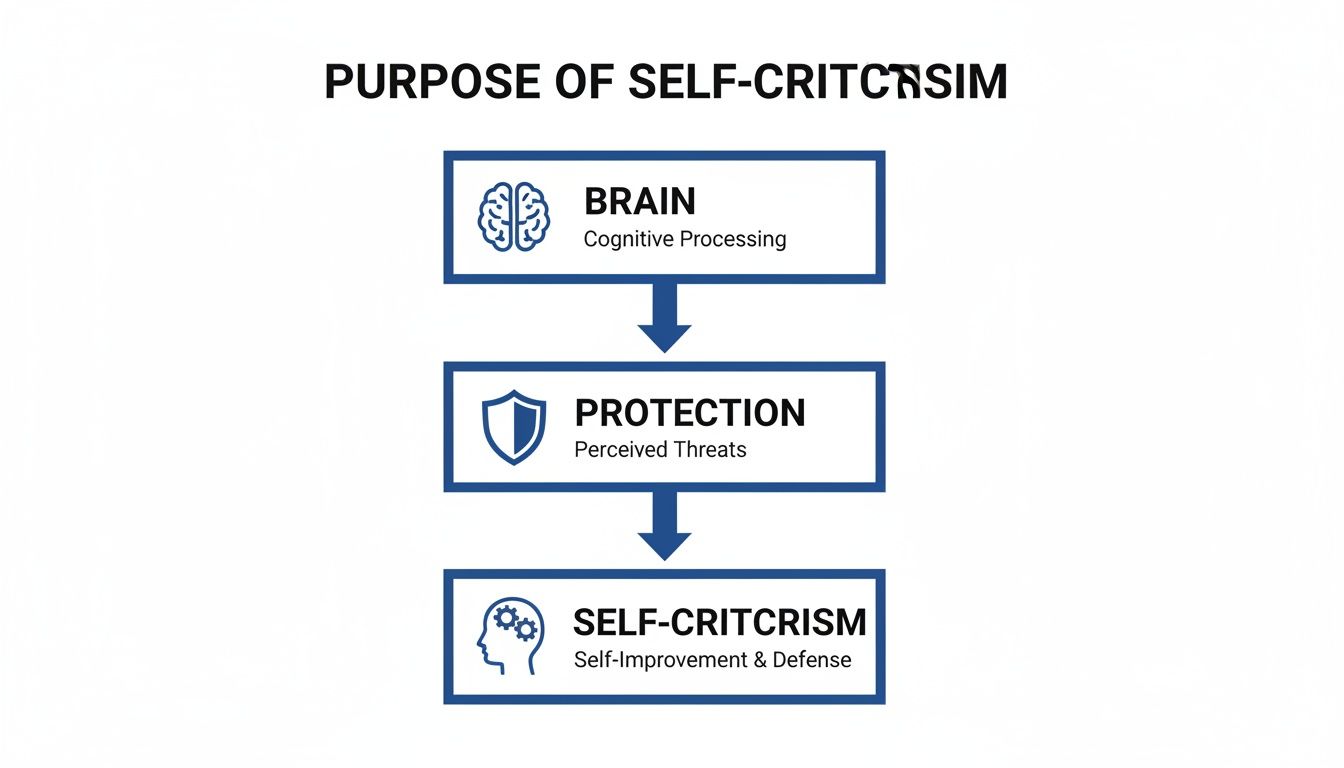
As you can see, what begins as a protective instinct can quickly spiral into a painful pattern of self-criticism. This helps explain why it can feel so automatic and deeply ingrained.
The Whisper of Inadequacy
The first form, inadequate self-criticism, is often the quieter, more insidious of the two. It’s that persistent, nagging feeling that you’re just not quite good enough. This voice doesn't usually shout; it whispers demoralising thoughts that slowly chip away at your sense of worth.
Think of it as a low-level hum of deficiency running in the background of your life. It sounds like:
- "I’m clearly not as smart as everyone else here."
- "I’ll probably just mess this up anyway, so what’s the point?"
- "They were just being nice with that compliment; they don't actually believe it."
This pattern is a breeding ground for shame, inferiority, and a sense of hopelessness. It pushes you toward avoidance because the fear of confirming your own inadequacy makes it feel safer to just not try. Over time, this can lead to pulling back from friends, family, and opportunities, leaving you feeling profoundly lonely.
The Roar of Self-Attack
The second form is a whole different animal. Hated self-criticism, or self-attacking, is aggressive, contemptuous, and relentlessly punishing. This is the voice that doesn't just see a mistake—it uses that mistake as cold, hard evidence that you are worthless, stupid, or fundamentally broken.
This critic is openly vicious. Its monologue is laced with a rage and disgust you would never direct at another human being. It sounds like:
- "You are such an idiot for doing that."
- "What is wrong with you? You’re a complete and utter failure."
- "You absolutely deserve to feel this awful."
This flavour of self-criticism is particularly toxic. It fires up the body's threat system, flooding you with anxiety, anger, and a deep, corrosive shame. In fact, research from UK-based clinical studies has drawn a direct line between this hostile inner voice and severe mental health struggles. Frighteningly, self-attacking has been identified as an independent predictor of suicide risk, even after accounting for depression and hopelessness. You can read the full research paper on these findings to grasp its clinical importance.
The self-attacking critic isn't trying to motivate you; it's trying to punish you. Realising its true, hostile nature is the first step in understanding that this voice isn't a rational guide—it's a source of internal harm.
To help you get a clearer picture, let's break down the key differences between these two patterns. See which column feels more familiar.
Comparing Inadequate vs Hated Self-Criticism
This table is designed to help you distinguish between the two main types of self-criticism. As you read, reflect on your own internal dialogue to see if you can identify your dominant inner voice.
| Aspect | Inadequate Self-Criticism | Hated Self-Criticism (Self-Attacking) |
|---|---|---|
| Core Belief | "I am not good enough." | "I am bad and deserve punishment." |
| Dominant Emotion | Shame, sadness, hopelessness. | Anger, contempt, disgust toward self. |
| Typical Thoughts | "I can't do this." "I'm falling behind." | "You're pathetic." "You're a failure." |
| Behavioural Impact | Avoidance, procrastination, social withdrawal. | Self-sabotage, risk-taking, self-harm. |
| Tone of Voice | Whispering, undermining, defeating. | Shouting, aggressive, cruel, hostile. |
Once you can clearly identify whether your inner critic whispers words of inadequacy or shouts messages of self-attack, you have the clarity you need. This is the starting point for challenging its story and, piece by piece, building a more compassionate relationship with yourself.
The Hidden Roots and Toll of Self-Criticism
That nagging, critical voice in your head didn’t just show up one day. More often than not, it's a ghost from the past—a deeply ingrained survival pattern learned long ago, still pulling the strings in your present life. Understanding where it comes from isn't about placing blame. It’s about realising this voice is a learned script, not some fundamental truth about who you are.
For many of us, that harsh inner monologue took root in childhood. Early experiences where love or approval felt conditional—where you had to perform, behave perfectly, or meet towering expectations to feel secure—can teach a young mind a pretty tough lesson. Your brain learns to internalise those critical voices from the outside to try and get ahead of the criticism, to dodge the pain of punishment or rejection.

The Brain's Misguided Alarm System
This pattern of self-criticism does a real number on our nervous system. From a psychological standpoint, that critical voice hijacks the brain’s threat system. This is the very same ancient wiring designed to save us from a predator lurking in the bushes.
When your inner critic launches an attack, your body doesn’t stop to ask if the threat is real or just a thought. It just registers danger. This kicks off a cascade of physiological alarms, flooding your system with stress hormones like cortisol and adrenaline. Your heart might race, your muscles tense up, and your mind goes on high alert, scanning for the next thing to go wrong.
Living with a relentless inner critic means your threat system is switched on almost all the time. You’re essentially stuck in a chronic, low-grade state of fight-or-flight. It's utterly exhausting and creates the perfect breeding ground for anxiety and burnout.
"Self-criticism isn’t a bad habit or a personality flaw—it’s often a deeply ingrained survival mechanism. The problem is, what once served you in childhood or early adulthood might now be keeping you stuck in a cycle of stress, burnout, and never feeling good enough."
This internal alarm bell fuels a vicious cycle that's incredibly hard to break. The constant self-judgement stirs up feelings of shame and inadequacy. To escape these painful emotions, you might start ducking challenges, isolating yourself, or putting off important tasks. Of course, this avoidance just gives the critic more ammunition, confirming its story that you’re incapable or lazy.
The Real-World Consequences of a Harsh Inner Critic
The fallout from this internal battle isn't just in your head; it has real, tangible consequences that ripple out into every corner of your life. The constant stress and negative self-talk create a heavy burden that takes a serious toll over time.
This chronic activation of our threat system has been linked to a whole host of serious health issues. The relentless drip of stress hormones can mess with your sleep, interfere with digestion, and even weaken your immune system, leaving you more vulnerable to getting sick.
The mental health consequences are just as severe. Study after study has shown a powerful link between high levels of self-criticism and conditions like:
- Clinical Depression: A ruthless inner critic is one of the biggest predictors for developing major depressive disorder.
- Anxiety Disorders: The constant state of threat and worry fuels things like generalised anxiety and social anxiety.
- Eating Disorders: Self-criticism often zeroes in on body image and perceived flaws, playing a huge role in disordered eating.
- Burnout and Chronic Fatigue: The sheer mental and physical exhaustion of being in a constant state of self-attack drains your energy right down to the reserves.
Shame is a particularly potent and painful emotion cooked up by self-criticism. It can leave you feeling exposed, flawed, and unworthy of connection, often leading to social withdrawal. If you want to dig deeper into this, you can learn more about how shame and self-criticism are linked and how Compassion-Focused Therapy can help you heal.
Recognising the far-reaching physical and psychological damage is often the first, crucial step toward change. Learning to quiet your inner critic isn't some self-indulgent luxury; it’s an essential part of protecting your long-term health and reclaiming your well-being.
Getting to Grips with Your Inner Critic: A Practical Self-Assessment
Before we can start to soften that harsh inner voice, we first need to learn how to hear it. Self-criticism often isn’t a clear, distinct monologue; it’s more like a low-humming background noise, a general feeling of being hard on yourself that you’ve probably lived with for years. The first step is to tune into that frequency and pinpoint exactly what it’s saying.
This little self-assessment isn't a clinical tool or a formal diagnosis. Think of it more like holding up a mirror to your own mind. It’s designed to help you see the landscape of your thoughts more clearly, giving you the awareness you need to start changing those well-worn neural pathways.
Common Signs Your Inner Critic is in Charge
Have a read through the following scenarios. Do any of them feel uncomfortably familiar? Try to notice if there's a theme in how you talk to yourself when you're feeling a bit wobbly or you've made a mistake.
- You replay your mistakes on a loop. Do you find yourself stewing over something you said or did hours, or even days, later? Long after everyone else has moved on, you're still re-watching the tape.
- You can't take a compliment. When someone offers you praise, is your first instinct to brush it off? Maybe you think they're just being kind, or worse, they just haven't spotted your flaws yet.
- You feel guilty for resting. Does taking a break feel like a waste of time? Even when you're completely drained, you might label rest as laziness.
- You fall into the perfectionism trap. If something you've worked on isn't flawless, do you write the whole thing off as a total failure? There’s no middle ground, only success or disaster.
- You’re always comparing yourself to others. A quick scroll on social media or a glance at a colleague's success can send you into a spiral of inadequacy, where you only see how you fall short.
These patterns are sneaky. They often run on autopilot, chipping away at your confidence and energy without you even noticing.
The Growing Need for Self-Awareness
This ability to notice our own thoughts is more critical than ever, especially for younger generations. In the UK, recent data shows a worrying trend: in 2023, around one in five children and young people in England had a probable mental health condition. This rise has been linked to an increase in self-attacking thoughts. It's become such a pressing issue that it's led to new research, including the development of the UK's first validated Child Self-Criticism Scale, to help us get a better handle on the problem. You can dig deeper into these UK mental health statistics and their implications.
Taking Your Reflection a Little Deeper
Once you've spotted a few patterns that resonate, we can go a level deeper. Answering these questions will help you understand not just what your inner critic says, but the impact it has on you.
- What does your inner voice sound like? Is its tone scolding, disappointed, aggressive, or sarcastic? If it helps, try giving it a character or a name.
- What feelings does this voice stir up? Does it leave you feeling ashamed, anxious, angry, or a bit hopeless?
- How does this self-criticism change what you do? Does it stop you from trying new things, speaking up at work, or going after what you really want?
Simply noticing your inner critic without judging it creates a tiny, yet powerful, gap between you and the thought. In that space, you reclaim the power to choose a different, kinder response. This is where the real work begins.
Getting honest with yourself here gives you the raw material you need to build a better relationship with yourself. You simply can't change a pattern you don't understand. Think of this assessment as your first step in mapping your inner world, showing you exactly where to begin the journey towards self-compassion.
Right, so you’ve got a handle on your inner critic’s particular brand of misery. What now? The instinct is often to fight back, to argue, to try and silence it with logic. But that’s like wrestling with smoke.
Instead, we need a different approach entirely. The most powerful antidote to that harsh internal voice isn't a battle; it's the cultivation of self-compassion.

Let’s be clear: this isn't about letting yourself off the hook or making excuses for your mistakes. It’s about a fundamental shift in your relationship with yourself. It’s about treating yourself with the same warmth, care, and understanding you’d offer a good friend who was having a tough time.
It’s a move away from judgment and towards warmth. From attack to support. At its core is the simple acceptance that being imperfect, failing, and messing up is just part of the shared human experience. No one gets a free pass.
This is the central idea behind Compassion-Focused Therapy (CFT), a therapeutic model built specifically to help people drowning in shame and self-criticism. Rather than just trying to argue with negative thoughts, CFT is about actively cultivating a sense of inner warmth, safeness, and reassurance.
The Foundation of Compassion-Focused Therapy
CFT helps us understand that our brains are a bit tricky. We have an ancient, automatic threat system – the very one your inner critic loves to hijack – but we also have a newer, more evolved capacity for compassion and kindness. The work is to deliberately strengthen that compassionate part of our minds so it can soothe the overactive threat system.
Think of it like this: your inner critic has been stomping the same path through your brain for years, creating a deep, muddy trench. It’s the default route. CFT is about consciously building a new, paved, and much more pleasant pathway alongside it. At first, you have to actively choose the new path, but with practice, it becomes the easier, more natural way to go.
"Self-compassion is not a sign of weakness but a source of strength. It provides the emotional safety needed to see ourselves clearly, acknowledge our shortcomings, and make meaningful changes without the destructive weight of shame and self-loathing."
The exercises that follow are practical, down-to-earth techniques drawn directly from CFT. They are designed to help you start laying the first paving stones on that new, compassionate pathway today.
Three Practical Self-Compassion Exercises
Here are three simple yet powerful exercises you can start with. They don’t require any special equipment, just a few minutes and a willingness to try something different.
| Exercise Name | Objective | Quick First Step |
|---|---|---|
| Imagine Your Compassionate Self | To create a wise, kind internal figure you can turn to for support. | Visualise a being (or a warm light) that embodies perfect compassion and its qualities. |
| Soothing Rhythm Breathing | To calm your body's threat response and signal safety to your brain. | Sit comfortably and focus on making your exhale slightly longer than your inhale. |
| Write a Compassionate Letter | To reframe a specific struggle from a kind and supportive perspective. | Pick one thing you're being hard on yourself about and imagine a kind friend writing to you. |
These are more than just feel-good activities; they are targeted training for your brain, helping you build genuine emotional resilience from the inside out. Let’s break them down.
Exercise 1: Imagine Your Compassionate Self
This exercise helps you build an internal figure that embodies the qualities of perfect compassion. This "compassionate self" becomes an inner resource, a wise and kind part of your own mind you can call on when the critic gets too loud.
Step-by-Step Guide:
- Find a Quiet Space: Sit comfortably where you won’t be disturbed. Close your eyes if that helps you focus inward.
- Visualise Compassion: Imagine a being—it could be a person, a colour, or just a warm light—that represents ultimate compassion. What qualities does it possess? Think of words like wisdom, strength, warmth, kindness, and non-judgment.
- Embody the Qualities: Now, imagine what it would feel like to be this compassionate self. Feel its wisdom in your mind, its strength in your posture, its warmth in your chest. Notice how things look from this perspective.
- Offer Yourself Kindness: From this viewpoint, turn your attention to the part of you that is hurting. What would this compassionate self say? It might be something simple, like, "This is really tough, and it's understandable that you're struggling."
Exercise 2: Practice Soothing Rhythm Breathing
When that inner critic starts its tirade, it triggers your body’s threat response—think racing heart, tight chest. Soothing Rhythm Breathing is a direct line to your nervous system, a physical way to tell your brain and body that you are safe. It activates the parasympathetic nervous system (our "rest and digest" mode), calming the "fight-or-flight" alarm.
Step-by-Step Guide:
- Find a Comfortable Position: Sit upright but relaxed, with your feet flat on the floor.
- Breathe Deeply and Slowly: Inhale gently through your nose for a count of about four, letting your belly expand.
- Exhale Even More Slowly: Breathe out gently through your mouth for a count of about six. The key is making the exhale a little longer than the inhale.
- Find Your Rhythm: Continue this for a few minutes. Don't force it; find a slow, soothing rhythm that feels calming for you.
Exercise 3: Write a Compassionate Letter to Yourself
Writing can be an incredibly powerful way to process difficult emotions and shift your perspective. This exercise involves writing a letter to yourself about something you feel self-critical about, but from the perspective of an unconditionally kind and understanding friend.
Step-by-Step Guide:
- Identify Your Struggle: Pinpoint something you’ve been judging yourself for lately—a mistake you made, a social interaction you feel awkward about, anything that’s causing you shame.
- Adopt a Compassionate Viewpoint: Imagine a friend (or your compassionate self from the first exercise) who is infinitely wise and accepting. From their point of view, write a letter to yourself about this struggle.
- Acknowledge the Pain: In the letter, start by validating your feelings. "I can see how much this has upset you, and that makes total sense."
- Offer a Broader Perspective: Gently remind yourself of your shared humanity. Remind yourself that everyone makes mistakes and that this one thing doesn't define who you are.
- Suggest Kindness: End the letter by suggesting a small, kind action you could take for yourself right now.
If you’d like to explore this topic in more depth, Dr Chris Irons provides some excellent resources that offer a deeper dive into the practice of self-compassion and its therapeutic benefits.
These exercises are just a starting point. But with consistent practice, they can begin to fundamentally rewire your inner world, transforming self-criticism into a powerful source of self-support.
Guidance for Therapists and Coaches
Working with a client’s inner critic is a delicate dance. It calls for a blend of validation and gentle, curious challenge. That harsh, internalised voice of self-criticism almost always has a protective job to do, even if its methods are painful. If we come in too strong, trying to silence it, we risk making the client feel completely misunderstood, which only makes them (and their critic) dig their heels in.
Our first job is to get to know this critic. Who is it? When did it show up on the scene? What, exactly, is it trying to protect the client from? Exploring these questions together builds a foundation of trust. It helps the client start to see the critic as just one part of them, not the whole story.
Targeted Assessment Questions
To get a real sense of the critic's flavour and intensity, we need to move beyond general questions. The goal is to help the client externalise this voice—to see it, hear it, and understand it more objectively.
Try asking questions like these:
- "If that critical voice had a body, what would it look like?"
- "What's the tone of voice it uses? Is it a shout, a whisper, or more of a sneer?"
- "If this voice had an age, how old would it be? Does it remind you of anyone from your past?"
- "What's its biggest fear for you? What disaster is it desperately trying to stop from happening?"
These kinds of questions help turn a vague, overwhelming feeling into a more concrete character we can actually work with. This process of externalisation—maybe even giving the critic a name—creates a sliver of psychological space. It’s in that space that a client can begin to observe the critic’s messages instead of being completely swept away by them.
The goal isn't to wage war on the inner critic and obliterate it. It's to help our client shift their relationship to it. When they can understand its protective intentions, however clumsy or outdated, they can start to approach it with curiosity and compassion, rather than fear and submission.
Introducing Self-Compassion to Resistant Clients
Many clients will balk at the idea of self-compassion, especially those with a history of trauma or those who are high-achievers. They often see it as self-indulgent, a sign of weakness, or a surefire way to kill their motivation.
It’s crucial to frame self-compassion as a pathway to strength and resilience, not a form of giving up. We can explain that compassion actually helps to regulate the brain’s threat system, which is the very system that self-criticism keeps firing up. This creates the emotional stability and safety needed to face challenges head-on and learn from our inevitable mistakes.
For professionals wanting to go deeper and build confidence in this area, exploring more advanced training can make a world of difference. You can find comprehensive on-demand Compassion-Focused Therapy training to develop these skills further. Ultimately, this work is about helping clients build an inner source of warmth and support—a far more powerful and sustainable motivator than fear could ever be.
Common Questions About Self-Criticism
As you start to untangle yourself from self-criticism, some tricky—and very common—questions often pop up. Let's walk through some of the biggest hurdles people face when trying to cultivate a kinder inner voice.
Do I Need Self-Criticism to Stay Motivated?
This is probably the biggest myth out there. So many of us are convinced that without that harsh inner drill sergeant, we’d just slack off and never get anything done. But there’s a massive difference between healthy self-correction and a destructive inner beatdown.
Think of it this way: self-correction takes a look at a mistake and asks, "Right, what can I learn from that?" It’s forward-looking and productive. Self-criticism, on the other hand, is purely punishing. It sees a mistake and declares, "See? I'm a total failure."
Real, lasting motivation doesn't grow from a place of fear. It comes from a genuine desire to learn and grow, which is exactly what self-compassion helps you build.
What if I Feel Like I Don't Deserve Compassion?
This feeling is incredibly common, especially if that critical voice has been your constant companion for years. It’s a classic move: the critic convinces you that kindness is something you have to earn, and you haven't made the grade yet.
The best thing to do here is to flip the whole idea on its head. Self-compassion isn't a reward for good behaviour. It’s a fundamental tool for well-being, just like drinking water or getting a decent night's sleep. It's a resource that helps you navigate life's inevitable bumps and build real emotional strength. You don't have to earn it; you just have to start practising it.
Treating yourself with kindness isn't an indulgence. It's the psychological equivalent of putting on your own oxygen mask first. It gives you the strength and clarity needed to navigate challenges effectively.
How Long Will It Take to Notice a Difference?
Changing your relationship with your inner critic isn't a quick fix. It's more like learning a new language or building up a new muscle at the gym. That critical voice has probably been rehearsing its lines for decades, carving out some pretty deep neural pathways in your brain.
At first, you might just notice tiny shifts. A moment where you catch the critic before it really gets going, or a brief pause where you manage to offer yourself a kind word instead. The goal here is consistency, not perfection.
With regular practice, these small moments start to add up. Over time, that compassionate voice will gradually get stronger, more familiar, and more automatic.
If you're looking for expert guidance on this journey, Dr Chris Irons offers therapy, coaching, and professional training grounded in Compassion-Focused Therapy. Find out how you can build a kinder, more supportive relationship with yourself at https://drchrisirons.com.