Let’s talk about Compassion Focused Therapy, or CFT. It’s a powerful way of working with the mind, developed right here in the UK by Professor Paul Gilbert, designed to help people who are really struggling with deep-seated shame and self-criticism.
At its core, CFT is about learning to cultivate a different relationship with yourself. It pulls together insights from evolutionary psychology, neuroscience, and social psychology to teach us how to engage with our inner world with genuine kindness. Think of it as mental training, but instead of pushing for performance, you’re training for compassion.
The Origins of a Gentler Approach to Mental Health
Picture this: you’ve spent years trying to fix a problem, but the tools you’ve been given just aren’t working. That’s exactly the dilemma Professor Paul Gilbert, a clinical psychologist, saw in his practice day after day.
He noticed that so many of his clients, especially those tangled up in high self-criticism and shame, just didn't seem to get better with traditional therapies. They could understand, on a logical level, that their harsh inner critic was being irrational. But they couldn't feel it. The self-attacking voice just wouldn't quieten down.
This frustrating gap between intellectual understanding and emotional change is what sparked the creation of Compassion Focused Therapy (CFT). Gilbert realised the problem wasn't a lack of logic; it was a deficit in the ability to access feelings of warmth, safety, and self-kindness. He pioneered CFT in the UK, with the approach taking shape around the year 2000, building it on a solid biopsychosocial foundation. You can read the full research about its development to learn more.
Moving Beyond Positive Thinking
One of the biggest misconceptions is that CFT is just another form of positive thinking. It's really not about papering over the cracks with forced affirmations. Instead, the goal is to fundamentally change the emotional tone of your inner world.
Imagine your mind is a garden. For years, you might have been frantically pulling out the weeds (those negative thoughts) while completely ignoring the quality of the soil. CFT is about enriching that soil—nurturing your mind with compassion and understanding so that healthier things can grow naturally.
The therapy works from a simple but profound premise: our brains are hardwired for survival. This "tricky brain," as Gilbert calls it, is constantly on the lookout for threats, and that includes turning on itself with harsh self-judgment. CFT teaches us how to intentionally activate a different, more recently evolved part of our brain—the part responsible for soothing, connection, and care. This creates an inner sense of safety that allows real, lasting change to happen.
The Core Goal of CFT
At its heart, Paul Gilbert Compassion Focused Therapy aims to help you develop a 'compassionate self' that can stand alongside and soothe your 'tricky brain'. It's not about a battle, but a partnership.
This process involves understanding why our minds work the way they do, without piling on more blame.
The primary goals are to:
- Understand our evolved brains: We learn why we're so prone to anxiety and self-criticism. It’s not a personal failing; it's a feature of our ancient survival wiring.
- Develop compassionate motivation: We cultivate a genuine desire to care for ourselves and ease our own suffering, just as we would for a friend.
- Build emotional resilience: We learn practical skills to soothe ourselves when we're distressed, rather than attacking ourselves and making things worse.
By focusing on these areas, CFT offers a clear path to healing from the pain of shame and self-criticism, helping us build a more supportive and balanced relationship with the most important person in our lives: ourselves.
To break it down even further, here's a quick look at the foundational pillars of CFT.
Key Principles of Compassion Focused Therapy at a Glance
| Principle | Brief Explanation |
|---|---|
| Evolutionary Model of Mind | Our "tricky brains" are products of evolution, designed for survival, not happiness. Understanding this helps depersonalise our struggles. |
| The Three Emotional Systems | We learn to balance our threat, drive, and soothing systems to foster psychological wellbeing and resilience. |
| The Compassionate Self | We cultivate an inner compassionate self, defined by qualities like strength, wisdom, warmth, and non-judgment. |
| The Three Flows of Compassion | Therapy focuses on developing our ability to give compassion to others, receive it from others, and—crucially—direct it towards ourselves. |
| Shame and Self-Criticism | CFT specifically targets the toxic cycles of shame and self-blame, helping to dismantle them from the inside out. |
These principles work together to create a comprehensive framework for changing not just what we think, but how we feel and relate to our own inner experiences.
The Three Emotional Systems at the Heart of CFT
To really get to grips with Compassion Focused Therapy, we first need to understand its view of the human mind. CFT kicks off with a core idea Paul Gilbert calls the "tricky brain". Now, this isn't some kind of defect or personal failing; it's the result of millions of years of evolution, built with one primary directive: survive.
Our brains literally evolved to be threat-detection machines, constantly scanning the horizon for danger to keep us safe. This ancient wiring is incredibly good at spotting problems, but let's be honest, it wasn't designed for the complexities of modern life or our deep-seated need for happiness and contentment. This mismatch is exactly why we so often get stuck in loops of anxiety, self-criticism, and shame. Our brain is just running an old, protective program that's often more of a hindrance than a help today.
Navigating Your Inner World
Gilbert brilliantly simplifies this complex inner landscape by suggesting our emotional lives are managed by three core systems. It helps to think of them like an internal traffic light, where each system has its own distinct job, colour, and feeling. Just knowing which system is switched on can help us make sense of our emotional state without piling on the self-blame.
This map gives a birds-eye view of CFT, connecting its founder, Paul Gilbert, with its central purpose of using compassion to work with shame.
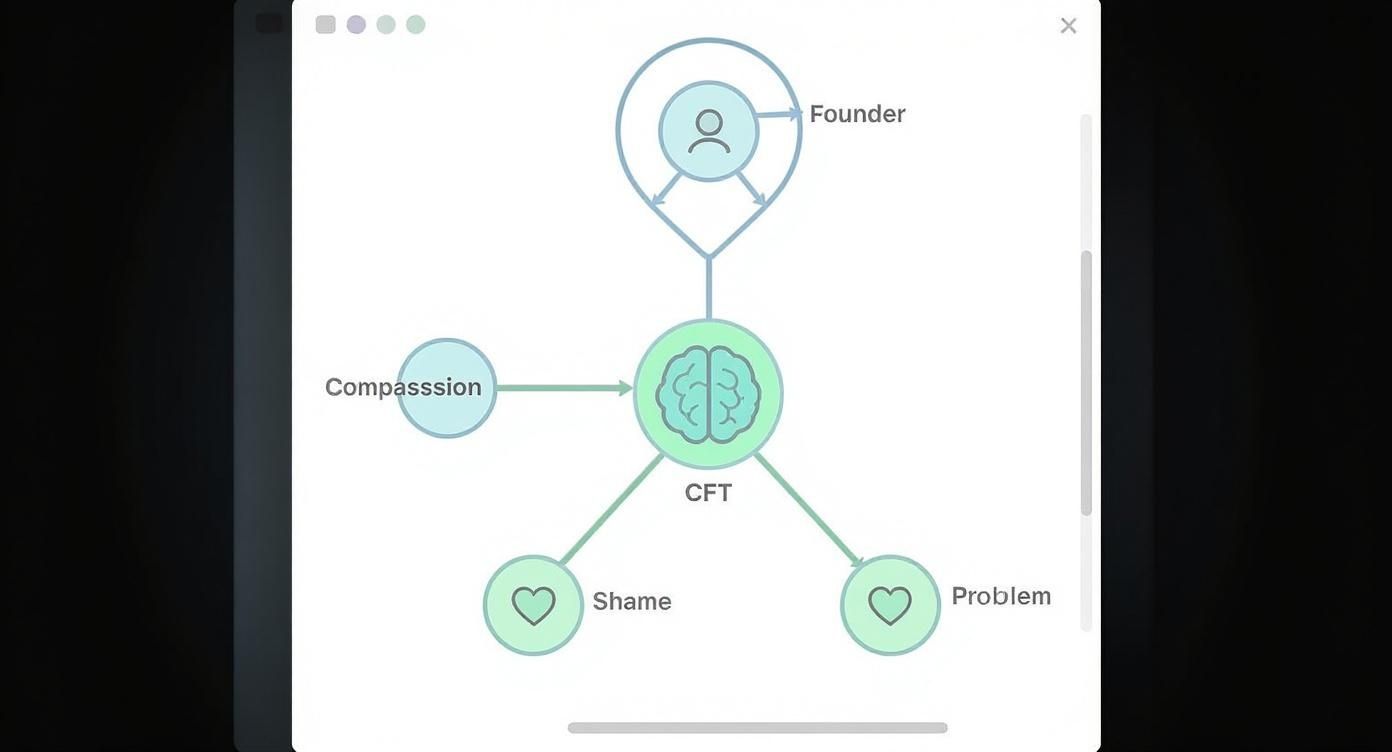
You can see how CFT was specifically developed to target the deep, painful roots of shame, using the deliberate cultivation of compassion as the key healing mechanism.
The Threat System: The Red Light
First up, and the oldest of the bunch, is the threat system. Its job is simple: detect and respond to danger, whether that’s a physical threat or a social one. When this system lights up, it triggers feelings like anger, anxiety, disgust, and shame. It floods our bodies with cortisol and adrenaline, getting us ready to fight, flee, or freeze.
This system is absolutely essential for survival, but in our modern world, it can go into overdrive. A critical email from your boss, a harsh inner judgment, or the fear of rejection can flip this red light on, leaving you feeling constantly on edge, defensive, or totally overwhelmed. For many people who struggle with high self-criticism, this system feels like it's permanently stuck in the 'on' position.
The Drive System: The Amber Light
Next, we have the drive system. This is our amber light—it’s all about pursuit, achievement, and seeking out resources. This is the part of us that feels motivated to chase goals, climb the career ladder, or acquire things we want. When the drive system is active, we feel energised, focused, and excited.
It works by releasing dopamine, the "reward" chemical that gives us a buzz when we tick something off the list. While this system is vital for getting things done, relying on it too much can lead to burnout, perfectionism, and that nagging feeling that we're never quite good enough.
The Soothing System: The Green Light
The third system, and the one that's most crucial for CFT, is the soothing system. This is our green light, and it’s associated with feelings of contentment, safeness, and connection. It gets activated when we feel cared for, safe, and like we belong.
"The soothing system is linked to our mammalian care-giving and attachment systems. It releases oxytocin and endorphins, which calm our threat response and create feelings of peace and wellbeing."
For many people, especially those with a history of trauma, neglect, or intense self-criticism, this soothing system is often underdeveloped or feels incredibly difficult to access. They might have a powerful, hair-trigger threat system and a strong drive system, but the ability to self-soothe and feel genuinely safe remains out of reach. The core work in Paul Gilbert Compassion Focused Therapy is to intentionally strengthen this very system.
Understanding the Three Flows of Compassion
Building up our soothing system involves more than just thinking nice thoughts. CFT organises this work around what Gilbert calls the Three Flows of Compassion. A lot of psychological distress comes from one or more of these flows being blocked.
-
Compassion Flowing Out: This is our ability to offer kindness, care, and support to other people. Most of us find this flow relatively easy; we're naturally wired to help those we care about.
-
Compassion Flowing In: This involves our capacity to receive compassion from others. For many, this is much, much harder. We might brush off compliments, distrust kindness, or feel unworthy of support, which effectively blocks this flow.
-
Compassion for Self (Self-to-Self): Often the most challenging flow of all is directing compassion inwards. It simply means treating ourselves with the same kindness, support, and understanding we would offer a good friend when we're suffering.
An overactive threat system often creates huge blockages, particularly in our ability to receive compassion and to be compassionate with ourselves. The goal of CFT isn't to get rid of the threat or drive systems, but to bring all three into a healthier balance by purposefully building the strength and accessibility of our soothing system.
Putting Compassion Into Practice With CFT Techniques
Knowing the theory behind Compassion Focused Therapy is a great start, but the real shift happens when we begin to actively train our minds. Think of it like building muscle at the gym; building our capacity for compassion requires consistent, deliberate practice. Paul Gilbert developed a whole toolkit of exercises designed to do just that.
These techniques aren't about slapping on a layer of fake positivity or trying to ignore our pain. Instead, they are practical skills that help us intentionally switch on our soothing system, paving the way for a new, more supportive relationship with ourselves.
Training a Compassionate Mind
The heart of applying CFT in real life is something called Compassionate Mind Training (CMT). This isn't a vague concept; it involves specific, repeatable exercises that help you cultivate the qualities of your compassionate self—things like wisdom, strength, warmth, and a non-judgemental stance.
One of the most foundational practices is soothing rhythm breathing.
This simple but incredibly effective technique directly dials into your nervous system. It’s a way to consciously shift out of a threat response (that familiar fight-or-flight feeling) and into the calm of your soothing system. It becomes an anchor, creating a physiological sense of safety that allows you to engage with difficult thoughts and feelings more kindly.
"When we practise compassion, we are stimulating and strengthening specific brain systems. Over time, these compassionate circuits become more accessible, helping us regulate our emotions and face life's difficulties with courage and wisdom."
By returning to practices like soothing rhythm breathing again and again, you're literally rewiring your brain. You’re making compassion a more natural, go-to response to distress.
Writing a Compassionate Letter to Yourself
One of the most powerful and often moving techniques in the CFT toolkit is Compassionate Letter Writing. This exercise is a brilliant way to step outside of your own harsh inner critic and respond to your suffering from a place of genuine wisdom and kindness. It’s a conversation with yourself, but with a completely different tone.
The process asks you to imagine your ideal compassionate self—a version of you that is wise, strong, and unconditionally caring. From that headspace, you write a letter to the part of you that's hurting.
Here’s a simple way to structure it:
- Empathy and Validation: Start by just acknowledging the pain without judging it. You might begin with, "I know you're feeling overwhelmed and are being so hard on yourself right now. It makes complete sense that you feel this way, given everything you're juggling."
- A Broader Perspective: Gently reframe the struggle, remembering that you’re working with a ‘tricky brain’. You could add, "Remember, your brain wasn't designed for constant happiness; it was built for survival. It's not a personal failing that you're wired to feel anxious or self-critical."
- Compassionate Action: Offer gentle, supportive suggestions—not demands. The focus is on what would be genuinely helpful. Something like, "Perhaps the kindest thing you could do for yourself right now is to just take a five-minute break."
This exercise gives you something tangible—a record of self-compassion you can read and re-read whenever that inner critic starts to get loud.
Creating Your Ideal Compassionate Image
Another cornerstone technique is developing a Compassionate Self or an Ideal Compassionate Image. This involves using your imagination to create a figure—it could be an ideal version of yourself, another person, or even a symbol—that perfectly embodies compassion.
This internal figure can become a secure base you can turn to for strength, wisdom, and soothing. The goal is to first imagine what it would feel like to receive compassion from this image, and then, over time, to start embodying its qualities yourself. This is an especially vital practice for those of us who find it difficult to generate a sense of kindness towards ourselves directly.
It's worth noting that, especially in the UK, clinicians have found that many people drawn to CFT have histories of trauma and a deep-seated distrust of kindness. For these individuals, real progress often comes from building these practical skills first, rather than trying to simply think their way into a new mindset. If you're interested in its clinical use, you can discover more insights about introducing Compassion Focused Therapy and its application.
Of course. Here is the rewritten section, crafted to sound like an experienced human expert in Compassion Focused Therapy, following all your specific instructions.
Who Is Compassion Focused Therapy For?
While many therapies focus on managing symptoms, Compassion Focused Therapy (CFT) takes a different route. It goes deeper, aiming right for the powerful undercurrents of shame and self-criticism that keep so many of us feeling stuck.
Professor Paul Gilbert originally developed CFT for people who hit a wall with other therapies. They could rationally understand that their self-critical thoughts were illogical, but they just couldn't shake the painful feeling of being flawed or unworthy.
This makes CFT a lifeline for anyone whose inner world is run by a harsh, relentless internal critic. It’s for those who find that traditional approaches don't quite reach the parts of them that need a sense of genuine warmth and safety.
For Anyone Tangled Up in Shame and Self-Criticism
At its heart, Paul Gilbert Compassion Focused Therapy was built for people wrestling with high levels of shame and self-blame. These feelings aren't just side effects; they often act as the very engine driving a whole range of mental health struggles.
CFT is particularly helpful for:
- Persistent Depression and Anxiety: When these conditions are locked in a cycle of self-attack ("Why can't I just get over this?"), CFT helps to calm the underlying threat system and cultivate a more supportive inner voice.
- Trauma and PTSD: Trauma often leaves behind a profound sense of being broken or unsafe. CFT helps people develop an internal source of safety and kindness, which is fundamental to healing those deep emotional wounds.
- Eating Disorders: The intense self-criticism and body shame tied to eating disorders can be directly addressed with compassionate mind training, helping to shift the focus from self-punishment to self-care and nourishment.
Put simply, if your go-to response to any struggle is to blame or attack yourself, CFT offers a direct, structured path toward a kinder, more resilient way of being. We explore this in much more detail in our guide on how CFT helps you heal from shame and self-criticism.
Does It Actually Work? A Look at the Evidence
This isn't just a nice idea—it’s an approach backed by a growing mountain of evidence, particularly within UK mental health services. Its specific focus on shame and self-criticism has led to its increasing use by organisations like the NHS, where it's proving to be an invaluable tool for complex mental health difficulties.
Time and again, research shows that CFT leads to significant drops in depression, anxiety, and self-criticism, while at the same time boosting self-compassion and our feelings of connection and safety with others.
A comprehensive review of 29 different studies really brought the therapy's impact to light, especially in group settings. In 21 of these studies (that's about 72%), people receiving CFT showed clear improvements in their mood, overall mental health, and their ability to be compassionate with themselves. You can learn more about these important findings here.
This kind of data gives us confidence that CFT can create meaningful, lasting change. It’s not about a temporary fix; it’s about fostering genuine psychological wellbeing from the inside out.
How Is CFT Different From Other Therapies?
To really get a feel for who might benefit most, it helps to see how CFT stands apart from other well-known therapies. While an approach like Cognitive Behavioural Therapy (CBT) is brilliant for challenging unhelpful thoughts, CFT works on a completely different level.
CFT is less concerned with the content of the thought and more interested in the emotional tone behind it. It’s less about getting into a debate with your inner critic and more about fundamentally changing your relationship with it.
You learn to deliberately activate a different part of your brain—your soothing, safeness system—to create a foundation of inner calm. It’s from this place of safety that you can then face life’s challenges.
To make this clearer, let's compare them side-by-side.
CFT vs Other Therapies: A Brief Comparison
This table contrasts Compassion Focused Therapy with more widely known therapies like CBT and Mindfulness to clarify its unique approach and focus.
| Therapeutic Approach | Primary Focus | Core Technique Example |
|---|---|---|
| Compassion Focused Therapy (CFT) | Cultivating an inner compassionate self to soothe the threat system and heal shame. | Developing a 'Compassionate Image' to generate feelings of warmth and safety. |
| Cognitive Behavioural Therapy (CBT) | Identifying and challenging irrational or negative thought patterns and behaviours. | Creating a 'thought record' to dispute automatic negative thoughts. |
| Mindfulness-Based Therapies | Developing non-judgemental awareness of present-moment thoughts, feelings, and sensations. | Practising a 'body scan' meditation to build awareness without judgement. |
As you can see, while all these approaches are incredibly valuable, CFT’s unique strength is its direct focus on building our inner capacity for soothing and kindness. This makes it a powerful choice for anyone whose struggles are deeply rooted in shame.
Where a Compassionate Mind Can Take You

It’s a common story. People often discover Compassion Focused Therapy when other approaches haven’t quite hit the mark. They might understand, on an intellectual level, that their self-critical thoughts are irrational, yet that painful, gut-level feeling of being flawed or not good enough just won't budge.
This is exactly where Paul Gilbert Compassion Focused Therapy steps in and offers a different path.
The unique strength of CFT lies in its focus on the emotional tone of our inner world, not just the logical content of our thinking. While a therapy like CBT might help you challenge the thought, “I am a failure,” CFT goes deeper. It helps you change the harsh, attacking feeling that rides along with that thought.
The whole approach is about intentionally building an inner environment of safeness and soothing. This creates a secure foundation from which real, lasting change can grow, rather than just papering over the cracks with forced positive thinking.
From Self-Attack to Self-Acceptance
Let’s think about someone we’ll call Alex. For years, his inner critic has been his constant companion, berating him for every perceived mistake at work or at home. He’d tried traditional therapy and learned to dispute his negative thoughts, but the underlying feeling of shame was relentless. The voice inside remained cold and unforgiving.
With CFT, Alex didn’t get into another argument with his critic. Instead, he started with simple breathing exercises designed to calm his threat system down. From there, he began to develop his “compassionate self”—an imaginary, wise, and kind version of himself he could turn to for support.
At first, it felt unnatural, even a bit silly. But slowly, Alex learned to listen to his own distress from this compassionate perspective, responding not with judgement but with warmth and understanding: "This is really tough for you right now, and it makes sense that you feel this way."
This gentle, consistent practice didn't magically erase his struggles. What it did was fundamentally change his relationship with them. The critic’s voice began to lose its power as a kinder, stronger voice grew in its place. He was building resilience from the inside out.
The Real-World Impact
Alex's journey gets to the heart of what CFT can do: it builds the inner resources we need to face life’s difficulties with courage instead of self-blame. Cultivating this compassionate relationship with ourselves is a direct antidote to the shame and self-criticism that fuel so much psychological struggle.
And the research is increasingly backing this up. Reviews of CFT effectiveness in the UK have shown clear improvements in psychological outcomes, especially in reducing deep-seated shame and self-criticism. One notable systematic review, for instance, identified significant positive effects across a whole range of psychological measures. You can explore the full details of CFT's effectiveness in this systematic review.
This growing body of evidence simply confirms what many have discovered in practice. We now know that developing self-compassion is a key to emotional wellbeing and resilience, offering a powerful counter-balance to our brain's natural negativity bias. Ultimately, CFT empowers you to become your own greatest ally, changing not just what you think, but how you live.
How to Find CFT Support and Resources

Taking the first step on a journey with Paul Gilbert Compassion Focused Therapy can feel big, but it’s a powerful move towards healing. The good news is, whether you’re looking for a therapist, some books to read on your own, or professional training, there are some fantastic resources out there to help you along.
Knowing where to look can be half the battle. Thankfully, trusted organisations have created clear pathways, ensuring you find qualified people who really get the nuances of this approach.
Finding a Qualified CFT Therapist
The most direct way to get a feel for CFT is to work with a trained professional. When you start your search, it’s really important to look for someone who has specific training and accreditation in Compassion Focused Therapy itself.
A brilliant place to start in the UK is the Compassionate Mind Foundation. This is the organisation set up by Paul Gilbert, and they keep a directory of accredited CFT practitioners. It's a great way to know you're connecting with therapists who have met high training standards and are deeply committed to the model.
When you choose a therapist from a recognised directory, you are investing in a therapeutic relationship built on a solid foundation of expertise, safety, and a deep understanding of how to work with shame and self-criticism.
Recommended Reading for Self-Study
If you’re keen to explore CFT concepts on your own, diving into some of the core texts can be incredibly illuminating. These books don't just explain the theory; they give you practical exercises you can start trying straight away.
- The Compassionate Mind by Professor Paul Gilbert: This is the go-to guide for the general public. It beautifully explains the science behind our tricky brains and shows you how to cultivate a more compassionate self.
- CFT Made Simple by Russell L. Kolts: A wonderfully accessible and practical workbook that breaks down the core ideas and techniques into easy-to-follow steps.
For a really comprehensive list of books, articles, and even guided meditations, you can find a wealth of CFT resources and materials pulled together by experts in the field.
Training for Professionals
If you’re a mental health professional curious about bringing CFT into your own practice, there are several reputable organisations offering structured training. The Compassionate Mind Foundation, for instance, provides workshops, supervision, and certification pathways. These courses are designed to give clinicians the skills and confidence to use CFT effectively and ethically with their clients.
Common Questions about CFT
As more people hear about Paul Gilbert's Compassion Focused Therapy, a few questions tend to pop up time and time again. Getting a feel for the answers can clear up a lot of misconceptions and really highlight what makes CFT so different.
Let's walk through some of the most common queries.
Is CFT Just About Being Nice to Yourself?
This is probably the most frequent—and important—question people ask. And the short answer is no. CFT goes so much deeper than simply "being nice" or letting yourself off the hook. Real compassion is a powerful blend of wisdom and courage.
Think about it: true compassion means having the strength to turn towards your difficulties, not away from them. It's about having the wisdom to figure out what will genuinely help you in the long run, and the commitment to actually do it. Sometimes, the most compassionate action you can take is a tough one—setting a firm boundary, having a difficult conversation, or sticking with a healthy routine when everything in you wants to quit.
The goal is to alleviate suffering, not to sidestep responsibility.
A firefighter running into a burning building is a perfect example of compassion in action. It's not "nice"; it's courageous, strong, and wise. CFT is about learning to bring that same quality of supportive strength to your own inner world.
How Long Does Compassion Focused Therapy Take?
There's no set timeline for CFT, because everyone's journey is unique. How long it takes really depends on your personal history, what you want to achieve, and the kinds of difficulties you're facing.
Some people feel a profound shift in their relationship with their inner critic after just a few months of weekly sessions. For others, especially those dealing with a long history of trauma or deep-seated shame, it can be a longer process. The aim isn't to race towards a finish line, but to steadily build the "muscle" of your compassionate mind.
It’s about creating lasting change, not a quick fix. Progress is often felt as a growing sense of inner safety and resilience, a fundamental shift in how you relate to yourself, rather than just ticking off symptoms.
Can I Practice CFT on My Own?
Absolutely. You can definitely start exploring the core ideas of CFT on your own, and it can be incredibly helpful. Picking up one of Professor Paul Gilbert's books or trying out some guided meditations is a fantastic way to get acquainted with concepts like soothing rhythm breathing.
But working with a trained CFT therapist brings something else to the table—something vital. A therapist creates a safe, supportive relationship where you can explore the fears and blocks to compassion that are often incredibly tricky to face alone.
A good therapist can help you navigate common roadblocks, such as:
- A deep-seated distrust of kindness: For many of us, self-compassion can feel strange, undeserved, or even a bit threatening at first.
- Getting stuck on certain exercises: A therapist can adapt techniques to fit you personally, helping you work through any challenges that come up.
- Uncovering painful emotions: Having a professional guide ensures you can process difficult feelings as they arise without becoming overwhelmed.
While self-help is a brilliant starting point, therapy provides the relational safety and expert guidance needed to get to the heart of what self-criticism and shame are often protecting.
At Dr Chris Irons, I offer specialised Compassion Focused Therapy and coaching to help individuals and leaders move beyond self-criticism and build a more resilient, fulfilling life. If you're ready to cultivate your compassionate mind, I invite you to explore my services and get in touch.