When traditional talking therapies hit a dead end, particularly for people trapped in the agonising loop of shame and self-criticism, it was clear something else was needed. This is where the story of Paul Gilbert, compassion, and his development of Compassion Focused Therapy (CFT) really begins. It was born from a very human need to get to the root of suffering that other methods just couldn't seem to touch.
The Origins of Compassion Focused Therapy

Picture a therapist working in the UK's National Health Service (NHS). Day after day, he noticed a frustrating pattern. His clients could grasp, on a logical level, that their self-critical thoughts were irrational. Yet, they couldn't feel any different inside.
This was the puzzle that Professor Paul Gilbert, a British clinical psychologist, kept encountering. He realised that for individuals with a ferocious inner critic, cognitive insights just bounced off. The emotional weather inside them was hostile. What they needed wasn't just another clever thought to challenge the negativity; they needed a way to cultivate an inner sense of warmth, safety, and genuine support.
This crucial insight became the seed from which Compassion Focused Therapy grew. Gilbert began weaving together threads from evolutionary psychology, modern neuroscience, and age-old contemplative traditions. He wanted to build a framework that did more than just put a plaster on symptoms. His aim was to actively train the brain's soothing systems, helping people develop a compassionate mindset as a direct antidote to the poison of shame and self-attack.
From Clinical Practice to a Global Movement
Working as the head of the Mental Health Research Unit at Derbyshire Healthcare NHS Foundation Trust, Gilbert put these powerful ideas to the test. His unit ran pivotal trials that proved CFT worked. A key 2009 UK study, for instance, showed that for NHS patients with high levels of shame, CFT slashed depression scores by 25-30%—a significant improvement over standard care. It was for this kind of contribution to mental health that Gilbert was awarded an OBE in 2011. You can find more on his groundbreaking research and accolades on his Wikipedia page.
To get this knowledge out into the world, he established The Compassionate Mind Foundation, an organisation dedicated to promoting the scientific study and real-world application of compassion. It provides training and resources for therapists, researchers, and anyone interested, turning what began as a clinical observation into a worldwide movement.
Today, pioneering therapists continue to build on this solid foundation, opening up new pathways for healing. You can learn more about how Dr Chris Irons is leading the way in Compassion Focused Therapy in our detailed article.
“What we do… is we need to practice how to be supportive and kind to ourselves and compassionate to ourselves and encouraging and empathic to ourselves. Now, that is a practice that is less common.” – Professor Paul Gilbert
Ultimately, CFT isn't just about 'being nice to yourself'. It's a structured, evidence-based approach designed to rebalance our emotional systems from the inside out. It gives us the tools to build inner courage and wisdom, fundamentally changing how we relate to our own suffering and guiding us toward genuine psychological wellbeing.
To really get to grips with Paul Gilbert’s work on compassion, we first need a map of the mind he’s working with. He suggests our brains have three core emotional regulation systems, each shaped by evolution for a very specific job.
Picture them as three different internal radio stations, each playing a completely different kind of music.
The problem is, modern life has a habit of cranking the volume way up on two of these stations, while the third is often so quiet you can barely hear it. Compassion Focused Therapy is all about learning how to deliberately reach over and tune into the right station, right when you need it most.
The Threat System: The Mind's Alarm Bell
First up, we have the Threat System. This is your ancient, hard-wired survival kit. Its job is simple and non-negotiable: protect you from harm.
When it sniffs out danger—whether that’s a real physical threat like a speeding car or a social one like giving a presentation—it pumps your body full of hormones like adrenaline and cortisol. This is what kicks off that classic fight, flight, or freeze response. The feelings that come with it are anxiety, anger, and disgust.
It’s designed to be lightning-fast, automatic, and powerful. It’s not your fault it’s so twitchy; it evolved to keep your ancestors alive in a world full of actual predators. The trouble is, in our world, it gets set off by work deadlines, social media comments, and our own critical thoughts, keeping many of us stuck in a state of high alert.
The Drive System: The Mind's Engine
Next, there's the Drive System. This is the engine that pushes you to go after resources, hit your goals, and chase rewards. It’s fuelled by dopamine and is all about feelings of excitement, motivation, and pleasure.
This system is what gets you out of bed to go for that promotion, finish a tough project, or strive for success. It’s incredibly useful and gives life much of its energy and sense of accomplishment.
But when it’s constantly in overdrive, it can lead to a relentless, joyless pursuit of more—more success, more stuff, more validation. It can feel like being on a treadmill where real contentment is always just one more achievement away.
"Your mind will change the flow of hormones and blood flow according to what you're fantasising… it's the same for compassion. If you practice compassion, you'll be stimulating circuits in your body and your brain. That will strengthen over time." – Professor Paul Gilbert
The Soothing System: The Mind's Safe Harbour
Finally, we get to the heart of Paul Gilbert's work on compassion: the Soothing System. This one is all about feelings of calmness, safeness, and contentment. It evolved from our deep-seated mammalian need for connection and care—think of the powerful bond between a parent and their child.
When this system is active, your body releases oxytocin and other calming opioids, which actively helps to turn down the volume on the Threat System. It’s not about achieving anything or avoiding danger. Its purpose is simply to feel settled, connected, and secure.
This is the system that lets us rest, digest, and recover. It’s that feeling of being okay just as you are, without needing to do or be anything more.
To bring this all together, here’s a quick breakdown of how these three systems function:
Understanding The Three Emotional Regulation Systems
| System | Primary Function | Associated Feelings | Key Neurochemicals |
|---|---|---|---|
| Threat | Protection & Safety | Anxiety, Anger, Disgust | Adrenaline, Cortisol |
| Drive | Seeking & Achieving | Excitement, Motivation, Pleasure | Dopamine |
| Soothing | Connection & Contentment | Calmness, Safeness, Security | Oxytocin, Endorphins |
This table shows at a glance how each system has a distinct role, feeling, and neurochemical signature. It's not about one being "good" and the others "bad"; it's about balance.
For so many people struggling with self-criticism and shame, the Soothing System is underdeveloped. Life has given them plenty of practice with threat and drive, but very little training in how to access genuine soothing and safeness.
CFT provides a clear, practical path to fixing this imbalance. By consciously engaging in practices that build this inner warmth and security, you can create a more balanced and resilient mind. If you're interested in actively building these skills, an 8-week compassionate mind training course like the one offered by my colleague Dr Chris Irons can be a brilliant place to start.
The goal isn't to get rid of the other two systems—we absolutely need them. It's about cultivating the Soothing System so it can effectively balance them out, giving you a solid foundation of inner security from which to face whatever life throws your way.
What Paul Gilbert Really Means By Compassion
When most people hear the word "compassion," their minds often jump to kindness, gentleness, or maybe even a certain softness. But in Paul Gilbert’s world, compassion is something far more muscular and active. It's not just a fuzzy feeling; it’s a courageous and wise response to the inescapable reality of pain.
So, let's set aside the idea that compassion is simply about being nice. Gilbert defines it with a much sharper lens as "a sensitivity to suffering in self and others with a commitment to try to alleviate and prevent it." Notice the active words there—this isn't a passive state, but a motivation that drives us to act.
This powerful definition is built on two core psychological components.
The Two Pillars of Compassion
Gilbert's version of compassion stands on two crucial pillars. Without both, our attempts to help can easily become overwhelming or miss the mark entirely.
- The Courage to Engage: First, you need the courage to turn towards suffering, not away from it. Pain is hard to look at, whether it’s ours or someone else's. Our natural instinct—our threat system—often screams at us to ignore it, numb it, or just run. Compassion demands the strength to stay present with that difficulty.
- The Wisdom to Help: The second pillar is having the wisdom to know what is genuinely helpful. You can be incredibly sensitive to someone’s distress, but if you don't know what to do, you can end up feeling helpless or even make things worse. This wisdom involves understanding what's causing the suffering and knowing what skills or actions can actually make a difference.
Think of a firefighter running into a burning building. They have the courage to face the danger (the suffering) and the wisdom—their training and knowledge—to navigate it safely and rescue those inside. That's compassion in action: strong, wise, and courageous.
"Compassion for us is the sensitivity to suffering in self and others, with a commitment to do something about it and with wisdom and courage. So, it's a little bit of a long definition, but it is important, because this is not really about love." – Professor Paul Gilbert
The Three Flows of Compassion
To truly cultivate a compassionate mind, Gilbert explains that we need to train this quality to flow in three distinct directions. If we neglect any one of them, our emotional systems can stay out of balance, leaving us stuck in loops of self-criticism and threat.
- Compassion for Others: This is the flow we're most familiar with—feeling and acting compassionately towards other people. It involves empathy, sympathy, and a genuine wish to support others when they're struggling.
- Receiving Compassion from Others: This one involves being open to accepting care, kindness, and support from other people. For many of us, especially those with a strong inner critic, this can be incredibly hard. It often gets blocked by feelings of unworthiness or fears of being a burden.
- Self-Compassion: This is often the trickiest flow to master. It’s about turning that same caring, supportive, and understanding attitude inward, towards yourself. It means treating yourself with the same kindness you would offer a good friend when you're having a hard time, have failed at something, or feel inadequate.
The diagram below shows the three core emotional systems that Gilbert's work on compassion helps to bring into balance.
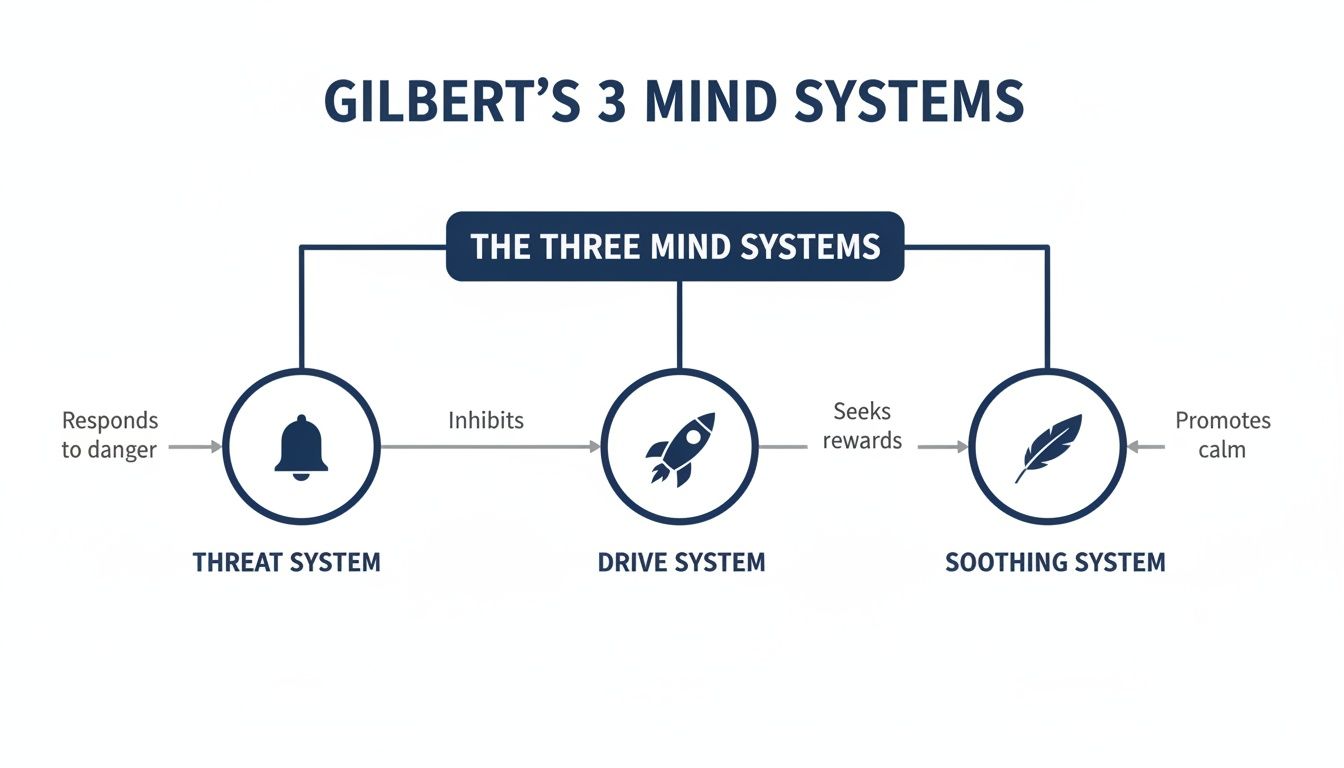
As the image shows, the Soothing system, which is where compassion does its work, is a distinct system from both our threat-focused and drive-focused parts of mind.
Ultimately, by looking at compassion through this structured lens, we move away from vague notions of just "being kind." We start to see it as a trainable skill—a form of mental fitness that involves courage, wisdom, and a balanced flow of care. This robust framework is the very foundation of Compassion Focused Therapy and its powerful techniques for healing and building resilience.
Practical Techniques To Build A Compassionate Mind

Knowing the theory behind Paul Gilbert's work is one thing, but putting it into practice is where the real shifts happen. The goal here isn’t to just add another task to your to-do list. It's about actively training your brain.
With every exercise, you're building new neural pathways that beef up your soothing system. Think of it as creating a reliable inner resource you can turn to when things get tough.
These techniques are designed to be potent but practical. They offer tangible ways to move out of that relentless threat or drive mode and into a state of genuine safeness and connection. It’s like developing a new kind of mental muscle; the more you practise, the stronger and more automatic your compassionate response becomes.
Soothing Rhythm Breathing
Before you can tackle the more complex stuff, you first need to calm the body. Soothing Rhythm Breathing is often the first port of call in CFT for a good reason: it speaks directly to your nervous system, sending a clear signal that you're safe.
When your threat system fires up, your breath gets fast and shallow. By deliberately slowing it down, you can essentially reverse-engineer a state of calm.
Here’s a simple way to start:
- Find a comfortable spot, either sitting or lying down. Keep your back straight but not rigid.
- Breathe in slowly through your nose for a count of about four or five. Feel the breath go deep into your belly, not just your chest.
- Pause gently for a moment at the top of the breath.
- Breathe out slowly and smoothly through your mouth for a slightly longer count, maybe six or seven.
- Focus on the rhythm. The real magic happens by making the out-breath a little longer than the in-breath. This helps activate the parasympathetic nervous system—your body’s built-in "rest and digest" mode.
Keep this up for a few minutes. Just bring a gentle, kind attention to the rhythm. It’s a powerful way to ground yourself and build a physiological foundation for compassion.
Creating Your Ideal Compassionate Self
One of the most powerful exercises in CFT is visualising an ideal compassionate version of yourself, or even a separate figure. This isn't about creating some perfect, flawless being. It’s about intentionally crafting an inner ally that embodies the qualities you most need when you’re struggling.
Think about what this ideal compassionate self would be like. What qualities would they have?
- Wisdom: They have a deep, lived-in understanding of life’s struggles. They get that humans are messy and imperfect, and that’s okay.
- Strength and Courage: They aren’t afraid of your pain. They can sit with your distress without getting overwhelmed or trying to rush you out of it.
- Warmth and Kindness: They have a genuinely caring, non-judgemental presence. Their voice is warm, and their sole intention is to help you, not fix you.
Spend some time really imagining this figure. What do they look like? What does their voice sound like? What does it feel like to be in their presence? The more sensory detail you can add, the more real and effective this inner resource becomes.
"When you practice compassion, they are stimulating brain systems. You are actually practicing developing brain systems, and we now know that if you practice, you literally will change circuits in your brain." – Professor Paul Gilbert
Compassionate Letter Writing
Self-criticism is often a fast, automatic, and well-worn track in our minds. Compassionate Letter Writing is an exercise designed to slow that process right down and let you consciously choose a different voice. It’s about writing a letter to yourself, but from the perspective of that ideal compassionate self you just imagined.
The process is surprisingly straightforward:
- Pinpoint a struggle: Think of something you’ve been beating yourself up about. A mistake you made, a perceived flaw, a difficult emotion you’re grappling with.
- Embody your compassionate self: Bring that ideal compassionate image to mind. Really step into their shoes and imagine you are them, writing to the part of you that’s hurting.
- Write the letter: Start with a warm, understanding tone. Express empathy for the pain you’re in ("I can see how hard this is for you…"). Validate the difficulty of the situation without any judgement.
- Offer wisdom and encouragement: From this compassionate viewpoint, what supportive perspective could you offer? This isn't about letting yourself off the hook; it's about motivating yourself with kindness instead of attacking yourself with criticism.
This exercise is a direct challenge to your inner critic. It gives you deliberate, focused practice in generating a kinder, wiser internal dialogue, which is a game-changer for reframing how you relate to your own so-called failures and imperfections.
Why We Fear Compassion and How To Overcome It
It sounds like a complete paradox, doesn’t it? Why would anyone be afraid of kindness, warmth, or support?
And yet, as Paul Gilbert’s work shows us time and again, many of us hold a deep-seated resistance to compassion, especially when we try to turn it inwards. This isn't some kind of personal failing; it's often a clever, protective mechanism that our minds have built over many years.
For some, receiving compassion just feels… weird. Unfamiliar. Even a bit threatening. If your emotional upbringing was heavy on criticism, neglect, or impossibly high expectations, the genuine warmth of compassion can feel alien. Your brain, wired for a completely different emotional climate, might flag this new feeling as unsafe or untrustworthy. In a flash, you’re back in that threat system we’ve been talking about.
For others, the fear is tied to specific beliefs. You might worry that self-compassion will make you weak, lazy, or self-indulgent. Maybe you’re convinced that your harsh inner critic is the only thing keeping you motivated and on track. These are really common blocks that keep our soothing system switched off.
Common Fears That Block Compassion
Getting to know these fears is the first, crucial step toward gently dismantling them. They often pop up as powerful, automatic thoughts that stop us from accessing the very thing that could help us heal.
Here are some of the most common resistances people run into:
- Fear of Weakness: A belief that being kind to yourself is just letting yourself off the hook or will somehow erode your resilience.
- Fear of Unworthiness: A deep-seated feeling that you simply don’t deserve kindness, often tangled up with past experiences of shame or guilt.
- Fear of Grief: A worry that if you open the door to self-compassion, a whole flood of sadness and grief about past hurts will become overwhelming.
- Fear of Unfamiliarity: When self-criticism is your factory setting, compassion can feel so strange that your system automatically rejects it as something foreign.
These fears aren't irrational; they are learned survival strategies. Compassion Focused Therapy doesn’t try to bulldoze them. Instead, it helps you understand where they came from with kindness and curiosity. You can learn more about how CFT addresses the deep roots of shame and self-criticism in our dedicated guide.
Gently Overcoming Resistance
The key to moving through these fears isn’t to fight them head-on. It’s about gently and repeatedly reintroducing the soothing system to your brain.
This is where the practical exercises of CFT become so powerful. By starting with small, manageable steps like Soothing Rhythm Breathing, you begin to show your nervous system that it is possible to feel safe and calm.
"Many individuals associate self-compassion with weakness or self-pity… CFT works by helping people understand that compassion is, in fact, a source of courage and resilience." – Dr Chris Irons, Clinical Psychologist
Think of it as building a new habit. Each time you choose a compassionate response over a self-critical one, you strengthen those neural pathways. You’re not trying to get rid of the fear all at once, but to create an alternative, safer emotional home for yourself, one step at a time.
The urgency of this became starkly clear during the COVID-19 pandemic. A 2021 study across 21 countries, co-authored by Paul Gilbert, found that people in the UK reported 32% higher fears of compassion than the average. This was at a time when UK anxiety rates had already soared to 40%, making compassionate mind training more vital than ever.
Putting Compassion Into Practice
The ideas behind Paul Gilbert’s work aren't just for the therapy room. Across the UK, Compassion Focused Therapy (CFT) is being put to the test in some of the most demanding real-world settings you can imagine—clinics, classrooms, and communities—and it's proving its power to build genuine emotional resilience.
What we're seeing is that compassion isn't just a nice idea; it's a trainable skill with real, measurable benefits. By taking CFT beyond one-on-one therapy, it's becoming a powerful model for preventative mental healthcare and for supporting people with complex needs inside large, often over-stretched, systems.
A New Way Forward in UK Schools
One of the most exciting developments is seeing CFT take root in UK schools, directly addressing the rising tide of mental health challenges among young people. Paul Gilbert's Compassionate Mind Training (CMT) is being rolled out to give kids and teenagers the tools to navigate the immense pressures of modern life.
Pioneering pilot programmes in Derbyshire schools between 2018 and 2022 gave us a glimpse of what’s possible. Involving over 500 pupils aged 11-16, the results were incredible. The young people involved reported a 28% drop in anxiety scores and a 35% jump in self-compassion. The approach has caught on; by 2025, over 200 UK schools had brought CMT into their classrooms, with more than 1,200 educators trained since 2015. Perhaps most tellingly, Ofsted reports from the pilot areas linked the training to an 18% fall in bullying incidents. You can dive deeper into these school-based findings from the University of Derby.
By helping young people develop empathy and self-kindness early on, these programmes give them the inner resources to handle stress and build healthier relationships. It’s not just about individuals; it’s about creating a fundamentally more supportive school culture.
Supporting Complex Needs in the NHS
Inside the NHS, CFT has become a vital lifeline for clinicians working with some of the most entrenched mental health conditions. It's often turned to when other therapies haven't quite hit the mark, especially for those wrestling with chronic depression, complex trauma, and the kind of deep-seated shame that can feel impossible to shift.
For these individuals, more traditional approaches can sometimes feel like they're missing the point, or even a bit invalidating. CFT offers a different way in by focusing first on creating a foundation of inner safeness. This is a game-changer because it helps dial down the threat system, which is often stuck on high alert for people who’ve lived through significant trauma or adversity.
By using practical techniques that directly activate the body's own soothing system, therapists can help their clients build the courage and stability they need to finally face painful memories and quiet those relentless self-critical voices. This makes CFT an indispensable part of mental healthcare across the UK, offering hope and a tangible path to recovery for so many who felt well and truly stuck.
A Few Common Questions About CFT
As people start to get to grips with Paul Gilbert's work, a few questions tend to pop up time and again. Let's tackle some of the most common ones to clarify how Compassion Focused Therapy (CFT) fits into the bigger picture of psychological support.
How Is CFT Different From Mindfulness?
This is a great question. While CFT absolutely uses mindfulness as one of its core tools, they're aiming for different things. Mindfulness, at its heart, is about developing a non-judgemental awareness of what's happening in the here and now. It’s about noticing your thoughts and feelings without getting swept away by them.
CFT takes this crucial first step and then asks, "Okay, now what?" It uses that mindful awareness as a launching pad to then intentionally cultivate feelings of warmth, safeness, and kindness towards yourself, especially when you're suffering. The goal isn't just to observe your pain from a distance, but to actively engage your body's soothing system to help you deal with it.
You could think of mindfulness as the clear lens that helps you see a wound properly, while compassion is the soothing balm you then consciously choose to apply.
Is Compassion Focused Therapy Effective For Anxiety?
Yes, absolutely. CFT can be a game-changer for anxiety, which is essentially your threat system firing on all cylinders. What often makes anxiety so much worse is the harsh inner critic that pipes up, adding a layer of shame or frustration ("Why can't you just calm down?!").
CFT comes at this from two angles. First, it uses practices like soothing rhythm breathing to directly calm the nervous system, which helps dial down the physical, fight-or-flight side of anxiety. Second, by helping you build a more compassionate inner voice, it teaches you to respond to anxious feelings with support and understanding instead of self-attack. This is crucial for breaking that vicious cycle where anxiety fuels self-criticism, which in turn fuels more anxiety.
Many CFT exercises, like compassionate letter writing, are excellent for self-practice. However, for deep-rooted issues of shame and trauma, working with a trained CFT therapist is recommended to help navigate the fears and emotional complexities that may arise.
At Dr Chris Irons, I specialise in helping individuals and professionals use the principles of Compassion Focused Therapy to build resilience and overcome self-criticism. If you're ready to cultivate a kinder, more supportive relationship with yourself, explore my therapy, coaching, and training services.