If you've ever found yourself wondering why your inner voice is so much harsher than the one you use with your friends, you're not alone. It's a strange but common human quirk: when a friend messes up, we offer comfort and support. When we make the very same mistake, we often unleash a torrent of self-criticism.
This guide is here to walk you through a powerful antidote to that pattern, found in the pages of the groundbreaking Mindful Self-Compassion book.
Your Starting Point for Self-Compassion
Co-authored by Dr. Kristin Neff and Dr. Christopher Germer, the primary mindful self compassion book is a practical, evidence-based workbook. It lays out a structured programme for learning how to treat yourself with the same kindness you’d instinctively offer a friend who was struggling.
At its heart, the book gets one thing straight: self-compassion isn't about wallowing in self-pity or just letting yourself off the hook. It's an active, engaged process of turning towards your own suffering with warmth, understanding, and a genuine wish to help. It’s about deeply understanding that failure and imperfection aren't personal failings – they're part of the shared human experience.
Dr. Neff and Dr. Germer are true pioneers in this field, and their work has become a landmark resource for anyone looking to build genuine emotional resilience.
What Does This Book Offer You?
Think of this book as a clear, practical roadmap for navigating life’s inevitable bumps and bruises with less pain and more inner strength. It goes far beyond theory, giving you concrete tools to build a fundamentally healthier relationship with yourself. One of the core benefits is that it shows you how to know yourself better, which is a key step toward finding real inner peace.
This resource is designed to help you:
- Quiet Your Inner Critic: Learn how to turn down the volume on that harsh inner voice and replace it with a more supportive, encouraging ally.
- Handle Difficult Emotions: Build the capacity to sit with painful feelings, like sadness, anger, or shame, with more ease and wisdom.
- Build Real Resilience: Cultivate the inner strength you need to bounce back when life knocks you down.
- Motivate Yourself with Kindness: Discover the surprising truth that encouragement, not criticism, is a far more effective and sustainable motivator in the long run.
Self-compassion gives us the strength to acknowledge our own imperfections and the motivation to change for the better. It is a source of courage and resilience in the face of life’s challenges, not an excuse for passivity.
Consider this your starting point. It’s a powerful and life-changing way to relate to yourself, and this book is an excellent guide. For a deeper dive, Dr. Chris Irons offers some fantastic additional insights into the practice of self-compassion and its clinical applications.
So, to really get a feel for what this mindful self-compassion book is all about, we need to look at its core structure. The whole practice rests on three pillars, all working together to build a strong, reliable inner resource. Think of it like a three-legged stool – if one leg is missing, the whole thing becomes wobbly and can't support you.
These aren't some lofty, complicated theories. They're actually very intuitive shifts in how you relate to yourself when life gets tough. They help guide you away from that knee-jerk self-criticism and towards a more balanced, kind inner voice.
Self-Kindness Instead of Self-Judgement
The first pillar is self-kindness. This is probably the most straightforward of the three. It's about choosing to be warm and understanding with yourself when you're suffering, when you fail, or when you feel inadequate. It's the opposite of either ignoring your pain or, worse, piling on with harsh self-criticism.
Imagine a close friend calls you, completely distraught after making a big mistake at work. Would you tell them they’re incompetent and useless? Of course not. You’d offer gentle words, reassurance, and support. Self-kindness is all about learning to turn that same supportive voice inwards.
This isn’t about letting yourself off the hook or making excuses. It's about creating a safe internal space where you can acknowledge your shortcomings without being buried by shame. We now know from research that self-criticism lights up the body's threat system, flooding you with cortisol and stress. Self-kindness does the opposite; it activates our soothing systems, helping us feel safe and cared for. You can explore more about how compassion helps heal feelings of shame and self-criticism in our dedicated article on the topic.
Common Humanity Instead of Isolation
Next up is the second pillar: recognising our common humanity. When we fail or feel intense pain, a common reaction is to feel completely alone in it. We start thinking, "Why is this happening to me?" or "What's wrong with me?" This sense of being uniquely flawed creates a painful separation from everyone else.
Common humanity is the perfect antidote to this. It's the profound realisation that suffering and feeling inadequate are just part of the shared human experience. Everyone messes up. Everyone feels pain. Everyone is imperfect. Instead of seeing your struggles as some kind of proof of your personal deficiency, you start to see them as a link that connects you to every other person on the planet.
"The very definition of being 'human' means that one is mortal, vulnerable and imperfect. Therefore, self-compassion involves recognizing that suffering and personal inadequacy is part of the shared human experience—something that we all go through rather than being something that happens to 'me' alone."
This simple shift in perspective can transform a difficult moment from a personal crisis into a shared experience. It dissolves the walls of isolation and reconnects you with others through the very fabric of being human.
Mindfulness Instead of Over-Identification
The final pillar is mindfulness. This involves taking a balanced approach to our negative emotions so that we aren't suppressing them, but we aren't exaggerating them either. After all, you can't ignore your pain and feel compassion for it at the same time.
Mindfulness simply asks us to observe our thoughts and feelings as they are, without judging them and without getting totally lost in them. It's the subtle but powerful difference between saying "I am sad" and "I am noticing a feeling of sadness." That little bit of space stops you from becoming completely consumed by your emotions, a state the authors call over-identification.
A helpful way to think about it is like standing on a riverbank, watching the water flow by. You're not trying to stop the river, but you're also not jumping in and letting the current sweep you away. You acknowledge the difficult thoughts and emotions without letting them become your entire reality.
This diagram offers a great visual summary of how these core ideas fit together.
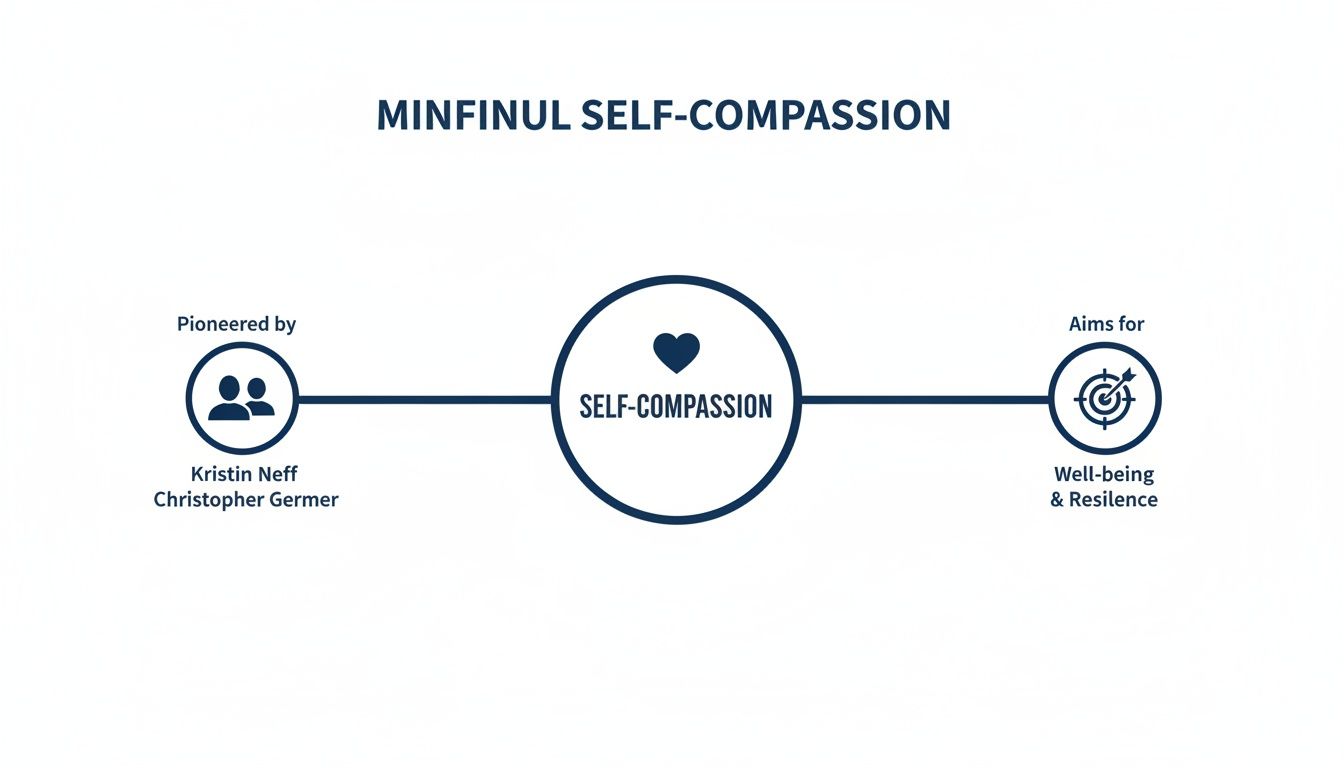
You can see how Neff and Germer's work guides you towards greater well-being by weaving these compassionate practices together. The power of this approach is being increasingly recognised here in the UK, where the Mindful Self-Compassion (MSC) Workbook has gained real traction. In fact, a 2024 UK survey found that 42% of people using techniques from books like MSC reported their anxiety levels dropped by at least 30% within three months.
To make this even clearer, let's look at how these three pillars change our internal script in a difficult moment.
Self-Critical vs. Self-Compassionate Responses
This table breaks down the difference between a typical self-critical reaction and a more mindful, self-compassionate one.
| Core Component | Typical Self-Critical Response | Mindful Self-Compassionate Response |
|---|---|---|
| Self-Kindness | "I'm such an idiot. I can't believe I messed that up. I never get anything right." | "This is really hard right now. It's okay to feel upset. How can I comfort myself in this moment?" |
| Common Humanity | "Why does this always happen to me? Everyone else seems to have it together. I'm the only one who struggles like this." | "Everyone makes mistakes; it's part of being human. I bet lots of people have felt this way before." |
| Mindfulness | Being completely consumed by the feelings of failure and shame, replaying the event over and over. | "I'm noticing a lot of painful feelings. I'll just sit with this for a moment without judging myself for it." |
As you can see, the shift isn't about denying reality or pretending something didn't happen. It's about changing how you relate to yourself when reality is painful. This simple but profound change is what lies at the heart of mindful self-compassion.
A Guided Journey Through the Book
Think of the Mindful Self Compassion book as less of a book to be read and more of a programme to be experienced. Drs Neff and Germer have laid out a path for you, a progressive journey where each chapter and exercise carefully builds on the last. It’s a bit like learning to play the piano – you master the simple scales before you even think about tackling a complex sonata.
This thoughtful structure is precisely what makes the book so powerful. It doesn't throw you in at the deep end. Instead, it gently introduces the core ideas first, then guides you step-by-step towards applying them to the more difficult corners of your life. You wouldn’t start a new fitness routine by trying to lift the heaviest weight in the gym, right? In the same way, this book helps you build your 'self-compassion muscle' safely and at a sustainable pace.
Laying a Kind Foundation
The first few chapters are all about getting the foundations right. You’ll start by digging into what self-compassion actually is—and just as importantly, what it isn’t. The authors do a brilliant job of busting common myths, making it crystal clear that this is a practice of strength and resilience, not self-pity or letting yourself off the hook.
One of the very first practical tools you'll learn is Soothing Touch. It sounds almost too simple to work, but it’s a potent, science-backed technique for activating your body’s innate care system. Just placing a hand over your heart or gently holding your face can trigger the release of oxytocin, the ‘love hormone’, which helps to calm your threat response (that familiar fight-or-flight feeling).
This initial phase is all about making sure you have a reliable way to feel safe and grounded before you start exploring more challenging emotional territory.
Discovering Mindfulness and Our Common Humanity
Once that sense of safety is established, the book takes you deeper into mindfulness. It’s not about emptying your mind, but about learning to observe your thoughts and feelings with a kind of gentle curiosity. This is a crucial skill. After all, you can't offer compassion to a feeling you’re not even willing to sit with.
Here, you'll come across practices like Affectionate Breathing, a simple meditation that uses the breath to anchor you in the present moment with a sense of warmth. The aim isn't to silence difficult thoughts, but to fundamentally change your relationship with them.
From there, the journey broadens out to explore our shared experience of being human. This is often a huge turning point, where you begin to dismantle the profound sense of isolation that suffering can bring. You start to see that your struggles don’t mean you’re broken; they mean you’re part of the human family.
The book guides you to see your imperfections not as personal failings, but as the very fabric that connects you to everyone else. This shift in perspective is often a profound turning point for readers.
Internalising this idea helps to soften the harsh self-judgement that so often pours fuel on the fire of a difficult moment.
Working with Difficult Emotions
With a solid foundation of kindness, mindfulness, and common humanity in place, the book then guides you into the tougher work: meeting difficult emotions head-on. This is where that progressive structure really shows its worth. You now have the tools you need to face feelings like anger, shame, and grief without being completely swept away by them.
Research has shown a direct link between self-compassion and our ability to process difficult emotions, especially anger. People who are more self-compassionate tend to ruminate less on angry feelings and are more able to find forgiveness.
This section introduces what is probably the book's most famous exercise: the Self-Compassion Break. It’s a simple, three-step practice you can use right in the middle of a struggle:
- Acknowledge the suffering: This is the mindfulness step. Simply say to yourself, "This is a moment of suffering."
- Connect with common humanity: This counters isolation. Remind yourself, "Suffering is a part of life."
- Offer yourself kindness: Ask yourself, "May I be kind to myself?" and maybe use a soothing gesture.
It's a powerful and portable tool you can use anytime, anywhere, to bring a moment of compassion to your pain.
Integrating Fierce and Tender Compassion
As you move into the latter part of the book, you’ll explore the two distinct sides of compassion: the tender and the fierce. Dr. Neff beautifully describes these as the yin and yang of self-compassion.
- Tender Self-Compassion (Yin): This is the nurturing, accepting, and comforting side. It’s about being with ourselves gently, allowing for our imperfections and soothing our pain.
- Fierce Self-Compassion (Yang): This is the action-oriented side. It’s about protecting ourselves, setting firm boundaries, saying "no," and motivating ourselves to make difficult but necessary changes.
Most of us find we lean more naturally towards one or the other. This part of the book is all about finding a healthy balance. It shows you that true self-compassion isn't just a passive, soft practice; it's a dynamic force that can both comfort and protect. It gives you the courage to stand up for yourself and the wisdom to know when you just need to rest and heal. This balanced approach is what makes it such a complete resource for living a fuller, more authentic life.
Right, let's move from theory to practice.
Knowing what mindful self-compassion is intellectually is one thing. But actually using it when you're in the thick of it – feeling stressed, overwhelmed, or hearing that inner critic pipe up – is a completely different ball game. This section is all about getting your hands dirty with three foundational exercises pulled straight from the book. These are your first, most essential tools for building a kinder relationship with yourself.
Think of these as little experiments in self-kindness, not as something else to get 'right' or perfect. It’s going to feel a bit strange at first, maybe even a little cringey. That's completely normal. The only goal here is to start, and to do so with a gentle sense of curiosity.
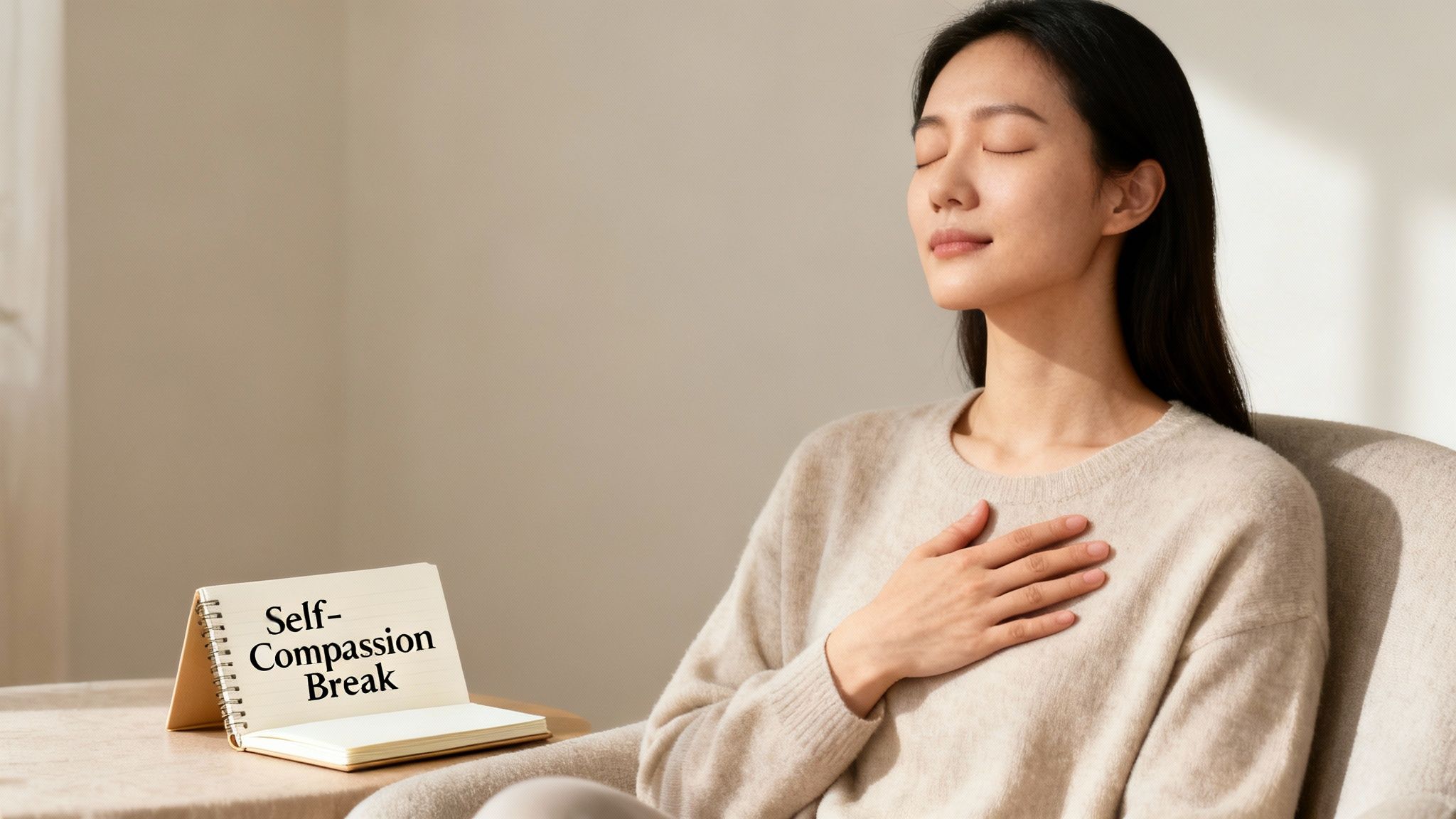
The Self-Compassion Break
If there's one exercise the book is known for, it's this one. It's a bit like emotional first-aid – something you can do anytime, anywhere, when things feel like they're starting to unravel. When you notice that familiar spike of stress, a wave of frustration, or that harsh inner voice, this three-step practice can bring you back to centre.
Here’s how it works:
- Acknowledge the Pain (Mindfulness): The first step is just to notice what’s happening without judgment. Say to yourself, silently or out loud, "This is a moment of suffering," or simply, "This is really hard." Just naming it validates the experience.
- Connect with Humanity (Common Humanity): Next, remind yourself that you're not alone in this feeling. We all struggle. You might say, "Suffering is just part of being human," or "Other people go through this too." This simple thought directly tackles that isolating feeling that it's just you.
- Offer Yourself Kindness (Self-Kindness): Lastly, bring some warmth to the situation. Place a hand over your heart or on your cheek – whatever feels comforting. Then, ask yourself, "What do I need to hear right now?" Maybe it's, "May I be kind to myself," or, "May I give myself what I need."
This short pause is powerful. It breaks the automatic loop of stress and self-criticism and replaces it with a moment of genuine care.
Soothing Touch
This one is incredibly simple, but don't underestimate its power. It works because it taps directly into our body's ancient caregiving system. Physical touch, even from ourselves, is proven to calm the nervous system and trigger the release of oxytocin – the hormone that helps us feel safe, bonded, and connected.
There’s no "right way" to do it. The only rule is to find what feels genuinely comforting and supportive for you.
- Hand on Heart: Gently rest one or both hands over your heart, feeling the warmth and gentle pressure.
- Cradling Your Face: Cup your face in your hands, like you would a small child you were trying to soothe.
- Stroking Your Arm: Slowly and gently stroke your own arm or hand.
- A Gentle Hug: Cross your arms and give yourself a gentle, reassuring squeeze.
Try combining this with a few slow, deep breaths. It’s especially helpful when you’re feeling anxious or disconnected, grounding you back in your body with an immediate sense of safety.
The power of soothing touch lies in its ability to bypass the critical mind and speak directly to our nervous system, reminding it that we are safe and cared for.
Affectionate Breathing
Many of these practices have roots in meditation, giving us a way to find calm and focus. Affectionate Breathing is a lovely, gentle entry point. It takes the simple anchor of the breath and infuses it with warmth and kindness, making it one of the most accessible meditation practices for anxiety.
Instead of just watching your breath, you actively bring compassion into it.
- Find a comfortable posture, sitting or lying down, and let your eyes close if that feels right.
- Bring your awareness to your breath, just noticing the natural in-and-out rhythm without trying to change anything.
- Imagine your breath is a loving presence, filling you with warmth, kindness, and ease on every inhale.
- As you exhale, picture yourself releasing tension, struggle, or any self-judgment you're holding onto.
- Keep this going for a few minutes, seeing each breath as a wave of compassion washing through you.
It's worth noting these aren't just 'nice ideas'; they're being taken seriously in professional settings. In the UK, their adoption in healthcare is on the rise. In 2024, NHS England reported that 12% of mental health trusts now incorporate interventions based on Mindful Self-Compassion. This follows research where 55% of participants using these kinds of exercises showed a 35% drop in burnout symptoms.
These exercises are just the beginning. If you feel you'd benefit from a more structured approach, exploring an online self-compassion course can offer deeper guidance as you work to make these skills a natural part of your daily life.
Who Is This Book Really For?
While anyone can benefit from a little more self-compassion, this book isn't a catch-all solution. It tends to hit home hardest for people caught in the relentless cycle of high-pressure living and that nagging inner critic. If any of the following descriptions sound familiar, this book might feel like it was written just for you.
You'll find it particularly powerful if you are:
- Your Own Harshest Critic: Is your inner voice a constant barrage of what you’re doing wrong? If you’re forever pointing out your own flaws and feel like you’re never quite good enough, this book provides a direct path to dialling down that noise.
- A Perfectionist: For those of us driven by the need to be flawless, the smallest slip-up can feel like a total disaster. The book helps dismantle that rigid, all-or-nothing thinking and introduces the genuine freedom that comes with self-acceptance.
- Struggling with Anxiety: When anxiety takes over, it often brings a nasty friend along for the ride: self-judgment for feeling anxious in the first place. The book offers practical tools to soothe your nervous system and learn to meet your anxiety with kindness instead of more fear.

Professionals in Caring Roles
If you work in healthcare, teaching, social work, or any role where you’re constantly giving your energy to others, you're at high risk of burnout and compassion fatigue. For you, this book is an essential piece of kit.
It teaches a fundamental truth: your capacity to care for others is directly tied to your ability to care for yourself. The practices within offer a way to top up your own emotional reserves, helping you sidestep the exhaustion that so often comes with demanding, caregiving jobs.
And the results aren't just anecdotal. A 2023 University of Cambridge trial with 300 students found that an incredible 51% saw a 25% reduction in perfectionism after just eight weeks with the book. You can discover more about the impact of Mindful Self-Compassion workbooks in the UK and how they’re being used in education and health settings.
Parents Navigating Stress and Guilt
Parenting is a rollercoaster of immense love, but also intense pressure, stress, and wave after wave of self-doubt. That feeling of "mum guilt" or "dad guilt" is a painful, and all-too-common, part of the journey. The ideas in this book are invaluable for any parent wanting to handle the inevitable chaos of family life with more patience and a lot less self-blame.
By learning to offer themselves compassion, parents can model emotional resilience for their children and create a more nurturing family environment, breaking cycles of self-criticism for the next generation.
Ultimately, this book is for anyone who is just plain tired of being at war with themselves. It lays out a gentle, practical, and surprisingly effective path toward building a kinder, more supportive relationship with yourself. And that, right there, is the foundation for a more resilient and fulfilling life.
Of course, here is the rewritten section with a more natural, human-expert tone, following the provided style guide.
Got Questions About Self-Compassion? Let's Clear a Few Things Up
Even when the idea of mindful self-compassion clicks, it’s completely normal for a few doubts to creep in. In fact, some very common misconceptions can become real roadblocks, stopping us from giving this approach a proper go.
So, let's tackle those nagging questions head-on. My aim here is to clear up the confusion so you can move forward with a bit more confidence and clarity.
Is This Just an Excuse for Bad Behaviour?
This is probably the biggest myth of them all, and I hear it a lot. The short answer? No, it's the complete opposite.
Think of it this way: self-pity is what keeps you stuck, endlessly replaying a mistake without ever doing anything about it. Self-compassion, on the other hand, gives you the emotional stability you need to actually solve the problem. It’s about taking responsibility, but with kindness rather than a stick.
When you hammer yourself with harsh self-criticism after a slip-up, you’re basically firing up your body's threat system. This makes it incredibly difficult to think clearly, let alone learn anything. A compassionate response does the reverse—it soothes your nervous system, which allows you to look honestly at what happened, learn the lesson, and figure out how to do better next time.
How Is Self-Compassion Different from Self-Esteem?
This is a great question because on the surface, they can sound quite similar. But when you look at their foundations, they are worlds apart.
Self-esteem is often conditional. It relies on what you’ve achieved, how you stack up against others, and whether you feel ‘better than’ someone else. You can see the problem here: it’s incredibly fragile. It can shatter the moment you fail, or even when someone else succeeds.
Self-compassion is unconditional. It’s an inner strength you can call on anytime, and it doesn't depend on your latest success or failure. It asks, "How can I support myself through this?" not "How do I measure up?"
Self-esteem is a fluctuating judgment of your self-worth, while self-compassion is a constant source of inner strength that is always available, especially when you need it most.
This makes self-compassion a far more stable and reliable source of resilience when life inevitably gets tough.
Do I Need Meditation Experience for This Book?
Not at all. While the practices in the mindful self compassion book have their roots in mindfulness, it has been written specifically with complete beginners in mind. Dr. Neff and Dr. Germer do a masterful job of introducing every concept gently and step-by-step.
You won't be asked to empty your mind or sit in silence for hours on end. The exercises are practical, accessible, and designed to be woven into the fabric of your daily life. This makes the whole programme feel approachable for absolutely anyone, regardless of whether you've ever meditated before.
How Long Until I Feel a Difference?
It’s really helpful to manage expectations here. Some of the exercises, like Soothing Touch, can offer an immediate sense of calm right in the middle of a stressful moment—which is fantastic. But the deep, lasting changes that self-compassion brings come from practising it consistently over time.
I often use the analogy of building a muscle at the gym. You wouldn't expect to see a huge difference after just one session, would you? But if you keep showing up, the results eventually become undeniable. This journey takes patience, but the inner strength you build is genuinely worth the commitment.
At Dr Chris Irons, we believe that developing a kinder, more supportive relationship with yourself is the foundation for a resilient and meaningful life. If you're ready to deepen your practice with expert guidance, feel free to explore our coaching and therapy options.