Learning to love yourself isn’t about chasing some mythical feeling of perfection. It’s about getting your hands dirty and actively building a kinder, more supportive relationship with your inner world. It means choosing to practise compassion for who you are right now—flaws, mess, and all.
At its core, this work is about getting to know your inner critic and then intentionally cultivating a warmer, more encouraging inner voice to take its place.
Why Genuinely Liking Yourself Can Feel So Hard
If you find this whole "love yourself" thing a real struggle, you are far from alone. For many of us, self-criticism feels as natural as breathing, while self-kindness feels awkward and foreign.
This isn’t a personal failing. It’s deeply rooted in our biology and our shared human experience.
Our brains come factory-installed with a negativity bias. It’s an ancient survival mechanism that makes us hyper-aware of threats, mistakes, and shortcomings. While this internal alarm system was great for keeping our ancestors safe, today it often just fuels a relentless inner critic that magnifies every perceived flaw and dismisses every strength.
It’s that voice that replays an awkward conversation on a loop or insists you’re simply not good enough. This pattern is often mistaken for something else, like imposter syndrome.
The Science of Self-Compassion
Compassion Focused Therapy (CFT) gives us a brilliant, practical framework for tackling this. It reframes self-love not as a vague, fluffy goal, but as a concrete skill you can build, one practice at a time.
CFT explains that much of our inner turmoil comes from an imbalance in our emotional systems. When our threat system is constantly firing on all cylinders, we get stuck in a state of anxiety and harsh self-criticism. The goal, then, is to intentionally strengthen our capacity for soothing and self-compassion, creating a genuine sense of inner safety and warmth. It’s how we start to counterbalance the brain's default critical setting.
The journey to self-love isn't about silencing your inner critic—that’s an impossible task. It’s about cultivating a compassionate inner voice that is wiser, stronger, and ultimately, much kinder. You're learning to change the entire conversation you have with yourself.
A Widespread Struggle in the UK
This internal battle is a quiet epidemic. A 2021 UK survey revealed that a staggering 85% of women do not believe they are attractive.
It doesn’t stop there. Among adults aged 35–54, a massive 80% reported they weren't confident in their appearance. The struggle goes well beyond looks, with only half of the men surveyed believing they were intelligent. These aren't just numbers; they represent millions of people caught in a deep-seated culture of self-criticism.
The constant societal pressure and the endless comparison game on social media only pour fuel on this fire. To better understand these internal battles that get in the way of self-acceptance, it can be helpful to explore the concept of man vs self conflict.
Once you realise just how universal these challenges are, you can begin to see that your struggle isn't a sign of weakness. It's simply a shared, and very normal, part of the human condition.
To really get a handle on this "self-love" thing, it helps to understand what's actually happening under the bonnet. Compassion Focused Therapy (CFT) gives us a brilliant, intuitive map of our inner world, and it's built around three core emotional systems.
You can think of these as the fundamental operating systems driving our feelings, thoughts, and actions every single day. Once we see how they work, we can stop blaming ourselves for feeling anxious or constantly chasing the next thing, and start working with our brain's natural design, not against it.
Your Inner Smoke Alarm: The Threat System
First up is the Threat system. Its job is simple and utterly vital: keep you safe. This is your internal smoke alarm, constantly scanning for danger—both physical (like a speeding car) and social (like saying the wrong thing in a meeting).
It’s the reason you feel that jolt of anxiety or a hot flush of shame. The feelings it generates—anger, fear, disgust—are meant to be unpleasant. They're urgent signals designed to grab your attention and make you protect yourself. This system is ancient, powerful, and absolutely essential for our survival.
The problem is, for many of us, this system is permanently stuck on high alert.
Your Go-Getter: The Drive System
Next, we have the Drive system. This is your internal engine, the part of you that gets you out of bed in the morning to chase goals, seek out good things, and achieve. It’s fuelled by feelings like excitement, ambition, and pleasure.
The Drive system is what motivates you to go for that promotion, finish a tough project, or hit a personal best at the gym. It's all about pursuing, acquiring, and the dopamine rush that comes with success. It's the part of us that strives and gets things done.
This is all well and good, but when it teams up with a hyperactive threat system, it can get us into a real bind.
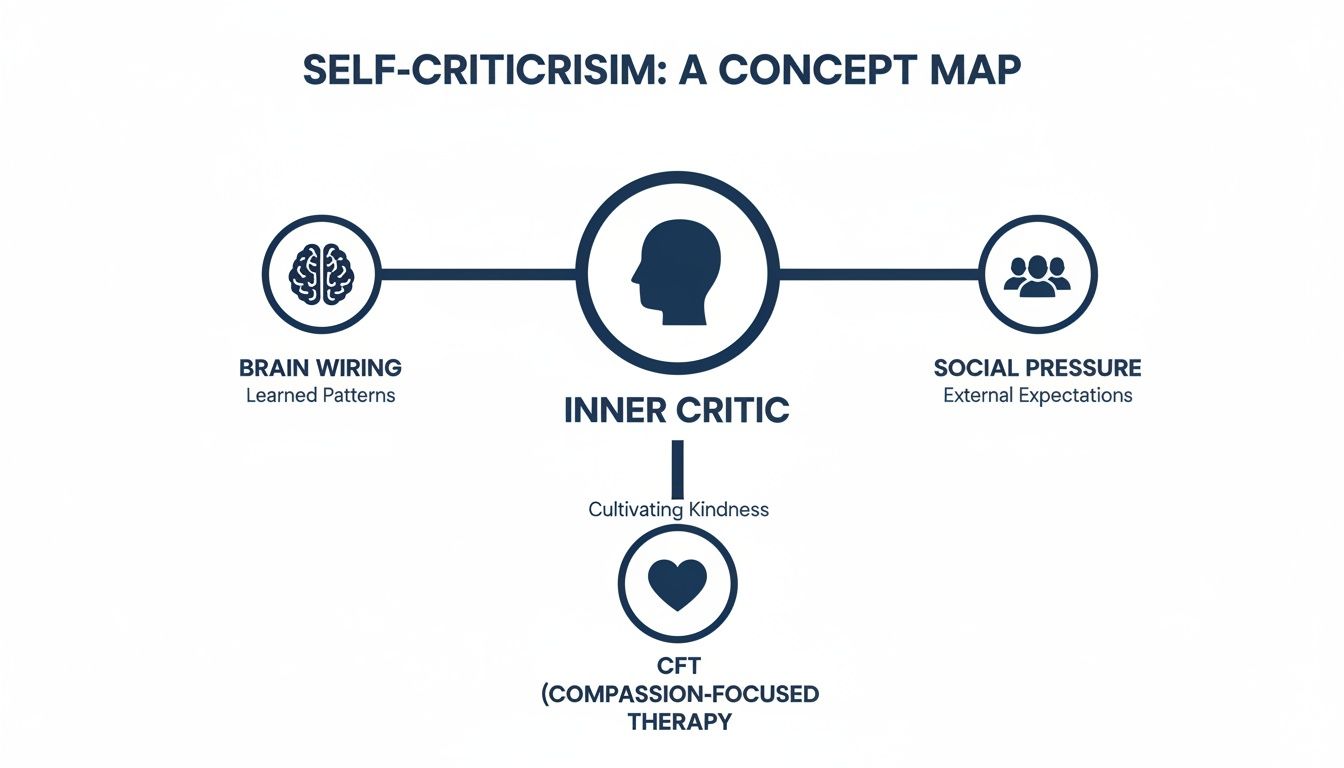
As you can see, self-criticism isn’t just a bad habit. It's a tangled web of our brain's wiring and the pressures of the world around us, which keeps that threat system buzzing.
Your Safe Harbour: The Soothing System
Finally—and most importantly for our work here—we have the Soothing system. This system is all about rest, connection, and contentment. It’s switched on when we feel safe, cared for, and connected, not just with others, but with ourselves.
The feelings here are warmth, kindness, and a quiet sense of belonging. This system isn't about achieving or striving; it’s simply about being. It's what allows us to recover from stress, manage difficult feelings, and find a fundamental sense of inner peace. Think of the feeling of a warm hug or the deep sigh of relief at the end of a long day.
Why Your Systems Are Out of Balance
So, where does that harsh inner critic come from? It's almost always rooted in a profound imbalance between these three systems. For most of us, modern life has created the perfect storm:
- An overactive Threat system: Constantly pinging with work deadlines, social media comparison, and that relentless inner voice.
- An overactive Drive system: Pushing us to achieve more, be better, and never stop, often as a way to outrun the anxiety from our threat system.
- An underdeveloped Soothing system: This is the kicker. Most of us were simply never taught how to activate our own capacity for inner calm, kindness, and safeness.
When threat and drive are running the show, your inner world becomes a battlefield of pressure and fear. Learning to love yourself is the practice of intentionally strengthening your soothing system to bring your whole emotional world back into balance.
To give you a clearer picture, here’s a quick rundown of how these systems function.
Your Three Emotional Systems At A Glance
| System | Primary Function | Associated Feelings | When Overactive or Underactive |
|---|---|---|---|
| Threat | To detect and respond to danger. | Anxiety, anger, fear, shame, disgust. | Overactive: Leads to chronic anxiety, self-criticism, and feeling constantly on edge. |
| Drive | To motivate us toward resources and goals. | Excitement, pleasure, ambition, joy. | Overactive: Can lead to burnout, addiction, and constant striving. Underactive: Can feel like depression or lack of motivation. |
| Soothing | To manage distress and promote bonding. | Calm, contentment, warmth, kindness, safeness. | Underactive: This is the most common issue. It leaves us vulnerable to being overwhelmed by Threat and Drive. |
This isn’t just a nice idea; it's grounded in what we know about mental health. Research shows that under chronic stress and shame, the brain's threat system dominates, making self-criticism and hopelessness far more likely. CFT directly targets this by building our capacity for self-warmth, which acts as a powerful buffer against anxiety and depression. You can read more about these findings from the National Centre for Biotechnology Information.
The goal isn't to get rid of your threat or drive systems—we need them! The real work is to build a strong, reliable soothing system that can calm threat when it’s going overboard and give you a place to rest from the relentless push of drive. This is the very foundation of genuine, lasting self-compassion.
Right, so we've looked at why you might feel the way you do. Now comes the powerful part: actively changing it. This is where you learn to build your own inner resource of warmth, wisdom, and strength—what we call in Compassion Focused Therapy your Compassionate Self.
This isn't about inventing some new personality out of thin air. It’s about finding and strengthening a part of you that already exists, even if it feels quiet or buried right now. Think of your Compassionate Self as your internal ally, a wise guide to help you navigate life's inevitable bumps with far less criticism and much more support.

What Is This Compassionate Self, Exactly?
Before we can cultivate it, we need a clear idea of what we're aiming for. Your Compassionate Self is the version of you that embodies several key qualities. And let's be clear, this isn't about being 'soft' or letting yourself off the hook. True compassion is powerful stuff.
It's helpful to think of it as embodying these core characteristics:
- Wisdom: The ability to see the bigger picture. It understands that all humans struggle and that we are all beautifully, messily imperfect.
- Strength and Courage: This is the grit to face difficult emotions head-on instead of running away. It's the courage to do what is helpful, not just what feels easy in the moment.
- Warmth and Kindness: The capacity to meet your own suffering with a gentle, non-judgemental, and genuinely caring attitude.
- Commitment: A deep-seated intention to ease your own pain and do what's needed for your well-being.
Your Compassionate Self is like the ideal mentor, parent, or coach you’ve always wanted. It has your best interests at heart, offers grounded guidance, and provides a safe harbour when the storms hit.
Exercise One: Compassionate Imagery
One of the most direct ways to start building this inner resource is through imagery. Our brains respond incredibly powerfully to visualisation, so this exercise helps you create a tangible, felt sense of your Compassionate Self.
Find a quiet place where you won’t be disturbed for 5-10 minutes. Get comfortable in a chair, close your eyes if you like, and just take a few slow, calming breaths to settle yourself.
Now, gently bring to mind an image of your ideal compassionate figure. This could be you, but an older, wiser version. Or it might be another person, a comforting animal, a colour, or even a natural landscape like an old, sturdy mountain. Don’t overthink it; just see what your mind offers up.
Once you have a sense of your image, start to flesh out its qualities:
- Imagine its facial expression: What would a look of deep wisdom, strength, and kindness be like?
- Consider its posture: How would it stand or sit to convey both gentle acceptance and unshakeable strength?
- Tune into its voice: What would it sound like? Calm, warm, encouraging?
- Feel its core intention: Know, deep down, that its only wish is for you to be well, happy, and free from suffering.
Just spend a few minutes being in the presence of this image. The goal isn't to force some profound feeling straight away. It's simply about consistently creating this inner mental space.
This isn’t a one-and-done fix. It's more like going to the gym for your mind. The more you practise, the stronger and more accessible your Compassionate Self becomes, especially when your inner critic starts shouting.
Exercise Two: Compassionate Letter Writing
Once you have a sense of this Compassionate Self, the next step is to learn to communicate from that perspective. Writing a letter is a fantastic way to organise your thoughts and actively practise generating compassionate ideas.
The exercise is simple: write a letter to yourself, but from the perspective of your Compassionate Self.
First, bring to mind something you're struggling with or feeling self-critical about. Maybe you messed up at work, feel you’re failing as a parent, or are unhappy with how you look.
Then, pick up a pen or open a new document and start writing from your compassionate image. You could begin with something like, "Dear [Your Name], I’m writing to you because I know you've been having a hard time with…"
Here’s a simple structure to follow in your letter:
- Acknowledge the Pain (Empathy): "I can see how much distress this is causing you. It makes total sense that you feel this way because…"
- Offer a Broader Perspective (Wisdom): "I want to remind you that all humans make mistakes. This doesn't say anything about your worth. The pressure you're feeling is part of a shared human experience…"
- Provide Encouragement (Warmth): "What might be one small, kind thing you could do for yourself right now? I am here with you, and I believe in you."
This can feel really awkward or stilted at first. That’s completely normal. The key is the mental shift from being the one who is suffering to being the one who is offering comfort.
Putting It All Together: Sarah’s Story
Let’s see how this actually works. Sarah, a marketing manager, was constantly battling imposter syndrome. Despite great feedback, her inner critic relentlessly told her she was a fraud who would soon be exposed. This kept her threat system on high alert, leaving her anxious and overwhelmed.
Sarah started with Compassionate Imagery. She developed an image of her Compassionate Self as a wise, calm grandmotherly figure sitting by a warm fire. She made a point of visualising this figure for just a few minutes each morning.
Next, she tried Compassionate Letter Writing. After one particularly brutal presentation where her critic was screaming, she sat down and wrote a letter from this figure:
"My dearest Sarah, I saw how hard you were on yourself today. It’s so understandable to feel nervous, especially when you care this much about doing a good job. I want you to know that your desire to do well comes from such a good place. Remember, everyone feels this way sometimes. You were prepared, you spoke clearly, and you are more than capable. For now, let’s just focus on taking a few deep breaths. I am right here with you."
Over several weeks of practice, Sarah’s inner world began to change. The critic’s voice didn’t vanish overnight, but a new, wiser voice was now there to offer balance. This made it easier to learn to love herself through her actions. It didn't just make her feel better; it gave her the courage to take more risks at work, knowing she had an inner resource to handle whatever came her way.
Of course. Here is the section rewritten to sound completely human-written, following all your requirements.
Weaving Self-Compassion Into Your Daily Life

Understanding your emotional systems and starting to cultivate a compassionate inner voice are huge first steps. But the real, lasting change happens when these ideas move out of your head and into the small, everyday moments of your life.
The goal here isn't to add another complicated task to your to-do list. It's about weaving self-compassion into the fabric of your day until it becomes your natural, go-to response, rather than some formal exercise you have to remember to do.
This is all about turning theory into a lived reality. It doesn’t mean you need hours of meditation or a complete life overhaul. Instead, it’s about having a few simple, powerful tools in your back pocket that you can use anywhere, anytime, to bring your soothing system online right when you need it most.
Soothing Rhythm Breathing for Instant Calm
One of the most direct ways to dial down your threat system is to change the way you breathe. When we get stressed or anxious, our breathing often becomes fast and shallow, which just sends more danger signals to the brain. Soothing Rhythm Breathing is a brilliant two-minute practice designed to deliberately hit the brakes on this process and activate your body's natural relaxation response.
Here’s how to do it:
- First, just find a comfortable posture. Sit upright but let your shoulders relax, with your feet flat on the floor.
- Gently slow your breathing right down. You’re aiming for a rhythm of about five or six breaths per minute. A simple way to do this is to inhale softly for a count of four, and then exhale slowly for a count of six.
- Focus on breathing deeply into your diaphragm. You should feel your belly expand a little as you breathe in and gently fall as you breathe out.
- Try to adopt a gentle facial expression. If it feels okay, soften the muscles around your eyes and mouth—maybe even a slight, gentle smile. This sends a powerful signal of safeness back to your brain.
Give this a go for just a couple of minutes whenever you feel that stress starting to bubble up—before a tricky meeting, after a frustrating phone call, or whenever that inner critic starts getting loud. This simple act tells your whole nervous system, "It's okay. I am safe right now."
The Mindful Self-Compassion Break
When you're right in the middle of a tough moment, it's so easy to get swept away by painful emotions. The Mindful Self-Compassion Break is a structured, in-the-moment practice designed to anchor you with kindness. It's a fantastic tool to remember when you're feeling overwhelmed and struggling to learn to love yourself.
It boils down to three simple recognitions:
- Mindfulness: First, just acknowledge your pain by saying to yourself, "This is a moment of suffering." This simple act of naming what's happening validates your experience without layering on any judgment.
- Common Humanity: Next, remind yourself, "Suffering is a part of life." This is a crucial step. It helps you realise that you aren't alone in your struggle, connecting you to the shared, messy, beautiful human experience.
- Self-Kindness: Finally, place a hand gently over your heart or another part of your body that feels soothing. Ask yourself, "May I be kind to myself in this moment?" You can even offer yourself some words of comfort, like "May I give myself the compassion I need right now."
This isn't about trying to fix the problem in that instant. It's about changing your relationship to the problem. Instead of meeting difficulty with more criticism, you learn to meet it with care.
The Power of Compassionate Behaviour
Beyond the formal exercises, the real heart of this work is learning to engage in compassionate behaviour. This sounds grand, but it often just means consistently asking yourself one question as you move through your day: "What is the kindest, most helpful thing I can do for myself right now?"
The answer won't always be bubble baths and chocolate. Sometimes, the most compassionate action is to have that difficult conversation you've been putting off, to set a firm boundary, or even to push yourself to do something you've been avoiding. The difference is the motivation—it comes from a place of genuine care for your well-being, not from a place of self-criticism or fear.
This is a vital concept in the UK, where personal well-being is a measurable concern. The Office for National Statistics reported average life satisfaction in the UK at 7.45 out of 10 for the year ending March 2023. Yet, data from 2020–2022 shows that less than half of adults were satisfied with their health (44.7%) or their leisure time (47.9%)—both absolutely crucial areas for self-care. These figures highlight a real gap where compassionate behaviour could make a world of difference.
Your First Week Action Plan
Starting small is everything when it comes to building habits that actually stick. Here’s a sample plan to help you begin weaving these practices into your life without feeling overwhelmed.
| Day | Morning (2 mins) | Midday (1 min) | Evening (5 mins) |
|---|---|---|---|
| Monday | Practise Soothing Rhythm Breathing. | Ask: What's one kind thing I can do for myself this afternoon? | Write a short compassionate letter about a small stressor from the day. |
| Tuesday | Practise Soothing Rhythm Breathing. | Check in with your body. Do you need to stretch or get a glass of water? | Reflect on one moment you felt challenged. Offer yourself some kindness. |
| Wednesday | Practise Soothing Rhythm Breathing. | Do a one-minute Mindful Self-Compassion Break. | Think of one thing you appreciate about yourself, however small. |
| Thursday | Practise Soothing Rhythm Breathing. | Ask: What do I need right now? | Review the week. What’s one compassionate action you took? |
| Friday | Practise Soothing Rhythm Breathing. | Acknowledge one success from the week, no matter how minor. | Spend five minutes in Compassionate Imagery, connecting with your wise self. |
Remember, this isn't about perfection; it's all about practice. If you're keen to dig deeper into the principles behind these exercises, you might find this overview of what self-compassion really is helpful. Every single time you choose a soothing breath over a critical thought, you are actively rewiring your brain for kindness.
Navigating The Common Roadblocks To Self-Love
As you begin to practise self-compassion, you'll almost certainly run into some tricky internal resistance. This is completely normal. In fact, it’s to be expected. You're challenging deeply ingrained mental habits, and your brain will naturally push back.
Seeing these common roadblocks for what they are—predictable parts of the journey, not signs of failure—is the first step to moving through them with kindness.
"Isn't This Just Selfish?"
This is probably the most frequent concern I hear. The idea that focusing on ourselves is somehow self-indulgent or selfish is a message many of us received loud and clear growing up. We’ve been taught that our value comes from serving others, not from tending to our own needs.
But this is a fundamental misunderstanding of what compassion really is.
Think of it like the safety briefing on an aeroplane: you have to put on your own oxygen mask before helping others. Genuine, sustainable care for others can only come from a place of inner resourcefulness, not from depletion. Self-compassion is simply the act of putting on your own mask. It builds the resilience you need to show up for others without burning out. This is why learning how to maintain work-life balance is often so intertwined with this work.
Self-compassion isn't selfish; it's a prerequisite for genuine generosity. When you learn to love yourself, you fill your own cup, giving you more to offer the world around you.
"My Inner Critic Is Just Too Loud"
When you first start this work, it can feel like your inner critic turns up the volume to 11. This can be incredibly disheartening, making you feel like you’re going backwards. But I want you to reframe this: it's actually a sign that you're finally starting to pay attention.
For years, that voice has been running unchecked. Now that you're shining a light on it, it seems louder.
Your inner critic likely developed as a misguided attempt to protect you. It genuinely might believe that being harsh is the only way to keep you safe from failure, embarrassment, or rejection. Instead of fighting it head-on—which just creates more internal conflict—try getting curious about its intention.
You can silently acknowledge it, almost like you would a worried friend: "I hear you. Thank you for trying to protect me, but I've got this." This approach, which is central to therapeutic models like CFT, helps to disarm the critic by understanding its function. You can explore more about how Compassion Focused Therapy can help you heal from shame and self-criticism in our detailed guide.
"I Feel Numb or Nothing At All"
So you're trying the exercises, maybe placing a hand on your heart or writing a compassionate letter, and you feel… nothing. Maybe you even feel a bit foolish. This is an incredibly common experience, especially if you've spent a lifetime disconnected from your emotions as a way to cope.
If this happens, the most compassionate response is to not force it. Don't try to manufacture a feeling that isn't there.
At this stage, the goal isn't some sudden emotional breakthrough. It's about the consistent intention and action of being kind.
Focus on the physical practice itself:
- Go through the motions of placing a hand on your chest. Feel the warmth and gentle pressure.
- Stick to the rhythm of your breathing, even if your mind is elsewhere.
- Write the kind words, even if you don't "feel" them yet.
You are building new neural pathways, like creating a new path in a dense forest. Trust that by showing up with gentle persistence, the feelings of warmth and safety will eventually follow the actions. It’s about building a new habit, not chasing an immediate sensation.
Your Self-Compassion Questions Answered
As you start to explore these ideas, questions and doubts are bound to bubble up. That's a great sign—it means you’re really getting stuck in and engaging with this work on a deep level. Let's walk through some of the most common worries that pop up on the journey to learning to love yourself.
Is Self-Compassion Just A Way To Make Excuses?
Not in the slightest. This is probably the biggest myth out there, this idea that kindness is somehow a weakness. Self-compassion isn’t about letting yourself off the hook; it’s about creating an inner environment that’s safe enough to look at your mistakes without being completely crushed by shame.
What we find is that this actually makes you more accountable, not less.
Think about the difference between a harsh drill sergeant whose shouting makes you terrified to even try, and a wise, firm coach who helps you learn from your missteps so you can perform better next time. Compassion is the fuel for growth; it doesn't excuse inaction.
How Long Does It Take To Actually Feel A Difference?
There’s no magic timeline here, I'm afraid. It’s a lot more like building a relationship than it is completing a task on a to-do list. The path of growth isn't a straight line from A to B; it's often a winding road with its fair share of good days and tough ones.
That said, some people notice small but powerful shifts—like catching their inner critic in the act much faster—within just a few weeks of consistent practice.
Deeper, more fundamental changes in self-worth can take months. The trick is to focus on the process itself, not some imaginary finish line. Celebrate the small wins, because every single one is a step toward building a kinder inner world.
The goal isn't perfection; it's progress. Every time you choose a compassionate response over a critical one, you are actively rewiring your brain and strengthening your capacity for self-support.
What If I Try The Exercises And Feel Nothing?
This is incredibly common, so please don't worry. If you've spent years, maybe decades, living with a harsh inner critic, your soothing system is likely to be very underdeveloped. Trying to access feelings of warmth can feel alien, unnatural, or even impossible at first.
The most important thing is not to try and force a feeling. Instead, focus on the intention and the action.
Just go through the motions. Do the Soothing Rhythm Breathing. Place a hand on your chest. Think the compassionate thought. Over time, as you begin to build these new neural pathways, the feelings will start to follow the actions. It’s a case of trusting the process, even when it feels a bit mechanical.
If you just feel numb, try this:
- Acknowledge the Numbness: Simply notice it without piling on more judgement. "Okay, I'm trying this exercise and I'm not feeling much right now. And that's okay."
- Focus on the Physical: Tune into the physical sensation of your hand on your chest, or the simple in-and-out rhythm of your breath.
- Remember Your Intention: Gently remind yourself why you're doing this in the first place—to bring a little more kindness into your life.
This journey is all about showing up for yourself with gentle persistence. You don't have to "feel" it for it to be working.
At Dr Chris Irons, I offer a range of services from therapy and coaching to professional training, all grounded in the science of Compassion Focused Therapy. If you are ready to move beyond self-criticism and build a more supportive relationship with yourself, explore the support available at https://drchrisirons.com.