So, what exactly is leadership coaching for executives?
At its core, it's a completely confidential, one-on-one partnership. It’s designed to help already high-performing leaders find new perspectives, challenge their own assumptions, and seriously amplify their impact.
Think of it this way: a world-class athlete would never dream of competing without a coach to push them, refine their technique, and help them see the game from a different angle. It's exactly the same for an executive. Coaching is how you navigate the immense complexity of leadership with greater clarity and skill.
Decoding Executive Leadership Coaching

Your executive coach is your strategic thought partner. Their job isn’t to hand you a list of answers; it’s to ask the powerful, sometimes difficult, questions that help you uncover your own answers. It’s a forward-looking process, entirely focused on sharpening your leadership capabilities and boosting your professional effectiveness.
The entire relationship is built on a bedrock of trust and confidentiality. This creates a rare, safe space where you can explore tough challenges, test out new ideas, and build genuine self-awareness without any fear of judgement. The focus is always on you and your growth, helping you close the gap between where you are now and where you truly want to be.
What Coaching Is Not (And Why It Matters)
It's really important to get clear on what executive coaching isn't, as the lines can sometimes get blurred.
Let’s be direct: coaching is not therapy. Therapy often delves into your past to heal emotional wounds and address mental health conditions. It's also not consulting, where you hire an external expert to come in and solve a specific business problem for you. And it's different from mentoring, where a seasoned professional shares advice and wisdom drawn directly from their own career path.
To make this distinction clearer, it helps to see how these disciplines stack up against each other.
Executive Coaching Compared to Other Development Models
| Discipline | Primary Focus | Relationship Dynamic | Key Outcome |
|---|---|---|---|
| Executive Coaching | Future potential & performance | Partnership of equals | Self-generated insight & action |
| Consulting | Specific business problems | Expert & client | A delivered solution or report |
| Mentoring | Career guidance & advice | Senior & junior | Knowledge transfer & networking |
| Therapy | Emotional healing & mental health | Clinician & patient | Psychological well-being |
This table shows how each model serves a very different purpose. Executive coaching is the only one designed to empower you—the leader—to develop your own solutions by acting as a catalyst for your thinking, not a director of your actions.
The Modern Imperative for C-Suite Coaching
The pressures on senior leaders today are just immense. Decision fatigue is real. Strategic isolation can set in at the top. The sheer weight of responsibility can create significant blind spots that you simply can't see on your own.
This is precisely why leadership coaching for executives has shifted from a 'fix-it' tool for struggling managers to an essential part of any successful modern leader's toolkit.
The growth in the field backs this up. In the UK, the business coaching sector has exploded right alongside a boom in new businesses. An incredible 890,500 new businesses were registered in 2023-24, which is up more than 11% from the year before. This entrepreneurial surge has only intensified the demand for specialised coaching, cementing its role as a key strategic advantage. If you're interested in the numbers, you can find more data on the UK's business coaching sector from The British Franchise Association.
Ultimately, coaching gives you that dedicated space and objective perspective you need to:
- Refine Strategic Thinking: Get out of the weeds, challenge your own assumptions, and gain real clarity on complex business issues.
- Enhance Emotional Intelligence: Build deeper self-awareness, improve empathy, and strengthen your ability to manage key relationships.
- Build Resilience: Develop practical strategies to manage stress, navigate pressure, and prevent burnout before it takes hold.
- Drive Organisational Impact: See how your personal growth translates directly into stronger team performance and better business outcomes.
What Does Executive Coaching Actually Deliver?
Let’s move beyond the theory. What are the tangible, real-world results you get from investing in leadership coaching? These aren’t abstract concepts; they’re concrete advantages that directly address the intense, often unique pressures that come with a senior leadership role. For many executives, the journey to the top is surprisingly isolating, a place defined by a constant stream of high-stakes decisions.
Think of a coach as a confidential thought partner. They create a dedicated space where you can untangle complex challenges, completely free from the internal politics and biases that are part of any organisation. This objective perspective is invaluable. It helps you sharpen strategic clarity, spot potential blind spots before they become expensive mistakes, and pressure-test ideas in a genuinely secure environment. It’s a powerful antidote to the echo chamber that so easily forms around a senior leader.
Building Your Psychological Armour for Leadership
One of the most profound benefits of executive coaching is the development of what I call psychological armour. This isn't about becoming hardened or unfeeling—quite the opposite. It’s about building the inner resilience needed to lead effectively when the pressure is immense. The goal is to manage stress proactively, quiet that persistent inner voice of imposter syndrome, and transform harsh self-criticism into constructive self-awareness.
This process directly boosts emotional regulation, a cornerstone of any great leader. When you can remain centred and thoughtful during a crisis, that calm confidence cascades throughout your entire team. This stability is absolutely crucial for fostering an environment where people feel safe enough to innovate and perform at their best.
A huge part of coaching is shifting from a state of constant reaction to one of considered, intentional action. It’s the difference between being pulled along by the currents of the business and steering the ship with a steady hand, no matter how rough the storm gets.
Of course, executive coaching also focuses on tangible skills, like learning how to effectively build executive presence and command a room. This isn't just about polishing your presentation style; it's about embodying a level of confidence and authenticity that naturally inspires trust and gets people on board.
Translating Personal Growth into Business Outcomes
The personal development you gain through coaching translates directly into measurable business results. A leader who is more self-aware, resilient, and strategically clear simply makes better decisions, builds stronger teams, and drives more sustainable growth. The impact ripples across several key areas of the business.
Recent findings really underscore this connection. The 2025 Coaching Trends Report highlights that UK organisations with systematic leadership coaching saw 25% stronger business outcomes, a figure made even more significant by our local economic volatility. This data suggests coaching provides a stabilising effect, helping leaders balance the relentless demands of technology with essential human connection. You can read the full analysis of leadership coaching trends on executive-coaching.co.uk to see how these dynamics are shaping modern leadership.
These benefits show up in practical, observable ways within an organisation:
- Improved Team Performance: Leaders with higher emotional intelligence are simply better communicators and motivators. The result? More engaged and productive teams.
- Higher Employee Retention: Great leadership is one of the main reasons people stay in a job. Coaching helps leaders create cultures where talented people want to stick around and grow.
- Enhanced Strategic Agility: By gaining clarity and perspective, executives are far better equipped to anticipate market shifts and pivot their strategies effectively.
- Stronger Decision-Making: Coaching provides a solid framework for evaluating options more objectively, reducing the impact of bias and decision fatigue on critical choices.
Ultimately, executive coaching isn’t a remedial fix for struggling leaders. It’s a strategic tool for optimisation. It equips exceptional leaders with the psychological and strategic frameworks they need not just to survive the pressures of the role, but to truly thrive within them, creating a lasting, positive impact on their organisation and their own professional journey.
How Compassion Forges Stronger Leaders
In the cut-and-thrust world of executive leadership, the idea of ‘compassion’ can feel a bit soft. It might even sound like an excuse for underperformance. But my work with senior leaders shows the exact opposite is true. Far from being a weakness, compassion—especially self-compassion—is a deep well of strength, resilience, and genuine courage. It’s the bedrock of sustainable high performance.
Think about the safety briefing on an aeroplane: you have to fit your own oxygen mask before helping others. It’s not selfish; it’s a non-negotiable prerequisite for being able to help anyone else effectively. The same logic applies to leadership. You simply can't lead, inspire, or support your teams if you're running on fumes, battling burnout, or caught in a loop of harsh self-criticism.
The Three Pillars of Self-Compassion in Leadership
Integrating self-compassion doesn't mean letting yourself off the hook when things go wrong. Not at all. It's about fundamentally changing how you relate to those inevitable setbacks. A coach helps you build this crucial skill by focusing on three core pillars, which you can read more about by exploring the fundamentals of self-compassion and its benefits. This framework gives you a practical way to manage the intense pressures that come with a C-suite role.
These pillars are:
- Kindness Over Self-Judgement: This means treating failures with understanding, not a barrage of internal criticism. It’s about acknowledging a mistake was made without branding yourself a failure.
- Recognising Shared Humanity: This is the simple but powerful understanding that to be human is to be imperfect. Everyone struggles. This insight helps to cut through the profound sense of isolation that often stalks senior leaders.
- Mindfulness and Balance: This is about observing your difficult thoughts and feelings without letting them hijack you. It allows you to keep your perspective and make clear-headed decisions, even when the pressure is on.
An executive coach works with you to turn these ideas into real, tangible leadership behaviours. They help you cultivate an inner dialogue that is supportive and constructive, rather than one that tears down your confidence precisely when you need it most.
From Self-Criticism to Constructive Action
Let’s play out a common scenario. Imagine a major product launch underperforms. The self-critical leader immediately spirals. Their inner voice might sound like, "I blew it. My strategy was wrong, and I've let everyone down." This kind of thinking inevitably leads to defensiveness, blame-shifting, and a deep-seated fear of taking future risks. It shuts down learning and creates a culture of fear.
Now, let's look at a leader who has been practising self-compassion. They'd approach the same setback from a completely different place. Their internal monologue, shaped through coaching, would be more like: "Okay, this is disappointing and incredibly frustrating. But setbacks happen, and this is a chance to learn. What is the data telling us? How can we pivot and get the team focused on what's next?"
This shift is monumental. It reframes failure from a personal indictment into a valuable source of strategic intelligence. It builds psychological safety, empowering your team to innovate without being paralysed by the fear of what happens if they get it wrong.
By learning to treat yourself with the same fairness and encouragement you’d offer a trusted colleague, you build the muscle to navigate adversity with composure and strength. This isn't soft; it's smart. It's also the key to preventing burnout—leaders who practice self-compassion consistently report lower levels of stress and emotional exhaustion.
Cultivating a Compassionate Organisational Culture
The ripple effects of this internal work travel far beyond your own office. When you lead from a place of self-compassion, you are modelling a healthier, more resilient way of working for your entire organisation. Your ability to handle pressure with balance and view setbacks as learning opportunities sets the cultural tone.
This creates a powerful, positive feedback loop:
- You feel less stressed, which frees you up to be more present and supportive for your people.
- Your team feels psychologically safer, which unleashes their creativity and engagement.
- The organisation becomes more resilient and better equipped to adapt to challenges and grab opportunities.
Ultimately, leadership coaching centred on compassion gives you a robust internal operating system. It provides the tools to manage your own inner world so you can lead the outer world with greater clarity, courage, and impact. It’s the strategic advantage that allows you to not just perform, but to thrive for the long haul.
Your Executive Coaching Journey From Start to Finish
Stepping into an executive coaching engagement can feel a bit like heading into the unknown. What really happens in those sessions? Far from being mysterious, it’s a structured, collaborative journey designed to create lasting, meaningful change. Knowing the roadmap, from the first chat to the final review, helps make sense of it all.
The whole thing kicks off with what we call a ‘chemistry check’. This is simply an informal but absolutely vital conversation where you and a potential coach get a feel for one another. The aim is straightforward: figure out if there's a genuine connection. Trust is the bedrock of any powerful coaching partnership, and this is where you decide if it’s there. It's your chance to ask direct questions about their style, their background, and how they work.
The Discovery and Goal-Setting Phase
Once you’ve found the right coach, the work begins with a discovery phase. Think of this as a deep dive into your world as a leader. It's all about giving your coach a 360-degree view of your strengths, your sticking points, and the specific landscape you’re navigating every day.
This phase usually involves a few key elements:
- In-depth interviews to explore your career path, your current role, and where you want to go next.
- Stakeholder feedback, which often means confidential chats with your direct reports, peers, or even board members to get a rounded view of your leadership impact.
- Psychometric assessments to offer objective data on your leadership style, communication habits, and emotional intelligence.
After this deep dive, you and your coach will work together to set clear, compelling goals. These aren’t just vague objectives; they're highly personalised targets that connect your own development directly to real business outcomes. This is a collaborative effort, ensuring you have total ownership of where the journey is headed.
How you show up as a leader is also a huge part of this work. As you develop, you might explore how to consciously shape your public image and presence. Learning effective strategies for building a strong personal brand can be a powerful complement to your coaching.
The Rhythm of Coaching Sessions
With clear goals in place, you’ll settle into a regular rhythm of coaching sessions. These typically last 60-90 minutes and happen every few weeks, creating the steady momentum needed for real progress. Each session is a confidential, focused space dedicated entirely to your growth. While every conversation is different, a typical 60-minute session usually has a clear flow.
A key theme that often comes up in our work is self-compassion. It's made up of three core components: kindness, recognising our shared humanity, and mindfulness, as shown below.
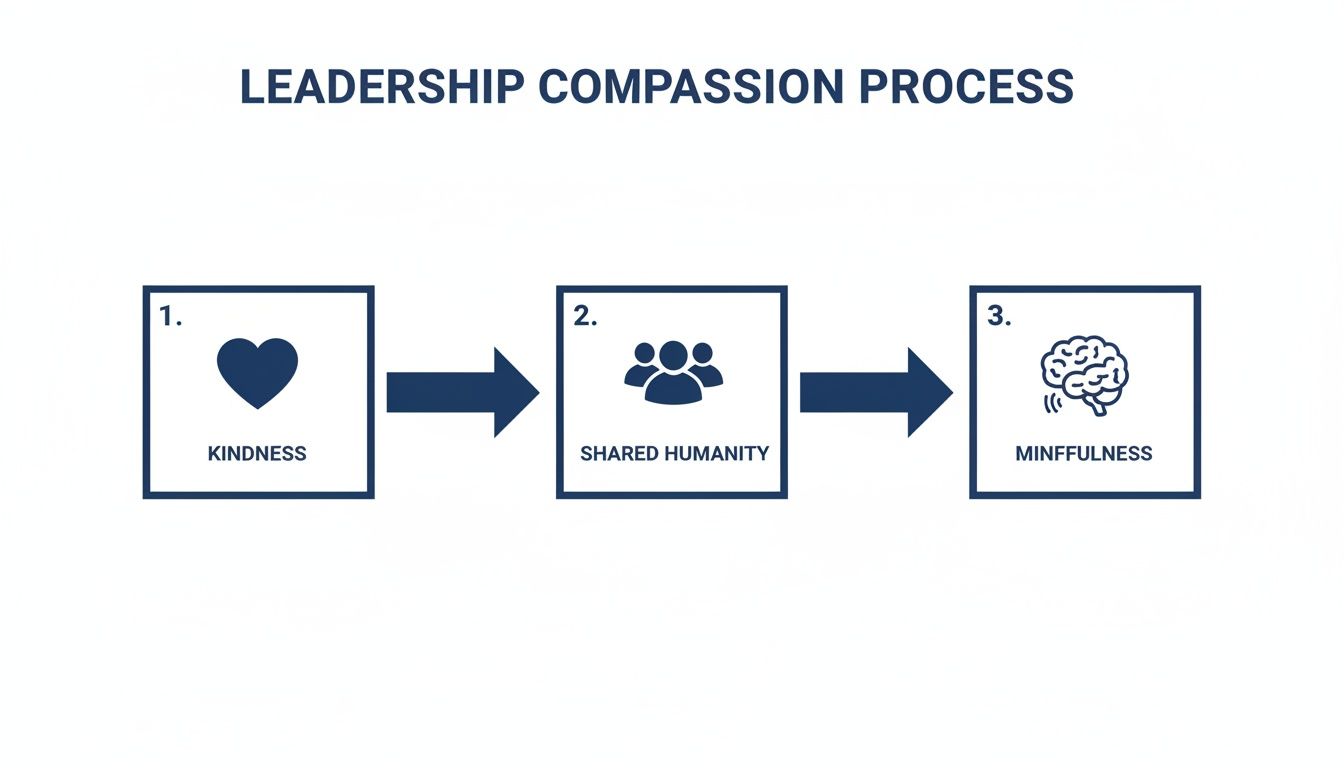
These three elements work together to build a more resilient and balanced way of tackling the leadership challenges we discuss in coaching sessions.
A typical session structure might look something like this:
- Check-in and Progress Review (10 mins): We'll start by talking through what’s happened since our last meeting—celebrating wins and tackling any roadblocks.
- Agenda Setting (5 mins): You'll decide on the most important issue or opportunity you want to focus on for the rest of the session.
- Core Challenge Exploration (25 mins): This is the heart of the conversation. I'll use powerful questions to help you see the issue from new angles, challenge old assumptions, and unlock fresh insights.
- Action and Commitment (15 mins): We then shift from insight to action. You'll brainstorm options and define clear, practical steps you commit to taking before we next meet.
- Wrap-up and Key Takeaways (5 mins): We finish by summarising your key learnings and cementing your action plan.
This structured yet flexible approach makes sure every conversation moves you forward. The engagement wraps up with a final review, where we’ll look back at the progress you've made against your original goals and build a plan to keep that growth going long after our work together is done.
Calculating the ROI of Your Coaching Investment

It’s easy to see leadership coaching for executives as just another line item on the budget. But it's far more than that. It’s a direct investment into the most critical asset your organisation has: its leadership. While the personal growth is profound, the real question every business leader asks is, "What's the return?" How do you possibly measure the impact of better decision-making or a boost in team morale in pounds and pence?
The secret is to stop thinking of these benefits as purely ‘soft’ skills and start connecting them directly to hard business metrics. Right from our very first coaching session, we can build a framework to track progress against tangible, specific outcomes. This approach turns abstract goals into a clear-cut business case, showing the powerful financial and operational ripple effect of high-level leadership development.
Linking Coaching to Key Performance Indicators
The most straightforward way to measure ROI is by tying coaching goals to your existing Key Performance Indicators (KPIs). Before we even start, we’ll pinpoint the core business challenges you want to solve. Are you trying to reduce costly staff turnover? Speed up project delivery times? Or maybe improve sales conversion rates?
By defining these target metrics upfront, coaching becomes a highly focused, strategic intervention. For example, if a leader’s goal is to improve team engagement, we can track metrics like staff retention rates, absenteeism, and pulse survey scores before, during, and after the coaching programme. This creates a clear line of sight, directly connecting the coaching work to your bottom-line results.
Measuring Both Quantitative and Qualitative Gains
A complete picture of ROI looks at both the numbers and the narrative. The quantitative data gives you the hard evidence, but it's the qualitative insights that explain the ‘how’ and ‘why’ behind those improvements. Together, they paint a full picture of the investment’s value.
A common mistake is to dismiss qualitative improvements like ‘better communication’ or ‘stronger executive presence’ as unmeasurable. In reality, these gains are often the direct drivers of significant quantitative shifts in business performance.
You can track both with a structured approach:
- Quantitative Metrics: These are the numbers you can count. Think of improved departmental productivity, a jump in revenue per employee, or a drop in recruitment costs because fewer people are leaving.
- Qualitative Metrics: These are the changes you can observe. We can measure these through stakeholder interviews or 360-degree feedback, assessing improvements in areas like strategic thinking, conflict resolution, and team collaboration.
To make this process clearer, here's a look at how organisations can translate coaching efforts into measurable outcomes.
Key Metrics for Evaluating Coaching ROI
| Metric Category | Example Metrics | Method of Measurement |
|---|---|---|
| Financial & Productivity | – Increased Revenue/Sales Growth – Reduced Operational Costs – Improved Profit Margins – Project Completion Rates |
– Financial Statements – P&L Analysis – Project Management Software Data |
| Employee Engagement & Retention | – Staff Turnover Rate – Employee Absenteeism – Engagement Survey Scores (e.g., eNPS) – Internal Promotion Rate |
– HR Information Systems (HRIS) – Anonymous Employee Surveys – Performance Review Data |
| Leadership Effectiveness | – 360-Degree Feedback Scores – Team Performance against KPIs – Stakeholder Feedback (Board, Peers) – Decision-Making Speed & Quality |
– Formal 360-Degree Assessments – Departmental Performance Reports – Structured Interviews |
| Customer Satisfaction | – Net Promoter Score (NPS) – Customer Churn Rate – Customer Lifetime Value (CLV) – Client Testimonials/Reviews |
– CRM Data & Customer Surveys – Sales & Marketing Analytics – Direct Client Feedback |
This structured approach ensures you capture the full spectrum of benefits, creating a powerful story backed by solid data.
This isn't just theory. Executive coaching in the UK has a proven track record. Leaders in structured programmes see 2.2 times faster growth and achieve 4 times greater business longevity. This lines up with broader trends showing that 61% of clients improve their business management skills, positioning coaching as a high-return investment with an average ROI estimated between 500-700%. To see how top executive coaching companies achieve this, you can explore more about their proven business impacts on vistage.co.uk.
Ultimately, calculating the ROI of coaching is all about being intentional. By setting clear goals, identifying the right KPIs, and systematically tracking both quantitative and qualitative progress, you can confidently show that investing in your leadership is one of the smartest financial decisions an organisation can make.
Finding the Right Executive Coach for You
Choosing a partner for your leadership coaching journey is the single most important decision you'll make. This isn’t about ticking boxes on a CV; it’s about finding the right person to challenge, support, and guide you. A great coach becomes a trusted confidant, a relationship that can only be built on a foundation of genuine chemistry and mutual respect.
The right partnership can unlock growth you simply can’t achieve alone. The wrong one? A frustrating and expensive waste of time. Your task is to find a coach who not only gets the immense pressures of C-suite life but also clicks with your personal values and how you communicate.
Evaluating Professional Credentials and Experience
Before you even start thinking about personality fit, there are a few non-negotiables every potential coach must have. Think of these professional benchmarks as your first filter, ensuring you’re only considering qualified, experienced practitioners. They separate the seasoned experts from the hobbyists—a crucial distinction when your professional development is on the line.
Here’s what to look for first:
- Formal Accreditation: Look for credentials from respected bodies like the International Coaching Federation (ICF) or the European Mentoring and Coaching Council (EMCC). This is your proof that they’ve met rigorous training and ethical standards.
- C-Suite Experience: Have they actually worked with leaders at your level before? Someone who’s been in the boardroom trenches will understand the unique complexities of your world, from managing stakeholder politics to navigating intense pressure.
- A Clear Methodology: Don’t be afraid to ask about their coaching philosophy. Do they use a particular framework, like Compassion Focused Therapy or a cognitive-behavioural approach? Understanding their method helps you gauge if it resonates with your goals.
Beyond the CV, the most critical factor is personal chemistry. You have to feel a sense of trust and psychological safety to be truly open and vulnerable. That's where the real growth happens.
This process is about more than just checking boxes; it’s about building a clear picture of their professional credibility. For a deeper dive into different coaching approaches and how they apply to executive challenges, you can explore the personal coaching services offered by Dr Chris Irons.
Questions to Ask a Potential Coach
Once you have a shortlist of credible candidates, it’s time for the chemistry check. This is your chance to interview them and see if there’s a real connection. The goal here is to get past their polished pitch and understand how they really work.
Don’t shy away from asking tough questions. A confident, skilled coach will welcome them. Here are a few powerful questions to get the conversation rolling:
- How do you challenge your clients when you think they're dodging a difficult issue? This reveals their style for holding you accountable.
- Can you describe a time a coaching engagement didn't work out and what you learned? This is a great test for self-awareness, humility, and honesty.
- What’s your process for establishing and measuring success in our work together? This makes sure they are results-oriented and aligned with your goals from day one.
- How do you handle confidentiality, especially when the company is footing the bill? This is a non-negotiable for building genuine trust.
Listen carefully not just to what they say, but how they say it. You’re looking for a partner who won’t just be a cheerleader, but who also has the courage to push you beyond your comfort zone.
Ultimately, your choice should be a blend of their professional credentials and your gut feeling. Taking this deliberate approach is the best way to find a coach who can truly help you unlock your full potential.
Your Questions About Executive Coaching, Answered
Even when the benefits and process feel clear, it’s completely normal to have some practical questions. As a leader, your time and resources are precious, so let’s tackle the common queries I hear from executives before they commit to a coaching partnership.
Getting these details sorted upfront is crucial. We’re often talking about the practicalities – the investment, the time involved, and of course, the absolute necessity of privacy. Answering these questions openly is the first step in building the trust we’ll need to do great work together.
How Much Does Executive Coaching Cost in the UK?
The financial investment for high-level leadership coaching varies quite a bit, really depending on the coach’s depth of experience and what we’re trying to achieve. As a general guide, you can expect to invest anywhere from £5,000 to over £20,000 for a typical six-month programme.
While that might seem like a significant figure, it’s helpful to think about it in terms of return on investment. When coaching helps you make better strategic calls, retain your best people, and sidestep costly leadership mistakes, the return nearly always eclipses the initial cost.
Are My Coaching Conversations Kept Confidential?
Yes, 100%. Confidentiality isn't just a feature; it's the bedrock of our entire relationship. Everything we discuss is strictly between us. It is never shared with your board, your manager, or anyone else in your organisation without you giving explicit, written permission.
This is what creates the psychologically safe space we need. It allows you to be completely honest, explore vulnerabilities, and work through tough challenges without a filter. Without that guarantee of total privacy, the real, meaningful work simply can't get done.
What Is the Typical Duration of a Coaching Engagement?
Most executive coaching partnerships are set up to create lasting, meaningful change, not just a quick fix. A typical engagement will run for six to twelve months. This timeframe gives us the space we need to go beyond surface-level issues and truly embed new ways of thinking and behaving.
The real goal here is to build sustainable leadership capabilities. A longer-term partnership provides the structure and accountability needed to make sure new insights don’t just stay insights, but become consistent, real-world actions with measurable results.
We’ll usually meet every two to four weeks. This rhythm keeps the momentum going while giving you enough time between sessions to actually apply what we’ve discussed and reflect on what’s changing.
How Is Success Measured in Executive Coaching?
This is a great question. We measure success against the specific goals we set together right at the start. It’s always a blend of hard and soft metrics – we might use tools like 360-degree feedback, track progress against specific business KPIs, or conduct interviews with key stakeholders to gauge your impact.
Ultimately, though, success is defined by tangible shifts in your leadership and your own sense of effectiveness. This could be anything from seeing team morale and performance improve, to you feeling a greater sense of confidence and resilience, especially when navigating challenges like imposter syndrome. If that’s a particular struggle, you can read more about overcoming imposter syndrome here.
At Dr Chris Irons, our work centres on a compassionate, evidence-based approach to leadership coaching. We help build resilient, effective, and self-aware leaders. If you’re ready to invest in your growth and amplify your impact, you can explore our services at https://drchrisirons.com.