When we talk about leadership in today's world, we're really talking about coaching. The old way of simply telling people what to do is out. Instead, the focus has shifted to unlocking an individual's own potential, creating a place where growth, engagement, and new ideas can truly take root.
Why Today's Best Leaders Are Coaches, Not Bosses

The traditional 'command-and-control' style of leadership just doesn't work anymore. In a world that changes as quickly as ours does, organisations need teams that are adaptable and genuinely motivated, not just people who follow orders. This calls for a huge shift in how a leader sees their role.
Think about the difference between a mechanic and a gardener. A mechanic fixes a machine, swapping out broken parts. It’s a very direct, problem-focused job. A gardener, on the other hand, creates an entire environment for growth. They provide water, sunlight, and the right soil, understanding that every single plant has different needs to flourish.
The Gardener Approach to Leadership
A leader who coaches is a gardener. They aren't there to micromanage or have all the answers. Their real job is to cultivate the conditions for success. This means focusing on a few key things:
- Nurturing Potential: They create a space where team members can thrive, learn from their mistakes, and build their own skills and confidence.
- Fostering Psychological Safety: They build a bedrock of trust where people feel safe enough to take risks, share half-formed ideas, and be honest without fearing they'll be shot down.
- Driving Engagement: They help each person see how their work connects to the bigger picture, which is a far more powerful motivator than any top-down directive.
To really get to grips with what this looks like day-to-day, let's compare the two mindsets side-by-side.
The Boss Mindset vs The Coach Mindset at a Glance
This table breaks down the core differences between a traditional "boss" mentality and a modern coaching approach to leadership.
| Attribute | Traditional Leader (The Boss) | Coaching Leader (The Coach) |
|---|---|---|
| Primary Focus | Managing tasks and processes | Developing people |
| Communication Style | Telling and directing | Asking and listening |
| Problem-Solving | Provides the solutions | Helps the team find their own solutions |
| Source of Authority | Position and hierarchy | Trust and influence |
| Measures of Success | Short-term results and compliance | Long-term growth and capability |
| Feedback Approach | Corrective and annual | Continuous and developmental |
Seeing it laid out like this makes the distinction crystal clear. One is about control, the other is about empowerment. One is about getting a job done, the other is about building a team that can get any job done.
This isn't just a 'fluffy' management trend; it's a strategic imperative. The proof is in the numbers. In the UK, the professional coaching industry is booming. It's projected that there will be around 167,300 active coaches by 2025 – more than double the figure from 2019. This explosion shows just how much value organisations now place on these skills.
A coaching approach to leadership isn't about being 'soft'; it's about being strategic. It’s the understanding that a team's collective intelligence and creativity will always outperform the knowledge of a single leader.
To make this shift from boss to coach, leaders need to intentionally build up their core coaching abilities. For a closer look at what these skills are, our guide on mastering essential coaching skills for managers is a great place to start.
How Compassion Becomes Your Leadership Superpower

If leadership and coaching give us the blueprint, then compassion is the energy that actually brings it to life. So many leaders I meet get this wrong. They see compassion as a “soft” skill, something that’s nice to have but ultimately a weakness in the cut-throat world of business. This couldn’t be further from the truth.
True compassion isn't about being fragile; it's a strategic strength. Think of it less like a delicate ornament and more like a suspension bridge—incredibly powerful, flexible, and built to handle immense pressure. This whole approach, which is grounded in the principles of Compassion Focused Therapy (CFT), redefines compassionate leadership as a potent mix of courage, wisdom, and genuine commitment.
The Core of Compassionate Leadership
At its heart, compassionate leadership has very little to do with avoiding tough conversations or letting standards slip. It's about having the strength to face challenges head-on, all while supporting your people through them. It really boils down to three key actions:
- The Courage to Understand: It takes real guts to properly engage with a team member’s struggles or setbacks without jumping to judgement.
- The Wisdom to Identify Needs: This is the skill of looking past the surface-level problem to see what support is really needed for that person to get back on track and succeed.
- The Commitment to Help: This is the follow-through. It’s about taking thoughtful, effective action to remove obstacles and help your team grow.
When you bring these three things together, you create this incredibly powerful dynamic where people feel seen, supported, and psychologically safe. And that safety is the absolute bedrock of high-performing, resilient teams. It’s what gives people the freedom to take risks, offer honest feedback, and be genuinely innovative.
The Three Flows of Compassion
Here’s something that’s often missed: compassion isn’t a one-way street. For it to be sustainable, it has to be a dynamic system that flows in multiple directions. In a leadership and coaching context, there are three flows that are essential for building a healthy, high-trust culture.
"Compassion involves the courage to descend into the reality of human suffering, coupled with the wisdom to act skillfully in response." – Paul Gilbert, Founder of CFT
Think of these flows as building on one another, creating a virtuous cycle of trust, support, and performance.
- Compassion for Others: This is the one we all think of first—showing empathy and support to your team. It means listening properly, offering help, and giving constructive feedback with kindness.
- Receiving Compassion from Others: This is just as important. Leaders have to be open to getting support, feedback, and understanding from their own teams. It builds mutual respect and breaks down those old-school hierarchies, making you far more approachable and human.
- Self-Compassion: This is arguably the most crucial, and the one that gets overlooked the most. Self-compassion is simply the ability to treat yourself with the same kindness you’d offer a struggling colleague. Without it, leaders are on a fast track to burnout, crippling self-criticism, and imposter syndrome. To dig into this a bit more, have a look at these insights on developing greater self-compassion and the massive role it plays in building resilience.
Putting Compassionate Coaching into Practice
Knowing the theory is one thing, but bringing compassionate leadership and coaching to life is where the real magic happens. This is all about translating those big ideas into the small, daily habits that build genuine trust and help your people unlock their own potential. It’s not about grand gestures; it’s about consistent, subtle shifts in how you talk to your team.
At its heart, this practice is about changing the questions you ask. It’s a move from leading with judgement to leading with curiosity. That simple pivot can completely flip the dynamic of a conversation, transforming a moment of accountability into a genuine opportunity for growth.
Master the Art of Powerful Questioning
Powerful questions are open-ended. They don't corner someone into a specific answer; instead, they empower the other person to think for themselves. The goal here is to spark insight, not to interrogate.
Think about a team member who has just missed a crucial deadline. Your knee-jerk reaction might be to ask, "Why did you miss the deadline?" But that question instantly puts them on the defensive, forcing them into a spiral of justification.
A compassionate coaching approach flips that script entirely.
-
Instead of: "Why is this late?"
-
Try: "What challenges came up that we didn't expect?"
-
Instead of: "Didn't you see this problem coming?"
-
Try: "Looking back, what can we learn from this for the next project sprint?"
This shift from 'why' to 'what' and 'how' is more than just a tweak in wording—it changes the entire focus from blame to collaborative problem-solving. It fosters autonomy, dials down the fear of failure, and invites your team member to partner with you in finding a way forward. This is a true cornerstone of effective coaching.
The quality of your questions reflects the quality of your leadership. A great question invites reflection, challenges assumptions, and creates a path forward, all without casting blame.
Use a Compassion-Infused GROW Model
The classic GROW model is a brilliant framework for giving coaching conversations a clear structure. But when you infuse it with compassion, it becomes even more powerful, creating a collaborative path from problem to solution.
Here’s how you can adapt it:
- Goal: "What do you truly want to achieve here?" (This centres the conversation on their aspirations.)
- Reality: "Talk me through what’s happening right now that's getting in the way." (Your job here is to listen with non-judgemental curiosity.)
- Options: "What possibilities can you see for moving forward?" (Create a safe space for creative thinking, where there are no 'bad' ideas.)
- Will (or Way Forward): "Of these options, which one feels most achievable for you right now? And how can I best support you in making it happen?" (This co-creates the next steps and offers tangible support, not just platitudes.)
This model provides a reliable structure that respects the other person's expertise and experience. It guides them to their own conclusions, which is always far more impactful than just being handed an answer. By applying these techniques consistently, you make compassionate leadership a tangible, daily practice.
For leaders and coaches looking to formalise this approach, understanding how to create a coaching program that sells is an essential next step in building a sustainable coaching culture within an organisation.
How to Structure a Great Coaching Conversation
Got the techniques down? Great. But without a clear structure, even the best coaching conversations can meander off course and lose their punch. A simple, repeatable framework keeps both you and your team member focused, making sure the chat is productive and, most importantly, leads to real action.
Think of it less as a rigid script and more like a reliable roadmap for a meaningful discussion. Having a predictable flow takes the guesswork out of coaching, turning it into a tool any leader can use effectively. It creates a safe space where your team can honestly explore their challenges, land on their own insights, and truly own the solutions that follow.
This diagram shows the natural rhythm of a compassionate coaching conversation, starting with the goal and moving all the way through to a firm commitment to act.
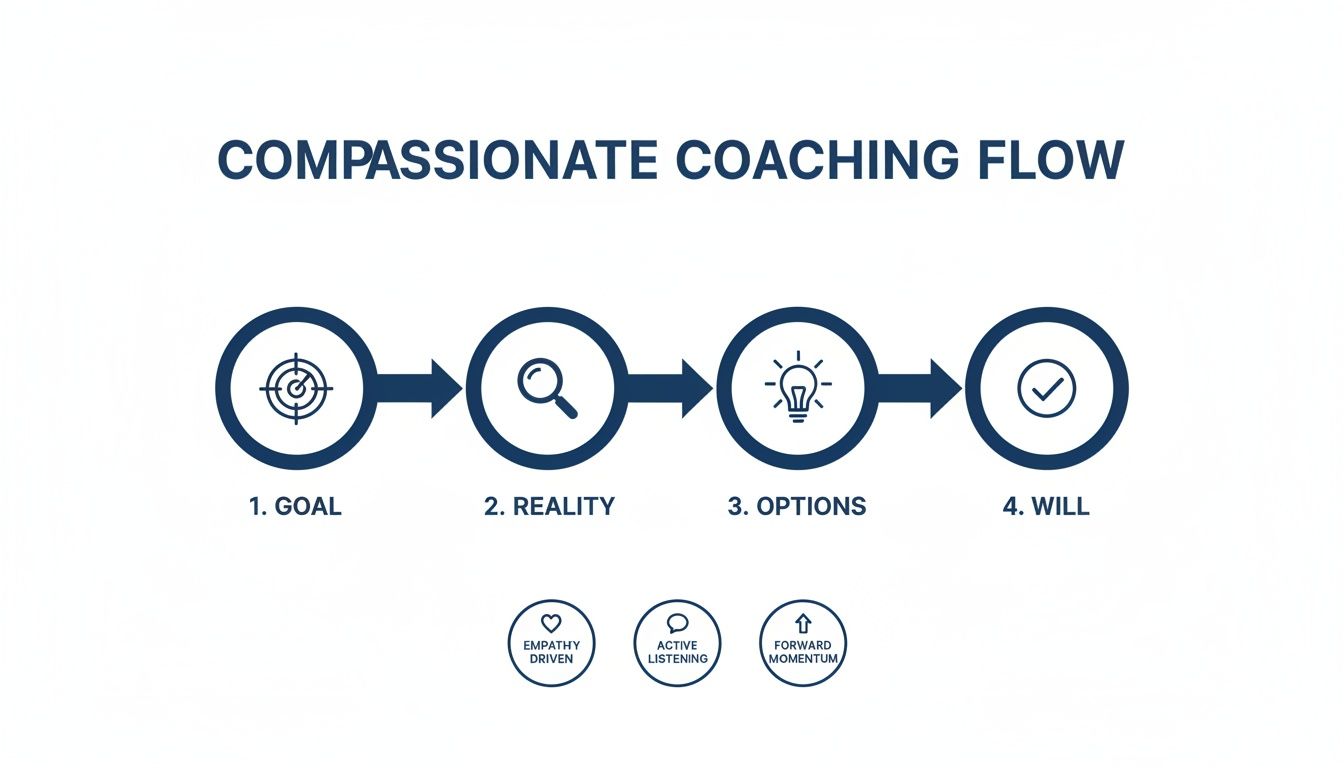
Each stage naturally builds on the one before it. This ensures the conversation stays grounded in what’s actually happening while keeping an eye on future possibilities and the steps needed to get there.
A Simple Four-Stage Framework
To give your coaching conversations a consistent, powerful impact, you can follow a straightforward, four-stage process. This approach gives the discussion a logical flow, from building initial trust right through to defining a clear commitment.
-
Build Connection and Context: Kick things off by creating a safe, non-judgemental space. Your only goal here is to understand the situation from their point of view. Try an opener like, "Talk me through what's been on your mind," to invite an honest conversation without any pressure.
-
Guide Exploration and Insight: Now it’s time for those powerful, open-ended questions. Your job is to be a guide, not a problem-solver. Ask things like, "What have you already tried?" or "What does success look like to you here?" to help them uncover their own answers.
-
Co-Create a Plan and Commitment: Once they've had a few 'aha' moments, it's time to shift the focus to action. Work together to map out clear, achievable next steps. The key word is co-creation. Ask, "What is one small step you feel confident taking this week?" This builds ownership and gets the ball rolling.
-
Offer Acknowledgement and Support: Wrap up by reinforcing their strengths and confirming that you've got their back. Acknowledge the courage it took to dig into the challenge and be specific about how you'll support them. This final step cements trust and makes it easier for them to open up next time.
This kind of structured approach isn't just a nice-to-have; it delivers measurable results. There's a reason executive coaching has become a cornerstone for high-performing UK organisations. A remarkable 77% of executives report that coaching significantly boosted at least one key business metric.
Even more impressive, coaching yields an average return on investment of nearly 600%, and 95% of clients confirm they do things differently as a direct result. You can read the full report on UK coaching trends to see the data for yourself.
Overcoming Your Own Leadership Hurdles with Self-Compassion
Before we can effectively lead or coach anyone else, we have to look at how we lead and coach ourselves. It's a simple truth, but one that’s easily missed. So many leaders I work with are driven by a brutally harsh inner critic, holding onto the belief that relentless self-criticism is the secret to high performance.
And for a short while, maybe it is. But that approach is a short-term motivator that almost always leads to long-term burnout, anxiety, and that nagging feeling of never being quite good enough.
The pressure to be perfect can be absolutely crushing. It’s the fuel for common leadership fires like imposter syndrome and decision fatigue. When your internal monologue is a constant reel of flaws and failures, it becomes nearly impossible to show up with the patience and presence your team needs. You simply can't pour from an empty cup.
This is exactly why self-compassion is such a vital, yet often overlooked, leadership skill. It’s a core principle of Compassion Focused Therapy (CFT), and it’s all about learning to treat yourself with the same kindness and understanding you’d offer a respected colleague who was struggling.
Your Resilience Toolkit: The Three Pillars of Self-Compassion
Building this kind of inner strength isn't about a complete personality overhaul. It's far more practical than that. It’s about practising three core skills that, together, form a powerful toolkit for resilience.
- Self-Kindness vs Self-Judgement: This is about being gentle and supportive with yourself when you inevitably make a mistake or face a setback. It’s the ability to reframe a failure not as proof of your inadequacy, but as a genuine opportunity to learn something valuable.
- Common Humanity vs Isolation: This pillar is a powerful reminder that struggle is a universal human experience. Every single leader faces setbacks, makes bad calls, and feels overwhelmed at times. Realising you aren’t alone in this instantly dials down feelings of shame and isolation.
- Mindfulness vs Over-Identification: Mindfulness is simply the ability to observe your stressful thoughts and feelings from a slight distance, without getting completely swept away by them. It lets you acknowledge, "I am feeling stressed," rather than letting that stress become your entire reality.
Self-compassion is not about letting yourself off the hook; it's about giving yourself the psychological safety needed to take risks, learn from mistakes, and lead with courage and authenticity.
This internal work is absolutely crucial. UK organisations are investing heavily in leadership development—spending an estimated £7.5 billion in 2023. It’s clear that building effective leaders is a top priority.
However, a huge chunk of that investment is wasted if leaders haven’t first built the internal resilience to withstand the pressures of the role. You can discover more insights about UK leadership development spending and see just how critical this area has become.
Ultimately, by turning compassion inward, you build the emotional stability and clarity you need to coach others. When you can navigate your own challenges with grace, you are far, far better equipped to guide your team through theirs.
Your Path to Becoming a Compassionate Coaching Leader
Bringing compassionate leadership and coaching into your work isn't just a case of learning a few new tricks; it’s a profound shift in how you show up for your team and, crucially, for yourself. It’s about making a real commitment to building psychological safety, unlocking the potential you know is there, and creating the kind of resilient, engaged teams that don't just survive challenges but actually thrive on them.
This journey asks for a bit of courage, plenty of practice, and a real willingness to turn that same compassion inwards.
It all starts with small, consistent actions. Pick one thing—maybe it’s shifting from 'why' to 'what' questions—and just practice it. Focus on creating those structured, supportive conversations that help your team members find their own way forward. Remember, this is a practice, not a destination.
Chart Your Next Steps
Ready to take this further? What you do next really depends on where you are right now.
- For New Leaders: Start with the fundamentals. Make active listening and asking powerful questions your daily habits. Really focus on getting these right before you do anything else.
- For Experienced Executives: You might find it useful to work with an executive coach. An outside perspective can be brilliant for refining your approach and challenging some of those deeply ingrained habits.
- For Deepening Your Practice: To truly embed these principles and take your skills to the next level, it's worth exploring some structured learning. You can find some fantastic, comprehensive resources through specialised courses, like on-demand Compassion Focused Therapy training.
Answering Your Questions About Leadership and Coaching
It's natural to have questions, and even a bit of healthy scepticism, when exploring new approaches to leadership. Let's tackle some of the most common ones that come up, clearing the air around how coaching and compassion really work in the real world.
Isn't 'Compassionate Leadership' a Bit Too Soft for a Competitive Business?
I hear this a lot, and it's a completely understandable concern. Many of us were taught that business is tough, and you have to be tough to succeed.
But here’s the thing: compassionate leadership isn't about being 'soft'. It’s not about dodging difficult conversations or letting standards slide. It’s about handling those tough moments with strength and clarity, in a way that helps people grow instead of making them afraid to fail. It means holding people accountable, but doing it in a way that builds them up rather than tears them down.
We have solid research showing this approach creates psychological safety. That’s not a fluffy concept; it’s the bedrock of the innovation, engagement, and resilience that gives a business a real competitive edge. It’s a strategic strength, not a weakness.
When you get right down to it, compassionate leaders build teams that are fired up to solve hard problems and take smart risks. That’s exactly what you need to get ahead—and stay ahead—in any competitive field.
How Can I Start Coaching if I Have No Formal Training?
You don’t need a certificate on the wall to begin. You can start weaving coaching principles into your leadership style right away, often with small shifts that have a surprisingly big impact.
Start with something simple: practice active listening. That means when someone is talking, you’re focused entirely on what they’re saying, not just waiting for your turn to speak or already forming your reply.
Another powerful change is to shift from judgemental "Why?" questions to curious "What?" or "How?" questions. Instead of, "Why is this late?", try asking, "What obstacles got in the way here?". See the difference? That simple tweak turns a potential confrontation into a collaborative problem-solving moment. For a bit more structure, the classic GROW model is another brilliant tool you can use immediately to guide more productive conversations.
What Is the Difference Between Therapy and Executive Coaching?
This is a crucial distinction. Both are incredibly valuable for development, but they serve different purposes. Knowing which is which helps leaders get the right kind of support for themselves and their people.
Therapy, especially a model like Compassion Focused Therapy (CFT), often helps you explore and heal the roots of recurring patterns—things like a harsh inner critic or persistent anxiety. It’s about understanding the 'why' behind your internal world.
Executive coaching, on the other hand, is typically forward-looking and geared towards performance. It centres on building specific skills, like communication or strategic thinking, to help you hit your professional goals.
Think of it like this: for a leader struggling with imposter syndrome, therapy might help uncover the deep-seated reasons it shows up, while coaching would provide the practical strategies to manage those feelings effectively at work. They often work powerfully in tandem.
At Dr Chris Irons, we specialise in helping leaders build the resilience and self-awareness needed to thrive. Explore our personal coaching and professional training to start your journey.