Overcoming perfectionism isn't about erasing your high standards. It’s about recognising when they’ve started to cause more harm than good, understanding why our brains get stuck in this safety-seeking loop, and choosing a kinder response.
It all boils down to shifting your goal from flawless outcomes to building a more resilient, compassionate relationship with yourself.
The Hidden Costs of Chasing Perfection
Let’s be honest—the pressure to be perfect is relentless. It’s that nagging voice whispering that if we just work harder, plan better, and never make a mistake, we’ll finally feel secure and valued.
But this chase isn't a badge of honour. It's an incredibly heavy burden, one that often leaves us feeling more anxious, isolated, and exhausted than accomplished.
I’m Dr. Chris Irons, a clinical psychologist who specialises in Compassion Focused Therapy (CFT). For over 20 years, I've worked with people trapped in the cycle of self-criticism that perfectionism fuels. Here’s the truth: perfectionism isn't really about having high standards. It's about tying your entire sense of self-worth to impossible ones.
This creates a constant state of threat in your mind, where even the smallest error can feel catastrophic.
And this isn't just a personal struggle; it’s a growing societal issue. In the UK, a landmark 2018 study revealed a startling 33% rise in socially prescribed perfectionism among young people between 1989 and 2016. This means more and more of us feel our environment demands flawlessness just for us to gain approval, a trend directly linked to rising anxiety and depression. If you're interested in the data, you can explore the full findings on this perfectionism surge to understand its broader impact.
A Kinder Path Forward with Compassion
So, how do we begin to dismantle this? The answer isn’t to just try harder or to stop caring. It's about changing our entire approach.
This is where Compassion Focused Therapy (CFT) comes in. It offers a practical, evidence-informed way out of the perfectionist trap by helping us understand and work with our brains, not against them.
Instead of battling your inner critic, CFT teaches you to cultivate an inner compassionate voice. This guide will give you a clear roadmap built on three core ideas:
- Acknowledging the Pressure: Simply noticing when perfectionist thoughts and feelings show up, without judging yourself for having them.
- Understanding its Roots: Getting curious about why our brains are wired to seek safety through perfection, even when it’s causing us pain.
- Responding with Compassion: Actively choosing to treat yourself with the same kindness and support you’d offer a good friend who was struggling.
Before we dive into the practical steps, let's look at the core mindset shift we're aiming for. This table contrasts the familiar perfectionist trap with the compassionate alternative offered by CFT. It’s a handy reference for the journey ahead.
Shifting from Perfectionism to Self-Compassion
| Perfectionist Trap | Compassionate Alternative (CFT Approach) |
|---|---|
| Self-worth is tied directly to performance and achievement. | Self-worth is inherent and unconditional. |
| Mistakes are seen as catastrophic failures and proof of inadequacy. | Mistakes are viewed as natural parts of learning and growth. |
| Self-criticism is the primary motivator for improvement. | Self-compassion and encouragement are the motivators. |
| The focus is on a flawless outcome. | The focus is on the effort, learning, and the process itself. |
| Feeling "not good enough" is a constant state. | Acknowledging common humanity—everyone struggles sometimes. |
| Avoids challenges to prevent potential failure. | Embraces challenges as opportunities to grow, with self-support. |
Seeing it laid out like this really highlights the difference, doesn't it? One path leads to burnout, the other to resilience.
Perfectionism promises control and acceptance but delivers anxiety and burnout. Self-compassion offers the genuine safety and resilience we were searching for all along. It’s about embracing progress over perfection as the true measure of growth.
This journey isn't about lowering your standards or becoming complacent. Far from it. It's about unhooking your self-worth from your performance so you can find a more sustainable, and ultimately more fulfilling, way to strive for what matters to you.
Throughout this guide, we'll move from theory into practical, real-world strategies you can start using today.
Why Your Brain Gets Stuck in Perfectionist Mode
Ever wonder why you can be so incredibly hard on yourself? It's easy to mistake it for a character flaw, but it’s really more about how our brains are wired for survival. Before we can figure out how to overcome perfectionism, we have to get to grips with why our minds get stuck in this demanding, exhausting loop in the first place.
Compassion Focused Therapy (CFT) offers a simple but incredibly powerful model for this. It suggests we all have three main emotional systems, which evolved to help us navigate the world. Perfectionism basically hijacks two of them, leaving the third one completely sidelined.
The Three Core Emotional Systems
Think of these systems as different gears in your brain, each with a very specific job.
- The Threat System (Safety-Seeking): This is your internal alarm bell. Its job is to sniff out danger—whether that’s physical or social—and protect you with feelings like anxiety, anger, or disgust. It's the system that screams, "What if I mess up the presentation?" or "Everyone will think I'm an idiot if I make a mistake."
- The Drive System (Resource-Seeking): This is your engine, the part of you that’s geared towards motivation and achievement. It floods you with feelings of excitement and vitality when you pursue goals, like chasing a promotion or finally finishing a big project. It’s where ambition and the desire to get things done come from.
- The Soothing System (Contentment): This is your brain's 'rest and digest' mode. It's tied to feelings of calmness, safety, and connection. This system kicks in when we feel cared for and content, allowing our minds and bodies to recover, feel peaceful, and build trust with others and, crucially, with ourselves.
Perfectionism creates this powerful, draining cycle by keeping you bouncing between the first two systems. The threat of not being good enough fuels an intense drive to achieve impossible standards. Of course, when you inevitably fall short, the threat system flares up again with a fresh wave of self-criticism, and the whole cycle kicks off again.
And the soothing system? It barely gets a look-in. This is precisely why perfectionism so often leads to burnout and anxiety—you're constantly running on adrenaline and cortisol, with no time for genuine rest and recovery.
How This Plays Out in Real Life
This isn't just abstract theory; this pattern shows up in very real, everyday situations.
I see this all the time. Take a manager, Sarah, who has a major project proposal due. Her threat system is firing off warnings that anything less than a flawless document will totally undermine her credibility. This kicks her drive system into overdrive, but the pressure is so immense that she ends up procrastinating, terrified she can't meet her own sky-high expectations. She's trapped between anxiety and a paralysed ambition.
Or think about a university student, Tom, who is petrified of getting a lower mark than he expects on an essay. His self-worth is so tangled up with his grades that the possibility of a B+ feels like a catastrophic personal failure (threat). This intense pressure doesn't just motivate him; it paralyses him, often leading to frantic, all-night study sessions that are fuelled by anxiety and ultimately make his work worse. This isn't a rare experience, either. UK data shows a massive rise in university students reporting mental health conditions, a trend that's closely linked to the pressures of perfectionism and burnout.
The graphic below helps to visualise the core steps needed to break free from this cycle. It's all about intentionally engaging a different part of your brain.
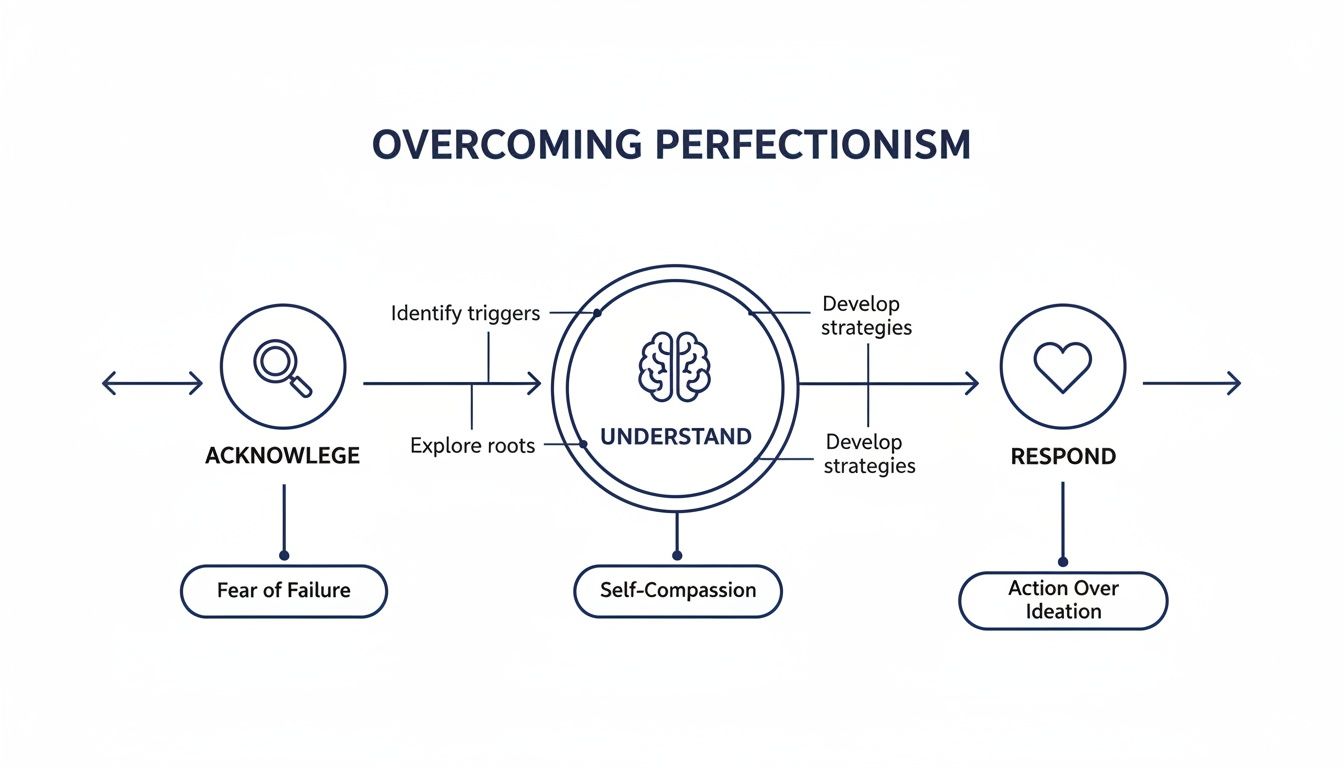
The key insight here is that the path out of perfectionism involves a conscious shift. You move from simply reacting (threat/drive) to mindfully acknowledging, understanding, and then responding with compassion (soothing).
Your perfectionism isn’t a personal failing; it’s a survival strategy that has become overactive. The goal is not to eliminate your threat and drive systems—we need them—but to bring them into balance by intentionally cultivating your soothing system.
Recognising these patterns is the first, crucial step. You might notice that perfectionism feels a lot like other feelings of inadequacy. For many, it's connected to a deep-seated fear of being "found out." You can learn more about the links between perfectionism and imposter syndrome in our dedicated article on the topic. Seeing this connection can help you realise these feelings aren't isolated flaws but part of a broader, and very human, experience.
Practical Ways to Build Your Compassionate Mind

Understanding the theory behind the perfectionist cycle is a great first step. But to actually step out of it? That takes practice. It’s all about intentionally strengthening your soothing system, a bit like building a muscle you haven't used in a while. This is where we shift from knowing to doing.
The idea isn't to magically silence your inner critic overnight. It’s more about cultivating a wiser, kinder inner voice—one that can offer some much-needed balance and perspective when things get tough.
Let's get into some powerful, evidence-informed exercises you can start using today. These are designed to help you build your compassionate mind and give you the tools for how to stop perfectionism in 5 steps.
Cultivating Your Compassionate Self with Imagery
One of the foundational practices in Compassion Focused Therapy (CFT) is compassionate imagery. This exercise is a direct line to your soothing system, helping you build an internal source of wisdom, strength, and genuine kindness. Think of it as creating a mental safe-haven you can retreat to when your threat system is firing on all cylinders.
Start by imagining a compassionate figure. This could be anything—a wise old person, a strong animal, a sturdy ancient tree, or even just a feeling of warm light. The specific form doesn't matter nearly as much as its core qualities.
- Wisdom: This figure gets it. It understands the pressures of life and the reality of human struggle. It knows you're not perfect, and it truly believes that’s okay.
- Strength: It’s resilient and courageous. It can sit with distress without being swept away by it, offering a solid, grounding presence.
- Warmth & Kindness: Most importantly, this figure is unconditionally caring and completely non-judgemental. Its only intention is to support you and help you feel safe.
Try spending a few minutes each day just visualising this figure and noticing what it feels like to be in its presence. What might it say to you about the pressure you’re putting on yourself? This simple practice begins to forge new neural pathways, making it easier over time to access that feeling of compassion from within.
Writing with a Compassionate Voice
Perfectionism is fuelled by a relentless inner monologue of harsh self-talk. A brilliant way to challenge this habit is through compassionate letter writing, which allows you to externalise those critical thoughts and respond to them with kindness instead.
Bring to mind a recent situation where your perfectionism really kicked in. Maybe you made a small mistake on a work project or felt you fell short of an unspoken expectation. Now, try writing a letter to yourself about that exact experience, but write it from the perspective of your compassionate image.
Your letter should aim to include:
- Validation: Start by acknowledging how difficult and painful the situation felt.
- Understanding: Show some empathy for why you felt that way, without any judgement.
- Encouragement: Offer some gentle, supportive words for how to move forward.
So, instead of the usual, "I can't believe I messed that up," your compassionate letter might sound more like, "It makes total sense that you're feeling disappointed about that mistake. You put so much pressure on yourself to get everything right, and it really stings when things don't go to plan. Just remember, this one moment doesn't define your ability or your worth."
This exercise starts to rewire your automatic response to setbacks, shifting the default from self-attack to self-support. If you’re interested in exploring this further, we have more resources on building https://drchrisirons.com/self-compassion/.
Spotting and Reframing Perfectionist Thoughts
While CFT is fantastic for building up your soothing system, tools from Cognitive Behavioural Therapy (CBT) are brilliant for dismantling the specific thought patterns that keep perfectionism going. The biggest offender is almost always all-or-nothing thinking.
You might know it as black-and-white thinking. It’s that cognitive distortion that screams if something isn't 100% perfect, it's a complete and utter failure. No room for nuance. No middle ground.
The All-or-Nothing Trap: It's seeing a project that gets 99% positive feedback as a failure because of one tiny piece of criticism. It's feeling like your diet is 'ruined' because you had one biscuit. It's deciding the whole day is 'wasted' because one task didn't get ticked off the list.
The trick is to start catching these thoughts in the act and actively challenging them. When you notice an all-or-nothing thought pop up, get curious. Ask yourself:
- Where’s the actual evidence that this is a total disaster?
- What are the shades of grey I’m completely ignoring right now?
- What’s one thing I can learn from this that I can use next time?
Here’s how a reframe can look in practice:
| All-or-Nothing Thought | Compassionate & Balanced Reframe |
|---|---|
| "I stumbled over my words during the presentation. It was a disaster." | "A few moments were tricky, but I got my key points across. It was a good learning experience for next time." |
| "I didn't stick to my workout plan this week. I've failed completely." | "I managed two out of four workouts, which is better than none. I'll aim for three next week and see how that feels." |
Learning to live in the grey area is a radical act of rebellion against perfectionism. It’s what allows for real progress, learning, and, most importantly, for being human.
These practices aren't about getting rid of your ambition or your drive to do well. They are about unhooking your sense of self-worth from the outcome. By building your compassionate mind, you give yourself the inner foundation to strive, to fail, to learn, and to grow—all while treating yourself with the kindness you’ve always deserved.
Right, it’s one thing to practise self-compassion when things are calm, but what about when a deadline is breathing down your neck or you’re in the middle of a high-stakes presentation? This is when it really counts. High-pressure situations are the natural habitat for perfectionism, where our fear of dropping the ball suddenly feels ten times bigger.
In these moments, self-compassion isn't some fluffy, nice-to-have idea. It's a pragmatic tool for resilience. It’s what helps you get a grip on performance anxiety before it completely takes over, and it gives you a way to navigate the inevitable bumps in the road that come with doing anything ambitious.
This is a particularly sharp issue here in the UK, where the workplace culture often celebrates massive achievement but can quietly push people towards burnout. Research has started to highlight this paradox: while perfectionistic tendencies can get you ahead, they often come with a hefty personal price tag. We’re seeing a significant rise in perfectionism, especially among younger professionals, with some studies pointing to a 10-33% spike since 1989. It’s a clear signal that we need kinder, more sustainable ways to strive for success. You can discover more insights on perfectionism and work performance here to see the full picture.
Navigating Imposter Syndrome and High Stakes
Think of imposter syndrome and perfectionism as two sides of the same coin. That nagging fear of being "found out" as a fraud is precisely what fuels the relentless drive to be flawless. It’s a vicious cycle of anxiety, over-preparing, and more anxiety.
When you feel that familiar dread creep in during a stressful moment, self-compassion gives you an exit route. Instead of letting that inner critic run the show, you can consciously step in and choose a different response.
- Acknowledge the Feeling: Don't fight it. Just name it. "Okay, this is a moment of pressure, and I'm feeling that 'not good enough' thing again. It's a perfectly normal human reaction."
- Offer Yourself Kindness: Imagine a good friend was in your shoes. What would you say to them? Try thinking, "This is tough, but I've got the skills to handle it. It doesn’t have to be perfect to be a success."
- Reframe the Goal: Shift your focus away from a flawless outcome and towards simply doing your best with the resources and time you have. This small mental tweak can dial down the internal pressure immensely.
Real-World Scenario: The Project Manager
Picture Anya, a project manager whose team just missed a major deadline. Her first perfectionist instinct is to take all the blame, viewing it as a catastrophic personal failure. But instead, she takes a breath and tries a different approach. She acknowledges her disappointment but reframes the situation: "This isn't a reflection of my worth; it's a chance to figure out where our process is breaking down. How can we learn from this to make the next sprint stronger?" In that moment, she moves from self-blame to constructive problem-solving.
Self-Compassion for Leaders
If you're in a leadership role, one of the most powerful things you can do is model self-compassion. When a leader is relentlessly self-critical and has zero tolerance for mistakes, they create a culture of fear where no one feels psychologically safe.
On the flip side, a leader who is open about their own learning process fosters a culture where people feel safe enough to innovate, take smart risks, and—most importantly—ask for help when they need it.
Here’s what that looks like in practice:
- Share Your Own Learning: When you make a mistake, own it without the harsh self-recrimination. Talk about it as a learning opportunity for the whole team.
- Celebrate Effort and Progress: Don't just praise the perfect results. Acknowledge the hard work, the dedication, and the progress made along the way.
- Set Realistic Standards: Collaborate with your team to set goals that are ambitious but actually achievable. This builds a culture that values sustainable high performance, not burnout.
This isn't about ditching accountability. It’s about building a foundation of trust where feedback feels supportive and developmental, not like a punishment. If you find your own inner critic is especially loud, you might find some useful strategies in our articles on managing self-criticism.
By showing your team that it’s okay to be human—to strive, to sometimes fall short, and to learn from it—you shift the entire culture away from blame and towards genuine growth. That’s how you start to overcome perfectionism not just in yourself, but in the very systems you influence.
Making Self-Compassion a Lasting Habit

Let's be clear: learning to overcome perfectionism isn't a one-and-done deal. It's a practice. True, lasting change comes from building resilience for the long haul, making self-compassion less of a tool you pull out on bad days and more of your default response. It's about turning kindness into an instinct.
This journey starts by getting brutally honest about your personal perfectionism triggers. What are the specific situations, people, or even internal feelings that unleash your harshest inner critic and send you down that all-or-nothing spiral?
These triggers are deeply personal. For one person, it might be receiving a piece of constructive feedback. For another, it's the doom-scroll through social media, where their messy reality clashes with someone else’s polished highlight reel.
Identify Your Triggers and Create a Plan
Awareness is everything. Once you know what sets off your perfectionist alarm bells, you can stop reacting on autopilot and start responding with intention. This simple shift moves you from a place of fear to a position of strength.
Start by just noticing. When do you feel that familiar, relentless pull towards perfection? Pinpointing these moments is the first step to understanding the deep-seated fears driving the behaviour.
Here are a few common culprits to look out for:
- High-Stakes Projects: Any task where you feel your reputation—or even your fundamental worth—is on the line.
- Social Comparison: Constantly measuring yourself against colleagues, friends, or even an imaginary, "better" version of yourself.
- Receiving Feedback: Hearing constructive criticism not as helpful data but as a personal attack on your competence.
- Fear of Failure: Sidestepping new challenges because the thought of not succeeding perfectly is just too much to bear.
When you’ve spotted a trigger, you can create a simple, compassionate response plan. For example, if you know feedback sends you into a spin, your plan might be to take a single mindful breath and silently repeat, "This is information, not a judgement," before you even think about replying.
Build Your Compassionate Toolkit
Think of this as your mental first-aid kit, ready for those tough moments. It’s your personal collection of go-to strategies that can calm your threat system when it’s firing on all cylinders. A well-stocked toolkit makes it so much easier to choose a compassionate response when you need it most.
This kit has to be yours. It should be filled with things that genuinely bring you a sense of calm and perspective, not just things you think should work.
Here are a few ideas to get you started:
- A Go-To Mantra: A short, simple phrase you can repeat to yourself. Maybe something like, "Progress, not perfection," or simply, "It's okay to be human."
- A Mindful Pause: A one-minute breathing exercise you can do absolutely anywhere to ground yourself in the present moment.
- A Compassionate Contact: A trusted friend or mentor you can call when you’re stuck in your own head and need an outside voice.
- A 'Common Humanity' Reminder: A note on your phone or a Post-it on your desk that reminds you that setbacks are a universal part of life. It’s the simple, powerful truth that you are not alone in this.
The goal isn’t to stop perfectionist thoughts from ever showing up again. That’s impossible. The goal is to notice them when they do, and to choose a kinder, wiser response. That is where real, lasting change happens.
Ultimately, this is about fundamentally shifting your definition of success. It's no longer about a flawless outcome. Instead, success becomes the act of showing up for yourself with kindness, learning from what happens, and choosing progress over perfection—one compassionate moment at a time. This is how you build a more fulfilling and resilient life.
Got Questions About Perfectionism? You're Not Alone.
When you start to push back against perfectionist habits you’ve held for years, maybe even decades, it's bound to feel a bit strange. Questions will pop up. Doubts will creep in. This is a huge shift in how you see yourself and your world, so feeling uncertain is completely normal—in fact, it’s a sign you’re on the right track.
Let's walk through some of the most common worries that come up on this journey.
Is Self-Compassion Just a Fancy Excuse for Being Lazy?
This is probably the biggest myth out there, and I can tell you with absolute certainty: no, it's not. All the research points in the opposite direction. Self-compassion is actually a far more powerful and sustainable motivator than the fear that perfectionism runs on.
What you're really doing is changing your 'why'.
Instead of grinding away out of a terrifying fear of failure, you start moving toward your goals because you genuinely care about your own growth and wellbeing. It’s like swapping out a harsh, screaming drill sergeant for a supportive, encouraging coach. That coach still wants you to win and will push you to do your best, but they do it because they believe in you, not because they want to tear you down.
Self-compassion isn’t about letting yourself off the hook; it’s about changing how you stay on the hook. It’s the difference between motivation fuelled by fear and motivation fuelled by care.
So, How Is This Different from Just Having High Standards?
This is a great question, and the distinction is crucial. Having high standards is about striving for excellence, and that’s a healthy, often wonderful, thing to do. The difference all comes down to where you anchor your self-worth.
Perfectionism is when your entire sense of who you are gets tangled up in whether or not you achieve those standards flawlessly.
Someone with high standards might be disappointed by a setback, sure, but they’ll ultimately see it as a chance to learn something. For a perfectionist, that same setback feels like a crushing personal failure—a devastating confirmation of their deepest fears about not being good enough.
- High standards are about the process, about growth and doing your best.
- Perfectionism is obsessed with a flawless outcome and ties it directly to your value as a person.
Self-compassion gives you the space to keep aiming high without the brutal self-criticism when things don’t go perfectly. If you're looking for a deeper dive, there are many excellent strategies to overcome perfectionism and find balance that can help guide you further.
What If I Just Find It Really, Really Hard to Be Kind to Myself?
If this is you, please know you are in good company. This is incredibly common. When your inner critic has been running the show for years, trying to be kind to yourself can feel awkward, fake, or even like something you haven't earned.
The key here is to start small. Be patient. This is a skill you're building, not an on/off switch.
The next time you’re struggling, just pause and think about how you’d talk to a close friend in the exact same spot. What words would you use? What would your tone of voice be? Now, see if you can offer just a tiny fraction of that warmth to yourself. It won’t feel natural at first, and that’s okay.
The exercises we’ve talked about, like Compassionate Letter Writing, are designed to help you build this "muscle" over time. Remember, it's a practice, not a performance.
At Dr Chris Irons, I provide specialised coaching and Compassion Focused Therapy to help individuals and leaders move beyond self-criticism and build lasting resilience. If you're ready to cultivate a kinder, more effective relationship with yourself, learn more about working with me.