Right, let’s get to the bottom of what self-doubt actually is. It’s not some kind of personal failing or a sign of weakness. Far from it. At its core, self-doubt is a perfectly normal, very human experience. It's rooted deep in our brain's ancient threat-detection system—think of it as a misplaced attempt to keep you safe from harm.
What Exactly Is Self Doubt?
To really wrap our heads around self-doubt, we need to ditch the dictionary and look at it through a more compassionate lens. Imagine your self-doubt isn't an enemy you need to conquer, but a rather clumsy, overzealous bodyguard.
This part of your brain evolved eons ago to protect you from genuine physical threats, like a predator lurking in the bushes. Fast forward to today, and that same wiring often gets its signals crossed. It mistakes modern-day challenges—giving a big presentation, applying for that dream job, or even just speaking up in a meeting—for life-or-death situations.
That nagging inner voice whispering, "You can't do this," or "You’re going to mess this up," is just your internal bodyguard trying to yank you back from what it perceives as the edge of a cliff. Its intention is protective, but its strategy is seriously outdated for the world we live in now.
The Compassionate View
This is where a Compassion-Focused Therapy (CFT) perspective can be so helpful. Instead of getting into a tug-of-war with your self-doubt, CFT encourages us to get curious about where it comes from. This part of you isn’t malicious; it’s just trying to do a very old job with very old tools. The real skill lies in recognising its protective intention, even when the execution is pretty unhelpful.
From this compassionate viewpoint, we can break self-doubt down into a few key ingredients:
- A Feeling of Uncertainty: That persistent, nagging question of, "Am I good enough?" or "Can I really pull this off?"
- A Focus on Inadequacy: The mind's tendency to zoom in on perceived flaws or replay past mistakes on a loop.
- A Hesitation to Act: The paralysis that can set in, stopping you from taking chances or even starting something you care about.
To make this clearer, here’s a quick summary of what we're working with.
Quick Guide to Understanding Self Doubt
| Component | Description |
|---|---|
| Protective Intent | An evolutionary mechanism designed to keep you safe from harm by making you cautious. |
| Cognitive Uncertainty | The mental state of questioning your own skills, judgement, and decisions. |
| Emotional Discomfort | The feelings of anxiety, fear, or inadequacy that accompany the uncertainty. |
| Behavioural Hesitation | The tendency to avoid challenges, procrastinate, or freeze instead of taking action. |
This table simplifies the idea that self-doubt is a complex system, not just a single thought or feeling.
Why This Definition Matters
When you start to see self-doubt as a protective mechanism instead of a character flaw, your entire relationship with it shifts. It creates space. You can step back from the harsh inner critic and approach yourself with a bit more kindness and curiosity. It allows you to hear the alarm bell without letting it dictate your every move.
Self-doubt will always be a passenger on your journey. The goal is not to kick it out of the car, but to learn how to drive without letting it grab the steering wheel. This shift from resistance to acceptance is the first step toward building genuine self-confidence.
By adopting this more compassionate definition, you can start to soothe that internal alarm system. You can learn to thank it for trying to do its job, and then confidently get on with what matters to you. It’s all about managing the noisy passenger, not trying to get rid of it for good.
Understanding Where Self-Doubt Comes From
Self-doubt rarely just shows up unannounced. It tends to grow from seeds planted long ago—in our past experiences, our relationships, and the culture we live in. To really get a handle on it, we need to trace that persistent, nagging voice back to its source.
Think of it like a complex web. Each thread represents a different influence, from your early family dynamics to the pressures of your daily life. Pulled together, these threads create a powerful force that can quietly shape how you see yourself and what you believe you’re capable of. When we start to untangle this web, we often find that self-doubt isn’t a personal failing at all, but a learned response to our unique life story.
This infographic captures this idea well, showing how self-doubt can act as both a misguided alarm system and a flawed protective shield.
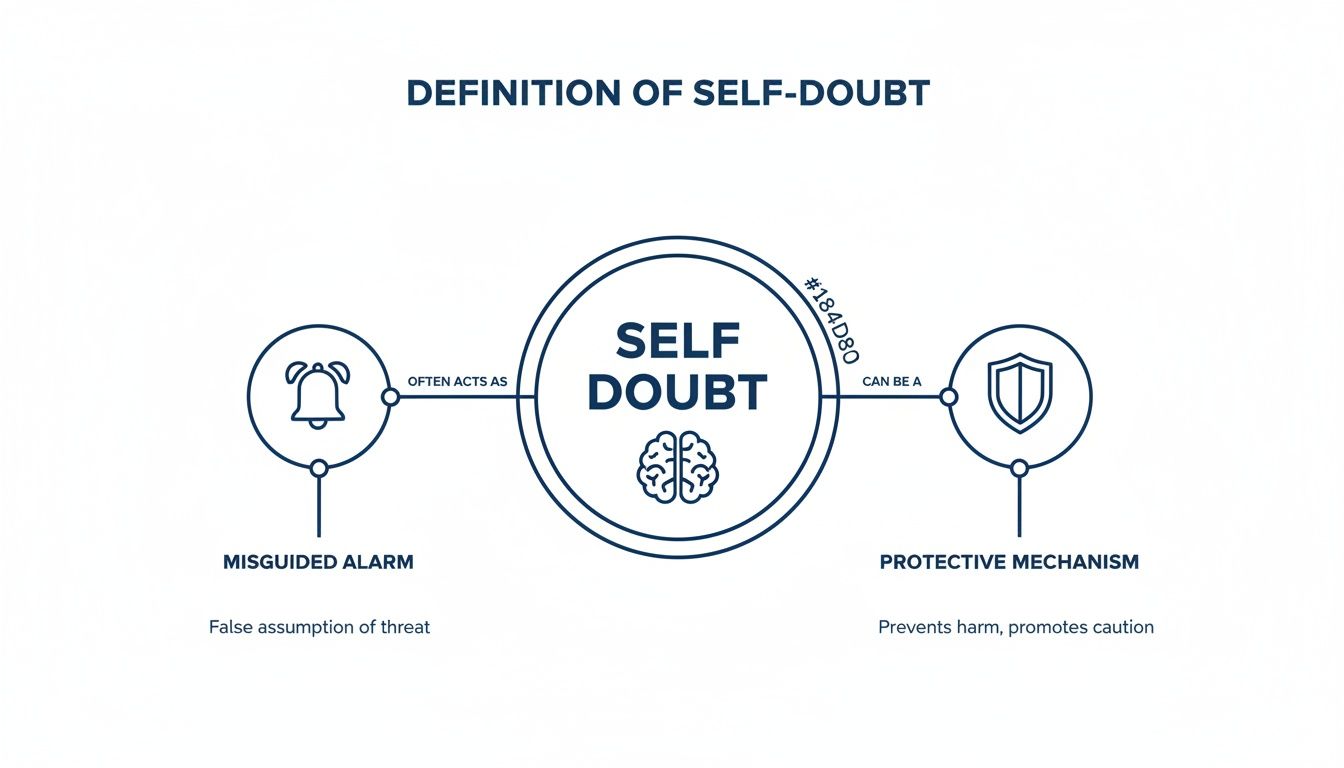
It’s a helpful reminder that this part of you isn't trying to be malicious. It’s an internal system trying to keep you safe from perceived threats, even if its methods are outdated and unhelpful.
Early Life Experiences and Attachment
Our first relationships often provide the blueprint for our inner world. The way we learned to connect with caregivers in those formative years can set the tone for our internal dialogue for the rest of our lives.
If you grew up in a home where praise and affection were tied to your achievements, you might have internalised the message that your worth isn’t inherent—it has to be earned. This can leave you with a deep-seated belief that you're only as good as your last success, creating a relentless pressure to perform.
Similarly, caregivers who were overly critical or demanding, perhaps with the best of intentions, can accidentally install a harsh inner critic. You absorb their voice, and it becomes the soundtrack to your adult life, constantly questioning if you’re ever really good enough.
These early dynamics might include:
- Critical Parenting: Consistently being told you’re “not trying hard enough” or having mistakes highlighted far more than successes.
- High Expectations: Feeling an unspoken pressure to be perfect in school, sports, or other activities to win approval.
- Emotional Neglect: Missing the warmth, encouragement, or validation needed to build a secure and confident sense of self.
This isn’t about laying blame. It’s about understanding how these early patterns shaped the neural pathways that now fire up your self-doubt.
The Role of Negative Thought Patterns
While past experiences might lay the groundwork, it’s our current mental habits that keep self-doubt alive and kicking. The mind is brilliant at getting stuck in repetitive, unhelpful loops that reinforce feelings of inadequacy.
Perfectionism is a major culprit. It’s the crippling belief that you have to be flawless to be acceptable. This mindset turns every task, big or small, into a high-stakes performance where anything less than perfect feels like a total failure. It’s an impossible standard to live up to, making it a fertile breeding ground for self-doubt.
Another powerful pattern is catastrophising—our tendency to leap to the worst-case scenario. Before a presentation, you don’t just worry about stumbling over a few words; your mind paints a vivid picture of public humiliation and career ruin. These exaggerated negative fantasies make it feel far too risky to even try.
Your inner critic is often a reflection of past hurts and fears, attempting to protect you from future pain by keeping you small. The challenge is learning to see its protective intent without buying into its critical content.
Learning to navigate the difficult feelings that come with this inner critic, like shame, is a crucial step. You can explore our guide on how Compassion-Focused Therapy can help you heal from shame and self-criticism.
Social Comparison and Cultural Pressures
As human beings, we’re wired to look to others to figure out where we stand. It’s a primal instinct for gauging our place in the group. But in our modern world, this instinct has been put on overdrive, and it’s often not doing our mental health any favours.
Social media platforms are essentially curated highlight reels of everyone else's lives. We scroll through an endless feed of promotions, perfect holidays, and flawless families, and our brain can’t help but interpret this curated fiction as reality. The inevitable comparison often leaves us feeling like we're falling behind, fuelling that nagging sense that we're just not enough.
This isn’t just a feeling; it’s reflected in wider mental health data. One longitudinal study showed that the proportion of British adults reporting low self-esteem nearly tripled from 7% to 20% between 2004 and today. At the same time, those reporting high self-esteem dropped from 37% to 29% in the last decade alone.
By understanding these powerful roots, we can start to approach our self-doubt with a bit more compassion and a lot less judgement. It didn’t spring from nowhere; it was learned. And the good news is, anything that can be learned can also be unlearned.
Recognising Self-Doubt in Your Daily Life
Self-doubt often works like a shadow, quietly influencing our choices and feelings without us ever really noticing. It’s that subtle hesitation before you speak up in a meeting, or that wave of anxiety when a new challenge lands on your desk. The first crucial step to getting a handle on it is simply learning to see it for what it is.
This means getting specific about how self-doubt actually shows up. It isn’t just some vague feeling of uncertainty; it weaves its way into our emotions, our thought patterns, and our everyday actions. Pinpointing these signs is like flicking a light on in a dark room—suddenly, you can see the obstacles clearly and start to find your way around them.

Common Emotional Signals
Emotionally, self-doubt is a bit of a shapeshifter, often wearing the disguise of other feelings. It’s rarely a simple case of thinking, "I doubt myself." Instead, it tends to manifest in more complex and persistent ways.
You might notice these emotional red flags:
- Persistent Anxiety: A constant, low-level hum of worry about your performance, your decisions, or how others see you.
- Feeling Like a Fraud: That nagging sense that you don’t really deserve your accomplishments and will soon be ‘found out’. This is the hallmark of imposter syndrome.
- Sensitivity to Criticism: Taking neutral feedback as a personal attack, or feeling totally crushed by even the mildest critique.
- Comparison and Envy: Constantly measuring yourself against others and coming up short, leaving you feeling inadequate.
These feelings create a really stressful internal environment, making it incredibly difficult to feel safe, settled, or confident in your own skin.
Unhelpful Mental Loops
Beyond emotions, self-doubt absolutely thrives in our thoughts. It creates these mental loops that are tough to break, replaying past slip-ups and forecasting future failures. This internal monologue can become so familiar that we start to accept it as fact.
Common thought patterns include:
- Negative Self-Talk: The voice of a harsh inner critic that relentlessly points out your flaws. It’s the voice that says, "You're not smart enough for this," or "You always mess things up."
- Indecisiveness: Agonising over even small decisions for fear of making the ‘wrong’ choice, which can lead to a kind of mental paralysis.
- Discounting Positives: Brushing off compliments or chalking up your successes to pure luck, rather than your own skills and hard work.
A crucial part of overcoming self-doubt is recognising that these thoughts are not objective truths. They are old, habitual mental patterns, often rooted in past experiences, that no longer serve you.
This internal struggle is incredibly common, particularly in professional settings. Self-doubt is one of the most widespread mental health challenges in the modern UK workplace. In fact, research shows that nearly three in five workers—roughly 58% of employees—experience imposter syndrome, which is a powerful form of self-doubt. Yet, an astonishing 94% of them have never discussed these feelings at work, often out of fear of being seen as less capable. You can read the full research about these workplace findings to understand more.
Behavioural Patterns and Avoidance
Ultimately, our thoughts and feelings drive what we do. The most telling signs of self-doubt are often found in our actions—or, more accurately, in what we don't do.
Consider these behavioural signs:
- Procrastination: You put off starting a task, not from laziness, but from a deep-seated fear that you won’t be able to do it perfectly. Endlessly rewriting the first sentence of an email is a classic example.
- Avoiding Challenges: You turn down opportunities for growth, like a promotion or a chance to lead a new project, because you’re convinced you’ll fail. This keeps you safely in your comfort zone but stunts your potential.
- Seeking Constant Reassurance: You find yourself frequently asking others for their opinion on your work, not for constructive feedback, but to temporarily soothe your anxiety and ‘borrow’ their confidence.
Recognising these patterns in your own life is a powerful act of self-awareness. It moves the idea of self-doubt from an abstract concept into a tangible, real-world experience—one you can finally begin to address with compassion and understanding.
It’s all too easy to throw feelings of inadequacy into one big, messy bucket. But if we want to get a handle on them, putting a precise name to what we’re feeling is a vital first step. Self-doubt rarely travels alone; it often brings friends like low self-esteem and imposter syndrome along for the ride. And yet, they aren't the same thing.
Getting clear on what makes each one unique isn’t just an intellectual exercise—it helps you understand your own experience and, crucially, find the right way to move forward.
You could think of it in terms of focus. Self-doubt is often specific and fleeting, like a spotlight on one particular performance. Low self-esteem is much more like a harsh, relentless floodlight, casting a negative shadow over your whole sense of self.
Differentiating The Internal Critics
Let's unpack these differences a bit more.
Self-doubt is that temporary wobble of uncertainty you feel about your capabilities in a specific area. It’s that nagging inner voice asking, “Can I really pull off this new project?” or “Am I actually prepared enough for this presentation?” While it’s certainly uncomfortable, a flicker of doubt like this can sometimes be a helpful nudge to prepare more thoroughly.
Low self-esteem, on the other hand, is a much heavier, more persistent feeling. It’s not about a situation; it’s a deep-seated, negative judgement of your fundamental worth as a person. Instead of questioning your ability to do something, it questions your value, whispering things like, “I’m just not good enough,” or “There’s something inherently flawed about me.”
Then there's imposter syndrome, a particularly tricky and specific flavour of self-doubt. This one is tied directly to your achievements. Despite all the evidence of your success—promotions, qualifications, praise from others—you’re haunted by a persistent fear of being exposed as a 'fraud'. You find yourself explaining away your wins, putting them down to luck or good timing, anything but your own competence. To dig deeper, you can explore this detailed breakdown of what imposter syndrome is and how to manage it.
The key difference really comes down to scope and permanence. Self-doubt asks, “Can I do this?” Low self-esteem insists, “I am not worthy.” And imposter syndrome worries, “They’re going to find out I can’t actually do this, despite everything I’ve achieved.”
Distinguishing Between Self Doubt and Related Feelings
To draw these lines even more clearly, the table below breaks down the core features of these inner experiences.
| Concept | Core Feature | Typical Focus | Example Thought |
|---|---|---|---|
| Self-Doubt | Uncertainty about abilities | A specific task or situation | "What if I mess up this speech?" |
| Low Self-Esteem | Negative view of self-worth | Your entire being or identity | "I'm just not a capable person." |
| Imposter Syndrome | Feeling like an undeserving fraud | Your accomplishments and success | "I only got this job because of luck." |
| Self-Criticism | The act of harsh self-judgment | Your perceived flaws or mistakes | "That was a stupid thing to say." |
Understanding these nuances gives you power. When you can accurately label what’s going on inside, you can shift from a vague, heavy feeling of "I feel bad about myself" to a much more specific observation like, "Okay, I'm experiencing imposter syndrome about this new role." That clarity is the launchpad for finding the most effective ways to support yourself.
For some, these feelings of self-doubt and impostorism can become a real barrier to getting things done, showing up as a kind of creative paralysis. If that resonates, exploring practical strategies to overcome creative block can be incredibly helpful. Pinpointing the true nature of your internal struggle is what allows you to find solutions that actually work.
How to Manage Self-Doubt with Compassion
Knowing what self-doubt is and what to do about it are two very different things. This is where we need to move from insight into action. Forget the hollow advice you’ve probably heard before, like “just think positive” or “be more confident.” We’re going to explore practical, evidence-based strategies from Compassion-Focused Therapy (CFT) that can genuinely change how you relate to that critical voice inside.
The goal isn't to declare war on your self-doubt. That's a battle you can't win. Instead, the aim is to learn how to soothe the anxious, threat-driven parts of your mind with warmth and wisdom. This means intentionally building what we call your ‘compassionate self’ in CFT—an inner anchor of strength, kindness, and courage that can hold steady when the waves of doubt start to crash.

Activating Your Soothing System
Before you can even think about reasoning with your inner critic, you have to calm your body’s threat response. When self-doubt flares up, it often triggers a cascade of anxiety or panic as your ancient fight-or-flight system kicks into high gear. Trying to think your way out of that state is like trying to have a quiet, reasonable conversation while a fire alarm is blaring right next to your ear. It’s just not going to work.
A powerful yet simple way to turn down that internal alarm is through Soothing Rhythm Breathing.
How to Practise Soothing Rhythm Breathing:
- Find a Comfortable Posture: Sit upright in a chair with your feet flat on the floor. Let your spine be straight but not stiff.
- Slow Your Breath: Gently slow your breathing down, aiming for a steady rhythm of about five or six breaths per minute. A simple way to do this is to inhale for a count of four and exhale for a count of six.
- Introduce a Compassionate Tone: As you breathe, bring a gentle, warm intention to mind. You might imagine that each breath is infused with a quality of kindness, flowing through your body to settle your nervous system.
Just a few minutes of this can make a real difference. It sends a signal to your brain that you are safe, helping to shift you out of threat mode and creating the mental space needed for the next steps.
Observing Thoughts with Mindful Awareness
Once your nervous system has settled a bit, the next step is to change your relationship with the doubtful thoughts themselves. Instead of getting tangled up in them and automatically believing every word, you can learn to watch them from a distance.
This is the practice of mindful awareness. Picture yourself sitting on a riverbank. Your thoughts are like leaves floating by on the current. You don't have to jump into the river and grab onto every single one. You can just sit and watch them come and go.
A huge part of managing self-doubt is learning how to stop negative thoughts from taking over. Creating this mindful distance is the crucial first move in breaking their hold on you.
When a self-doubting thought pops up—"I'm going to completely fail at this"—just notice it. You can gently label it in your mind: "Ah, there's that thought again, the one about me failing." You are not the thought; you are the one observing the thought. This simple shift creates a vital separation, stopping you from becoming fused with the negativity.
Responding with Compassionate Reframing
The final piece of the puzzle is learning to actively respond to your inner critic with warmth and wisdom. This isn't about arguing back or trying to force-feed yourself positive affirmations. It’s about bringing a different voice—your compassionate self—into the internal conversation.
Compassionate reframing is about first acknowledging the protective (if clumsy) intention behind the doubt, then offering a wiser, more balanced perspective.
Here’s how that might look in practice:
- Acknowledge the Feeling: Start by validating the emotion. You could say to yourself, "I can feel I'm really anxious about this presentation. I get that a part of me is just trying to protect me from messing up."
- Offer a Compassionate Response: Then, speaking from your compassionate self, offer a kind and encouraging counter-statement. It might be something like, "It’s completely understandable to feel nervous. I've prepared as well as I could, and I have the strength to handle whatever happens. I’m going to be kind to myself, no matter the outcome."
This approach begins to transform your inner world from a battlefield into a place of self-support. To really build this skill, it helps to understand what self-compassion really means at its core. By consistently practising these techniques—soothing your body, observing your thoughts, and responding with kindness—you can fundamentally change your relationship with self-doubt, turning it from a source of paralysis into a much more manageable part of your human experience.
When to Seek Professional Support
While the self-help strategies we’ve covered are powerful, sometimes the roots of self-doubt run too deep to manage on your own. Recognising when you might need a bit of extra support isn’t a sign of failure; it’s a courageous, proactive step towards lasting wellbeing.
If you find that self-doubt is consistently holding you back, it might be time to think about professional help. This becomes especially important if its impact feels severe, causing you significant distress or getting in the way of the life you want to lead.
Key Signs It Is Time for Support
Consider reaching out to a therapist if you notice that self-doubt is:
- Sabotaging your career. Perhaps you’re turning down promotions, avoiding important projects, or constantly feeling like a fraud at work.
- Harming your relationships. This can show up as constant reassurance-seeking, pulling away from people you care about, or finding it impossible to accept a compliment.
- Fuelling persistent anxiety or low mood. Self-doubt can become a constant, draining presence that colours your entire day.
- Preventing you from pursuing your goals. That paralysing fear of failure can stop you from taking the meaningful risks needed for growth.
Seeking therapy isn’t about admitting defeat. It’s about equipping yourself with specialised support to navigate a challenge that’s become too heavy to carry alone. It is a powerful act of self-compassion.
A therapist trained in an approach like Compassion Focused Therapy (CFT) can help you explore the origins of your self-doubt in a safe, non-judgmental space. They can offer tailored guidance to help calm your threat system and build an inner voice of compassion and encouragement.
This is crucial for everyone, but particularly for those who might "suffer in silence" due to social stigma. For instance, research has highlighted a growing mental health crisis among young men in the UK, who often grapple with significant self-doubt but are less likely to seek help. You can learn more about the state of young men's mental health in the UK and why targeted support is so important. Reaching out is a genuine sign of strength.
Got Questions? Let's Talk Them Through
As we dig into the weeds of self-doubt, it’s only natural for questions to pop up. Here are a few common ones I hear, with some straightforward answers to help clear things up as you work on being kinder to yourself.
Is It Possible to Completely Get Rid of Self-Doubt?
Honestly, trying to eliminate self-doubt entirely isn't a realistic goal, and it probably wouldn't even be helpful. Think about it: a little bit of healthy doubt can be what pushes us to double-check our work, prepare properly for a big presentation, or think twice before making a risky move.
The real aim of Compassion-Focused Therapy isn't to silence that voice, but to change your relationship with it. Instead of letting your inner critic run the show, you learn to listen with a compassionate ear, see its (often clumsy) attempts to protect you, and choose how to respond from a place of wisdom, not fear. The goal is to dial down its volume so it no longer stops you from living your life.
How Does Compassion-Focused Therapy Tackle Self-Doubt Differently?
Many therapies zero in on challenging your negative thoughts, which is a great start. But Compassion-Focused Therapy (CFT) goes a step further—it’s about training the brain’s own systems for soothing and reassurance. It’s less about arguing with your thoughts and more about changing how you fundamentally feel toward yourself.
CFT gives you practical tools, like soothing rhythm breathing and compassionate imagery, to directly calm down your threat system. This is the part of your brain where anxiety and self-doubt are born. By activating feelings of safety, warmth, and courage, you’re treating the emotional root of the problem, not just trimming the leaves.
Can Self-Doubt Actually Affect My Physical Health?
Yes, absolutely. Persistent self-doubt and high-level stress are often two sides of the same coin. When you’re constantly second-guessing yourself, your body’s threat system (that classic 'fight-or-flight' response) can get stuck in the ‘on’ position.
Over time, having stress hormones like cortisol flooding your system can lead to very real physical issues. We’re talking about things like:
- Constant fatigue and burnout
- Stomach and digestive problems
- A weaker immune system (catching every cold that goes around)
- Trouble sleeping or full-blown insomnia
When you learn to approach your self-doubt with compassion, you're not just doing a favour for your mental health. You’re also giving your body a much-needed break from the chronic stress that can wear it down. Understanding the full definition of self-doubt means seeing how it touches both mind and body.
At Dr Chris Irons, I focus on helping people use Compassion-Focused Therapy to move beyond self-criticism and build a stronger, kinder relationship with themselves. If you feel ready to quiet your inner critic and step forward with more confidence, you can learn more about my therapy, coaching, and training services at https://drchrisirons.com.