Compassion Focused Therapy (CFT) is an approach to wellbeing developed by Professor Paul Gilbert specifically to help people who are really struggling with high levels of shame and self-criticism. It’s built on a simple yet profound evolutionary insight: our brains weren't designed for modern life, they were designed for survival. This means they are naturally 'tricky' and can all too easily get us stuck in painful loops of self-judgement.
CFT offers a way to work with our tricky brains, not against them. It’s a powerful shift in how we relate to our own suffering, guiding us away from self-criticism and towards a more supportive, kinder inner world.
The Foundation of Compassion Focused Therapy

At its heart, CFT isn't about trying to get rid of difficult feelings. Instead, it’s about fundamentally changing our relationship with them. It helps us understand that many of our most painful emotions—like anxiety, anger, and shame—are not our fault. They are simply by-products of an ancient brain wiring that is brilliant for spotting threats, but not so great at making us feel happy and content.
This therapy gives us a new map for understanding why we can be our own harshest critics. It proposes that we can intentionally train our minds to be more compassionate, much like we’d train a muscle at the gym. This process helps to build an inner sense of safety and support, something that is often missing for people who have experienced trauma, neglect, or harsh upbringings.
A New Approach to Mental Wellbeing
CFT brings together wisdom from various psychological traditions, but its unique emphasis is on cultivating a particular state of mind: the compassionate mind. This means actively developing key qualities that allow us to face life’s difficulties without getting completely overwhelmed.
These core attributes include:
- Sensitivity: Actually noticing when we, or others, are suffering.
- Sympathy: Allowing ourselves to be emotionally moved by that suffering.
- Distress Tolerance: Having the strength to stay with difficult feelings without needing to run away or shut down.
- Empathy: Taking the time to understand the reasons behind our feelings and actions.
- Non-Judgement: Observing our experiences with warmth and acceptance, rather than tearing ourselves apart.
Pioneered by UK clinical psychologist Paul Gilbert in the early 2000s, this approach has become a significant therapeutic method within UK mental health services, including the NHS. It's especially helpful for people who have tried other therapies without much success. In fact, UK studies show that around 55% of CFT interventions are delivered in groups, which have been shown to be really effective in reducing symptoms of depression and anxiety. You can learn more about how CFT has been implemented in UK clinical settings in this study.
From Self-Criticism to Self-Kindness
A central aim in CFT is to help you shift from a default mode of self-attack to one of genuine self-care. It provides practical, down-to-earth tools and exercises designed to build up your 'compassionate self'. This isn't about being soft or letting yourself off the hook; it’s about finding the courage and wisdom to support yourself through life’s inevitable challenges.
By learning to activate our innate capacity for compassion, we can soothe our threat system and cultivate a sense of inner security. This is the foundation for lasting emotional healing and resilience.
Ultimately, Compassion Focused Therapy with Paul Gilbert offers a roadmap to developing a kinder, more encouraging internal voice. It empowers you to become your own best ally rather than your worst enemy. For anyone wanting to delve deeper, there are many valuable CFT resources available to explore these concepts and start the journey.
Understanding Your 'Tricky Brain' Through an Evolutionary Lens
A central idea in Paul Gilbert's work is that much of our deepest emotional pain isn't actually our fault. This is a game-changer for anyone stuck in a cycle of self-blame. The real culprit, he suggests, is what he calls the ‘tricky brain’ – a mind perfectly designed for survival in the ancient world, but not for happiness in our modern one.
Think of your brain as a piece of sophisticated survival software, programmed over thousands of generations with one primary directive: keep you alive. It got incredibly good at spotting threats, clinging to resources, and securing a place in the tribe. For our ancestors, these were life-or-death functions.
The problem? We're now running that ancient software on the hardware of a 21st-century life. The same system that once scanned the horizon for predators now scans a work email for a hint of criticism or scrolls through social media, flagging every perceived gap between our lives and others'.
Why Your Brain Isn't Built for Bliss
Our brains evolved with a powerful negativity bias. For our ancestors, remembering the one time they saw a lion near the waterhole was far more important for survival than remembering the hundred times they didn't. It was a life-saving feature.
But this old wiring creates some very common modern struggles:
- Anxiety: Your brain's threat system flares up in response to a tight deadline just as it would for a prowling sabre-toothed tiger, flooding your body with stress hormones.
- Self-Criticism: The powerful impulse to fit in and avoid being cast out of the group now manifests as a harsh inner critic. It relentlessly points out your flaws in a misguided attempt to "keep you safe."
- Shame: That deep, painful feeling of being flawed was an evolutionary tool to stop you from doing things that could get you rejected by the tribe.
When we don't understand this evolutionary backstory, we mistake these automatic, hardwired responses for personal failings. We think, "What's wrong with me for feeling so anxious?" or "I'm so useless for making that mistake."
The most fundamental message of Compassion Focused Therapy is this: It is not your fault. Your difficult emotions are not a sign of weakness. They are a signal from a brain doing exactly what it was designed to do—protect you.
Internalising this shift in perspective is the first real step towards self-compassion.
From Self-Blame to Self-Understanding
Realising you have a tricky brain allows you to stop fighting against yourself. You can begin to see your inner critic not as an enemy to be silenced, but as a kind of clumsy, overzealous bodyguard using old, unhelpful tactics to try and keep you from harm. This evolutionary context takes the personal sting out of the struggle.
Take procrastination, for instance. We often beat ourselves up for being "lazy." But from a CFT perspective, procrastination can be the brain’s threat system kicking in to protect us from the potential pain of failure or judgement. The motivation isn't laziness; it's fear. Understanding the complex ways our 'tricky brain' works can be easier when we also look at related ideas, like cognitive load theory, which helps explain how our minds process information, especially when we're trying to manage difficult emotions.
By understanding the 'why' behind our reactions, we can move from harsh self-judgement to a more curious and understanding place. We can start asking, "Okay, what is my brain trying to protect me from right now?" This question alone opens the door to a kinder, more effective way of managing our inner world, which is a foundational skill in compassion focused therapy.
Finding Balance with the Three Circles Model
So, we know our brains are a bit 'tricky' and wired for survival. That’s a great starting point, but how do we actually manage these powerful, ancient impulses in our day-to-day lives?
This is where Paul Gilbert’s work becomes incredibly practical. He developed a simple yet profound map of our emotional world called the Three Circles Model. Think of it as a way to see what’s going on inside us, helping us understand why we so often feel pulled in different directions.
The model lays out three core emotional regulation systems, each with a very distinct job.
The Threat System: Our Inner Protector
First up is the Threat System. Its one and only job is to sniff out danger and get us ready to react. When this system is switched on, it floods us with feelings like anxiety, anger, and disgust.
It’s basically your internal alarm system, primed to keep you safe by preparing you for fight, flight, or freeze. In the modern world, this system doesn’t just get triggered by a sabre-toothed tiger; it fires up in response to a critical email from your boss, a social snub on Instagram, or the gnawing fear of failure.
The Drive System: Our Inner Seeker
Next, we have the Drive System. This is your internal engine, the part of you that’s all about motivation, achievement, and pursuing goals. It's what gets you chasing after resources and gives you that buzz of success.
When your drive system is online, you feel energised, excited, and focused. It's the force that pushes you to go for that promotion, finish a marathon, or master a new skill. The snag is, modern culture often pushes us to live almost entirely in this system, convincing us that our self-worth is tied directly to what we achieve.
The diagram below gives a great visual of how our ancient survival wiring (like the Threat System) can spiral into modern anxiety, and how self-compassion offers a way to manage this 'tricky brain' of ours.
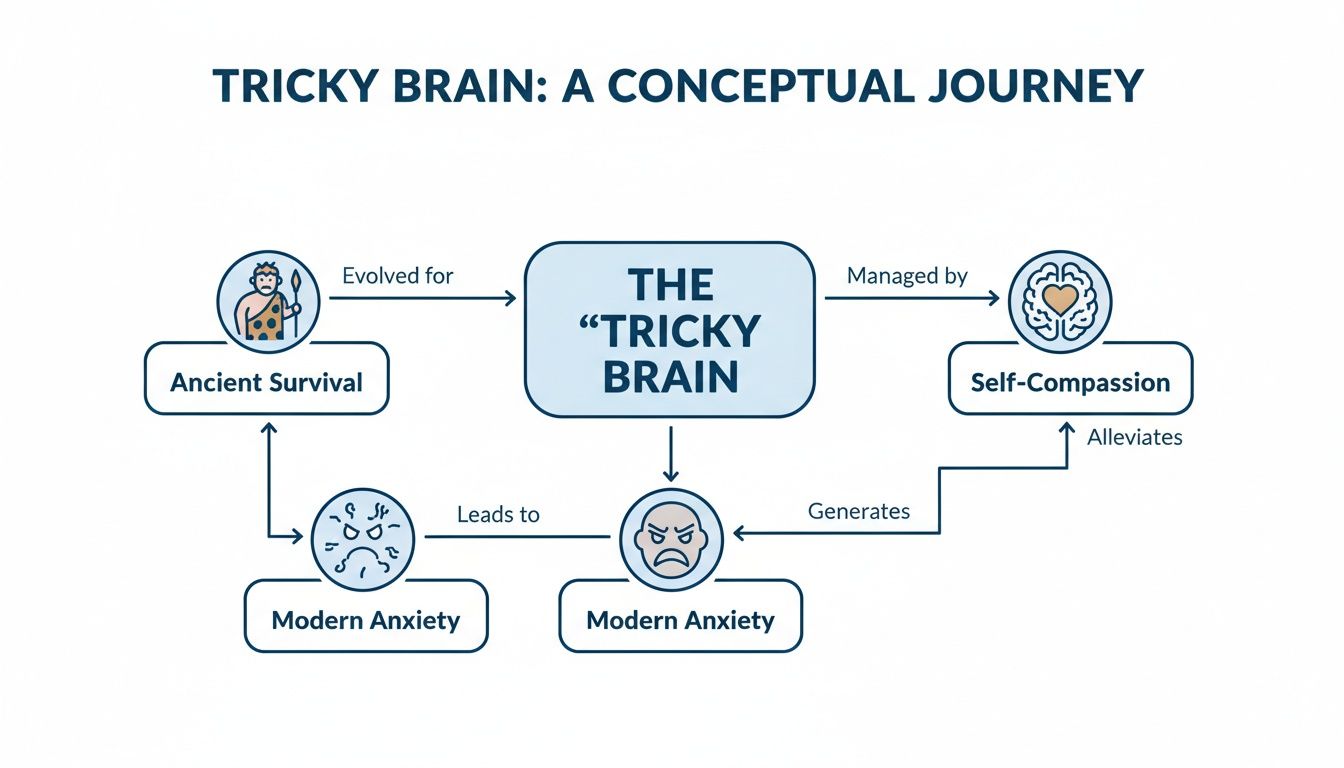
It’s a powerful reminder that while our evolutionary brain isn’t our fault, learning to be compassionate with ourselves is a skill we can absolutely develop to find more balance.
The Soothing System: Our Inner Carer
The third and final circle is the Soothing System. This one is all about feelings of calm, contentment, safety, and connection. It comes online when we feel cared for and safe—when we’re not under threat and not striving to achieve anything.
This system has its roots in our evolutionary need for connection and caregiving, like the feeling a mother has comforting her child. It acts as the emotional handbrake, helping to regulate the other two systems so we can rest and recover. The problem is, for many of us—especially those with a history of high self-criticism or trauma—this system is often underdeveloped and collecting dust.
To help you spot these systems in your own life, here’s a quick breakdown:
The Three Emotional Regulation Systems in Daily Life
| System | Primary Function | Associated Feelings | Everyday Example |
|---|---|---|---|
| Threat | To protect you from harm and danger | Anxiety, Anger, Fear, Disgust | Worrying about a looming deadline or feeling hurt after a critical comment. |
| Drive | To motivate you to seek rewards and achieve goals | Excitement, Joy, Focus, Eagerness | Working hard for a promotion or feeling a sense of accomplishment after a workout. |
| Soothing | To promote rest, recovery, and feelings of safety and care | Contentment, Calmness, Safety, Connection | Enjoying a warm cup of tea, receiving a hug, or listening to calming music. |
By seeing how these systems play out, you can start to notice which 'circle' you’re spending most of your time in.
The Vicious Cycle and the Way Out
The central problem that Compassion Focused Therapy tackles is that modern life has most of us bouncing relentlessly between the Threat and Drive systems. We feel anxious (Threat), so we work harder to feel successful (Drive). When we inevitably burn out or feel like we’ve failed, we crash right back into the Threat system, beating ourselves up.
It’s an exhausting and demoralising cycle.
The Soothing System is the missing piece of the puzzle. It offers a safe place to land, a way to manage our distress without having to fight it or flee from it.
The goal of CFT isn’t to get rid of the Threat or Drive systems—we need them both to navigate life. Instead, the aim is to consciously and deliberately strengthen our Soothing System. By doing this, we can bring our entire emotional world back into a healthier balance.
When we learn to activate our own soothing system, we can quieten the frantic alarms of the Threat system and step off the relentless hamster wheel of the Drive system. This isn't about weakness; it's about building a profound inner resilience. It creates a foundation of kindness from which we can face life’s challenges with far more strength and wisdom.
Putting Compassion into Practice with Core CFT Techniques

Understanding the Three Circles Model is the first step, but the real change begins when we learn how to actively strengthen our soothing system. This is where Compassionate Mind Training (CMT) comes in—it’s the practical, hands-on toolkit at the heart of compassion focused therapy.
Think of it as physiotherapy for your mind. CMT uses a series of targeted exercises designed to help you cultivate a more compassionate inner voice. Instead of just hoping to feel better, you're actively building the mental muscles needed to regulate your threat system and find your emotional balance.
These techniques aren't rigid instructions. They're invitations to explore a kinder way of relating to yourself by directly engaging the parts of your brain associated with care and connection. Over time, this helps to effectively rewire your automatic responses to distress.
Creating an Inner Ally with Compassionate Imagery
One of the most powerful tools in the CMT toolkit is compassionate imagery. This isn’t about daydreaming; it’s a focused practice where you use your imagination to create a figure that embodies perfect compassion. This could be an ideal compassionate version of yourself or another being.
This figure is wise, strong, warm, and completely non-judgemental. Its only intention is your well-being. By vividly imagining this figure and picturing it directing kindness toward you, you start to internalise these very qualities yourself.
The process might involve:
- Visualising its appearance: What does this compassionate figure look like?
- Sensing its presence: What is its facial expression? What does its voice sound like?
- Feeling its qualities: Imagining its profound wisdom, strength, and unwavering warmth.
This is a sophisticated psychological tool, not just creating an imaginary friend. Your brain doesn't always distinguish clearly between a vividly imagined experience and a real one. This exercise stimulates your soothing system, creating a tangible feeling of safety you can learn to access when you need it most.
In fact, a systematic review from the University of Edinburgh looked at 14 UK-based studies and found consistent evidence for this. The research showed that Compassion Focused Imagery led to big improvements in mood and self-compassion, while also reducing self-criticism and shame. You can read more about these promising findings on the effectiveness of CFI for yourself.
The Power of Compassionate Letter Writing
Another cornerstone of CFT is compassionate letter writing. This exercise gives you a structured way to get your thoughts out of your head and respond to that harsh inner critic with kindness, rather than getting into a fight with it.
You write a letter to yourself, but from the perspective of your compassionate self. The idea is to address a specific struggle or moment of self-criticism with the same warmth and wisdom you'd offer a dear friend.
The compassionate letter isn't about making excuses or denying difficulties. It's about validating the pain of the experience while offering support, encouragement, and a non-judgemental perspective on why you might be struggling.
So, if you made a mistake at work and your inner critic is on a rampage, your compassionate letter might start by acknowledging your disappointment. It would then gently remind you that mistakes are human, and this one event doesn't define your worth. It's a practice that helps break the cycle of self-attack.
Rewiring Your Brain for Kindness
These practices, along with others like mindful breathing and compassionate behaviour experiments, are the engine of change in CFT. They aren't quick fixes. As Paul Gilbert emphasises, compassion is a skill that takes training and patience.
Every time you do a compassionate imagery exercise or write a kind letter to yourself, you're laying down new neural pathways. You're teaching your brain there's an alternative to the threat-drive cycle. Eventually, turning to your compassionate self becomes more natural. You can explore this process in more detail by reading about the journey towards self-compassion and how it reshapes our inner world.
Ultimately, the techniques of Compassion Focused Therapy provide a practical way to work with our tricky brains. They empower you to move from being a victim of your evolutionary wiring to becoming an active, wise, and kind manager of your own mind.
Who Can Benefit from Compassion Focused Therapy
While the ideas behind self-compassion can genuinely enrich anyone's life, Compassion Focused Therapy (CFT), developed by Paul Gilbert, is especially powerful for people wrestling with particular kinds of psychological pain. It really offers a different path to healing, particularly for those who feel like other therapies haven't quite managed to reach the heart of their distress.
CFT often proves to be a turning point for people caught in a relentless cycle of high shame and self-criticism. If your inner world is run by a harsh, attacking voice that leaves you feeling flawed, worthless, or simply not good enough, this approach was designed with you in mind. It helps you realise that this inner critic isn’t some personal failing, but a misguided—and often frantic—attempt by your 'tricky brain' to keep you safe.
This therapy can bring profound relief to those dealing with the long shadow of trauma, abuse, or neglect. When past experiences have left you with a deep-seated sense of being unsafe or a core belief that you are somehow broken, CFT works to build the inner security that never had a chance to develop. It directly targets the emotional wounds that so often fuel conditions like anxiety, depression, and eating disorders.
Addressing Deep-Rooted Emotional Pain
At its heart, CFT is for people whose suffering is tangled up with feelings of shame and self-blame. Unlike some therapies that focus mainly on changing thoughts and behaviours, CFT goes a level deeper to work with the emotional systems that are driving them in the first place.
CFT is an especially good fit for individuals who:
- Struggle with a powerful inner critic: This isn't just everyday negative self-talk; it's a persistent, attacking internal voice that shreds your confidence and keeps your mood low.
- Have a history of trauma or neglect: Early life experiences that felt threatening or were emotionally cold can leave our internal soothing system underdeveloped. CFT helps to build this system from the ground up.
- Feel blocked in other therapies: Some people find they can understand their issues on an intellectual level (perhaps through CBT) but still feel emotionally stuck. CFT helps bridge that frustrating gap between knowing you should be kinder to yourself and actually feeling it.
For anyone grappling with these challenges, structured programmes can offer a clear way forward. Learning to actively cultivate a kinder inner voice through a dedicated process, like an 8-week compassionate mind training course, provides the tools and support needed for lasting change.
Expanding the Applications of Compassion
One of the great strengths of CFT is just how adaptable it is. Its principles can be applied to a surprisingly wide range of complex conditions because its focus on regulating our threat responses and building inner safety is so fundamental.
Recent clinical studies, many led or co-authored by Paul Gilbert and his colleagues in the UK, have been exploring these wider applications. For example, research into compassion-focused group therapy for people diagnosed with Bipolar Affective Disorder has shown its potential to improve clinical outcomes. In a completely different setting, another UK-based case study demonstrated significant reductions in psychopathic traits among juvenile detainees after a CFT-based intervention, showing compassion's power even in forensic contexts.
Ultimately, Compassion Focused Therapy is for anyone who recognises that their relationship with themselves has become a source of pain. It offers a way to move from being your own worst enemy to becoming your most steadfast and supportive ally on the journey to healing.
Answering Your Questions About Compassion Focused Therapy
It's completely normal to have a few questions when you first come across a new way of working in therapy. And when it comes to Compassion Focused Therapy (CFT), developed by Paul Gilbert, there are a few common queries that pop up again and again.
Let's clear some of those up, so you can get a better sense of how CFT works in practice and whether it feels like the right fit for you.
Is Self-Compassion Just a Fancy Term for Self-Pity?
This is probably the most important question to tackle, and the answer is a firm no. In fact, you could say self-compassion is the complete opposite of self-pity.
Self-pity tends to keep us stuck. We get lost in our problems, feel totally alone in our suffering, and end up feeling powerless. It’s a passive state of wallowing.
Self-compassion is an active response. It's about turning towards our pain, but with kindness and the understanding that struggle is just part of being human. This mindset helps us feel connected to others, not isolated. Instead of getting stuck, the question becomes, "Okay, this is tough. What do I need right now to help myself get through this?" It's about building inner strength, not dwelling on our difficulties.
How Is CFT Different from CBT?
Many people are familiar with Cognitive Behavioural Therapy (CBT), a brilliant and effective approach for changing unhelpful thinking and behaviour patterns. CFT grew out of CBT and they share some common ground, but there’s a crucial difference in the emotional tone.
Think of it this way:
- CBT's Focus: The main job is to challenge and reframe negative or irrational thoughts. It’s a very logical, rational process.
- CFT's Focus: While we're still interested in our thoughts, CFT is more concerned with the feeling behind them. The goal is to change the harsh, critical way we often talk to ourselves and instead cultivate a kinder, more supportive inner coach.
Let’s use an example. Imagine your inner critic pipes up with, "I completely messed up that presentation, I'm useless."
A CBT approach might guide you to find evidence against that thought: "Well, I didn't mess it all up, the Q&A part went well, and one mistake doesn't make me useless." This is a fantastic and useful skill.
A CFT approach adds another, deeper layer. It would help you notice the pain of disappointment that’s fuelling that self-criticism and respond to that feeling with kindness: "Wow, that feels really painful right now. It's okay to be disappointed. Berating myself isn’t going to help. How can I support myself through this feeling?" CFT gets to the root of the problem by soothing the underlying threat system, not just correcting the thought on the surface.
What Actually Happens in a CFT Session?
While every session is unique to the person, there are some core elements you can expect. A therapist trained in the work of Paul Gilbert will guide you through exercises designed to deliberately activate your brain's soothing system and build up what we call your 'compassionate self'.
A CFT session is much more than just talking; it’s about actively training your mind in a new way.
"When you practice compassion, you are stimulating brain systems. You are actually practicing developing brain systems, and we now know that if you practice, you literally will change circuits in your brain." – Paul Gilbert
So, what might you actually do in a session?
- Learning About Your Brain: You'll start by understanding your 'tricky brain' and the Three Circles Model. This isn’t dry theory; it’s about seeing why you think and feel the way you do, which helps to remove any sense of self-blame.
- Soothing Rhythm Breathing: This is a cornerstone practice. It's a simple but powerful way to calm your nervous system and shift out of a state of anxiety or threat.
- Compassionate Imagery: These are guided exercises where you might create a mental image of an ideal compassionate figure. The aim is to generate real feelings of safeness, warmth, and support that you can draw on anytime.
- Compassionate Letter Writing: You might explore difficult memories or feelings by writing to yourself, but from the perspective of your compassionate self.
- Behavioural Experiments: This involves gently encouraging yourself to try out compassionate actions in your daily life, both for yourself and for others.
The whole atmosphere is one of warmth and non-judgement. Your therapist is there as a guide, helping you build the skills you need to become your own best ally. It's a truly collaborative process focused on developing inner resources that will stay with you long after therapy ends.
At Dr Chris Irons, we specialise in helping individuals and professionals use the principles of Compassion Focused Therapy to overcome self-criticism and build kinder, more resilient lives. To learn more about our therapy, coaching, and training services, please visit us at https://drchrisirons.com.