Compassion Focused Therapy (CFT) is an approach we use to help people who are really struggling with shame and a harsh inner critic. Developed by Professor Paul Gilbert, it’s all about training our minds for compassion, much like you’d train a muscle at the gym. The core idea is to intentionally bring our brain’s natural soothing system online to help balance out our tendency to get stuck in threat-based thinking.
Getting to the Heart of CFT
Have you ever found yourself trapped in a loop of self-criticism? Replaying mistakes over and over, feeling like you're just not good enough? It's a surprisingly common, and painful, human experience.
The reason this happens is that our brains evolved with a powerful "threat system" designed to keep us safe by constantly scanning for danger. This was brilliant for our ancestors dodging predators, but in our modern world, that threat system can easily turn inward. The result? A relentless inner critic that never seems to give us a break.
Compassion Focused Therapy gives us a direct way to work with this "tricky brain," as we often call it. The aim isn't to get rid of difficult thoughts or feelings, but to build an entirely new internal resource: a compassionate self.
This approach is built on a few key ideas:
- It’s Not Your Fault: CFT starts from the understanding that our self-critical minds are a product of evolution and our life experiences, not some personal failing. Just realising this can lift a huge weight of shame right from the start.
- Balancing Your Emotions: The therapy helps you see how we have three main emotional systems: the threat system (for protection), the drive system (for motivation), and the soothing system (for safety and connection). For many of us, the threat system is overworked and the soothing system is seriously underdeveloped. CFT aims to bring these into better balance.
- Building Inner Strength: Through specific, targeted exercises, you learn to cultivate an inner voice that is wise, strong, and caring. This isn’t about fluffy, empty affirmations; it's about developing the genuine courage and warmth you need to face life's challenges.
The real therapeutic goal in Compassion Focused Therapy is to help people develop their capacity for self-compassion. It’s a shift from a threat-based, self-critical way of being to one of warmth, safeness, and genuine support for yourself.
From Theory to a Practical Skill
Think of CFT as a form of mental training. Just as you’d go to the gym to build physical strength, CFT provides exercises to build up your compassionate mind.
This involves learning practical skills like soothing rhythm breathing, using compassionate imagery, and actively changing self-critical behaviours. The goal is to create a more balanced and resilient internal world, giving you the tools to manage distress and live a more meaningful life. To broaden your understanding of various therapeutic approaches and mental wellness topics, you might find valuable articles on Buddypro's Blog for Therapeutic Insights.
How Your Three Emotional Systems Work
At the very core of Compassion Focused Therapy is a beautifully simple, yet profound, model of the mind. It suggests we all have three main emotional regulation systems, which have evolved over millions of years not just to help us survive, but to help us flourish. Getting to grips with these systems is the first, crucial step toward bringing them back into balance.
Think of it like being the captain of a ship with three different engines. Each engine has a distinct purpose, and you need all three working in harmony to navigate the choppy waters of life. But when one engine is constantly red-lining and another has seized up from neglect, the voyage becomes exhausting and perilous.
This is a great little map for understanding how CFT sees the mind. It shows how our threat and soothing systems interact, and how this dynamic shapes the inner voice we live with day in, day out.
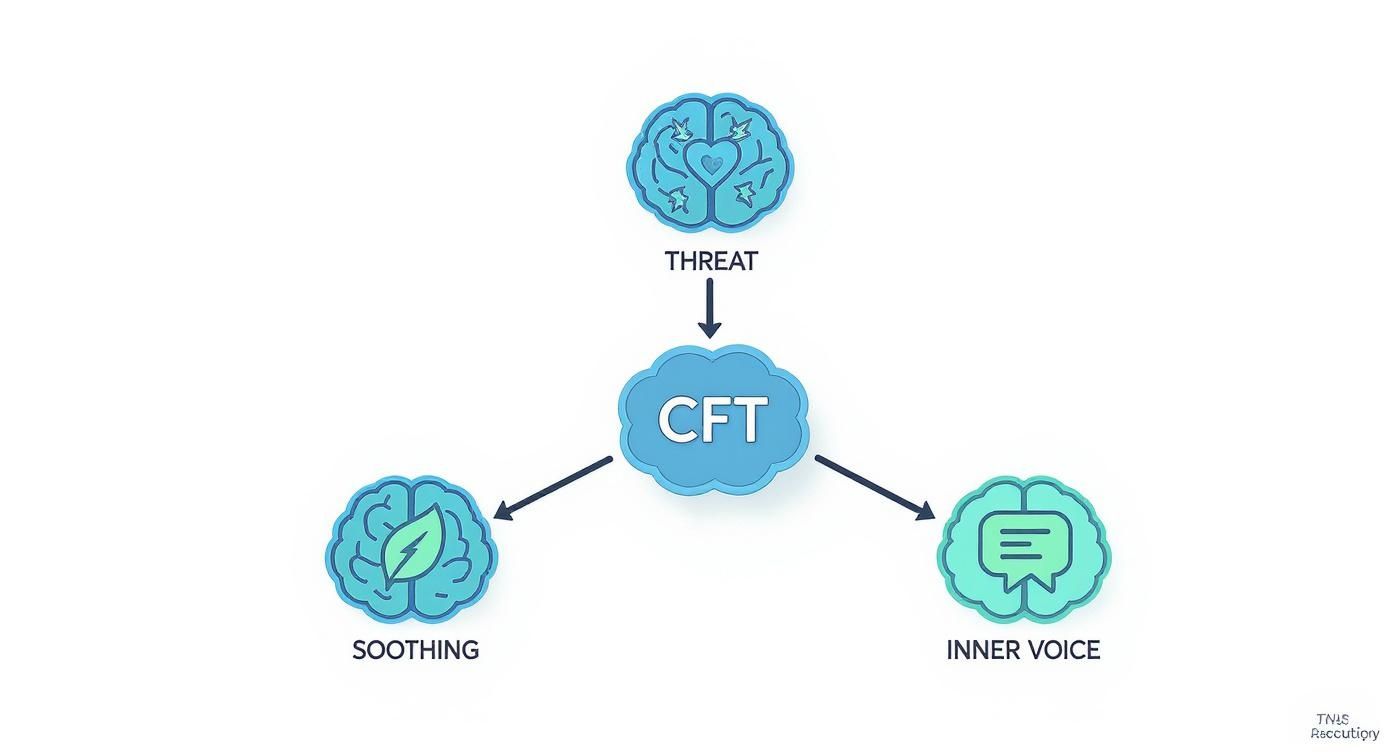
What the diagram really brings home is that while our threat system is a natural, hard-wired part of us, CFT offers a direct route to intentionally strengthening our soothing system. This is how we begin to create a more balanced and compassionate internal world.
The Threat System: Our Ancient Alarm
First up is the threat system, our built-in alarm designed to sniff out and react to danger. It's the oldest and often the loudest of the three systems, a feature we share with all animals. Its one and only job is to protect us.
When this system kicks in, our bodies are flooded with hormones like adrenaline and cortisol. This triggers feelings we all know well: anger, anxiety, fear, or disgust. It’s preparing us for a fight, flight, or freeze response—absolutely vital for escaping a sabre-toothed tiger, but far less helpful when the "threat" is a terse email from our boss or a harsh, critical thought about ourselves.
The Drive System: Our Engine for Achievement
Next, we have the drive system. This is our internal engine for motivation, designed to get us seeking out resources, chasing goals, and achieving things that feel good. It’s the juice that gets you out of bed in the morning and pushes you to finish that project or master a new skill.
This system is all about feelings of excitement, desire, and accomplishment, and it runs on the neurotransmitter dopamine. It’s what gives us our sense of purpose and vitality. The trouble is, when it’s stuck in overdrive, it can lead to burnout, relentless striving, and that awful feeling that you’re never, ever doing enough.
The Soothing System: Our Haven for Calm and Connection
Finally, there’s the soothing system. This system is where we find feelings of calm, safeness, and contentment. It comes online when we feel cared for and connected to others—when we’re not under threat and not striving for the next big thing.
This system is deeply linked to the mammalian care-giving instinct and is activated by things like warmth, kindness, and gentle touch. It releases hormones like oxytocin, which helps us feel safe and bonded, allowing our minds and bodies to finally rest, digest, and recover. It's the very foundation of our well-being.
To make these distinctions clearer, let's break them down in a table.
The Three Emotional Regulation Systems in CFT
| System | Primary Function | Associated Feelings | Key Hormone/Neurotransmitter |
|---|---|---|---|
| Threat System | Protection, safety-seeking | Anxiety, anger, fear, disgust | Adrenaline, Cortisol |
| Drive System | Motivation, achievement, resource-seeking | Excitement, wanting, joy, vitality | Dopamine |
| Soothing System | Rest, digest, bonding, contentment | Calm, safeness, connection, contentment | Oxytocin, Endorphins |
Seeing them side-by-side really highlights how different their jobs are. You can start to see how an imbalance might cause problems.
Why Are Our Systems So Unbalanced?
Here’s the rub: for many of us, modern life keeps our threat and drive systems switched on almost permanently. We’re bombarded with deadlines, social pressures, and a 24/7 news cycle that keeps our threat system on high alert. At the same time, our culture relentlessly glorifies achievement and busyness, keeping our drive system running at full throttle.
All this frantic activity leaves precious little room for our soothing system to come online. It becomes weak and underdeveloped, like a muscle we’ve forgotten how to use. The result? We get stuck in cycles of anxiety, stress, and self-criticism, without the internal toolkit to calm ourselves down and find a sense of inner safety. This imbalance has become a defining feature of the mental health challenges so many people face today.
For example, a recent evaluation of a Compassion Focused Therapy programme for NHS staff in England was launched precisely because initial assessments found widespread self-criticism and low self-compassion. This points directly to that systemic imbalance we’re talking about. You can read more about the CFT implementation within the NHS to see how this works in a real-world setting.
The whole point of Compassion Focused Therapy is to correct this imbalance. It’s not about getting rid of threat or drive—we need them! It’s about giving you practical, powerful exercises to deliberately stimulate and strengthen your soothing system. This gives you the capacity to manage your threat system more effectively and, ultimately, find a more sustainable and kinder way of being with yourself and the world.
Right, so we’ve touched on the theory behind CFT – the three emotional systems. But understanding the map is one thing; learning to navigate the territory is another entirely. This is where the real work begins, and it's less about abstract thinking and more about practical, hands-on training for your mind.
The journey starts with what we call Compassionate Mind Training (CMT).
Think of CMT as physiotherapy for your emotional world. If you had a weak muscle, you wouldn't just think about it getting stronger; you’d do specific, targeted exercises to build it up. CMT applies the same principle to your soothing system, using structured practices to deliberately activate and strengthen your mind's capacity for kindness and resilience.
This isn't a quick fix. It's about gradually cultivating a new way of relating to yourself and your difficulties. The goal is to give you the tools to consciously shift out of that reactive, threat-based mindset and into a state of warmth and safeness, especially when life throws its inevitable curveballs.

Developing Your Compassionate Self
A central pillar of this training is helping you find and develop your 'compassionate self'. This involves imagining and connecting with an ideal version of yourself—one that embodies all the qualities of compassion you'd want to have available.
This isn't about creating an imaginary friend. It's about building a powerful, internalised resource you can call on anytime. We focus on cultivating three key qualities:
- Wisdom: The ability to see things clearly, with real perspective. It’s about stepping back and understanding the bigger picture – your life history, the way our tricky human brains are wired, and the simple fact that you didn't choose to have this struggle.
- Strength and Courage: This is crucial. True compassion isn’t soft or weak; it’s the courage to turn towards your pain and engage with it, rather than running from it. It's the strength to stay present with difficult feelings with the intention to help.
- Warmth and Commitment: This is the deep sense of care and dedication to your own well-being. It’s about bringing a non-judgmental kindness to your experience and a firm commitment to be there for yourself, no matter what happens.
Through guided imagery and meditation, we practise embodying this compassionate self again and again. Each time you do, you're building new neural pathways, making it less of an "act" and more of a genuine, accessible part of who you are. It might feel a bit strange or unfamiliar at first, but with practice, it becomes a powerful source of inner stability.
Using Imagery to Create Safeness
One of the most potent tools in the CFT toolkit is compassionate imagery. Our brains are amazing; they respond to imagined scenarios almost as strongly as they do to real ones. We can use this to our advantage by creating a 'safe place' in our minds.
This involves building a detailed, multi-sensory mental sanctuary—a place you can retreat to whenever that threat system kicks into overdrive. We guide you to imagine a place where you feel completely safe, calm, and at peace, focusing on every detail: what you can see, hear, smell, and feel on your skin.
The goal is to create a vivid mental experience that actively triggers your soothing system. Returning to this safe place regularly helps to regulate your nervous system and reinforces the feeling of internal security, which is often underdeveloped in people struggling with self-criticism.
This isn't about escaping reality. Far from it. It's about creating a secure internal base from which you can more bravely engage with life's difficulties. Developing this skill is fundamental to building emotional resilience within the compassion focused therapy framework.
The Power of Compassionate Letter Writing
Another core technique that can be incredibly powerful is compassionate letter writing. This exercise takes your inner critic head-on by asking you to write a letter to yourself from the perspective of your compassionate self.
It’s a structured process that usually looks something like this:
- Acknowledge Your Struggle: You start by clearly articulating a specific difficulty you're facing. Maybe it's a mistake you made or a painful feeling of shame that keeps popping up.
- Express Understanding: Next, you write about why it’s understandable that you feel this way. You consider your life history, how human brains work, and the context of the situation. This step is about validating your emotional experience without judgment.
- Offer Compassionate Support: From the wise, strong, and warm perspective of your compassionate self, you offer yourself the support, encouragement, and kindness you actually need.
- Identify Helpful Actions: Finally, you think about what might be a genuinely helpful next step, no matter how small. What would be a kind and useful thing to do now?
This practice can be profoundly moving. It externalises your inner compassionate voice, making it feel more real and much easier to access. Over time, it helps dismantle those old, harsh, self-critical habits and replaces them with a more supportive internal dialogue.
Many people find this becomes a cornerstone of their progress. For those looking to deepen these skills in a structured way, programmes like an 8-week Compassionate Mind Training course can provide invaluable guidance and a supportive community. When practised consistently, these exercises lay the foundation for lasting, meaningful change.
Who Benefits Most From This Therapy?
While just about anyone could benefit from learning the skills taught in Compassion Focused Therapy (CFT), it’s particularly life-changing for people who feel stuck in certain, deeply ingrained emotional patterns.
If you feel like you’re in a constant war with a harsh inner critic, or if you’re carrying a heavy weight of shame, this approach was quite literally designed with you in mind.
CFT gets right to the heart of how self-criticism and shame work. It sees them not as character flaws, but as powerful (and often protective) habits linked to an overactive threat system. By intentionally training the mind's soothing system, CFT offers a direct way to quieten that relentless critical voice and loosen the painful grip of shame.
When Your Inner Critic Is Running the Show
For so many people, the toughest battle is with that voice in their head – the one that’s always judging, blaming, and pointing out flaws. This inner critic can feel like an inescapable part of who you are, turning every minor mistake into a catastrophe and every success into a fluke you didn't really deserve.
This is precisely where CFT shines. It doesn't just tell you to "be nicer to yourself." It gives you the practical tools to actually build and strengthen a different kind of inner voice—one that is wise, strong, and genuinely supportive.
Think about a common scenario:
Meet Alex, who replays every single mistake at work. After a small error in a report, Alex's inner critic launches an immediate attack: "You're so incompetent. Everyone knows you can't handle this job. It's only a matter of time before they find out." That one thought spirals into a whole weekend of anxiety and self-doubt, draining away all energy and joy.
For someone like Alex, CFT would offer a way out of this painful loop. Through compassionate mind training, Alex could learn to recognise this as the threat system kicking into overdrive. From there, they could intentionally activate their soothing system, creating the mental space to respond with wisdom and self-reassurance instead of self-attack.
Finding a Foothold with Common Mental Health Struggles
Beyond self-criticism, CFT has proven to be incredibly helpful for a range of mental health conditions. Its core ideas connect directly to the emotional challenges that underpin these difficulties.
- Anxiety and Depression: Both of these often involve a mind stuck in threat mode. With anxiety, it’s about worrying about future dangers; with depression, it's often ruminating on past regrets and feelings of hopelessness. CFT helps by strengthening the soothing system, which directly counteracts the physiological and psychological state of threat, fostering a much-needed sense of calm and safeness.
- Trauma: People who have experienced trauma often live with intense shame and a highly sensitised threat system. CFT offers a gentle, non-blaming framework for understanding these responses as the brain’s natural attempt to keep you safe. Techniques like creating a "safe place" imagery become a vital resource for grounding and emotional regulation.
- Eating Disorders: The cycle of an eating disorder is so often fuelled by extreme self-criticism, body shame, and a desperate drive for control. CFT helps to address these underlying emotional drivers by cultivating a kinder, more accepting relationship with oneself and one’s body, which in turn reduces the need for destructive coping behaviours.
The use of Compassion Focused Therapy in clinical practice has generated strong evidence for its benefits. Its growing adoption in places like the UK's National Health Service (NHS) speaks volumes about its real-world impact. For example, a 2013 evaluation of a CFT group programme discovered that participants who completed the 16-session course showed significant increases in self-compassion, along with notable reductions in self-criticism, shame, and depression. You can explore the full study on CFT's effectiveness in clinical practice for a deeper look.
Ultimately, CFT is for anyone who feels their relationship with themselves is more of a source of pain than a source of strength. If you feel stuck, isolated by shame, or just exhausted from the constant internal battle, this therapeutic approach offers a clear, structured path toward building a more supportive inner world for lasting well-being.
So, Does CFT Actually Work? Exploring the Evidence
While the ideas behind Compassion Focused Therapy (CFT) often just feel right, it’s fair to ask: does it really work? The short answer is yes. A growing pile of scientific research backs it up, showing real, measurable changes for people wrestling with serious emotional pain.
It's this solid evidence base that has seen CFT being embraced in demanding environments like the UK's National Health Service (NHS). The research isn't just academic, either. It translates into real-world outcomes. Study after study shows people who go through CFT experience significant drops in depression and anxiety, and a real easing of that persistent shame and self-criticism that can be so paralysing.
Real-World Impact and Why People Stick With It
One of the most telling things about CFT is just how well it lands with clients. In a therapy landscape that can sometimes feel a bit cold or clinical, CFT really stands out. Research consistently flags it as a highly acceptable and engaging therapy.
What does that mean in practice? Well, for one thing, it has noticeably lower dropout rates than many other psychological treatments. People find the approach helpful and supportive, so they stick with it. Instead of just picking apart their problems, they're given practical, empowering skills that truly resonate.
If there's one key takeaway from the evidence, it's this: CFT doesn't just chip away at the 'bad stuff'; it actively builds up the 'good stuff'. The most consistent finding across all the research is a significant increase in self-compassion, giving people a powerful internal resource for resilience that they can carry with them long after therapy ends.
The Power of the Group
A lot of the research, especially from places like the NHS, has looked at CFT delivered in groups. This setup has proven to be incredibly effective. It creates a shared space where people quickly realise they aren’t the only ones struggling with a harsh inner critic – a hugely powerful realisation in itself.
As one of the leading voices in this area, Dr Chris Irons, is a leading voice in Compassion Focused Therapy, often highlights just how healing it is to connect with our shared human experience.
The data backs this up strongly. A major 2025 systematic review and meta-analysis confirmed that compassion-based approaches lead to much bigger improvements than control groups across the board. Drilling down into the specifics for CFT, 21 out of 29 studies in that review used a group format, and every single one reported positive results.
You can discover more about these compelling findings on compassion-based interventions yourself. The evidence is clear: whether you experience it one-on-one or in a group, CFT offers a reliable and effective path toward a kinder, more balanced inner world.
How to Find a CFT Therapist in the UK

Deciding to look for a therapist is, in itself, a real act of self-compassion. When you feel ready to see what compassion focused therapy could do for you, knowing where to start can make a huge difference. Let's walk through some clear, practical steps to help you find the right support here in the UK.
The best way to begin is by going straight to the organisations that specialise in this specific approach. They keep updated lists of accredited therapists who’ve been through rigorous, dedicated training.
Starting Your Search for a Practitioner
Your first port of call should be The Compassionate Mind Foundation. It was founded by Professor Paul Gilbert, the man who developed CFT, and its website has a directory of therapists all over the country. This is really the gold standard for finding someone with verified expertise.
A few other professional bodies are also really useful:
- British Association for Behavioural and Cognitive Psychotherapies (BABCP): Because many CFT therapists also have a background in CBT, you can often find them through the BABCP register.
- British Psychological Society (BPS): Their directory lets you search for chartered psychologists, and many will list CFT as one of their specialisms.
- Counselling Directory: This is a wider platform, but its search filters are great for narrowing down therapists who specifically offer CFT.
As you look through profiles, keep an eye out for clear evidence of their CFT training. Check their qualifications and professional memberships on their websites – it should be easy to find.
A huge part of this process is about finding a good fit. During that first chat, it's not just about what's on paper; it's about whether you feel a sense of safety and connection with them. Trust your gut.
Key Questions for Your First Consultation
That initial call or meeting is your chance to get a feel for whether a therapist is right for you. Don’t hold back from asking direct questions – it’s the best way to make sure they have the right skills for what you need.
You might want to think about asking things like:
- What is your specific training in Compassion Focused Therapy? You’re listening for details about courses, workshops, or supervision they've had with recognised trainers in the field.
- How do you bring CFT into your work with clients? This question helps you get a sense of how they actually apply the ideas day-to-day.
- What’s your experience of working with issues like self-criticism (or whatever your main concern is)? Their answer will quickly tell you how familiar they are with the kind of struggles you're bringing.
- What might the first few sessions look like? This gives you a peek into their process and helps you know what to expect.
Finding the right person is such a crucial part of the journey. For anyone looking for therapy directly with a leading expert, you can explore options for compassion focused therapy with Dr Chris Irons to see if his services might be a good match for you.
Training for Professionals
For fellow professionals interested in training in CFT, there are some fantastic resources in the UK. Balanced Minds, which I co-founded, offers a whole range of workshops and training events. The Compassionate Mind Foundation also lists official training pathways, giving you a clear, structured route to becoming a skilled CFT practitioner.
Got Questions About Compassion Focused Therapy?
As you get to know compassion focused therapy, it’s completely natural for some questions to pop up. This way of working can feel quite different from other therapies, so let’s clear up a few common queries right from the start.
Getting your head around the practical side of CFT is a great way to see how it might fit into your life. Here are some of the most frequent things people ask when they're thinking about starting this journey.
"Is This Just About Being Nice to Yourself?"
This is probably the most common question I hear, and the answer is a firm no. While kindness is a huge part of it, CFT is a structured psychotherapy deeply rooted in what we know about neuroscience and psychology. It’s a world away from simply thinking positive or slapping on a few empty affirmations.
Instead, CFT is about actively training your mind to find the courage and wisdom to turn towards your suffering, not away from it. The goal is to build a compassionate self that is strong enough to handle life's challenges with resilience, rather than just papering over the cracks.
"How Long Does CFT Take to Work?"
There’s no one-size-fits-all answer here; the length of therapy always comes down to your individual needs and what’s going on in your life. Everyone’s journey is unique.
That said, a typical NHS group programme might run for about 12-16 weeks. For individuals working one-on-one with a therapist on more deep-seated difficulties, therapy could go on for several months, or even a year or more. The important thing is that you and your therapist will figure out a timeline that feels right for your personal goals.
The real focus in compassion focused therapy is less on a fixed timeline and more on the process of building lasting internal resources. The skills you learn are designed to serve you for a lifetime, long after formal therapy has ended.
"Can I Do Compassion Focused Therapy on My Own?"
Yes, absolutely. You can practise many CFT exercises by yourself, and doing so is incredibly helpful. There are some brilliant books, guided meditations, and online resources out there that can help you start building your compassionate mind training skills.
However, when it comes to tackling profound issues like trauma, persistent shame, or a really harsh inner critic, I’d always recommend working with a trained CFT therapist. A good therapist provides expert guidance, a bit of accountability, and, crucially, a safe therapeutic relationship. That supportive connection is often essential for navigating the more difficult emotions that can surface as you heal.
At Dr Chris Irons, I provide specialised therapy and coaching to help you build a kinder, more resilient inner world. Explore how you can begin your journey at my website.