Ever felt like you’re on stage, in the spotlight, but you’ve been handed the wrong script? Everyone else seems to know their lines, but you’re just winging it, terrified that at any moment someone will tap you on the shoulder and say, “You don’t belong here.”
That gut-wrenching fear of being ‘found out’, even when you have a track record of success, is the very core of imposter syndrome. It’s not a personal failing or a sign of weakness; it’s a deeply personal yet surprisingly common experience.
Understanding the Imposter Feeling

At its heart, imposter syndrome is a psychological pattern where you consistently doubt your skills and accomplishments. It comes with a persistent, internalised fear of being exposed as a fraud. No matter what external evidence says—promotions, praise, successful projects—you remain convinced that you’ve somehow deceived everyone and don’t deserve any of it.
This isn't just a fleeting moment of self-doubt. It’s a recurring cycle of thought and feeling that can take a real toll on your career, wellbeing, and confidence. The crux of the issue is an inability to truly internalise your achievements. You might chalk up a win to luck, good timing, or someone else’s help—anything but your own skill and hard work.
Imposter Syndrome at a Glance
To get a clearer picture of what imposter syndrome feels like from the inside, let’s look at some of the common thoughts and feelings it triggers. Recognising these patterns in yourself is the first, crucial step toward breaking free from them.
| Characteristic | What It Feels Like |
|---|---|
| Pervasive Self-Doubt | "I only got this job because they made a mistake in hiring." |
| Attributing Success to Luck | "I was just in the right place at the right time; anyone could have done it." |
| Fear of Being Exposed | "One day, everyone will realise I don't know what I'm doing." |
| Dismissing Praise | "They're just being nice; they don't see how much I struggled." |
| Overworking to Compensate | "I have to work twice as hard as everyone else just to keep up." |
Seeing these written down can be a real eye-opener. It helps to externalise the internal monologue that often runs on a loop, unchecked.
How Widespread Is This Feeling?
If these feelings resonate with you, it's vital to know you are far from alone. This isn’t some rare affliction; it’s a widespread human experience, especially in high-pressure environments. The irony is that the very experience that makes you feel so isolated is the one that connects you to millions of others.
Imposter syndrome is the experience of feeling like a phony—you feel as though at any moment you are going to be found out as a fraud—like you don't belong where you are, and you only got there through dumb luck. It can affect anyone no matter their social status, work background, skill level, or degree of expertise.
This feeling is remarkably common right here in the UK. A recent study found that a staggering half of all UK adults (50%) have experienced imposter syndrome at some point.
The data also points to some significant differences between groups. For example, 54% of women and 57% of non-binary individuals reported doubting their abilities at work, compared to 38% of men. You can dive deeper into these findings over at edn.training.
The good news is that there are effective ways to manage these feelings. This guide will introduce you to Compassion Focused Therapy (CFT) as a practical and supportive path forward.
The Common Signs and Triggers of Imposter Feelings

Spotting imposter syndrome really starts with noticing the small, everyday ways it shows up. It’s not just a fuzzy sense of not being good enough; it's a pattern of specific thoughts, actions, and feelings that keep you trapped in a cycle of self-doubt.
These signs can be sneaky. Often, they masquerade as positive traits like being diligent or humble, but underneath, they're chipping away at your confidence and stopping you from feeling secure in what you’ve achieved.
Getting to know these patterns is the first real step toward breaking free. When you can pinpoint your own signs and the situations that set them off, you can start to dismantle the story that you're a fraud and build a more accurate, compassionate view of yourself.
Common Behavioural Signs You Might Recognise
So, how does imposter syndrome actually affect what you do? It tends to push you into behaviours that look productive on the surface but are really driven by a deep-seated fear of being exposed.
-
Relentless Over-Preparation: Do you find yourself spending hours getting ready for a presentation while your colleagues seem to breeze through? This isn't just being conscientious; it's a compulsive drive to know everything, just in case you get 'caught out'. It comes from a core belief that your own natural ability simply isn't enough.
-
Procrastination Followed by Frantic Work: The fear of failing to meet your own impossibly high standards can be paralysing. This often leads to putting off a task until the pressure is immense, then working in a frenzy to get it done. When you succeed, you chalk it up to luck or that last-minute adrenaline rush, not your actual skill.
-
Downplaying Your Achievements: When someone pays you a compliment, is your gut reaction to brush it off? Maybe you say, "Oh, it was a team effort," or "I just got lucky." This isn't true humility. It’s a flat-out inability to internalise your own success, which only strengthens the feeling that you didn't really earn it.
These behaviours end up creating a self-fulfilling prophecy. By overworking or crediting luck, you rob yourself of the chance to see that your own competence was the real reason you succeeded.
The Internal Monologue of an Imposter
Beyond what you do, the most telling signs of imposter syndrome are found in your own head—in that constant internal chatter. These thoughts often run on a loop, quietly sabotaging your confidence from the inside.
The core internal experience of imposter syndrome is a profound disconnect between external reality (your achievements, skills, and praise from others) and your internal feeling state (the belief that you are a fraud and undeserving of your success).
This disconnect is what fuels that specific kind of self-talk. It's the voice that immediately discounts positive feedback, blows mistakes way out of proportion, and relentlessly compares you to others (and always finds you lacking). This isn't just normal self-doubt; it's self-doubt on steroids, and it sticks around even when you have a mountain of evidence to the contrary.
Identifying Your Personal Triggers
Imposter feelings don’t just pop up out of the blue. They’re usually sparked by specific events or situations that act like a switch, flipping on that deep-seated fear of being found out. Figuring out what your triggers are is a game-changer.
Common triggers often pop up during times of transition or when you're in the spotlight:
- Starting a New Role: Being the new person can make you feel like a complete beginner, surrounded by seasoned experts. That kind of uncertainty is the perfect breeding ground for imposter thoughts to take hold.
- Receiving a Promotion: Instead of feeling proud, you might feel pure terror. A promotion raises the stakes and makes you more visible, which can feel like you just have further to fall when you're 'exposed'.
- Public Recognition or Praise: Getting an award or a shout-out in a meeting can feel intensely uncomfortable. All that attention shines a spotlight right on you, amplifying the fear that people are about to see the 'truth'.
- High-Stakes Projects: When a project is vital for your team or the entire organisation, the pressure can ignite the belief that you’re not up to the job, even though you were specifically chosen for it.
Think of a manager who, after a brilliant quarter, tells herself, "We just got lucky with the market this time," dismissing her team's praise. Or the developer who, after cracking a complex bug, worries he’ll never solve a problem that tough again, convinced his success was a one-off fluke.
These aren't just fleeting moments of doubt. They are clear signals of an underlying imposter pattern. By learning to spot these signs and triggers in yourself, you can finally start to challenge them.
Here’s the rewritten section, designed to sound completely human-written and natural, following the provided style guide.
Why So Many High Achievers Feel Like Frauds
It’s a strange, almost cruel, irony of success, isn’t it? The more you accomplish, the more you might feel like you’re just one mistake away from being exposed as a complete fraud. This isn’t some random fluke; it's a feeling deeply tangled up in the very psychological patterns that drive so many talented and successful people.
If you’re a high achiever, you’ve likely got to where you are by setting high standards. But when imposter feelings get mixed in, that healthy drive can curdle into something much more punishing: perfectionism. This isn't just about striving for excellence. It's about setting the bar so impossibly high that you can never truly clear it.
So when you finally do hit a target, there’s no real sense of satisfaction. Instead, you might feel a fleeting moment of relief, which is almost immediately replaced by thoughts like, "Well, that was a fluke," or "I should have done it so much better." This internal monologue is a powerful saboteur, ensuring you never actually get to internalise your own competence. It keeps you stuck on a treadmill of relentless effort with no emotional reward.
The Unseen Pressure of Perfectionism
Perfectionism traps you in a no-win game. Because your standards are fundamentally unrealistic, any tiny slip-up feels like a catastrophe. It becomes the very evidence your inner critic has been waiting for, confirming your deepest fear: you’re just not good enough.
This sets off a vicious and exhausting cycle:
- You set an impossible goal. Think aiming for a presentation so flawless that no one could possibly ask a question you haven’t already anticipated.
- You work yourself to the bone to meet it. This isn’t work fuelled by passion; it’s over-preparation and burnout driven by a deep-seated fear of being found out.
- You’re crippled with anxiety about the outcome. The stakes feel sky-high because, in your mind, anything less than perfect is a total, public failure.
- When you do succeed, you write it off. You might tell yourself, "Of course I did well, I put in 100 hours. Anyone could have done that."
This pattern makes it impossible to ever feel genuinely proud of what you've done. The success gets credited to the superhuman effort, not your actual skill. All this does is reinforce the belief that you’ll have to pull off the same herculean feat next time, just to keep your head above water.
The Spotlight Effect and the Terror of Failure
High achievers often operate under a powerful cognitive bias known as the spotlight effect – that persistent, nagging feeling that everyone is watching and judging your every single move. You walk into a room and feel convinced that all eyes are on you, just waiting for you to stumble.
This imagined scrutiny magnifies the fear of failure to an unbearable degree. It’s no longer about letting yourself down; it’s about the crushing public humiliation you’re sure is just around the corner. A minor mistake isn't just a mistake; it’s the moment of exposure you’ve been dreading your whole career.
At its core, the link between high achievement and imposter feelings is driven by a deep-seated belief that your worth is conditional. It depends entirely on your next success, your next perfect project, your next flawless performance.
This is precisely why praise can feel so intensely uncomfortable. A compliment just seems to crank up the brightness of the spotlight, leaving you feeling even more exposed. You’re left thinking, "If they really think I'm this good, the fall is going to be that much harder when they finally discover the truth."
How Our Early Experiences Set the Stage
These deeply ingrained patterns don't just spring out of nowhere. More often than not, their roots are in our early life experiences, which created the initial blueprint for how we relate to success and failure.
Certain family dynamics can inadvertently lay the groundwork. Perhaps you grew up in a household where achievement was prized above all else, teaching you that your value was directly tied to what you accomplished. Another common origin story is being labelled the "smart one" or the "gifted one," which creates an unspoken pressure to live up to that label, always and without fail.
These early messages teach you to look outside of yourself for validation, rather than trusting your own internal sense of accomplishment. Understanding these origins is a crucial step. It allows us to move from self-blame ("What's wrong with me?") to self-awareness ("Okay, what's the pattern here?"). This simple shift in perspective is the first real step toward building a more accurate, and much kinder, relationship with yourself and your success.
The Hidden Costs to Your Career and Wellbeing
Living with imposter syndrome isn't just about feeling a bit stressed now and then. Think of it more like a constant, invisible tax you pay on your own success and happiness. This way of thinking has real, tangible consequences that can quietly sabotage your career and drain your emotional battery over time.
That relentless pressure to prove you belong, to work harder than everyone else just to feel like you’re keeping up, is a fast track to burnout. It essentially keeps your body’s threat system on high alert, creating a chronic state of anxiety that makes it almost impossible to feel settled or genuinely proud of what you've achieved. This isn’t just a bad week at work; it's a long-term pattern that erodes your wellbeing.
Career Stagnation and Missed Opportunities
The fear of being "found out" directly shapes your professional choices, often in ways you might not even consciously realise. You start to play it safe. Instead of putting your hand up for that challenging new project, you hang back, worried you'll be exposed as incompetent.
This self-doubt quickly becomes a self-imposed career ceiling. Research into workplace wellbeing shows just how damaging this can be. In a major survey of UK workers who experience imposter feelings, a staggering 39% admitted to actively avoiding applying for internal promotions. The very opportunities designed for growth become sources of terror, leading directly to career stagnation. You can dig into more data from this Indeed 'Working on Wellbeing' report.
When you're stuck in this cycle, your career can grind to a halt. You watch colleagues step into leadership roles while you stay in the shadows, convinced you’re not ready, even when all the evidence points to the contrary. This avoidance might protect you from the immediate fear of exposure, but it comes at the steep price of your long-term potential.
The Heavy Emotional Toll
Beyond your career, the emotional burden of imposter syndrome is immense. It fosters a profound sense of isolation. You’re convinced you’re the only one feeling this way, which makes it incredibly difficult to speak up or ask for help. And of course, this secrecy only reinforces the feeling of being a fraud.
Persistent feelings of shame and a chipped-away sense of self-worth often follow. You might find yourself caught in a loop of negative self-talk, constantly criticising your performance and blowing every small mistake out of proportion. This internal critic is relentless, and it makes it tough to experience any genuine joy or satisfaction in your work.
The greatest cost of imposter syndrome is the disconnect it creates with your authentic self. You spend so much energy maintaining a facade of perfection that you lose touch with your genuine strengths, passions, and the simple pleasure of doing good work.
This emotional weight doesn’t just stay at the office; it follows you home, impacting your relationships and your overall quality of life. The good news is that simply recognising these costs is the first, most powerful step toward making a change. By understanding what’s really at stake, you can begin to build a new, kinder relationship with yourself. Learning about self-compassion as the key to emotional wellbeing is an excellent place to start this journey.
How to Build an Inner Ally with Compassion Focused Therapy
Living with the relentless voice of an inner critic is exhausting. But what if the goal wasn't to fight that voice, but to cultivate a kinder, more supportive one? This is where Compassion Focused Therapy (CFT) comes in, offering a profoundly different—and effective—way to handle imposter syndrome.
CFT isn't just about 'thinking positive'. It’s a science-backed approach that helps you actively train your brain to develop an inner sense of safety, encouragement, and support. Think of it as building a powerful inner ally to stand with you against self-doubt.
Understanding Your Three Emotional Systems
To really get why CFT is so helpful for imposter feelings, we first need to look at a core concept: the brain's three main emotional regulation systems. Our brains evolved these systems to help us survive and thrive, but when they get out of balance, they can cause a huge amount of distress.
-
The Threat System: This is your brain's alarm bell. Its main job is to spot danger (real or imagined) and fire off feelings like anxiety, anger, and shame to keep you safe. Imposter syndrome keeps you stuck here, constantly on high alert for the 'threat' of being exposed as a fraud.
-
The Drive System: This is your motivation engine. It’s what gets you excited about chasing goals, achieving things, and seeking rewards. While it's essential, an overactive drive system, especially when paired with the threat system, can fuel the kind of relentless perfectionism that so often comes with imposter syndrome.
-
The Soothing System: This is your brain's centre for contentment, safeness, and connection. It’s switched on by feelings of kindness, warmth, and reassurance—from others and from yourself. It releases calming neurochemicals like oxytocin and is designed to manage distress and promote wellbeing.
Imposter syndrome creates a painful imbalance. Your threat system is working overtime, and your drive system pushes you to overwork in an attempt to quiet the anxiety. All the while, your soothing system is often neglected and underdeveloped, leaving you without the internal resources to calm yourself down.
The good news? CFT gives you practical tools designed specifically to activate and strengthen this underused soothing system.
Activating Your Soothing System with CFT Exercises
The aim of CFT is to deliberately build up your capacity for self-compassion, giving you a way to regulate the fear and anxiety that imposter syndrome churns out. Instead of just trying to argue with your inner critic, you learn to generate a feeling of inner warmth and safeness that can calm your threat system right down.
Here are a couple of foundational CFT exercises you can start practising today.
1. Develop Your Compassionate Self
Your ‘compassionate self’ is an imagined version of you that embodies all the qualities you'd want in a wise, supportive friend or mentor. It's the part of you that is strong, kind, and understands what it is to be human.
To get started, take a few moments to imagine this version of yourself. What qualities would they have?
- Wisdom: They get that life is tough and that making mistakes is just part of the deal.
- Strength and Courage: They have the resilience to face difficulties without being knocked over by them.
- Warmth and Kindness: They have a genuine desire to be helpful and supportive, completely free from judgement.
Once you have a clearer sense of this compassionate self, you can practise "dropping into" it. Try looking at your current struggles through their eyes. What would this wise, strong, and kind part of you have to say? This exercise helps you tap into a different part of your mind—one that isn't trapped in threat and self-criticism.
The constant worry about being 'found out' at work can easily lead to burnout, stagnation, and a deep sense of isolation.
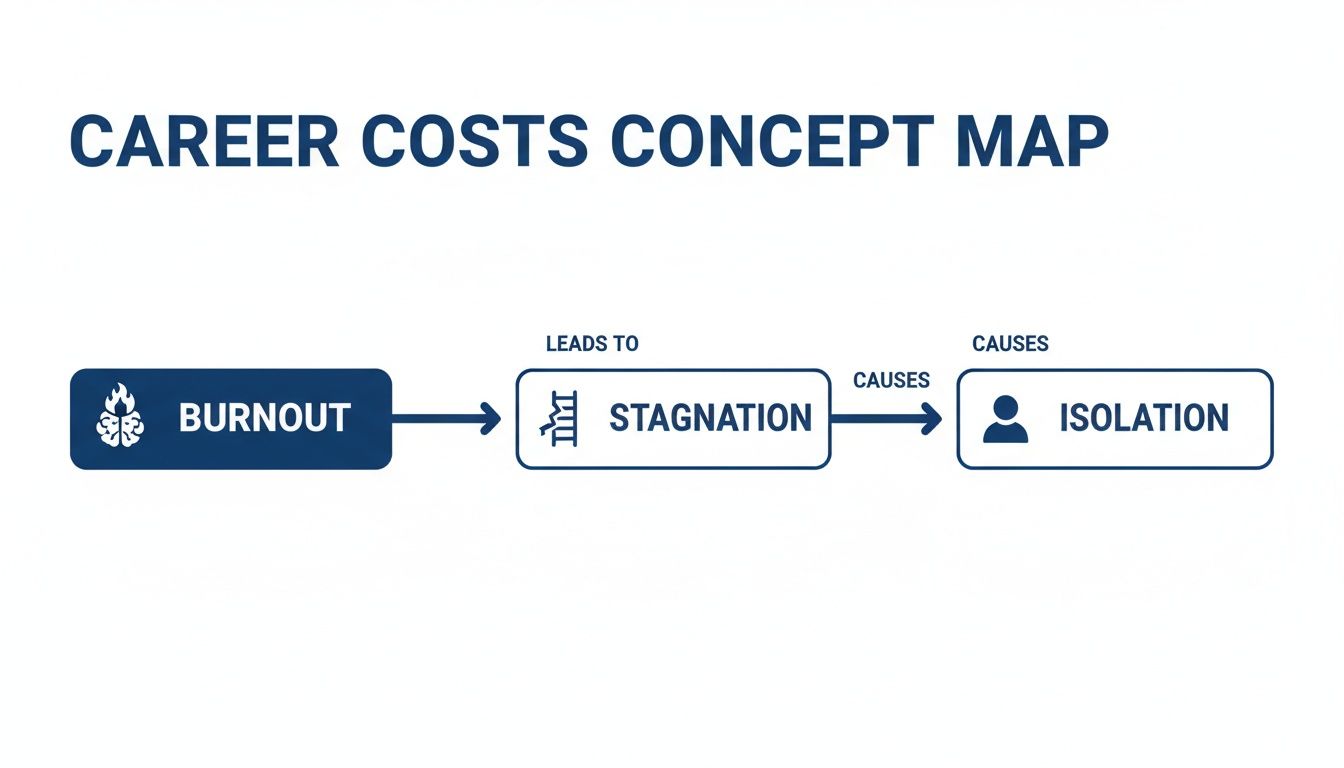
As you can see, the internal pressure of feeling like a fraud often pushes people into professional burnout. This, in turn, can make you stop taking risks, leading to a feeling of being completely alone with the struggle.
2. Practise Compassionate Self-Talk
When your inner critic starts shouting, it’s tempting to either believe it or try to aggressively shut it down. Compassionate self-talk offers a third, much more effective, option. It's about speaking to yourself with the same warmth and understanding you'd offer a good friend who was struggling.
Instead of: "You're going to fail. Everyone will see you don't know what you're doing."
Try this compassionate alternative: "This feels really scary, and it's okay to be nervous. I've prepared as best I can, and I have the strength to handle whatever happens."
Notice the difference in tone. It’s not about false positivity; it’s about acknowledging the difficulty and offering yourself genuine encouragement. If you want to dive deeper into this, learning more about how shame and self-criticism can be healed with Compassion Focused Therapy can offer some powerful insights.
"The aim of CFT is to help people develop and work with experiences of inner warmth, safeness, and soothing, via compassion and self-compassion." – Professor Paul Gilbert, Founder of CFT
By consistently practising these exercises, you're not just managing symptoms; you are fundamentally rewiring your brain. You are building new neural pathways that make compassion and self-reassurance your default response to distress, rather than fear and self-attack. This is how you build a lasting inner ally to finally overcome imposter syndrome.
Actionable Steps to Overcome Imposter Syndrome
Knowing what imposter syndrome is and recognising the patterns is a great start. But insight alone isn't enough; taking action is where the real change happens.
The goal here is to move from simply being aware of these feelings to using practical strategies that build up your resilience against self-doubt. These aren't quick fixes. Think of them as consistent practices that, over time, help you genuinely internalise your successes and turn down the volume on that harsh inner critic.
This process involves catching and challenging those deeply ingrained thought patterns as they happen. It’s about creating a new body of evidence—one your brain can actually believe. Let's dig into a toolkit of concrete actions you can start using today to regain a sense of control and foster a more accurate, compassionate view of yourself.
Reframe Your Inner Critic
The first, and most powerful, step is to start noticing the stories your inner critic tells you and then actively reframe them. The next time you catch yourself thinking, "I just got lucky," I want you to pause. Stop right there and challenge that thought.
Ask yourself, "Okay, but what specific skills did I use to make this happen?"
This simple question is a game-changer. It shifts you from being a passive victim of your own self-doubt into an active participant in shaping your self-perception. Instead of just accepting the ‘fraud’ narrative, you begin to build a solid case for your own competence.
Here are a few common reframes you can practise:
-
Instead of: "I'm going to fail, and everyone will finally see I don't belong here."
-
Try: "It's completely normal to feel nervous about a big challenge. I have the skills to handle this, and at the very least, it's a great opportunity to learn."
-
Instead of: "They're just being nice; they have no idea how much I struggled to get this done."
-
Try: "I really appreciate their positive feedback. I worked hard on this, and it’s okay that it wasn't easy—important things rarely are."
Build Your Success File
Because imposter syndrome has a nasty habit of making you dismiss your own achievements, you need a system that forces you to acknowledge them objectively. This is where a "success file" or an "accomplishment log" comes in.
It’s an incredibly simple but powerful tool. Just keep a document or a physical notebook where you jot down your wins, no matter how small they might seem at the time.
Your success file is not for anyone else's eyes; it is your private, factual counter-argument to the emotional claims of your inner critic. It serves as tangible proof of your abilities when your feelings are telling you otherwise.
Be specific and include details:
- Positive feedback you received in an email.
- Projects you completed successfully.
- A tricky problem you managed to solve.
- New skills you learned and actually applied.
When that familiar wave of self-doubt starts to creep in, open your file and read it. It provides you with cold, hard data that makes it much, much harder to believe the story that you're a fraud.
Break the Cycle of Isolation
Imposter syndrome absolutely thrives in silence. The shame it cooks up makes you feel completely alone, convinced that you're the only person on the planet who feels this way. Breaking that silence is a critical step.
Find a trusted colleague, a mentor, or a friend and share how you're feeling. More often than not, you’ll discover they've felt the exact same way. That moment of connection instantly normalises the experience and helps the shame dissolve. Once you realise you aren't alone, the feeling loses a great deal of its power.
However, if these self-help strategies don't feel like enough and these feelings are really starting to impact your wellbeing, it might be time to seek professional support. A therapist or a coach can offer personalised strategies to get to the root of the issue. For those who'd like a more structured approach, exploring an online self-compassion course can provide guided exercises specifically designed to build these essential skills.
As we wrap up, it's completely normal to have a few questions still buzzing around. Let's tackle some of the most common ones to bring a final bit of clarity to what imposter syndrome is, and what it might mean for you.
Is Imposter Syndrome a Recognised Mental Health Diagnosis?
This is a really important point to get clear on. The short answer is no, imposter syndrome isn’t a formal diagnosis you’ll find in clinical manuals like the DSM-5. It’s better understood as a psychological pattern of thoughts and feelings, rather than a mental illness.
But that doesn't mean its impact isn't real. Far from it. These feelings often show up alongside—and can certainly worsen—conditions like anxiety and depression. Thinking of it as a pattern is actually quite empowering, because it means the thoughts and behaviours holding you back are things that can be changed with the right approach.
Can I Overcome Imposter Syndrome on My Own?
For many people, the answer is yes. You can make significant strides by yourself. Getting stuck into self-help resources, consistently practising self-compassion exercises, and learning to challenge those automatic negative thoughts can make a world of difference in turning down the volume of that inner critic.
Sometimes, though, these feelings are dug in deep or cause so much distress that they start to interfere with your work and personal life. In those cases, working with a therapist can be incredibly helpful. A professional can offer personalised strategies and a supportive space to get to the root of where these feelings are coming from.
Deciding to seek help is a sign of strength and self-awareness, not a failure to cope. It's simply choosing the most effective path toward building a genuine, lasting confidence in yourself and your abilities.
How Is Imposter Syndrome Different from Humility?
That's an excellent question, as it's easy to mix the two up. The key difference really comes down to one thing: accuracy.
Humility is about having a realistic and grounded view of your abilities. It’s the capacity to accurately see both your strengths and your areas for growth. Someone with humility can accept a compliment for a job well done because they know they’ve earned it, while also recognising where they might improve next time.
Imposter syndrome, on the other hand, is a distorted view of yourself. It forces you to constantly dismiss your successes and blow your perceived failures out of all proportion, even when all the evidence points the other way. Humility fosters a quiet confidence; imposter syndrome just fuels persistent anxiety.
At Dr Chris Irons, we focus on helping individuals and professionals move beyond self-criticism using proven methods like Compassion Focused Therapy. If you're ready to build a kinder, more resilient relationship with yourself, learn more at https://drchrisirons.com.