Shame. It's a heavy, powerful, and deeply painful emotion. It's that gut-wrenching feeling that we're not just flawed, but that our flaws make us unworthy of connection. At its core, shame isn't about something we did; it's the intensely personal and often secret belief that we are bad.
This core feeling of being defective is what makes us want to hide, to isolate ourselves, and to live in fear of being truly seen.
What Is Shame, and Why Does It Feel So Powerful?

Shame is far more than a fleeting moment of embarrassment. It's a profound experience that strikes right at the heart of our self-worth, operating like a relentless internal critic. It's the voice that whispers we're fundamentally broken, unlovable, or simply not good enough. It’s not about a single mistake—it's about our very essence.
This is the crucial difference between shame and its close relative, guilt. Guilt can actually be a healthy, productive emotion. It zeroes in on a specific behaviour and signals that we've strayed from our own values.
- Guilt says: "I did something bad."
- Shame says: "I am bad."
Because guilt is tied to an action, it often motivates us to apologise, make amends, or learn from our mistakes. It can be a catalyst for positive change. Shame, on the other hand, attacks our identity. It tells us the problem isn't what we did, but who we are. This can lead to a sense of paralysis and withdrawal, not growth.
The Science Behind the Feeling
Shame isn't just a psychological idea; it has deep roots in our neurobiology and evolutionary past. When we feel shame, our brain’s threat-detection system—the amygdala—lights up. This triggers a physiological cascade almost identical to facing a physical predator: the fight, flight, or freeze response. Your heart might race, you might feel a hot flush in your face, or you might be hit with an overwhelming urge to become invisible.
From an evolutionary standpoint, this reaction makes perfect sense. For our early human ancestors, belonging to the social group was essential for survival. The threat of being rejected or cast out—a primary trigger for shame—was quite literally a life-or-death situation. Shame evolved as a powerful social glue, an emotion designed to help us maintain group harmony and stick to social norms.
This ancient wiring explains why shame feels so crushing today. It convinces our brain that we are at risk of losing connection with others, which it interprets as a critical survival threat.
Shame vs Guilt At a Glance
Getting clear on the distinction between shame and guilt is one of the most important first steps in starting to heal. They can certainly show up together, but their impact on our wellbeing is worlds apart. One leads us to hide away, while the other can lead us to repair and reconnect.
This table breaks down the key differences:
| Characteristic | Shame | Guilt |
|---|---|---|
| Focus | Self ("I am bad") | Behaviour ("I did something bad") |
| Impact | Isolating and paralysing | Motivates repair and change |
| Associated Urge | To hide, disappear, or withdraw | To confess, apologise, and make amends |
| Self-Talk | "I'm a failure," "I'm unlovable" | "I made a mistake," "I hurt someone" |
Simply learning to recognise whether you're feeling shame or guilt is a huge step. When we can start to see that our worth isn't defined by our mistakes, we create the space needed to heal and reconnect—both with ourselves and with the people who matter to us. This foundational understanding sets the stage for everything that follows.
The Hidden Scars Shame Leaves on Mental Wellbeing

While guilt might be a temporary storm that passes, chronic shame is more like a slow, corrosive acid. It quietly eats away at the very foundations of our mental wellbeing, not just making us feel bad about something we’ve done, but fundamentally altering how we see ourselves. It leaves deep, invisible scars.
This powerful emotion acts as a direct line to our deepest insecurities, reinforcing the painful, core belief that we are inherently flawed.
Unlike other emotions, shame thrives in isolation and silence. It’s a master manipulator, convincing us that our perceived flaws are unique and so terrible that they must be hidden at all costs. This internal state of high alert keeps our nervous system in a constant state of threat, paving the way for more persistent mental health challenges.
How Shame Fuels Mental Health Struggles
The link between persistent shame and conditions like depression and anxiety isn't just a coincidence; it’s causal. Shame operates as the engine for a relentless inner critic, providing a constant stream of negative self-talk that chips away at our self-worth until there’s little left. This internal narrative of inadequacy soon becomes a self-fulfilling prophecy.
Think about how this plays out in real life:
- Depression: Shame whispers that we are worthless and unlovable, creating a profound sense of hopelessness—a hallmark of depression. It isolates us from the very connections that could help us heal.
- Anxiety Disorders: The constant fear of being "found out" or exposed as flawed fuels social anxiety and generalised anxiety. Perfectionism, a common companion to shame, creates an impossible standard where any mistake triggers intense fear and self-criticism.
- Eating Disorders: Shame is often deeply entangled with body image. It can drive destructive behaviours as people attempt to control their bodies to feel worthy of acceptance, mistaking external control for internal validation.
This emotional burden is heavy enough on its own, but societal attitudes often add to the weight. A recent UK survey found that 51% of adults believe there is still significant shame tied to mental health conditions. Even more telling, 56% of those with personal experience of mental ill health reported feeling ashamed themselves. This often traps people in a painful silence. You can read more about these findings on mental health stigma from Mind, the mental health charity.
The Behavioural Footprint of Shame
Shame doesn't just live inside our heads; it dictates our actions and shapes our lives in very tangible ways. The core impulse of shame is to hide, which manifests as avoidance and withdrawal. And this isn't just about skipping a party; it's about avoiding life itself.
Someone steeped in shame might turn down a promotion for fear of being exposed as an imposter. They might avoid dating to prevent what they see as the inevitable pain of rejection. This withdrawal starves them of the very positive experiences and social feedback that could challenge their negative self-view, creating a vicious cycle.
Shame is a soul-eating emotion. It tells you that your story is not worthy of being told and that you are not worthy of connection. The antidote is not to be perfect, but to be seen and to belong.
This core message reminds us that the healing journey from shame involves stepping out of the shadows. Recognising these patterns is the first step toward understanding that these struggles are not a personal failing but a natural response to a deeply painful emotion. You are not alone in this experience, and there is a path toward healing and reconnection.
Of all the difficult emotions we face, shame is a master of disguise. It rarely announces itself. Instead, it works from the shadows, quietly shaping our thoughts, feelings, and how we act. We might not even have a name for it, but its influence is profound. The first real step toward working with shame, then, is simply learning to spot its footprint in our day-to-day lives.
Shame often starts as a story we tell ourselves. It’s that nagging inner critic, the voice that whispers critical judgements that, over time, start to feel like undeniable truths. These aren't just fleeting self-doubts; they're deep-seated beliefs about our very worth as a person. They don't just question what we did; they attack who we are.
This internal monologue acts like a filter, colouring how we see ourselves, others, and the world around us. Learning to recognise these thought patterns is like switching on a light in a dark room. All of a sudden, you can see the shape of the thing that's been tripping you up.
Identifying Your Shame-Driven Thoughts
The thoughts that shame fuels are usually sweeping, permanent-feeling, and deeply personal. They don't just point out a single action; they issue a verdict on our entire being. Think of the vast difference between, "I made a mistake," and the shame-soaked thought, "I am a mistake."
Here are a few of the common scripts shame likes to run:
- "I am not good enough." This is a classic. It can pop up anywhere – at work, in our relationships, or just in our general sense of self.
- "I am unlovable." This belief fosters a painful sense of being fundamentally separate from others, unworthy of their care or affection.
- "I'm a failure" or "I'm a fraud." Often tangled up with imposter syndrome, these thoughts create a persistent fear of being exposed or "found out."
- "There is something wrong with me." This is an intensely isolating thought. It suggests we have some core defect that makes us different from, and lesser than, everyone else.
These thoughts are never just thoughts, are they? They kick off a cascade of painful emotions and push us toward very specific behaviours—all designed to hide the part of ourselves we believe is so flawed.
Shame is the intensely painful feeling or experience of believing that we are flawed and therefore unworthy of love and belonging – something we've experienced, done, or failed to do makes us unworthy of connection.
This gut-punch of unworthiness is what powers the urge to pull away, to hide ourselves from the world. Shame convinces us that if people ever saw the "real" us, they would turn away in rejection.
How Shame Shows Up in Your Actions
Because shame’s core instruction is to hide, the behaviours it drives are all about avoidance, concealment, and sometimes even self-sabotage. You might see some of these patterns in your own life.
Common behavioural signs include:
- Social Withdrawal: You start actively dodging social events, ducking out of important meetings, or letting calls go to voicemail. It’s all about minimising the risk of being judged.
- People-Pleasing: You find yourself going to extraordinary lengths to keep others happy, often sacrificing your own needs. It’s driven by a deep fear that if you disagree or set a boundary, you’ll be rejected.
- Avoiding Eye Contact: This is a physical tell – a visible manifestation of the desire to shrink, to become invisible.
- Perfectionism: You set impossibly high standards for yourself. It’s not about striving for excellence; it's a frantic attempt to avoid the shame you’re sure will follow if you make even a tiny mistake.
One of the most powerful places shame takes root is in our relationship with our bodies. We're bombarded with unrealistic societal ideals, and when our bodies don't match up, that gap can curdle into a deep sense of inadequacy. Body image struggles in the UK are inextricably linked with shame. A 2019 survey found that 20% of adults had felt shame because of their body image in the last year. This corrosive feeling also led to 34% feeling down or low and 19% feeling disgusted when they saw their own reflection. You can find more of these insights in the Mental Health Foundation's report on body image.
How Shame Silences Survivors of Trauma and Abuse
Shame is an incredibly powerful emotional weapon. Nowhere is its destructive force more obvious than in the aftermath of trauma and abuse.
For survivors, shame often becomes an invisible cage, one that isolates them and enforces a painful, suffocating silence. It’s a tool deliberately used by perpetrators to maintain control, secrecy, and power over those they harm.
An abuser will often manipulate a victim’s reality, twisting events to suggest the survivor was somehow responsible for what happened. They might say things like, "You wanted this," "You were asking for it," or "If you tell anyone, you’ll tear this family apart." This tactic is devastatingly effective because it transfers the burden of the wrongdoing from the person causing harm to the person experiencing it.
This external blame slowly seeps inward, becoming a deeply internalised belief. The survivor starts to believe they are fundamentally flawed, damaged, or dirty. This isn't just guilt over an event; it's a core conviction that says, "I am bad."
The Psychology of Staying Silent
Once this toxic shame takes root, the fear of speaking out becomes immense. It's not just a fear of the perpetrator but a profound terror of social judgment and rejection. The inner world of a survivor is often plagued by a relentless loop of anxious questions that keep them trapped in silence.
These fears are often multifaceted and deeply personal:
- Fear of Not Being Believed: Survivors worry that friends, family, or authorities will doubt their story, siding with the abuser or dismissing the severity of the trauma.
- Fear of Being Blamed: They dread hearing the very words the abuser used against them, echoed by others—"Why didn't you leave?" or "What were you wearing?"
- Fear of Rejection: There is an intense fear that loved ones will see them as "damaged goods" and pull away, leaving them even more isolated.
- Fear of Hurting Others: Survivors often feel a misplaced sense of responsibility to protect others from the painful truth, especially if the abuser is a family member.
This complex web of fear is incredibly powerful. Statistics reveal just how significant a barrier shame is. Among those who suffered child sexual abuse but did not disclose it immediately, a staggering 49.1% cited embarrassment, humiliation, or shame as the main reason for their silence. This is a stark reminder of how shame perpetuates cycles of suffering. You can explore more data on this topic from the Office for National Statistics.
The Long-Term Damage of Silence
This shame-induced silence does more than just prevent a story from being told; it actively obstructs the path to healing. When trauma is kept hidden, it festers. The survivor is left alone with their most painful memories and the crushing belief that they are unworthy of help or connection.
The shame of trauma is not the survivor's to carry. It belongs entirely to the person who inflicted the harm. Reclaiming your story is not an act of weakness; it is an act of profound courage and defiance.
Silence allows the distorted narrative created by the abuser to go unchallenged. It reinforces the lie that the survivor is at fault and isolates them from the compassion, validation, and support that are so essential for recovery. This isolation can lead to long-term mental health struggles, including complex PTSD, depression, anxiety, and difficulties forming healthy relationships.
Breaking the silence isn’t about exposing a secret for the sake of it. It’s about reclaiming your own truth, challenging the abuser's narrative, and affirming that what happened to you was wrong. It is the first, brave step toward transferring the weight of the shame back to where it truly belongs—with the perpetrator.
Healing Shame Through Compassion Focused Therapy
Knowing how shame works is one thing, but that insight alone rarely heals its deep wounds. To really move past it, we need a practical approach that gets to the heart of shame’s isolating, critical nature. This is where Compassion Focused Therapy (CFT) offers a powerful way forward.
CFT is built on a simple yet profound idea: shame lives and breathes in our brain's threat system. The most effective antidote, then, is to intentionally cultivate our capacity for compassion. This isn't about ignoring the pain; it's about learning to balance and soothe our own minds, seeing them not as enemies but as complex systems we can work with.
Your Three Emotional Systems
To get a real feel for how CFT works, it helps to understand its model of our three core emotional regulation systems. Think of them as different channels in your brain, each evolving to help us survive, each with its own distinct motivations, feelings, and even brain chemistry.
-
The Threat System: This is your internal alarm bell. Its job is to spot danger and protect you using responses like anxiety, anger, and disgust. Shame absolutely thrives here. It hijacks this system, keeping it switched on, making you feel perpetually unsafe and on high alert.
-
The Drive System: This is your engine for getting things done. It’s what gives you that buzz of excitement and pleasure when you’re chasing goals or acquiring resources. It’s vital, of course, but if you rely on it too much for your self-worth, it can easily lead to burnout and harsh self-criticism when you inevitably fall short.
-
The Soothing System: This system is all about feeling content, safe, and connected. It’s switched on by kindness, warmth, and reassurance—whether that comes from others or, crucially, from yourself. This is the very system that shame shuts down, and it's the one CFT helps us deliberately bring back online.
When shame takes over, your threat system is working overtime while your soothing system is completely offline. You get stuck in a nasty loop of fear and self-attack with no internal resource to find calm or safety. CFT essentially teaches you how to consciously activate and strengthen your soothing system, creating an inner sanctuary of kindness to stand up to the harsh voice of shame. For a deeper look at this, you can learn more about how Compassion Focused Therapy can help you heal from shame and self-criticism.
The diagram below really brings home how a perpetrator’s actions can lead to a victim’s silence—a cycle so often driven by shame.
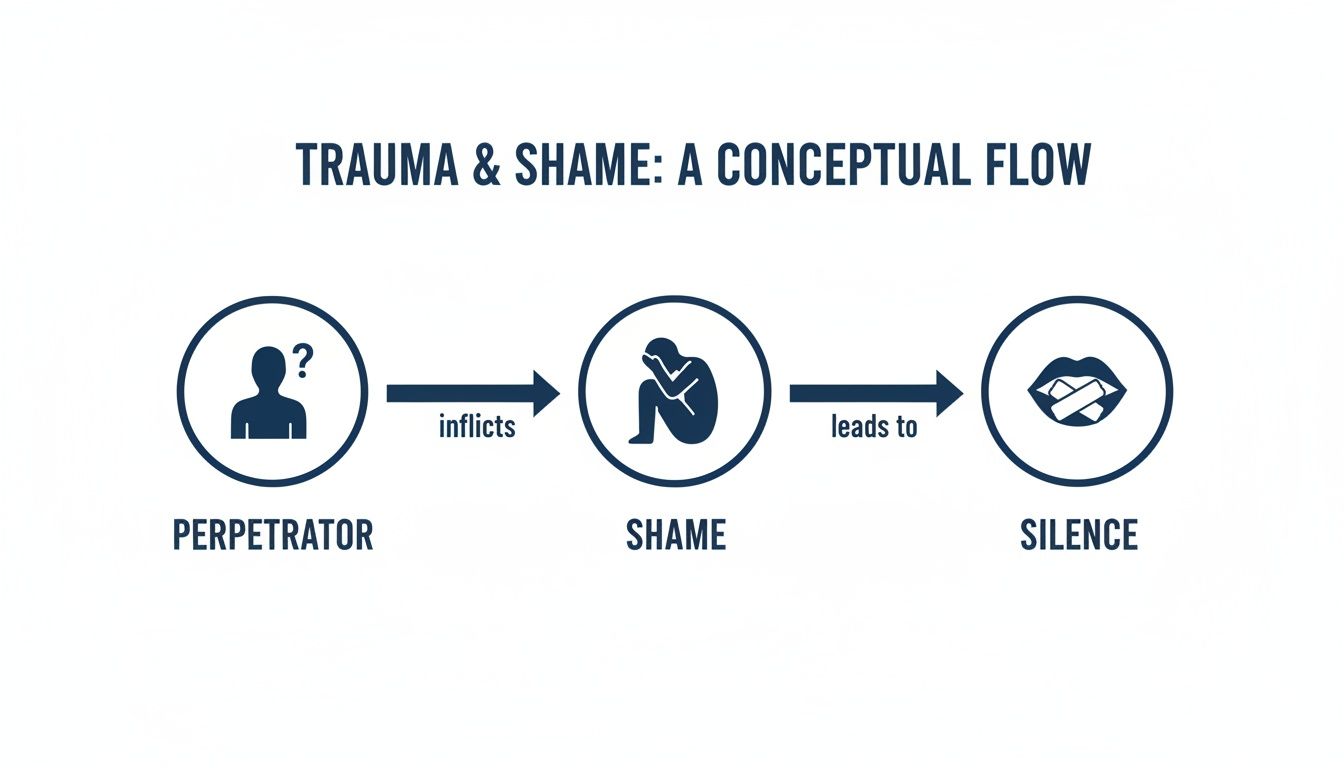
You can see how shame becomes an internal barrier, effectively doing the perpetrator's work for them by keeping the survivor isolated and quiet.
The Ingredients of True Compassion
In CFT, compassion isn't some fluffy, passive feeling. It’s an active, courageous process. It’s about having the strength to turn toward our pain, not run from it. This practice is made up of several key qualities that directly challenge what shame is all about.
Compassion is the courageous willingness to see suffering, to move toward it, and to be wise in our efforts to alleviate it. It is the practice of creating an internal sense of safety and support.
This means compassion has two core parts: the courage to actually engage with your distress and the wisdom to know how to help. This active stance involves building specific skills:
- Sensitivity to Suffering: This is the first step—simply noticing that pain is present, without immediately judging it or trying to shove it away.
- Non-Judgement: This means observing your thoughts, feelings, and actions with warmth and understanding, rather than with a critical eye.
- Empathy: It’s about trying to understand your own experience from a place of kindness, recognising that struggle is a shared part of being human.
- Courage to Act: This is the commitment to take thoughtful steps to ease your own suffering, whether that’s through soothing self-talk, setting a boundary, or reaching out for support.
By practising these skills, we actively build and strengthen our soothing system. We create a reliable inner resource that can stand up to the voice of shame and guide us back to a place of safety and self-worth.
Practical Exercises to Cultivate Self-Compassion

Understanding the mechanics of shame is a crucial first step, but the real healing begins when we start to actively build a kinder relationship with ourselves. This takes practice. Think of it like building a muscle; the more you intentionally work on self-compassion, especially in those moments you feel most vulnerable, the stronger it becomes.
The gentle, accessible exercises that follow are grounded in Compassion Focused Therapy (CFT). They’re specifically designed to help you activate your soothing system, creating a reliable internal source of safety that can stand up to the harsh inner critic that fuels shame.
Visualise Your Compassionate Self
This first exercise is about connecting with an inner source of wisdom, strength, and kindness. You’re going to imagine your ideal compassionate figure—a part of you that can offer genuine support whenever shame is triggered.
Find a comfortable position, take a moment to settle, and close your eyes.
- Imagine the Qualities: First, just think about what true compassion feels like. What qualities would your ideal compassionate self have? You might consider attributes like wisdom, strength, warmth, and non-judgement.
- Bring It to Life: Now, let’s give these qualities a form. It doesn’t need to be a person. It could be a warm, glowing light, a wise old tree, or even a gentle, powerful animal. What colour is it? What might its voice sound like? What’s its facial expression?
- Feel Its Presence: Imagine this compassionate self with you right now, looking at you with complete kindness and understanding. It knows all about your struggles and accepts you exactly as you are, without condition.
This visualisation isn't just a daydream; it creates a powerful mental resource you can return to anytime you feel overwhelmed by shame. It’s a direct way to generate feelings of inner safety and warmth.
The goal is not to eliminate pain but to hold it with kindness. Self-compassion gives us the emotional stability needed to face our difficulties without being consumed by them.
Soothing Rhythm Breathing
When shame activates your threat system, your breathing often gets fast and shallow without you even noticing. This simple practice uses the power of your own breath to calm your nervous system and send a clear signal to your body: you are safe.
- Find a quiet, comfortable place to sit.
- Place a hand gently on your chest or stomach, wherever you feel the breath most.
- Slow your breathing down, aiming for a rhythm that feels naturally soothing to you. A good starting point is breathing in for a count of four and out for a count of six.
- As you breathe, try to bring a compassionate intention to the process. With each inhale, imagine breathing in a sense of calm; with each exhale, imagine letting go of tension.
Focus on the gentle rise and fall of your hand. Just a few minutes of this can make a world of difference when you feel shame or self-criticism bubbling up.
Write a Compassionate Letter
This exercise is fantastic for shifting your perspective away from self-criticism and towards self-kindness. It involves writing a letter to yourself about something you feel shame over, but you’ll write it from the viewpoint of an unconditionally loving and supportive friend. If you want to dive deeper into this, there are many fantastic resources exploring the practice of self-compassion.
How to do it:
- Start by identifying something about yourself that tends to trigger feelings of shame or inadequacy.
- Now, think of someone real or imagined—a wise, deeply compassionate friend. Imagine what they would say to you about this specific struggle. How would they comfort you?
- Write a letter to yourself from their perspective. Capture their tone of warmth, understanding, and unconditional acceptance. Have them remind you that being imperfect is simply part of being human.
Putting these compassionate thoughts onto paper can make them feel far more concrete and real. It’s a powerful way to directly counter the isolating, critical narrative that shame thrives on.
Frequently Asked Questions About Shame
When we start to talk about shame, it often feels like opening a Pandora's box of questions. It's an emotion that loves to keep us confused and alone, so getting some clear answers is a huge first step toward feeling better.
Let's demystify this powerful emotion with some straightforward, practical insights you can use, whether for yourself or in your work with clients.
Is Shame a Mental Illness?
No, shame itself isn't a mental illness. It’s a core human emotion, something nearly all of us will feel at some point. Like anger or sadness, shame is a natural part of our emotional toolkit, wired into us over millennia to help us navigate the complex rules of social living.
Where it gets tricky, though, is when shame becomes chronic and pervasive. That’s when it can become a major driver of various mental health conditions. A constant, nagging sense of being fundamentally flawed or worthless can fuel depression, anxiety disorders, eating disorders, and post-traumatic stress disorder (PTSD). So, while shame isn't an illness, toxic shame is often a key ingredient in many mental health struggles.
Can Shame Ever Be a Good Thing?
This is a really nuanced question, and the answer hinges on what we mean. Those fleeting, blushing moments of shame can sometimes act as a moral compass, alerting us that we've stepped over a line or violated a value we hold dear. This can nudge us to reflect and make amends, functioning a bit like healthy guilt.
The crucial difference is what the feeling targets. If it sparks constructive change ("I probably shouldn't have done that"), it can be helpful. But if it hardens into a damning statement about who you are ("I am a bad person"), it becomes toxic. It paralyses us rather than motivating us to do better.
How Do I Start Healing From Shame?
Healing from shame is a journey—one that shifts the inner dialogue from self-criticism to self-compassion. It starts with the simple but courageous act of just acknowledging that the feeling is there, without judging yourself for it. Instead of running from shame, you learn to turn towards it with a bit of kindness.
Here are a few foundational places to start:
- Name It to Tame It: Just being able to recognise and label the feeling as "shame" can immediately lessen its grip on you.
- Share Your Story: Shame thrives in secrecy. Opening up to a trusted friend, partner, or therapist breaks its isolating hold.
- Practise Self-Compassion: Intentionally activate your body’s soothing system. Simple exercises like Soothing Rhythm Breathing or writing yourself a compassionate letter can make a real difference.
- Connect with Others: Gently remind yourself that to struggle is to be human. You are not alone in feeling this way.
If you're interested in exploring these practices more deeply, there's a wealth of information available in these CFT resources to guide you on your healing path.
At Dr Chris Irons, I specialise in helping people and professionals understand and work with difficult emotions like shame. If you're struggling with self-criticism and want to build a kinder, more supportive relationship with yourself, explore the therapy, coaching, and training opportunities available at https://drchrisirons.com.