Compassion isn't just a feeling. It's the active response to suffering, a genuine desire to help that actually gets us moving. Empathy lets you feel what someone else is going through, but true compassion motivates you to do something about it, whether for them or for yourself. It’s a powerful quality, one that builds resilience and forges deeper human connections.
What Is Compassion and Why Does It Matter So Much Today?
At its core, compassion is about being sensitive to suffering—in ourselves and others—and then making a commitment to try and ease it. Think of it less like a passive emotion and more like a dynamic, engaged process. It's the bridge that takes us from simply feeling concern to taking meaningful action.
And while we often picture grand, heroic gestures, compassion usually shows up in the small, everyday moments of kindness and understanding.
This quality has become more vital than ever. We're living in a world that’s fast-paced, often digitally disconnected, and where burnout is on the rise. Compassion is a powerful counterbalance to all of that. It helps us navigate the messiness of modern life by nurturing supportive relationships and strengthening our own mental reserves.
The Three Pillars of Compassion
To really get to grips with what compassion is, it helps to break it down into its core parts. These elements aren't always perfectly linear, but they work together to move us from simply noticing a problem to actually doing something helpful.
This framework shows us that compassion is a multi-step process, not just a fleeting feeling. It involves our head, our heart, and our hands.
The Three Pillars of Compassion
| Pillar | What It Means | In Practice |
|---|---|---|
| 1. Recognising Suffering | This is the first step: simply noticing that someone—including you—is having a hard time. It requires mindfulness and a willingness to be present with discomfort instead of turning away. | Pausing to ask a colleague who seems quiet, "Is everything alright?" or acknowledging to yourself, "I'm really struggling today." |
| 2. Feeling for the Person | This is where you connect emotionally. It's about feeling warmth, concern, and a non-judgemental sense of care for the person in pain. It’s the difference between just observing hardship and being moved by it. | Feeling a genuine pang of concern when a friend shares bad news, rather than just thinking of solutions. |
| 3. Acting to Help | This is the crucial final piece—the motivation to do something. The action can be anything from offering a listening ear or a comforting word to providing practical support to ease the source of the suffering. | Making a cup of tea for a stressed partner, sending a supportive message, or just sitting with someone in silence so they know they're not alone. |
What truly makes compassion so impactful is its active nature. It’s not about having all the answers or fixing every problem, but about showing up with a genuine intention to help.
Compassion is not a relationship between the healer and the wounded. It's a relationship between equals. Only when we know our own darkness well can we be present with the darkness of others.
This quality is essential because it’s a sustainable resource for both giving and receiving care. Empathy on its own can be exhausting and lead to what’s known as ‘empathic distress’. Compassion, on the other hand, gives us the strength to support others without getting completely overwhelmed ourselves.
Better yet, it creates a positive feedback loop. Studies show that when we act compassionately, it activates the reward centres in our brains, making us feel good and encouraging us to do it again. This makes compassion a renewable source of strength and connection—something we all need to navigate the challenges of today.
Untangling Compassion, Empathy, and Self-Compassion
We often hear the words ‘compassion’ and ‘empathy’ used as if they’re the same thing. While they’re certainly related, the difference between them is crucial, especially for avoiding emotional burnout.
Think of it like this: they might seem like two sides of the same coin, but one involves sharing a feeling, while the other prompts a supportive action.
Empathy is our ability to feel with someone. It’s when we truly step into their shoes, absorbing their joy or their pain as if it were our own. This deep connection is a beautiful, vital part of being human. But there’s a catch. When you’re constantly taking on the suffering of others, you can end up with empathic distress—that feeling of being completely overwhelmed and emotionally drained.
Compassion, on the other hand, is about feeling for someone. It allows you to recognise another’s suffering and feel warmth and care, but from a place of strength. This motivates you to help without getting lost in their pain yourself. It’s a far more sustainable and empowering way to respond, both for you and for the person you’re supporting.
A Tale of Two Doctors: Empathy vs. Compassion in Action
Imagine two doctors working in a busy, high-stress hospital ward.
One doctor is highly empathetic. She feels the anxiety and pain of every patient so deeply that she carries their emotional weight home with her every night. After a while, she’s exhausted, finds herself becoming distant, and her ability to provide effective care starts to fade. This is empathic burnout, plain and simple.
The second doctor practices compassion. She understands her patients are suffering and feels genuine concern for them, but she doesn’t absorb their distress. Instead, that feeling of concern fuels her desire to act—to provide the best medical care, offer a comforting word, or support the family. She stays engaged and resilient because her compassion is a renewable resource, not a draining one.
This story highlights how compassion is a skill that blends warmth with wisdom. It’s the secret ingredient that lets caregivers, leaders, and friends offer support over the long haul without sacrificing their own wellbeing.
Compassion is the courageous willingness to see suffering, to stay with it, and to do something to relieve it. It's a practice of turning towards pain with a kind and supportive heart.
This simple model breaks down the process of compassion into three core pillars.
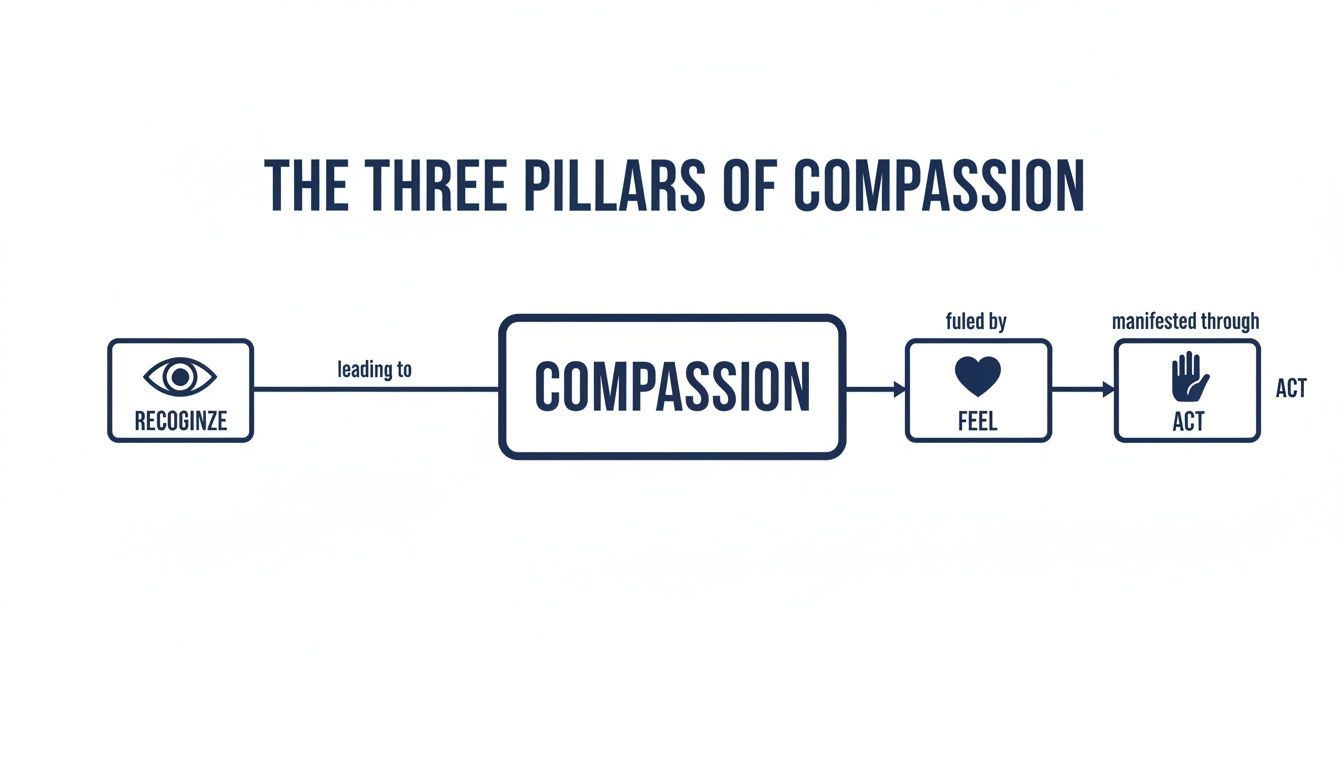
As you can see, compassion isn't passive. It's an active journey that moves from awareness (recognise), through emotional connection (feel), and into helpful engagement (act).
To help clarify these often-confused concepts, the table below breaks down the core differences between compassion, empathy, and pity.
Comparing Compassion, Empathy, and Pity
| Concept | Core Definition | Typical Outcome |
|---|---|---|
| Empathy | Feeling with someone; sharing their emotional state. | Can lead to connection, but also to emotional exhaustion or burnout. |
| Compassion | Feeling for someone, combined with a motivation to help. | Leads to supportive action, resilience, and mutual wellbeing. |
| Pity | Feeling sorry for someone; often from a place of superiority. | Can create distance and make the other person feel disempowered. |
Understanding these distinctions helps us choose responses that are not only helpful to others but also sustainable for ourselves.
The Critical Role of Self-Compassion
Just as it’s vital to offer compassion to others, it’s equally important to turn that kindness inward.
Self-compassion is about treating yourself with the same care and understanding you’d offer a good friend who was going through a tough time. It isn’t about self-pity or making excuses for yourself. It’s about simply acknowledging your own humanity—flaws and all—without a storm of harsh self-judgment.
For many of us, being kind to others comes far more naturally than being kind to ourselves. Research from the UK really brings this gap to light. In studies using modern compassion scales, participants consistently scored much higher on giving compassion than on receiving it from others or directing it toward themselves.
That same research also found that self-compassion was the strongest predictor of reduced psychological distress and greater overall wellbeing. When you learn to apply that same kindness to your own struggles, you build a foundation for a more authentic and resilient connection with others.
You can learn more by exploring our detailed guide on https://drchrisirons.com/self-compassion/.
To build on this, a great resource on how to practice self-compassion offers practical strategies for applying kindness and support to yourself. This isn't selfish; it’s an essential part of emotional health that gives you the strength to truly show up for others.
The Science-Backed Benefits of a Compassionate Mind

Making the choice to be compassionate isn’t just a nice thing to do for others; it's a powerful act of self-care with deep, measurable effects on your own mind and body. That warm glow you feel after helping someone isn’t just a fleeting emotion. It’s a complex neurobiological event that strengthens your resilience, deepens your connections, and genuinely improves your health.
When you act with compassion, your brain’s reward centres light up, releasing a feel-good cascade of neurochemicals. This isn't just wishful thinking; it’s a well-documented physiological response.
The science is clear: a compassionate mindset actively rewires your brain and body for the better, making it one of the most effective tools we have for building lasting mental and emotional wellbeing.
How Compassion Reshapes Your Brain Chemistry
Engaging in compassionate behaviour triggers a release of oxytocin, often nicknamed the 'bonding hormone' or 'cuddle hormone'. This powerful chemical is central to building social connection, fostering feelings of trust, safety, and generosity.
You can think of oxytocin as the glue that holds our relationships together. When you offer a kind word or a helping hand, your brain rewards you with a hit of this hormone, which strengthens the very circuits that encourage you to connect with others again in the future.
This chemical shift brings several direct benefits:
- It lowers stress: Compassionate acts help to tamp down levels of cortisol, the body's main stress hormone. One study found that people who consistently practise compassion have lower cortisol levels and stronger immune responses.
- It promotes connection: Higher oxytocin levels make you more attuned to social cues, which naturally enhances your ability to form and maintain supportive relationships.
- It boosts happiness: By activating the brain's reward system—much like it responds to good food or music—compassion generates genuine feelings of pleasure and contentment.
This whole biological process explains why giving support can often feel just as good, if not better, than receiving it. It’s an inbuilt system, designed to reinforce the very behaviours that strengthen our social bonds and ensure our collective wellbeing.
Building Resilience and Emotional Regulation
Beyond the immediate chemical rewards, a regular compassion practice builds psychological strength for the long haul. It's like a workout for your emotional regulation system, helping you manage difficult feelings without getting completely overwhelmed.
When you approach your own struggles or the pain of others from a compassionate stance, you activate the parts of your brain associated with caregiving. At the same time, you soothe the threat-focused areas linked to anxiety and fear.
Practising compassion is like building an internal safe haven. It gives you a secure base from which you can courageously face life's challenges, knowing you have the inner resources to handle distress with kindness rather than criticism.
This shift helps you develop greater emotional resilience. Instead of being knocked over by setbacks, you learn to meet them with a balanced and supportive mindset, which allows you to recover more quickly. It’s the difference between being caught in a storm and having a sturdy shelter to weather it.
The Real-World Impact on Healthcare
The tangible benefits of compassion are so significant that they are now reshaping institutional policies, particularly within healthcare. The UK's NHS, for example, has increasingly embedded compassionate care into its core framework.
This shift was dramatically accelerated by the Francis Inquiry, which investigated serious failings at Stafford Hospital. The inquiry identified a profound 'lack of attentiveness and compassion' as a central cause of the failures in care. The report's impact was immediate and measurable. References to compassion in UK nursing literature skyrocketed from just 6 mentions in the 1980s to 1,645 in the decade from 2010–2019—an increase of over 27,000%. You can discover more insights about the rise of compassion in healthcare frameworks.
This data powerfully illustrates a wider recognition: compassion is not a 'soft skill'. It's a critical component of effective, humane, and safe care. It improves patient outcomes, reduces clinician burnout, and fosters a culture of trust and safety. When compassion is prioritised, everyone benefits.
How to Cultivate Compassion with Practical Everyday Exercises

Understanding what compassion is and why it matters is a great start. But the real change happens when we turn that knowledge into a lived experience.
Like any skill, compassion grows stronger the more we practise. This isn't about grand, dramatic gestures. It's about weaving small, intentional acts of kindness and awareness into the fabric of your day.
Think of this section as your toolkit. It’s filled with practical, accessible exercises designed to help you build your compassion muscles. Whether you have five minutes or twenty, these techniques can help you find a more caring and connected way of being—both for others and, crucially, for yourself.
Start with Loving-Kindness Meditation
One of the most direct ways to cultivate feelings of warmth and care is through Loving-Kindness Meditation (LKM). The practice is simple: you silently repeat phrases that wish wellbeing for yourself and others. It's a gentle yet surprisingly powerful method for training your mind to default to kindness.
The goal isn't to force a feeling you don't have. It's about planting the seeds of goodwill. Over time, this practice can genuinely shift your perspective, making compassion a more natural, go-to response to the world around you.
Here’s a simple sequence to get you started:
- Find a Quiet Space: Sit comfortably, close your eyes, and take a few deep breaths to help your mind settle.
- Begin with Yourself: Silently repeat phrases filled with warm wishes for yourself. You could try, "May I be safe. May I be happy. May I be healthy. May I live with ease."
- Extend to a Loved One: Bring to mind a friend, family member, or someone you care for deeply. Direct the same phrases towards them: "May you be safe. May you be happy…"
- Think of a Neutral Person: Now, picture someone you don't know well—perhaps a shop assistant or a neighbour. Extend the same wishes to them.
- Extend to Someone Difficult: This part can be challenging. Bring to mind someone with whom you have a difficult relationship. As best you can, offer them the same wishes for wellbeing.
- Expand to All Beings: Finally, radiate these compassionate phrases outward to everyone, everywhere, without exception: "May all beings be safe. May all beings be happy…"
Loving-Kindness Meditation is not about pretending everything is perfect. It is an act of courage, a conscious choice to meet the world—and yourself—with an open and caring heart, even amidst the difficulties.
Practise Mindful Perspective-Taking
One of the biggest roadblocks to compassion is getting stuck in our own point of view. Perspective-taking is the active effort to imagine a situation through someone else's eyes, considering their thoughts, feelings, and experiences.
This isn’t about agreeing with them or condoning their actions. It's about expanding your understanding and recognising the shared humanity that connects you both.
Try this simple exercise the next time you feel frustrated with someone:
- Pause and Breathe: Before you react, just take a moment to centre yourself.
- Ask "What If?": Ask yourself what might be happening in their life that you can't see. Could they be stressed, unwell, or dealing with a personal struggle?
- Consider Their Story: Briefly imagine their day leading up to this moment. This small mental shift can soften judgement and open the door to a more compassionate response.
Build Your Self-Compassion Skills
Directing kindness inward is often the hardest part of the journey, but it’s also the most rewarding. A harsh inner critic can sabotage your efforts, keeping you stuck in cycles of shame and self-doubt. Actively practising self-compassion helps to quieten that voice.
One powerful technique is to write a compassionate letter to yourself. When you're struggling with a perceived failure or a difficult emotion, take out a pen and paper.
Write to yourself from the perspective of an unconditionally loving friend. Acknowledge your pain, validate your feelings without judgement, and remind yourself of your inherent worth. This exercise can feel a bit strange at first, but it is a concrete way to offer yourself the same support you would readily give to someone you love.
For those looking to go deeper, you can find a wealth of guided practices and information among these excellent Compassion Focused Therapy resources. These tools provide structured ways to build a kinder relationship with yourself, which is the very foundation for genuine compassion towards others.
Overcoming the Roadblocks to Compassion
If you find compassion tricky to put into practice, you're in good company. The idea of being kinder to ourselves and others sounds simple enough, but a lot of us run into some surprisingly powerful internal roadblocks. They can make compassion feel unnatural, or even a bit unsafe.
Figuring out what these barriers are is the first real step toward gently working through them.
Often, these obstacles are tangled up in deep-seated fears and beliefs we're not even consciously aware of. They usually pop up as critical thoughts or a wave of uncomfortable feelings just when we’re trying to be a bit more compassionate.
Think of these barriers not as signs of failure, but as old protective strategies. Maybe they helped you at one point. Just acknowledging them with a bit of curiosity, rather than judgement, is a compassionate act in itself.
Common Fears and Myths
There are a few common myths about compassion that can really hold us back. These misconceptions often stop us from even trying to cultivate a more caring way of being, both for ourselves and for the people around us.
Let's unpack some of the big ones:
- "Compassion is just weakness." So many of us worry that being compassionate means we'll become a doormat or let people walk all over us. The truth is, genuine compassion takes incredible strength, courage, and wisdom. It’s about facing suffering head-on without getting completely overwhelmed.
- "Self-compassion is just selfish." This is probably the most common hurdle. We’ve been conditioned to think that being kind to ourselves is self-indulgent or narcissistic. But study after study shows that self-compassion is actually the bedrock of resilience and good mental health. It’s what fuels our ability to genuinely give to others without burning out.
- "It'll open the floodgates." There's often a real fear that if we let ourselves feel compassion, we’ll be swamped by an ocean of grief, sadness, or pain. While compassion does involve turning towards difficulty, it also gives us the tools and the inner strength to handle those feelings without drowning in them.
The biggest barrier to compassion is often the sneaky belief that it’s a luxury. In reality, it’s a fundamental necessity for our psychological wellbeing and for building a life of meaning and connection.
The Internal Hurdles
Beyond those common myths, we also have our own internal patterns of thinking and feeling that can actively block our best efforts. These are often more subtle, but they pack just as much of a punch.
One of the most significant barriers is a harsh inner critic. You know the one—that relentless inner voice that judges, belittles, and finds fault with everything you do. This voice can make self-compassion feel downright impossible, because any attempt at kindness gets immediately shot down. Learning how to work with this inner critic is a central part of many therapeutic approaches. If this sounds familiar, you might want to explore how shame and self-criticism can be healed with Compassion Focused Therapy.
Other internal roadblocks often include:
- Your Past Experiences: If you grew up in a place where kindness was thin on the ground or even viewed as a weakness, learning to be compassionate can feel foreign and unsafe.
- Fear of Not Deserving It: Many of us carry a deep-seated feeling of unworthiness, a core belief that we just don't deserve kindness or care—especially from ourselves.
- A Distrust of Others: Painful past relationships can make it incredibly hard to trust people. This can lead to a guardedness that prevents us from both offering and receiving compassion.
Working through these barriers isn't about forcing anything. It’s a gentle process of unlearning old habits and building new, more supportive ones. It all starts with simply noticing the resistance, acknowledging the fear behind it, and then taking small, courageous steps toward a kinder way of being.
Compassion in Action at Work and in Your Community

When we take compassion out into the world, something powerful happens. It’s not just about an internal shift; it’s about creating a ripple effect that can genuinely reshape our daily environments.
By bringing care, understanding, and a willingness to help into our professional and social lives, we do more than just improve our own experience. We actively change the culture for everyone around us, transforming workplaces from sources of stress into communities of support.
Fostering Compassionate Leadership
In the workplace, compassion isn’t some fluffy, ‘soft’ skill. It's a strategic advantage. Compassionate leadership goes way beyond just managing tasks; it’s about creating an environment of psychological safety, where your team feels valued, understood, and trusted.
Think about it. When a leader responds to a mistake with curiosity instead of criticism, or acknowledges the real-life personal challenges an employee might be facing, they build incredible loyalty and encourage innovation. This approach is a direct antidote to burnout and low morale. It builds a culture where people feel safe enough to take creative risks and truly collaborate.
A compassionate leader fosters:
- Trust and Openness: Team members feel they can share ideas, worries, and feedback without fear of being shut down.
- Increased Engagement: People who feel genuinely cared for are naturally more motivated and committed to the team’s goals.
- Greater Resilience: A supportive environment helps teams navigate setbacks and tough times far more constructively.
This leadership style proves that acknowledging our shared humanity is the real key to unlocking a team's full potential.
Building Stronger Community Bonds
These same principles are just as vital when we zoom out to our wider communities. Whether in schools, healthcare, or local volunteer groups, a compassionate approach strengthens the social fabric and helps us navigate conflict.
It looks different depending on the setting. In schools, it might mean tackling bullying with restorative practices, not just punishment. In healthcare, it’s about seeing the person, not just the patient file—a core idea in many modern care models. For a fantastic deep-dive on this, check out this guide to providing compassionate care for the elderly, which is packed with practical tips.
Compassion in a community isn't about solving every problem for everyone. It's about ensuring no one has to face their problems alone.
Interestingly, there seems to be a gap between how we see ourselves and how we see society at large. Polling in the UK found that while an overwhelming 92% of British adults describe themselves as compassionate, most believe the country has become less caring over the last decade.
This suggests that while individual compassion is strong, turning it into collective action is our biggest challenge. But there’s hope. The same research shows 86% of young people prioritise compassionate values, so the foundation for a more caring society is clearly there.
Every small act—every moment spent truly listening to a neighbour, every effort to support a local cause—helps bridge this gap. It’s how we turn individual goodwill into a shared reality.
Of course, as you start to explore compassion more deeply, questions are bound to pop up. It’s only natural to wonder if you’re “getting it right” or to bump into a few common myths.
Let’s clear up some of the most frequent queries. Think of this as a handy guide to keep in your back pocket, offering a bit of clarity as you build a kinder, more compassionate relationship with yourself and those around you.
Common Questions About Compassion
This table offers quick answers to some of the most common questions people have when they start their compassion journey.
| Question | Answer |
|---|---|
| Is Self-Compassion just self-pity? | Not at all. Self-pity gets us stuck in a "poor me" loop, making us feel isolated. Self-compassion is an active response—it’s about recognising our pain with kindness and remembering that struggle is part of being human. It empowers us to act. |
| Can you be too compassionate? | True compassion doesn't lead to burnout, but unchecked empathy can. This is often called 'empathic distress'. Real compassion includes the wisdom to set healthy boundaries, so you can offer support without draining your own resources. It’s a renewable energy source, not a finite one. |
| How long does it take to feel more compassionate? | There's no finish line here—it's a lifelong practice. Everyone's journey is different. But you might be surprised how quickly you notice small shifts, like catching your inner critic a little faster or responding to a mistake with a kind thought instead of frustration. |
Is Self-Compassion a Form of Self-Pity?
This is probably the most common worry I hear, but the two couldn’t be more different. Self-pity is passive. It has a "poor me" flavour that tends to isolate us, making us feel like we’re the only one suffering.
Self-compassion, on the other hand, is an active and connecting practice. It’s about turning toward your own struggle with kindness, acknowledging it, and remembering that pain is a universal part of the human experience. It's the difference between getting stuck in a bog of despair and finding the strength to pull yourself out.
Can You Be Too Compassionate?
In a word, no. But it’s crucial to understand the difference between true compassion and something else entirely: empathic distress. Burnout doesn’t happen because you’re too compassionate; it usually comes from feeling another’s pain so intensely that you become overwhelmed, without the tools to manage it.
True compassion is intelligent. It involves wisdom and healthy boundaries. It’s about showing up for others in a way that’s sustainable, which means you also have to show up for yourself.
This is where self-compassion becomes your superpower. It’s the counterbalance that ensures you can keep offering care without running on empty.
How Long Does It Take to Feel More Compassionate?
This is a practice, not a project with a deadline. There's no set timeline, because every single one of us is starting from a different place, with different life experiences shaping us. That said, many people report feeling small but meaningful shifts quite quickly once they start practising intentionally.
It often starts with the little things:
- You might catch that harsh inner voice a split-second sooner.
- You might feel a tiny bit less reactive when someone cuts you off in traffic.
- You might offer yourself a moment of kindness after making a simple mistake.
Consistency beats intensity every time. Just five minutes a day, practised regularly, can begin to gently rewire your brain's old habits. Over time, compassion starts to feel less like something you do and more like who you are. The most important thing is to be patient and kind with yourself along the way.
At Dr Chris Irons, we specialise in helping individuals and leaders build resilience by overcoming self-criticism and developing a more compassionate mindset. If you're ready to explore this further through therapy or coaching, visit us at our website.