When we talk about being kind to yourself, what we really mean is treating yourself with the same care and support you'd automatically offer a good friend. It's a practice built on three core ideas: being mindful of your feelings, recognising you aren't alone in your struggles, and actively choosing to be supportive instead of critical.
This isn't about letting yourself off the hook or ignoring mistakes. It's about how you respond to those mistakes—with encouragement, not a verbal beating.
Why Being Kind to Yourself Is a Skill Worth Learning
Let’s be honest, the idea of self-kindness can feel a bit… soft. Especially when we're wired for high achievement and our inner critic has the loudest voice, often fuelled by societal pressures that reward constant striving.
But what if treating yourself with compassion isn't a weakness, but a powerful tool for building genuine resilience?
This guide isn't about chanting empty affirmations in the mirror or pretending everything is perfect. It's about learning the practical, evidence-based skill of self-compassion, one step at a time.

The Real Need for a Kinder Inner Voice
For many of us, self-criticism is the default setting. We've been led to believe that being hard on ourselves is the only way to do better, but more often than not, it just leads to burnout, anxiety, and that persistent feeling of never being good enough. This internal pressure is only magnified by the external expectations we face from work, family, and the curated perfection of social media.
The need for a kinder internal dialogue is more urgent than ever. In England, one in five adults—that's 20.2%—are currently living with a common mental health problem. For young adults aged 16-24, this rate has surged by an alarming 47% in recent years, highlighting the incredible strain of modern life. You can explore the full report on these mental health statistics and trends to see the bigger picture.
"We say things to ourselves we would never dream of saying to someone else. Imagine how your life might change if you spoke to yourself with the same encouragement you’d offer a friend."
Learning how to be kind to yourself is about actively rewiring this pattern. It's about acknowledging your needs, forgiving your imperfections, and speaking to yourself in a more supportive tone. This shift doesn't happen overnight; it’s a skill you build through consistent, deliberate practice.
The Three Pillars of Self-Kindness: A Quick Overview
To make this practical, we can break down self-kindness into three core components. Understanding these pillars provides a solid framework for all the exercises and strategies we'll cover later in this guide. Think of them as the foundation upon which a more compassionate relationship with yourself is built.
Here’s a quick breakdown of what they are and what they mean in the real world.
| Pillar | What It Means In Practice | A Simple First Step |
|---|---|---|
| Self-Kindness | Actively being warm and understanding towards yourself when you suffer, fail, or feel inadequate. It's the opposite of being cold and critical. | The next time you make a small mistake, pause and ask, "What would I say to a friend right now?" Then, try saying it to yourself. |
| Common Humanity | Realising that struggle, failure, and imperfection are part of the shared human experience. You are not alone in your flaws or hardships. | When you feel isolated by a mistake, gently remind yourself, "Other people feel this way too. This is part of being human." |
| Mindfulness | Noticing your thoughts and feelings without judgment. Instead of ignoring pain or getting swept away by it, you simply acknowledge its presence. | Simply say to yourself, "This is a moment of suffering," or "This hurts." This small act of naming acknowledges your pain without over-identifying with it. |
These three pillars work together to create a powerful buffer against the harshness of our inner critic. They allow us to face challenges not with self-blame, but with a supportive and resilient mindset.
Now that we have the 'what' and the 'why' sorted, the following sections will show you exactly how to put these ideas into action in your daily life.
How to Recognise and Understand Your Inner Critic
Before you can even begin to change the conversation in your head, you first have to learn how to listen. The very first step in being kinder to yourself is tuning into that persistent, nagging voice that chimes in with all its unhelpful commentary—your inner critic.
It's the voice that pops up when you make a simple mistake at work, compare yourself to someone's highlight reel on social media, or feel you haven't been productive enough. This internal monologue often masquerades as motivation, but if you listen closely, its tone is harsh, absolute, and deeply unforgiving. Learning to spot its specific phrases is the key to disarming its power.

Learning to Identify the Voice of Self-Criticism
The inner critic can be incredibly subtle, weaving itself into your thoughts so seamlessly that you mistake its judgements for objective truth. A dead giveaway is its use of absolute language—words like "always," "never," "idiot," "failure." It tends to focus on personal flaws rather than specific, isolated behaviours.
Here are a few classic scenarios where the inner critic loves to make an appearance:
- At Work: You get some constructive feedback on a project. Your critic immediately translates this to, "I'm a complete failure. I can never get anything right."
- In Social Situations: You say something a bit awkward at a gathering. The critic replays it all night, whispering, "Everyone thinks I'm an idiot. I'm so socially inept."
- When Comparing Yourself: You scroll through Instagram and see a friend's promotion. Your critic chimes in with, "Look at them succeeding. I'm so far behind in life."
See the pattern? The critic doesn’t say, “I made a mistake.” It says, “I am a mistake.” This tiny shift in language is everything. It takes a single event and blows it up into a sweeping verdict on your character and worth. Realising this is the first move towards taking back your own story.
Give Your Inner Critic a Name
One of the most powerful things you can do is to externalise this voice. It’s about learning to see it as a habitual thought pattern rather than an undeniable truth about who you are. A surprisingly effective way to do this is to give your inner critic a name.
It might sound a bit silly at first, but it genuinely works. Maybe your critic is a grumpy cartoon character like "Sergeant Scrutiny" or a dreary, judgemental figure named "Brenda."
When you hear that familiar harsh tone, you can then say to yourself, "Ah, Brenda is back with her usual complaints."
This simple act of naming does two crucial things:
- It creates separation: You are not your critical thoughts. By naming the voice, you turn it into an external 'other' instead of an integral part of your identity.
- It adds a touch of humour: It's much harder to take a voice named "Sergeant Scrutiny" as seriously as an unnamed, all-powerful internal judge. This lightness helps defuse the emotional weight of the criticism.
This isn't about waging war on your inner critic. It's about changing your relationship with it. Instead of being a victim of its attacks, you become an observer of its patterns.
Understanding the Critic’s Misguided Intentions
It also helps to understand where this voice actually comes from. For most of us, the inner critic is a misguided attempt at self-protection. It probably developed in childhood as a strategy to anticipate criticism from parents or teachers, or to push you to fit in and avoid rejection.
Its core motivation is often rooted in fear—fear of failure, fear of not being good enough, fear of being abandoned. It operates on the flawed logic that if it can beat you up first, you'll be prepared for the world's harshness or motivated to avoid future mistakes.
Of course, we now know the opposite is true; harsh self-criticism almost always leads to shame and paralysis, not growth. Compassion Focused Therapy offers some brilliant insights into how to work with shame and self-criticism to heal and break free from this fear-based cycle.
By getting to know your critic's playbook—recognising its voice, naming its presence, and seeing its fearful intentions— you can stop reacting automatically. You can start, instead, to respond with the wisdom, patience, and kindness you truly deserve.
Practical Scripts for More Compassionate Self-Talk
Spotting your inner critic is a massive first step. But the real shift begins when you consciously decide to talk back with a different, kinder voice. This isn’t about slapping on a layer of forced positivity. It's about bringing balance, validation, and genuine support into your internal world.
But knowing how to be kind to yourself in those moments often requires a whole new vocabulary. The goal here is to build up a collection of ready-to-use phrases that feel authentic, giving you something tangible to grab when self-criticism rears its head. Think of this as your playbook for a kinder inner conversation.
From Critic to Compassionate Friend
One of the most powerful techniques I’ve seen is the "compassionate friend" exercise. It's beautifully simple. The next time you catch yourself in a spiral of harsh self-judgement, just pause and ask yourself:
"What would I say to a dear friend who was in this exact situation?"
It's amazing how we are almost always kinder, more patient, and more encouraging with others than we are with ourselves. This simple shift in perspective helps you tap into that natural wellspring of compassion and finally turn it inwards.
Let's look at some "before and after" examples to see this in action.
Before (The Critic’s Script):
- "I can't believe I messed up that presentation. I'm such an idiot."
- "Everyone at this party seems so confident. I'm so awkward and have nothing interesting to say."
- "I've been so unproductive today. I'm lazy and will never achieve my goals."
After (The Compassionate Friend’s Script):
- "That presentation was really challenging, and it's okay to feel disappointed with how it went. What can I do to support myself right now?"
- "Social events can be draining for me, and that's alright. I don't have to be the life of the party; I can just be myself."
- "It feels like I didn't get much done, and that's frustrating. But rest is also productive. My body and mind needed a break today."
See the difference? The compassionate script acknowledges the feeling—disappointment, anxiety, frustration—without turning it into a sweeping judgement of your worth. It validates your experience and gently opens the door to taking care of yourself.
Specific Scripts for Common Situations
Having a few specific phrases ready to go can make all the difference. Think of them as pre-written lines you can use to interrupt the critic's monologue before it gains momentum.
Here are a few you can borrow and adapt:
- When you make a mistake: "This is a moment of suffering, not a sign of failure. It's human to make mistakes, and I can learn from this."
- When you feel overwhelmed: "This feels like a lot to handle right now. It's okay to take a step back and breathe. I will handle one thing at a time."
- When comparing yourself to others: "I'm on my own unique path. Comparing my journey to someone else's isn't fair to me. I'll focus on my own progress."
The key is to speak to yourself with warmth and validation. The tone matters just as much as the words. You're aiming for a gentle, reassuring inner voice, not another demanding instructor.
This kind of practice directly fights back against feelings of isolation. Self-kindness is a powerful antidote to loneliness, an issue that touches a significant portion of adults in the UK. Data shows that many in England grapple with mixed anxiety and depression, conditions that are often made worse by harsh self-judgement. While evidence-based self-care like this can reduce symptoms, many sufferers don't receive treatment, making these self-management skills absolutely vital. You can find more information in these UK mental health statistics.
For those looking for more structured guidance, Dr Chris Irons provides some excellent resources and exercises on his page dedicated to compassion self-help. It’s a fantastic place for a deeper dive into these practical skills.
Ultimately, changing your self-talk is a practice, not a perfect science. Some days it will feel natural, and on others, your inner critic will be particularly loud. The goal is consistency, not perfection—which is, in itself, an act of self-kindness.
Building Self-Kindness into Your Daily Routine
True, lasting self-compassion isn’t about grand, one-off gestures. It’s forged in the small, consistent actions you weave into the fabric of your daily life. The goal is to make self-kindness a sustainable habit, transforming it from a lovely idea into a tangible, practiced skill.
This isn't just fluffy self-help; it's a vital practice, especially when you look at the bigger picture of mental wellbeing in the UK. The rise in common mental health conditions across England shows just how much we need these internal resources. Suicidal thoughts have seen a worrying increase among adults recently, and with NHS referrals for mental health support hitting record highs, demand is far outpacing the services available. Preventative self-care isn't a luxury; it's becoming essential.

Start Your Day with Intention
The first few moments of your morning can set the tone for the entire day. Before you even think about reaching for your phone to scroll social media or check emails, try a Five-Minute Morning Check-In.
Before your feet even touch the floor, just take a few gentle breaths. Ask yourself a simple question: "What do I need today?" The answer might be patience. It might be energy. It might just be a moment of quiet. This simple act immediately shifts your focus from the world's demands to your own internal needs.
A simple structure for this might look like:
- Acknowledge: Gently notice how you feel, physically and emotionally, without any judgment. Are you tired? Anxious? Hopeful? Just observe what’s there.
- Set an Intention: Based on what you need, set a small, kind intention. It could be as simple as, "Today, I will be patient with myself," or "I will make sure I take a proper lunch break."
- A Moment of Gratitude: Think of one small thing you’re grateful for about yourself – maybe it's your resilience, your sense of humour, or just the fact you’re trying.
This isn’t about adding another chore to your to-do list. It's about starting your day from a place of self-awareness and care.
Weave Mindful Pauses into Your Day
Stressful moments are going to happen. They’re an inevitable part of life, especially at work. When you feel that spike of pressure, your inner critic often seizes the opportunity to pile on. A Mindful Pause is a powerful way to interrupt that whole cycle.
It’s just a brief, intentional break to ground yourself. When you notice tension rising—maybe after a difficult email lands in your inbox or right before a challenging meeting—excuse yourself for just one minute. Find a quiet space (even a bathroom stall will do) and focus on your breath for 60 seconds. Feel your feet planted firmly on the floor and notice the simple sensation of air moving in and out of your lungs.
This small act of stepping away sends a powerful message to both your nervous system and your inner critic: "My wellbeing matters more than this single moment of stress."
The Power of Compassionate Boundaries
Learning how to be kind to yourself often involves learning how to protect your own time and energy. Setting boundaries—like being able to say 'no' without a tidal wave of guilt—is a profound act of self-respect. It’s simply acknowledging that your resources are finite and that you deserve to preserve them.
You can start small. Maybe it’s declining a social invitation when you feel drained. Or perhaps it’s telling a colleague you simply can’t take on an extra task right now. Try framing it kindly but firmly: "I appreciate you thinking of me, but I don't have the capacity for that at the moment."
If you’re looking for a more structured way to build these habits, exploring an ultimate daily self-care checklist can give you some great ideas for core practices.
Remember, every single boundary you set reinforces the idea that your needs are valid. Kindness isn't just about soft words; it’s also about the strong, protective actions you take on your own behalf, one day at a time.
Dealing with the Roadblocks to Self-Compassion
Learning to be kind to yourself can feel surprisingly tough at first. If it feels unnatural, awkward, or even a bit wrong, you’re not alone. Many of us have deep-seated beliefs that make self-compassion feel like we’re breaking some unwritten rule. But understanding these roadblocks is the first step to moving past them.
These barriers often pop up as persistent, nagging questions in our minds. Let’s tackle some of the most common ones head-on. Think of this as your troubleshooting guide for when your inner critic really puts up a fight.
"Isn't This Just an Excuse for Laziness?"
This is probably the biggest and most common fear. We’ve been conditioned to believe that a harsh inner critic is what keeps us on track and drives us to succeed. The worry is that if we let up on ourselves, we’ll just end up on the sofa all day, achieving nothing.
But the evidence actually points in the opposite direction. Self-criticism often fuels a fear of failure, which can lead to procrastination and make us less likely to take on new challenges. It just drains our mental energy and leaves us feeling defeated before we've even started.
Self-compassion, on the other hand, is a powerful and sustainable motivator. When you meet a setback with kindness instead of shame, you create a sense of psychological safety. This makes it so much easier to acknowledge your mistakes, learn from them, and try again. It fosters resilience, not laziness. It’s the difference between having a supportive coach and a relentless drill sergeant.
A supportive coach gets far better results than a punishing one. Self-compassion encourages growth from a place of care, whereas self-criticism often leads to paralysis born from fear.
"Am I Just Wallowing in Self-Pity?"
It’s easy to confuse these two, but there’s a crucial difference between self-compassion and self-pity.
Self-pity tends to isolate us. It weaves a narrative where we are the sole victim of our circumstances, making us feel separate and utterly alone in our suffering. It often involves blowing our problems out of proportion and feeling that our pain is unique.
Self-compassion does the opposite; it connects us. A core part of being kind to yourself is recognising our common humanity—the simple, grounding truth that everyone struggles, fails, and feels inadequate at times. It frames your pain not as an isolating experience, but as part of the shared human condition.
- Self-Pity says: "Poor me. Why does this always happen to me and no one else?"
- Self-Compassion says: "This is really hard right now. It's human to struggle, and I know many people have felt this way."
This simple shift in perspective stops you from getting stuck in a cycle of victimhood. Instead, it helps you approach your difficulties with a more balanced awareness.
"What if I Feel Like I Don’t Deserve It?"
The feeling of unworthiness is a heavy barrier to carry. Many people hold a core belief that they are fundamentally flawed and therefore don't deserve kindness, especially from themselves. This often has roots in past experiences where love or approval felt conditional.
If this resonates with you, start incredibly small. The good news is you don't have to believe you deserve kindness to begin practising it. Just treat it as an experiment. Think of it like taking medicine even if you didn't feel you 'deserved' to get well; you can offer yourself a small gesture of compassion as a form of mental health hygiene.
Over time, these small, consistent acts begin to chip away at that old belief. Each moment you choose a kind thought over a harsh one, you are casting a vote for a new, more supportive way of relating to yourself. It’s the action that slowly changes the belief, not the other way around.
When to Seek Professional Support
Learning how to be kind to yourself is a journey, and like any journey, you don't have to walk it alone. The exercises in this guide are powerful tools for building self-compassion, but sometimes our inner critic is just too deeply entrenched.
This can happen for all sorts of reasons—past experiences, persistent anxiety, or trauma. In these cases, self-help might not feel like it's enough, and that’s perfectly okay.
In fact, recognising you need a bit more help is a courageous act of self-care. It's not a sign of failure. Reaching out to a professional is one of the kindest and most proactive steps you can take for your long-term wellbeing.
Signs It Might Be Time to Talk to Someone
It can be tough to distinguish between a rough patch and a more persistent issue. If any of the following patterns feel familiar, it might be a good time to consider speaking with a GP, counsellor, or therapist:
- You feel constantly overwhelmed. Your self-critical thoughts are so pervasive they get in the way of your daily life, your work, or your relationships.
- Self-help tools just aren't cutting it. You've given the techniques a real go, but you still feel stuck in cycles of shame or anxiety.
- Your mood is consistently low. You’re experiencing long periods of sadness, hopelessness, or just a general lack of interest in things you used to enjoy.
- You're leaning on unhealthy coping habits. You find yourself turning to avoidance, substance use, or other behaviours that you know aren't helping in the long run.
This decision tree can help you visualise some of the common barriers that might point to a deeper struggle.
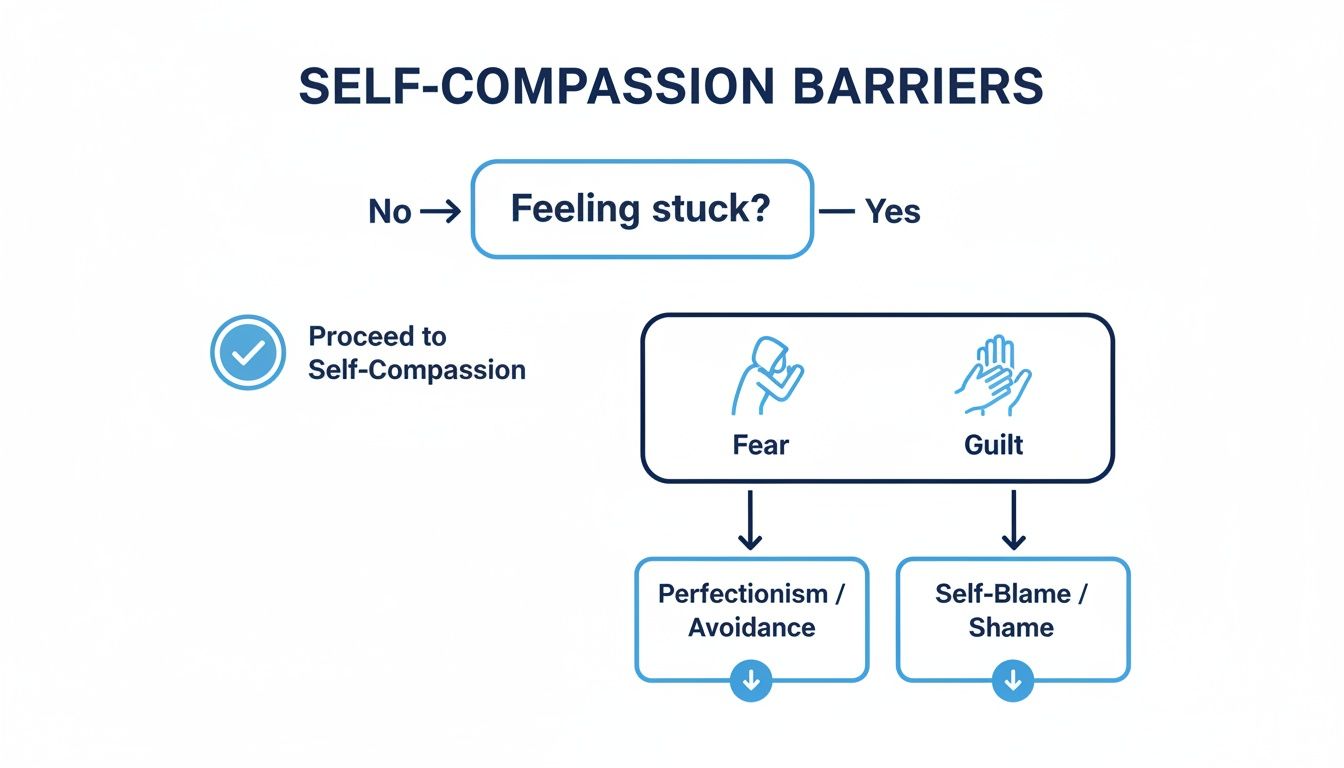
As you can see, feeling stuck often stems from deep-rooted fears or guilt. These are tricky things to navigate on your own, and professional guidance can make all the difference.
Finding the Right Support in the UK
Taking that next step can feel daunting, I know. But there are excellent resources available.
Your GP is always a great first port of call. They can listen to what's going on and refer you to the right NHS mental health services.
Organisations like Mind also offer incredible support and can guide you in finding help in your local area. For those interested in a more specialised approach, it's worth exploring different types of therapy. Compassion Focused Therapy (CFT), for instance, is specifically designed to work with shame and self-criticism.
If you'd like to learn more about this approach, you can explore the different types of CFT therapy available and find a qualified professional who's a good fit for you.
Your Questions, Answered
Putting self-kindness into practice can bring up a lot of questions, especially when it feels like you're going against a lifetime of conditioning. Let’s tackle some of the most common queries that come up on this journey.
Why Does It Feel So Hard to Be Kind to Myself?
If you’re finding this whole self-kindness thing a real struggle, you’re not alone. For many of us, self-criticism is a deeply learned, almost automatic habit. We’ve often picked up messages from our upbringing or society that being hard on ourselves is the only way to stay motivated and avoid messing up.
You might even believe that a harsh inner voice is what drives your success. This pattern can become so ingrained that choosing a kinder response feels completely unnatural, maybe even a bit weak or counterintuitive. The challenge, then, is that you’re consciously practising a brand new skill that directly opposes years of mental muscle memory. It takes time.
How Is Self-Kindness Different From Just Being Positive?
This is a brilliant question. Forced positivity often involves glossing over or outright ignoring difficult feelings, slapping a smile on and insisting everything is fine when it clearly isn't. Self-kindness, on the other hand, is about validating your entire experience—including the painful, messy parts.
Think of it as the difference between saying "Don't be sad!" and "It's okay to feel sad right now." It acknowledges your struggle with warmth and understanding, rather than trying to paper over it with affirmations that ring hollow in the moment. This validation is the bedrock of genuine resilience.
A core tenet of learning how to be kind to yourself is acknowledging the reality of your feelings without judgement. True compassion makes room for sadness, anger, and disappointment, offering support instead of dismissal.
What Is a Simple First Step I Can Take Today?
One of the most immediate and powerful things you can do is to change how you speak to yourself right after a small mistake. The next time you forget something, say the wrong thing, or feel you've fallen short in some minor way, just pause.
Instead of letting your usual critical voice jump in, ask yourself this: "What would I say to a good friend right now?"
Then, try actually saying that to yourself, either out loud or in your head. It might be something as simple as, "That was a tough moment, and it’s okay," or "You're only human." This single, small act can begin to shift the entire tone of your inner world.
At Dr Chris Irons, we specialise in helping individuals and professionals move from a place of self-criticism to one of genuine self-compassion. If you're ready to deepen this practice with expert guidance, explore the therapy and coaching services available at https://drchrisirons.com.