Of course. Here is the rewritten section, crafted to sound like it was written by an experienced human expert in Compassion Focused Therapy.
We’ve all got that harsh inner voice, the one that pipes up when we make a mistake or feel vulnerable. For many of us, that voice can be relentless, leading to overwhelming feelings of shame and self-criticism. Compassion Focused Therapy, or CFT, is a powerful approach designed to help us work with that inner critic.
But let’s be clear: this isn’t about fluffy affirmations or just "being nicer to yourself." CFT is a science-backed method for training your mind. It’s about deliberately cultivating an inner source of compassion that gives you the strength and resilience to navigate life’s inevitable storms.
Getting to the Heart of Compassion Focused Therapy
Far from being a 'soft' option, CFT is better understood as an active training programme for your brain. Developed by Professor Paul Gilbert, it draws on everything from evolutionary psychology and neuroscience to attachment theory. Its core insight is that our minds, wired over millions of years for survival, can easily get stuck in painful loops of self-blame and shame—the very things that often fuel our mental health struggles.
Think of it this way: a part of your brain works like a highly sensitive smoke alarm—what we call the threat system. Its job is to constantly scan for danger. For many people, especially those who have experienced trauma or a difficult upbringing, this system is stuck on high alert. The result? A constant undercurrent of anxiety, fear, and a tendency to turn on ourselves when things go wrong.
CFT gives you the tools to intentionally switch on and strengthen a different part of your brain: the soothing system. This is the part that allows us to feel content, safe, and genuinely cared for.
Healing Without the Blame
One of the most profound principles in CFT is that your struggles are not your fault. That’s a big statement, but it’s fundamental. The therapy helps you see that your brain is simply doing what it evolved to do, even if its old survival strategies are no longer helpful in today's world. This compassionate, "no-blame" stance is incredibly freeing; it lifts the heavy weight of shame right off your shoulders.
Instead of getting into a losing battle with your inner critic, CFT teaches you to relate to it differently by developing your ‘Compassionate Self’. This isn't about creating a new personality; it’s about nurturing three innate human qualities:
- Wisdom: The ability to understand the nature of your difficulties without judgement.
- Strength & Courage: The capacity to turn towards your pain and face difficult emotions head-on.
- Warmth & Commitment: A deep-seated intention to care for your own wellbeing, day in and day out.
“Compassion isn’t about eliminating difficulties, but about meeting them with warmth and care. We all deserve kindness, especially in these moments of transformation.”
Through specific, practical exercises like compassionate imagery, letter writing, and soothing rhythm breathing, you learn to directly activate your body’s natural calming responses. It’s not just talk; this work actually helps build new neural pathways, making compassion a more natural, go-to response over time.
The goal isn't to get rid of pain—that's impossible. The goal is to build the inner resources to support yourself through the pain. In essence, you learn how to become your own best ally.
The Core Principles of Compassion Focused Therapy
To help pull these ideas together, here’s a quick overview of the foundational concepts that make Compassion Focused Therapy so unique.
| Principle | What It Means for You |
|---|---|
| Our "Tricky Brain" | Your brain evolved for survival, not happiness. Understanding its old, unhelpful programming (like the threat system) allows you to stop blaming yourself for automatic reactions like anxiety or self-criticism. |
| Three Affect Systems | CFT focuses on balancing three emotional systems: the Threat System (safety-seeking), the Drive System (resource-seeking), and the Soothing System (contentment and connection). Many of our problems stem from an overactive threat system and an under-developed soothing system. |
| A "No-Blame" Stance | Your struggles are not your fault. They are the result of a combination of your genes, your life experiences, and the way your tricky brain is wired. This removes shame and opens the door to self-compassion. |
| The Three Flows of Compassion | Wellbeing involves practising compassion in three directions: 1. Giving it to others, 2. Receiving it from others, and 3. Directing it towards yourself (self-compassion). |
| Developing the Compassionate Self | This involves actively training your mind to embody qualities of wisdom, strength, courage, and warmth. You learn to access this compassionate part of yourself to support you through difficult times. |
These principles aren't just abstract theories; they form the practical roadmap we use in CFT to help you build a kinder, more supportive relationship with yourself.
The Science of Your Three Emotional Systems
To really get to the heart of Compassion Focused Therapy, we need to pop the bonnet and look at how your brain is wired for survival. CFT is built on a really practical and frankly fascinating model of the mind, which revolves around three core emotional systems. These systems evolved millions of years ago to help us navigate a tricky world, and understanding them is the first step toward finding a sense of balance.
Think of these systems like the controls in a car. Each one has a specific job, but big problems start to brew when one gets overused and another is neglected. To fully see how CFT works, we have to start with this emotional architecture. For a deeper dive, there are some great resources on understanding what emotions are.
The Threat System: The Brakes
Your Threat System is your brain's ancient alarm bell. Its entire purpose is to spot danger and protect you from it, whether that’s a real physical threat or a social one like rejection or criticism. When it kicks in, it floods your body with emotions like anxiety, anger, and disgust, getting you ready to fight, flee, or freeze.
This system is like the brakes on your car—absolutely vital for keeping you safe. The trouble is, for many of us, especially those wrestling with self-criticism or anxiety, this system is chronically overactive. It’s as if the brake pedal is stuck to the floor, keeping you on high alert and seeing danger around every corner, even when there isn't any.
The Drive System: The Accelerator
Next up is your Drive System, which is basically the car’s accelerator. This is the system that motivates you to seek out resources, achieve your goals, and chase after things that feel rewarding. It’s what fuels feelings of excitement, desire, and anticipation.
The drive system is what gets you out of bed for work, pushes you to strive for that promotion, or helps you finish a marathon. It’s essential for getting things done and feeling a sense of vitality. But if it’s constantly floored without any time for rest, it leads straight to burnout, exhaustion, and that nagging feeling of never being satisfied.
This visual map shows how CFT aims to soothe that overactive threat system, strengthen our capacity for calm, and support a more balanced way of living.
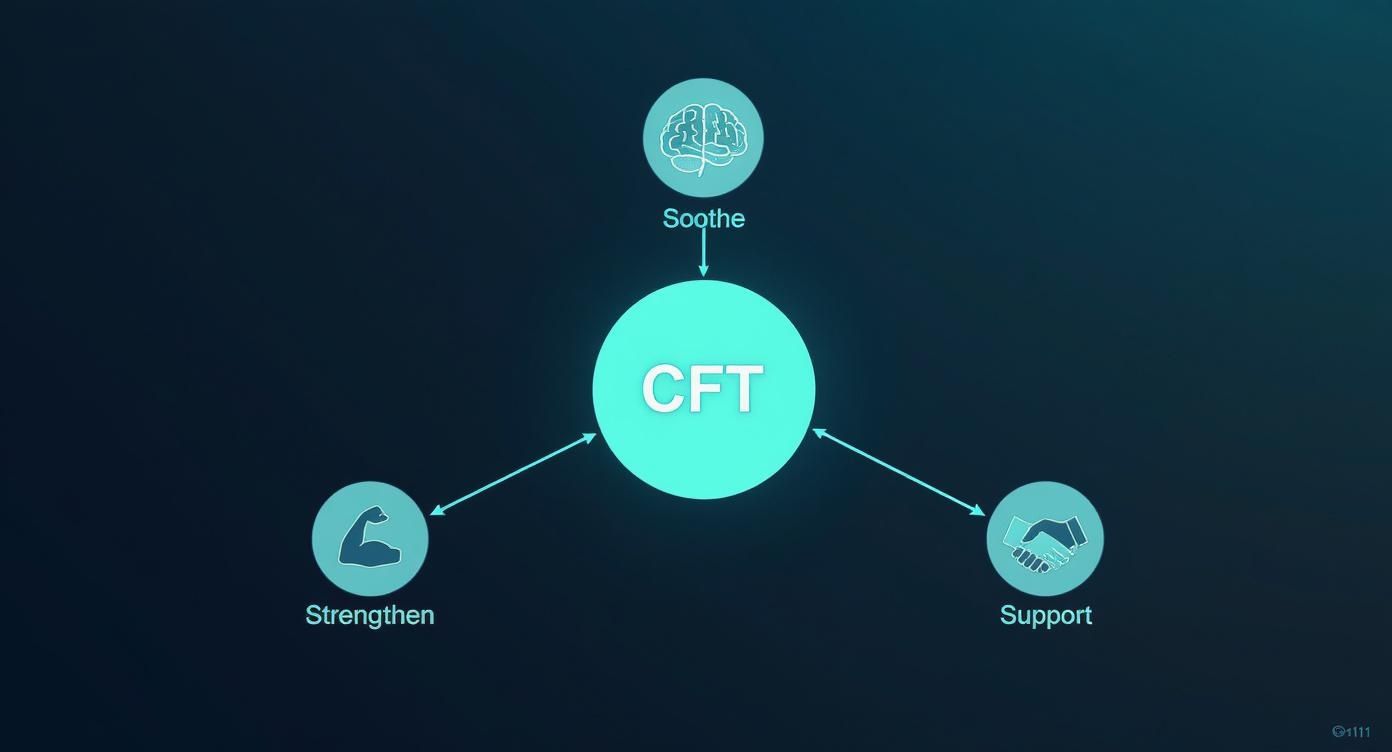
The key insight here is that CFT isn't just theory; it provides a practical framework for actively working with these different parts of our minds to build genuine wellbeing.
The Soothing System: The Cruise Control
Finally, and this is really the cornerstone of CFT, we have the Soothing System. This system is all about feelings of calm, contentment, and safety. It’s switched on when we feel cared for, connected, and at peace—basically, when we feel we don’t need to be on guard or striving for anything.
Think of it as the cruise control in your car. It lets you relax and feel settled. This system is linked to the part of our nervous system responsible for "rest and digest" functions, and it's nurtured through kindness, warmth, and gentle affection. For a lot of people, this is the most underdeveloped of the three systems.
A core idea in Compassion Focused Therapy is that many of our psychological difficulties arise from an imbalance between these systems. An overactive threat system and an under-developed soothing system create a perfect storm for shame and self-criticism.
The goal of CFT isn't to get rid of the threat or drive systems—we absolutely need them to survive and thrive. Instead, the real work is about bringing them into balance by intentionally strengthening the soothing system. By learning practical skills to activate this calming part of your brain, you gain more say over your emotional responses. This builds a powerful inner resource for navigating life's challenges with a sense of safety, strength, and real self-support.
Of course. Here is the rewritten section, crafted to sound human-written and natural, following all your specific instructions and examples.
How CFT Works: The Core Techniques
Knowing the theory behind Compassion Focused Therapy is one thing, but putting it into practice is where the real change happens. CFT isn't just about talking; it's an active, skills-based therapy designed to quite literally train your brain. It gives you practical tools to consciously engage your soothing system and build a much more supportive inner world.
The whole point of these techniques is to move beyond simply knowing you should be kinder to yourself and to start developing the felt, embodied experience of compassion. These aren't quick fixes. Think of them as exercises that, with consistent practice, build new neural pathways. This process helps compassion become a more natural, go-to state of mind when you need it most.

Let’s dig into some of the core, hands-on techniques you’re likely to learn and practise in CFT sessions.
Developing Your Compassionate Self
A central pillar of CFT is cultivating what we call the Compassionate Self. This isn't about becoming someone else, but about tapping into and strengthening a part of you that’s already there. It’s a process of intentionally cultivating the qualities of wisdom, strength, and warmth within yourself.
Imagine the Compassionate Self as your own internal mentor—a version of you wise enough to see your struggles without judgement, strong enough to face pain, and warm enough to offer genuine care. Your therapist will guide you through exercises to help you connect with and embody this self.
You might, for example, be asked to explore what this part of you would look, sound, and feel like. This process helps you create a reliable inner resource you can turn to whenever that harsh inner critic starts to take over.
Mastering Compassionate Mind Training
Compassionate Mind Training (CMT) is the active, nuts-and-bolts part of CFT. It’s basically the collection of all the exercises we use to stimulate your soothing system and build up your capacity for compassion. This training is absolutely essential for learning how to handle difficult emotions and dial down self-criticism.
These exercises are varied and can be tailored to what you need, but they often include:
- Soothing Rhythm Breathing: This is a foundational practice. It involves deliberately slowing your breathing to a gentle, rhythmic pace. This simple act directly activates your parasympathetic nervous system—your body’s ‘rest and digest’ mode—which creates a physiological feeling of calm and safety.
- Compassionate Imagery: Here, you use your imagination to create a sense of safety and support. You might visualise a perfectly compassionate place, a comforting colour, or an ideal compassionate figure who embodies wisdom and warmth.
- Compassionate Tone of Voice: You’ll practise noticing the tone you use when you talk to yourself and intentionally shift it to one that is warmer and kinder, much like you’d use with a friend you care about.
For anyone looking to really deepen these skills, structured programmes like an 8-week compassionate mind training course can provide a guided pathway to mastering these techniques.
Using Compassionate Letter Writing
One of the most powerful exercises in CFT is Compassionate Letter Writing. It’s a beautifully structured way to change your relationship with your inner critic and practise self-compassion in a tangible way.
You learn to write letters to yourself, but from the perspective of your Compassionate Self. In these letters, you might express understanding for a specific struggle, acknowledge your pain without judgement, or offer words of encouragement and support.
This practice is not about making excuses; it's about fostering understanding. It helps you see that your difficulties are understandable given your life experiences and your 'tricky brain', which shifts you out of self-blame and into self-support.
Writing these letters regularly can fundamentally change your inner dialogue. It helps you internalise a kinder voice, making it a more automatic response over time and providing a powerful antidote to shame and self-criticism.
Applying Functional Analysis
CFT also uses a technique from behavioural psychology called Functional Analysis to help you understand your self-critical patterns. This involves taking a specific self-critical thought or behaviour and exploring its history, its triggers, and its function. What purpose did this pattern serve in the past? What are its consequences now?
This is a “no-blame” investigation. The goal is simply to develop a compassionate understanding of why these patterns exist. For instance, you might realise that your harsh inner critic developed as a way to motivate yourself or maybe to protect you from the criticism of others.
By understanding the function of these patterns, you can begin to see them not as personal failings but as old survival strategies. That wisdom is the first step toward developing new, more compassionate ways of relating to yourself that better serve your wellbeing today.
Who Can Benefit Most From CFT?
While the core ideas of compassion are pretty universal, Compassion Focused Therapy is a specialist approach, honed to help with very specific kinds of psychological pain. It’s particularly powerful for people whose inner world is dominated by high levels of shame and self-criticism. These painful, potent emotions often form the common thread running through a whole host of mental health struggles.
Think of it this way: if your mind is a garden, self-criticism is like a persistent, thorny weed that relentlessly chokes out everything else. Some therapies might help you manage the garden, but CFT gets right to the root of that weed. It helps you understand where it came from and gives you the tools to cultivate something much kinder and more nourishing in its place.
This approach can be a real game-changer for people who’ve tried other therapies but felt like something was missing. Perhaps you can logically identify your unhelpful thought patterns, but you still feel, deep down, worthless or broken. CFT is designed to bridge that exact gap between thinking and feeling, targeting the deep-seated emotional wounds that self-criticism both creates and, in a strange way, tries to protect.
Individuals Drowning in Self-Criticism and Shame
At its heart, what is Compassion Focused Therapy if not a direct antidote to the harsh inner critic? It's tailor-made for anyone who feels trapped in relentless cycles of self-blame.
This often shows up for individuals experiencing:
- Chronic Depression: Where a constant internal barrage of criticism fuels feelings of worthlessness and hopelessness.
- Anxiety Disorders: Especially social anxiety, where the fear of judgement from others is just a reflection of an intensely critical inner voice.
- Eating Disorders: These are so often driven by profound body shame and a punishing internal dialogue about food, weight, and self-worth.
- Post-Traumatic Stress Disorder (PTSD): Trauma can leave behind deep-seated feelings of shame and self-blame, creating a sense that you are fundamentally flawed or broken.
CFT offers a gentle, non-judgemental space to explore where this inner critic actually came from. If you want to dive deeper into this, you can learn more about how CFT helps you heal from shame and self-criticism. The therapy helps you see that this critical part of you often developed as a misguided protective strategy, which allows you to start softening towards it rather than just fighting it all the time.
A Proven Approach in Demanding Settings
The power of CFT isn’t just theoretical; it’s been widely adopted in demanding clinical environments, most notably the UK's National Health Service (NHS). Its growing use within the NHS really speaks to its real-world value in helping people navigate complex and enduring emotional pain.
CFT's integration into NHS services shows its power to help diverse groups of people. It has proven especially effective for those who haven't responded well to other psychological interventions, offering a new path towards healing.
This success is partly down to how well people take to it. Studies have shown that CFT programmes often have lower dropout rates than the 30-50% typically seen in other psychological therapies. It seems its core message—that your struggles are not your fault—resonates deeply and encourages people to stick with the process. What's more, UK-based research shows it effectively reduces symptoms of anxiety and depression, with around 55% of these interventions delivered in group settings, which also helps to reduce feelings of isolation.
Anyone Looking for a Kinder Relationship with Themselves
Ultimately, you don’t need a specific diagnosis to find value in what CFT offers. This therapy is profoundly helpful for absolutely anyone who feels stuck in a battle with themselves.
This could easily be:
- People experiencing burnout from high-pressure jobs.
- Individuals navigating difficult life transitions, like relationship breakdowns or grief.
- Those struggling with nagging feelings of being an imposter, no matter what they achieve.
- Anyone who simply wants to shift from a life governed by fear and self-criticism to one guided by courage and self-support.
If you recognise that your own inner critic is holding you back, causing you distress, or just stopping you from living a fulfilling life, then CFT could give you the skills and understanding you need. It's about building a foundation of inner safety and warmth, a place from which you can face all of life’s challenges.
What to Expect From Your First CFT Sessions
Walking into a therapist’s office for the first time can feel a bit nerve-wracking, and that’s completely normal. When it's for something specific like Compassion Focused Therapy, you're probably wondering what it’s actually going to be like. Let's pull back the curtain.
Those first few sessions are all about building a solid foundation. This isn’t about jumping straight into the deep end of your pain. Instead, it’s about creating a safe, trusting space where you and your therapist can begin to explore things together.

Your therapist will want to hear your story—not to judge it, but to compassionately understand how your current struggles, especially that harsh inner critic, came to be. It's about mapping out your inner world together and making sense of why you feel the way you do.
Building an Understanding of Your 'Tricky Brain'
A huge part of these early conversations involves what we call psychoeducation. This is just a fancy term for learning the science behind why your mind works the way it does.
Your therapist will introduce you to core CFT ideas, like your 'tricky brain' and the three emotional systems we looked at earlier: the threat system, the drive system, and the soothing system. This isn't a stuffy university lecture. It’s an eye-opening process that helps you realise your difficulties aren't some personal failing.
Suddenly, you see that your brain is just running on old, outdated survival software. For so many people, this understanding lifts a massive weight of shame. It's a genuinely relieving, 'no-blame' approach that paves the way for true self-compassion.
This shift in perspective is everything. It takes you from asking, "What's wrong with me?" to exploring, "What happened to me, and how has my brain tried to keep me safe?" This is the first, vital step toward changing your relationship with yourself.
Once this foundation is in place, your therapist will gently begin to introduce the practical skills of CFT, always moving at a pace that feels right for you.
Gently Introducing Compassion Practices
You won't be asked to become a master of self-compassion overnight. Far from it. The exercises are introduced gradually, starting with simple grounding techniques before moving on to anything more involved.
Your first practical steps might look something like this:
- Soothing Rhythm Breathing: A simple but incredibly powerful way to calm your nervous system and switch on your soothing system.
- Creating a Safe Place: Using your imagination to build a mental sanctuary where you feel completely safe, calm, and held.
- Noticing Your Inner Critic's Tone: Just starting to pay attention to how you talk to yourself, and maybe experimenting with a kinder, warmer alternative.
The entire process is a partnership. Your therapist is your guide, working with you to find the practices that really click. These first sessions are about planting the seeds of compassion and creating the safe, warm space they need to grow.
To give you a clearer picture, here’s a typical roadmap for how your therapy might unfold.
Your CFT Journey: A Phase-By-Phase Overview
This table gives you a sense of the typical journey, from building foundational knowledge to integrating compassion into your daily life.
| Phase | What You Will Learn and Do |
|---|---|
| Phase 1: Foundation Building & Psychoeducation | You'll learn the 'no-blame' science behind your 'tricky brain' and the three affect-regulation systems. The focus is on creating a safe therapeutic relationship and reducing self-criticism. |
| Phase 2: Developing Compassionate Skills | This phase involves practical exercises like soothing rhythm breathing, compassionate imagery, and learning to generate a 'compassionate self' to offer yourself kindness and support. |
| Phase 3: Working with Difficult Emotions | With your new skills, you'll start to compassionately engage with painful memories, shame, and self-criticism, learning to hold them with warmth rather than being overwhelmed by them. |
| Phase 4: Integration & Moving Forward | The focus shifts to integrating your compassionate mind into daily life, relationships, and future challenges, building resilience and a lasting sense of inner warmth and security. |
Remember, this is a flexible guide. Your therapist will tailor the pace and focus to your unique needs, ensuring you always feel supported and never rushed.
How to Find CFT and Other Compassion Resources
Deciding to build a more compassionate mind is a genuinely courageous step. Whether you feel ready to dive into one-on-one therapy or you’d rather start with some self-guided resources, there are fantastic pathways available to support you. Knowing where to look is the first part of the journey.
For anyone in the UK looking for professional support, finding a qualified Compassion Focused Therapy practitioner is the best place to start. These therapists have gone through specialised training in the model, so they can guide you through its core practices with real expertise and care. It all begins with a conversation.
Finding a Qualified CFT Therapist
The right therapist makes all the difference. Finding someone you can trust is crucial for building the kind of safe, effective therapeutic relationship where real change happens. Thankfully, several trusted organisations keep registers of accredited therapists, which takes a lot of the guesswork out of finding someone with the right credentials.
Here are the best places to begin your search:
- The Compassionate Mind Foundation: This is the official home of CFT, founded by Professor Paul Gilbert himself. Their website lists practitioners who have trained directly with them, so you know you’re in good hands.
- British Association for Behavioural & Cognitive Psychotherapies (BABCP): Many CFT therapists are also accredited in CBT. You can often find highly experienced practitioners through the BABCP register.
- Counselling Directory and Psychology Today: These platforms are great for searching for therapists in your local area. You can filter by specialism to find someone who specifically lists CFT.
It's also worth knowing that you can sometimes access CFT through the NHS. The first port of call is usually your GP, who can refer you to your local psychological therapies service (what used to be called IAPT). Availability does vary from place to place, but CFT is becoming more common, especially for difficulties rooted in shame and self-criticism.
Self-Guided Compassion Resources
If you're not quite ready for therapy, or maybe you just want to supplement your sessions, there's a wealth of brilliant resources you can explore on your own. These tools are perfect for getting started with compassionate mind training and building a solid understanding of the core ideas.
Building self-compassion is a practice, not a destination. Starting with small, consistent steps through books or apps can create meaningful shifts in your inner world, paving the way for deeper therapeutic work if and when you're ready.
Consider these excellent starting points:
- Books by Professor Paul Gilbert: His books, like The Compassionate Mind and Overcoming Depression, are a fantastic introduction. They offer a deep dive into the theory and practice of CFT in a way that’s really accessible.
- Online Training and Courses: If you prefer a more structured learning experience, there are many excellent options out there. You can explore a variety of on-demand Compassion Focused Therapy training to deepen your understanding at your own pace.
- Meditation and Mindfulness Apps: Many of the popular apps now include guided self-compassion meditations. They are a brilliant way to begin practising the core skills in just a few minutes a day.
Frequently Asked Questions About CFT
As you start to explore Compassion Focused Therapy, it's completely normal to have a few questions. CFT pulls together ideas from neuroscience, evolutionary psychology, and ancient contemplative practices, so it can feel a little different from other therapies you might have heard of.
Let's unpack some of the most common queries I hear.
How Is CFT Different From Mindfulness?
This is a fantastic question, and one that comes up a lot. The two are definitely related, but they're not the same thing. Think of mindfulness as the foundational skill—it’s about learning to pay attention to the present moment, on purpose, without getting caught up in judgement. It’s the ability to simply notice your thoughts, feelings, and bodily sensations as they arise and pass.
CFT takes this powerful skill of awareness and adds a crucial second step: active compassion. It’s not just about noticing what’s happening inside you; it’s about learning how to relate to it with warmth, strength, and wisdom.
So, while mindfulness helps you notice the storm of difficult thoughts and feelings, CFT teaches you how to become a calm, steady anchor in the middle of it all.
Is CFT Just About Being Nice to Yourself?
Not at all. This is probably the biggest misconception out there. In fact, the compassion we cultivate in CFT is far from a soft or passive state—it’s courageous.
True compassion requires the strength to turn towards our pain instead of running away from it. It takes the wisdom to understand where our struggles come from, without piling on more blame. And it demands the commitment to do what’s genuinely helpful for our wellbeing in the long run.
Sometimes, the most compassionate thing you can do is set a firm boundary, have a difficult conversation, or push yourself to face something you’ve been avoiding. CFT is about building an inner resource that is both kind and incredibly resilient.
A key insight in CFT is that compassion provides the emotional foundation needed to face life's difficulties. It builds the inner safety required to do the hard work of healing and growth, which is a courageous, not a weak, act.
What Is the Difference Between CFT and CBT?
Cognitive Behavioural Therapy (CBT) is a brilliant approach for helping people identify and challenge unhelpful patterns in their thoughts and actions. It’s incredibly effective for many people and focuses primarily on the content of your thinking.
But here’s a scenario I’ve seen time and time again in my practice: someone can logically challenge a self-critical thought (like, "Okay, I know I'm not really a total failure"), but they don't actually feel any better. The deep, painful sting of shame or self-criticism just won't budge.
This is exactly where CFT comes in. It works on the emotional tone that sits underneath your thoughts. Rather than just changing what you think, CFT helps to change your fundamental relationship with yourself. It directly targets those underlying feelings of threat and shame by actively building up your brain's capacity for soothing and self-support. The goal is to create a felt sense of inner safety that logic alone often can't reach.
At Dr Chris Irons, we specialise in helping individuals and professionals use the power of compassion to overcome self-criticism and build fulfilling lives. Whether through therapy, coaching, or professional training, we provide expert guidance grounded in decades of clinical experience. Explore our resources and services to begin your journey at https://drchrisirons.com.