Tackling workplace stress isn't a one-and-done fix. It's a blend of in-the-moment coping skills, habits that build resilience over time, and crucial changes at the organisational level. It all starts with pinpointing what’s driving the pressure—be it a crushing workload or that nagging inner critic—and then applying specific, compassionate techniques to manage how you react.
The Reality of Modern Workplace Stress
If you feel like you’re constantly treading water just to keep up with work, you’re far from alone. Today’s work environment, with its relentless pace and 24/7 connectivity, has cooked up a perfect storm for stress. For so many of us, the boundaries between our work and personal lives have all but vanished, creating an ‘always-on’ culture where truly switching off feels like a distant dream.
This isn’t just a vague feeling; it’s a widespread reality for millions.
The pressure often comes from outside sources – impossible deadlines, overwhelming workloads, and tricky team dynamics. It’s important to understand these external factors, like exploring how poor time management impacts employee well-being. But, a huge chunk of the stress we feel is actually amplified from within, by our own harshest critic. That voice in our head that replays every mistake, questions our abilities, and insists we’re not doing enough is often the loudest one in the room.
The Scale of the Problem
The fallout from this pervasive stress is staggering. Here in the UK, it has hit crisis levels. The Health and Safety Executive (HSE) recently reported that a shocking 964,000 workers were suffering from work-related stress, depression, or anxiety.
This tidal wave of distress led to 22 million lost working days, making up 54% of all sickness absences and costing businesses up to £28 billion a year. You can dive into the full details in the HSE's official report.
These aren't just numbers on a page; they paint a picture of a shared, deeply human experience. The exhaustion, the anxiety, the feeling of being completely overwhelmed—it's real, and it has very real consequences for people and the places they work. Just trying to 'push through' it or 'be tougher' is rarely the answer. In fact, it usually just feeds the cycle of self-criticism and burnout.
As a clinical psychologist with over two decades of experience, I’ve seen firsthand how self-criticism acts as a powerful amplifier for workplace stress. It turns a challenging situation into a personal failing, making it feel inescapable.
A Kinder, More Effective Path Forward
This is where we need a different approach. Instead of fighting stress with even more pressure, Compassion Focused Therapy (CFT) offers a gentler, more effective way forward. CFT is a well-researched, evidence-based approach that helps you cultivate a supportive inner voice to balance out that harsh inner critic.
This isn't about letting yourself off the hook. It’s about fundamentally changing your relationship with yourself. Rather than motivating yourself with fear and criticism, you learn to do it with encouragement, wisdom, and kindness. This workbook will guide you through practical CFT techniques designed to help you:
- Calm your body's threat system when you're in the thick of a high-pressure moment.
- Quiet your inner critic and develop a more compassionate way of thinking.
- Build long-term resilience with proactive, sustainable habits.
The goal isn't to eliminate stress entirely—that’s an impossible task. It’s to change how you respond to it. By learning how to reduce workplace stress with self-compassion, you can navigate professional challenges without sacrificing your mental and emotional wellbeing. Let’s start this journey toward a healthier, more balanced working life.
Calm Your Mind in Overwhelming Moments
We’ve all been there. That sudden surge of stress right before a big presentation, or the wave of dread that washes over you after some tough feedback. In those moments, long-term strategies are great, but what you really need are tools to dial down the intensity, right now.
Think of these techniques as your first-aid kit for stress. This isn't about ignoring or bottling up your feelings. It's about working with your body to calm its threat system, which has a tendency to go into overdrive when the pressure is on.
When you're overwhelmed, your mind loves to spin worst-case scenarios. But your body? Your body offers a direct line to regaining a sense of control. By focusing on simple physical sensations – like your breath or the feeling of your feet on the floor – you can send a powerful signal of safety to your nervous system. It’s a small shift that makes a huge difference, helping you respond thoughtfully instead of just reacting.
Activate Your Soothing System with Your Breath
One of the quickest and most powerful ways to tackle workplace stress is to simply breathe. Intentionally. I’m a big advocate for Soothing Rhythm Breathing, a core practice in Compassion Focused Therapy, because it’s specifically designed to activate your parasympathetic nervous system – the bit responsible for making you feel calm and settled.
When stress hits, our breathing gets shallow and fast. This tells our brain something is wrong, keeping us stuck in that high-alert state. Soothing Rhythm Breathing does the exact opposite; it sends a message of safety that quiets the noise in your head.
You can do this anywhere – at your desk, in a meeting room, even in the loo before a tricky conversation.
- Get comfortable. Sit upright, but let your shoulders drop and relax.
- Slow it all down. Aim for about five to six breaths a minute. A simple way to do this is to breathe in for a count of four and out for a count of six.
- Breathe from your belly. Imagine a balloon in your stomach gently inflating as you breathe in and deflating as you breathe out. This is deep, diaphragmatic breathing.
- Set a kind intention. As you breathe, you could silently repeat a phrase that feels helpful, like, "Breathing in calm, breathing out tension."
Just two or three minutes can make a world of difference. The key is the slow, deep, rhythmic pace. It’s an anchor when your thoughts are threatening to spiral out of control.
Use Your Senses to Anchor Yourself in the Present
When anxiety kicks in, our minds tend to time-travel, either worrying about the future or replaying the past. Grounding is a fantastic technique to pull yourself back to the here and now. It works by shifting your focus away from anxious thoughts and onto neutral, tangible sensations.
The "5-4-3-2-1" exercise is brilliant for this, and you can do it without anyone even noticing.
- Five things you can see. Look around and silently name five objects. Don't judge them, just notice them. "I see my blue pen, the wood grain on the desk, my black computer monitor…"
- Four things you can feel. Tune into the physical sensations you're experiencing right now. Notice four things you can touch, like the solid feeling of your feet on the floor, the texture of your chair, or your sleeve against your skin.
- Three things you can hear. Listen. What are the sounds in your environment? The hum of the air con, keyboards clicking, distant traffic? Acknowledge three of them.
- Two things you can smell. This one can be subtle. Maybe it's your coffee, the scent of hand sanitiser, or even just the smell of paper.
- One thing you can taste. What’s the last thing you can taste? It might be the last sip of tea, or simply the neutral taste in your mouth.
These in-the-moment exercises aren’t about avoiding problems. They are about creating the mental space needed to face those problems with a clearer, calmer mind. They are your first line of defence against becoming overwhelmed.
When you're caught in a moment of stress, it can be tough to know what to do next. Is the pressure coming from external demands or your own internal critic? This decision tree can help you quickly figure out the source of your stress so you can choose the right path forward.
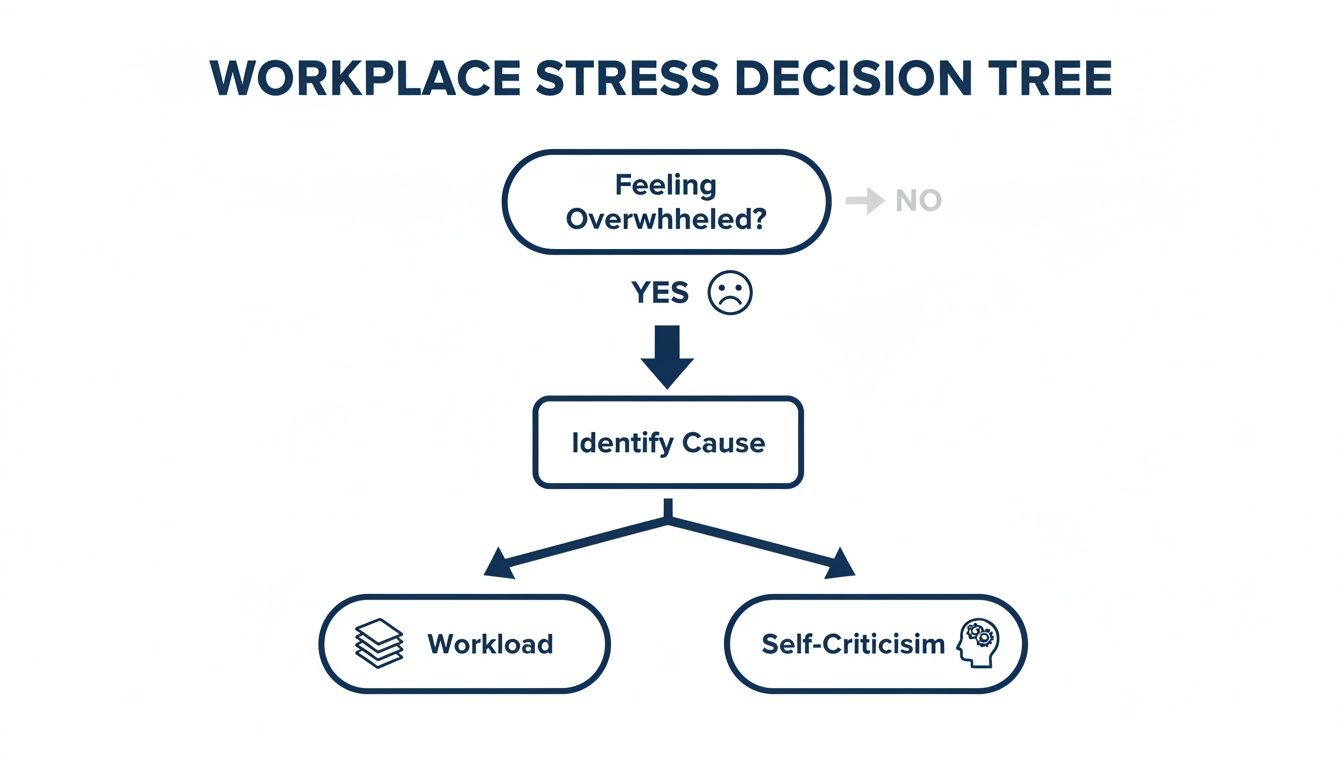
As the flowchart shows, the first step is always to identify the root cause. Only then can you apply the most effective strategies to actually make a difference.
Your In-the-Moment Stress Reduction Toolkit
When you're in the thick of it, you need simple, go-to techniques that work fast. Think of this table as a quick-reference guide for those high-pressure moments at work.
| Technique | When to Use It | How It Helps |
|---|---|---|
| Soothing Rhythm Breathing | Before a big meeting, after receiving difficult news, or when you feel your heart racing. | Activates your body's calming system (parasympathetic nervous system) and signals safety to your brain. |
| The 5-4-3-2-1 Grounding | When your mind is racing with "what if" scenarios or you feel disconnected and anxious. | Pulls your attention out of anxious thoughts and anchors you firmly in the present moment. |
| A Mindful Minute | During a short break between tasks or when you feel overwhelmed by your to-do list. | Interrupts the stress cycle by focusing your attention on a single neutral sensation, like your breath. |
| Stretching at Your Desk | When you feel physical tension building in your neck, shoulders, or back from sitting too long. | Releases muscle tension, which can hold a surprising amount of stress, and gets your blood flowing. |
Keep these tools in your back pocket. The more you practise them when you're calm, the easier they'll be to call upon when you really need them.
Develop a Compassionate Mindset to Silence Your Inner Critic

While those in-the-moment techniques are fantastic for calming a racing heart, a more profound shift comes from changing the relationship you have with your own mind. A huge amount of the pressure we feel doesn't just come from looming deadlines or a demanding boss; it’s amplified by the harsh, relentless voice of our own inner critic.
This internal voice is a master of magnification. It can take a minor typo in an email and blow it up into a career-ending catastrophe. It’s the voice whispering, “You’re a fraud” during a successful presentation, making you feel like an imposter despite all your hard work and achievements. Living with this constant self-criticism is utterly exhausting, and it’s a powerful engine for stress and anxiety.
Understand the Critical-Shame Loop
When you make a mistake at work, what’s your immediate internal reaction? For so many of us, it’s a wave of self-blame, quickly followed by a sinking feeling of shame. This is the critical-shame loop, and it’s a vicious cycle. The inner critic attacks, you feel ashamed or anxious, and then the critic attacks you for feeling that way. It’s a downward spiral that can leave you feeling isolated and unworthy.
Across my two decades of clinical experience with Compassion Focused Therapy, I've seen time and again how shame and imposter feelings fuel this destructive cycle. Self-criticism creates a feedback loop where people feel they don’t deserve a break, which leads to chronic anxiety and makes it impossible to ever truly switch off.
This isn't a niche problem. A Priory Group survey found that a staggering 74% of UK adults felt overwhelmed by stress in the past year, a figure that climbs to 81% for women, often linked directly to the pressures of work.
Your inner critic isn't actually trying to harm you. It's a primitive, threat-focused part of your brain desperately trying to keep you safe by preventing you from making mistakes. The problem is, its methods are outdated and incredibly harmful. Learning to manage workplace stress means learning to update this internal safety system with compassion.
This cycle is especially tough for those of us who wrestle with imposter syndrome. Despite all the external evidence of your competence, you live with a persistent, internalised fear of being exposed as a 'fraud'. Recognising this pattern is the first real step toward breaking free. You can dive deeper into this specific struggle in our guide on overcoming imposter syndrome.
Exercise: Cultivating Your Compassionate Self
The antidote to a powerful inner critic is an equally powerful compassionate self. This isn’t about being fluffy or letting yourself off the hook for everything. It's about cultivating an inner resource that is wise, strong, and deeply encouraging. Think of it as developing the ultimate inner mentor.
This exercise is designed to help you create and connect with this part of yourself. Find a quiet moment where you won't be disturbed for five to ten minutes.
-
Visualise Your Ideal Compassionate Figure
Close your eyes and just imagine what a truly compassionate being would be like. Don’t worry about getting it ‘right’. This figure could be old or young, human or animal, real or imagined. The important thing is to focus on the qualities you want it to have.- Wisdom: It understands life is full of challenges and doesn't expect perfection.
- Strength: It is resilient and can tolerate distress without being overwhelmed.
- Warmth: It has a deep sense of care and unconditional kindness for you.
-
Sense Its Presence
Once you have a bit of an image, imagine this compassionate figure is right there with you. How does it look at you? What is its tone of voice like? Picture its facial expression as one of genuine warmth and kindness. Feel the supportive presence it offers. -
Imagine It Speaking to You
Now, bring to mind a recent situation at work that really triggered your inner critic. Maybe you felt you didn’t speak up enough in a meeting, or you missed a small detail on a project. Let yourself recall that feeling, and then imagine what your compassionate self would say to you about it.
It wouldn't just say, "Don't worry, it's fine," in a dismissive way. Its response would be validating, understanding, and encouraging.
Changing Your Self-Talk
The final piece of the puzzle is to bring this compassionate voice into your daily life. The goal is to consciously start replacing those harsh, critical thoughts with kind, supportive ones. I won't lie, this takes practice, but it can fundamentally rewire your brain's response to stress.
Here’s a simple table to help you practise this shift in real time. The next time you notice your inner critic piping up, see if you can consciously choose a compassionate alternative.
| Instead of This Critical Thought… | Try This Compassionate Response… |
|---|---|
| "I can't believe I made such a stupid mistake. Everyone thinks I'm incompetent." | "This was a difficult task, and mistakes happen. It's okay. What can I learn from this for next time?" |
| "I'm going to be found out. I don't deserve this job." | "It's understandable to feel nervous, but I have the skills for this. I can handle this challenge." |
| "I have to work late again. I'm so behind everyone else." | "I am feeling a lot of pressure right now. It is important to rest. I will do what I can and then switch off." |
By consistently practising this, you aren't trying to silence your inner critic with force. You're simply turning up the volume on a wiser, kinder, and far more effective inner voice. This is one of the most powerful ways to reduce workplace stress from the inside out.
Build Long-Term Resilience with Proactive Habits

While the in-the-moment calming techniques are brilliant for putting out fires, building true, lasting resilience is about fire-proofing. It’s a proactive game.
This is where we shift from reacting to acute stress to building a foundation that prevents it from taking hold in the first place. We’re talking about weaving small, sustainable habits into your day-to-day that act as a buffer against the pressures of work. It’s not about some dramatic life overhaul; it's about consistency.
With so many of us in hybrid or fully remote roles, the old lines between work and home have all but vanished. Without the commute to act as a natural separator, work can easily seep into every corner of our lives. Learning to manage workplace stress in this new world means we have to consciously, deliberately create that psychological distance for ourselves.
These habits aren't just ‘nice-to-haves’. They are the essential toolkit for stopping that slow creep of overwhelm that eventually leads to burnout, helping you reclaim your time and energy so you can actually enjoy your life outside of work.
Create Clear Boundaries with Your Workday
One of the most powerful moves you can make is to put a firm fence around your workday. A surprisingly effective way to do this is to ‘bookend’ your day with rituals. These are simple routines that tell your brain when it’s time to be ‘on’ and, even more importantly, when it's time to switch ‘off’.
Your morning bookend might be as simple as a five-minute stretch and a cup of tea before you even glance at an email. Your evening bookend could be tidying your desk, jotting down your top 3 priorities for tomorrow, and then physically closing the laptop. That simple act of shutting down your machine helps your mind shut down, too.
Proactively scheduling 'unproductive' rest is a radical act of self-care in a culture that glorifies being busy. Block 15 minutes in your calendar for a walk, to listen to music, or just sit quietly. Treat this appointment with the same respect you'd give a client meeting.
Of course, you also need to communicate these boundaries. If you're drowning, you have to talk to your manager. The trick is to frame it around finding a sustainable solution, not just complaining. You could try saying something like, "I'm really committed to producing high-quality work, but I'm finding the current workload is making it tough to meet deadlines without working late. Could we go over my priorities to make sure I'm focused on the most critical tasks?"
Design a Compassionate Daily Routine
Building resilience isn’t just about what you stop doing, like checking emails at 10 p.m. It’s also about what you consciously start doing. This is where a compassionate daily routine comes in – it’s all about intentionally sprinkling small acts of self-kindness throughout your day. Think of it as a practical way to support yourself, especially when the pressure mounts.
It’s about actively looking for moments to top up your own resources, and understanding that your wellbeing is the very foundation of your ability to perform. To get started and build that long-term resilience, it can be really useful to see what the experts recommend, like these seven top tips for wellness at work.
Here are a few small things you can weave into your day:
- Mindful Micro-Breaks: Instead of reaching for your phone, take a two-minute break to do some of that Soothing Rhythm Breathing we talked about earlier.
- A Compassionate Check-In: Around mid-afternoon, just pause and ask yourself, "What do I need right now?" It might be a glass of water, a quick stretch, or just five minutes staring out the window.
- Celebrate Small Wins: At the end of the day, take a second to acknowledge one thing you handled well. It doesn't matter how small it was.
This approach helps shift your mindset from a relentless drive for productivity to a healthier, more sustainable rhythm of effort and recovery. If you want to go deeper, learning the core principles of self-compassion can provide a deeper framework for these practices. It’s a powerful way to reduce workplace stress for good.
How Leaders Can Foster a Low-Stress Workplace
Workplace stress is rarely just an individual's problem to solve. More often than not, it's a symptom of the wider organisational culture. As a leader, you have a unique and powerful opportunity to shape an environment where your team can thrive, not just survive.
This isn't about eliminating pressure entirely. Healthy pressure can be motivating. It's about building a system of support that stops that pressure from boiling over into chronic, damaging stress. The first move? Treat mental wellbeing with the same seriousness you give to physical safety.
Start with a Proactive Stress Risk Assessment
Many organisations treat risk assessments as a box-ticking exercise, but a thoughtfully executed stress risk assessment is a game-changer. It helps you move from guesswork to data, pinpointing the specific stressors hitting your teams.
Are workloads consistently unmanageable? Is there a lack of clarity around roles? Are people feeling disconnected? These are systemic issues that no amount of individual resilience training can ever hope to fix.
An organisation that waits for employees to burn out before acting is already too late. A proactive approach identifies and addresses the root causes of stress, creating a foundation of genuine support rather than just offering a sticking plaster after the damage is done.
Getting to grips with these pain points allows you to make targeted, meaningful changes. It also sends a clear message to your team: their wellbeing is a genuine priority. That’s how you build trust and foster a culture where it’s safe to speak up about challenges.
Champion Compassionate Leadership
In all my work with leaders, one thing stands out: compassionate leadership is a powerful antidote to a high-stress culture. This isn’t about being ‘soft’—it’s about being wise, strong, and supportive. It means leading with empathy, genuinely listening to your team's concerns, and responding with supportive action instead of dismissiveness.
Let's say an employee is struggling. A compassionate leader checks in without micromanaging. Instead of asking, "Why is this project late?" you could try, "I've noticed you've been putting in a lot of extra hours. How are things going, and what support do you need from me?" That small shift in language can completely transform the dynamic.
This approach is crucial, especially when you consider that unmanageable workloads are a primary driver of stress. Research from the TUC shows that 60% of workers point to excessive workloads as a key problem, a challenge often made worse by the blurred lines of hybrid working. As a CFT expert, I often teach self-compassion as a tool for individuals, but it's on leaders to tackle the systemic causes. You can explore more insights on how stress impacts the modern workforce on LiveCareer.co.uk.
Practical Steps for Daily Leadership
Fostering a low-stress environment is built on the back of consistent, daily actions. It’s about spotting the early signs of burnout and responding effectively, not waiting for a crisis.
Here are a few actionable things you can start doing today:
- Model Healthy Boundaries: Take your lunch breaks. Log off at a reasonable time. Don't send emails at 10 p.m. When you model these behaviours, you give your team implicit permission to do the same.
- Encourage Open Dialogue: Create regular, informal opportunities for your team to talk about their workload and wellbeing. Normalise conversations about pressure before it becomes overwhelming.
- Prioritise with Clarity: Help your team understand what’s truly most important. When everything is a priority, nothing is—and that’s a direct recipe for burnout.
By championing mental wellbeing from the top down, you do more than just reduce workplace stress; you build a more resilient, engaged, and effective team. For leaders looking to deepen these skills, our resources on compassionate leadership can provide a valuable framework.
Of course. Here's the rewritten section, crafted to sound like it was written by an experienced human expert.
Knowing When to Call in the Professionals
The strategies we've covered are genuinely powerful for handling the everyday grind. I've seen them work wonders. But, and this is important, it's crucial to be honest with yourself about when self-help just isn't cutting it anymore. A big part of managing workplace stress is knowing when it’s time to bring in professional backup.
There’s a tipping point where persistent stress morphs into something more serious: burnout. It’s a state of total emotional, physical, and mental exhaustion. Think of it this way: stress is about feeling over-engaged, like you're drowning in demands. Burnout, on the other hand, is about disengagement. You start to feel cynical, emotionally distant from your work, and, frankly, just not very good at your job anymore.
Red Flags: When to Ask for Help
If you find yourself nodding along to several of these for more than a couple of weeks, please take it as a sign to reach out.
- You're running on empty: It’s a bone-deep exhaustion that sleep doesn't seem to touch.
- A constant grey cloud: Feelings of sadness, hopelessness, or even dread have become your default setting.
- The joy is gone: Things you used to love, both at work and outside of it, now feel like a monumental effort.
- You're pulling away: You find yourself avoiding colleagues, cancelling on friends, and isolating yourself from family.
- Your body is screaming for a break: Think persistent headaches, an upset stomach that won't quit, or trouble sleeping.
Making that call to a therapist or a coach isn't admitting defeat; it's a courageous step toward taking back control. They offer a safe, confidential space to get to the real root of what's going on.
A therapist who specialises in Compassion Focused Therapy (CFT), for example, can be a game-changer. They can help you tackle that relentless inner critic that so often pours fuel on the burnout fire, teaching you how to build a more supportive and resilient inner voice.
Reaching out for professional support isn't a sign of weakness. It's an act of profound strength and self-respect. You're simply choosing the right tool for the job.
Got Questions About Stress at Work?
Trying to bring a kinder, more compassionate approach to managing stress, especially in a high-pressure job, can definitely bring up some questions. It’s one thing to read about these ideas, and another to put them into practice in the real world.
Let's tackle some of the most common worries I hear from people when they start this journey.
Can You Really Be Self-Compassionate in a Tough Work Culture?
This is a big one. A lot of people worry that being compassionate with themselves will look like a sign of weakness, especially in a competitive, "dog-eat-dog" environment.
Honestly, that’s a complete misunderstanding of what self-compassion is all about. It’s not about letting yourself off the hook or making excuses for poor performance. It’s about shifting how you motivate yourself – moving away from a place of fear and self-criticism towards one of genuine, sustainable wellbeing.
Think of it as your own internal scaffolding. You can be compassionate with yourself after a project goes wrong – acknowledging how tough it feels and letting yourself be human – while still being 100% committed to learning from it and doing better next time. It’s the secret to sustainable high performance. A burnt-out, self-critical employee isn't effective. But someone who can skillfully manage their own internal state? That person is resilient.
True strength is about longevity and resilience, not punishing yourself into the ground.
As a Manager, What’s the Most Impactful Thing I Can Do?
If you’re a manager wondering where to even begin, the single most powerful thing you can do is model healthy behaviour and create genuine psychological safety. Your team is constantly looking to you for cues about what’s really valued in the workplace culture.
What does that look like in practice? It means actually taking your lunch breaks, logging off at a reasonable time, and talking openly about why wellbeing matters. It's about your actions, not just a line in an HR policy.
When someone on your team comes to you with concerns about their workload, listen without judgement. Collaborate with them to find a solution instead of just expecting them to "suck it up." When you show them, through your actions, that you prioritise their health, you give them the permission they need to do the same.
The most impactful thing a leader can do is make it safe to be human at work. This means showing vulnerability, prioritising wellbeing through actions not just words, and creating an environment where asking for help is seen as a strength.
How Quickly Will I Actually Feel a Difference?
The great thing about these compassion-focused exercises is that their effects are both immediate and gradual.
A simple technique like Soothing Rhythm Breathing can offer a very real sense of relief from that sharp, in-the-moment stress in just a few minutes. It’s a powerful tool for calming your nervous system right when you need it most.
But let's be realistic: rewiring your brain's default setting from self-criticism to self-kindness is a practice. It's a lot like learning an instrument or a new language. You wouldn't expect to be fluent overnight.
You'll likely notice small but meaningful shifts in your internal chatter within a few weeks of consistent practice. The long-term goal, though, is to build a deep, lasting well of resilience, and that's something that unfolds over months. Be patient and, most importantly, be kind to yourself during the process.