Your compassionate mind is a bit like an internal coach—strong, wise, and always in your corner, helping you navigate life’s challenges with courage and care. It’s that supportive inner voice offering strength when you’re struggling, a direct antidote to the harsh inner critic so many of us live with every day.
Understanding The Compassionate Mind
Have you ever caught yourself listening to a persistent inner voice that points out every flaw, magnifies every mistake, and constantly tells you how you fall short compared to others? For many of us, this internal critic runs on a relentless loop, stirring up feelings of anxiety, shame, and inadequacy. This is precisely why developing the compassionate mind has become such a vital skill for modern life.
The concept comes from Professor Paul Gilbert, who made it the foundation of Compassion Focused Therapy (CFT). This isn't about slapping on a smile, ignoring your problems, or engaging in some kind of wishful thinking. Far from it. It's an active, deliberate process of cultivating a new internal system—one that is wise, strong, and deeply committed to your wellbeing.
Think of it as intentionally building an internal ally. While your inner critic might lash out with, "You failed again, you're just not good enough," your compassionate mind would respond differently. It might say, "This is really difficult, and it makes sense that you're struggling. What can we do to support ourselves right now?" That simple shift changes everything.
Why Our Brains Often Default to Self-Criticism
Here’s the thing: our brains weren't designed for the complexities of modern life. They’re wired for ancient threats. Thousands of years ago, your brain's main job was to keep you safe from predators and other physical dangers. To do that, it developed a powerful negativity bias—a tendency to scan for, and fixate on, threats and potential failures to ensure you survived.
Today, that same old threat system gets triggered by very modern stressors: a looming work deadline, a social rejection, or a simple mistake. Our brain can react as if these are life-or-death situations, firing up the inner critic to "whip us into shape."
Cultivating a compassionate mind is about intentionally activating a different part of our brain—the part responsible for care, connection, and soothing. This doesn’t happen by accident; it takes conscious, dedicated practice.
The goal of developing a compassionate mind is not to eliminate pain but to develop the strength, wisdom, and courage to face it. It's about learning to stand by yourself when you need it most.
The Core Qualities of a Compassionate Mind
Developing this inner resource means nurturing specific qualities that build a solid foundation for resilience. Unlike something fleeting like self-esteem, which often hinges on external achievements, these attributes create a stable, internal source of support. For a deeper look into this, exploring the nuances of self-compassion can provide some valuable context and practical guidance.
Here are the key qualities you'll be building:
- Wisdom: The ability to see situations clearly, with perspective and understanding, free from the distortions of harsh self-judgement.
- Strength and Courage: The capacity to face, tolerate, and engage with life's difficulties and emotional pain rather than just avoiding them.
- Commitment: A dedicated intention to soothe your own suffering and promote your wellbeing, guiding you to act in ways that support your long-term health.
- Warmth: Treating yourself with the same kindness and care you would naturally offer a good friend who is going through a hard time.
Ultimately, nurturing a compassionate mind is about fundamentally transforming your relationship with yourself. It's the journey from being your own worst critic to becoming your own strongest ally. This process is the very cornerstone of building genuine resilience and lasting wellbeing.
Your Brain's Three Emotional Systems
To really get our heads around the compassionate mind, we first need to look at the fundamental operating system we all share. Think of your brain as having three distinct emotional systems, each with its own very specific job. Compassion Focused Therapy (CFT) gives us a beautifully clear and practical way to see how these systems work, why they get so easily knocked off balance, and—most importantly—how we can bring them back into harmony.
These systems evolved for very good reasons: to keep us safe, help us get things done, and allow us to rest and connect. The problem isn't the systems themselves. It’s that modern life has a knack for constantly firing up some while completely neglecting others.
The Threat System: Our Internal Alarm
First up is the Threat System, our ancient survival mechanism. You can picture it as your internal smoke alarm, always scanning the environment for danger. Its motto is simple: Better safe than sorry.
This system is designed to trigger powerful, protective emotions like anger, anxiety, fear, and disgust. When it sniffs out a potential threat—whether it's a genuine physical danger or a perceived social one, like public speaking or getting a critical email—it floods your body with adrenaline and cortisol. This is what preps you for a fight, flight, or freeze response. It’s absolutely essential for survival, but when it’s overactive, it can leave us feeling perpetually stressed, anxious, and on edge.
The Drive System: Our Engine for Achievement
Next, we have the Drive System. This is the part of you that hauls you out of bed in the morning. It’s your internal engine, motivating you to chase after resources, hit your goals, and seek out rewarding experiences.
When you feel that buzz of excitement about a new project, push hard for a promotion, or enjoy a wave of accomplishment, that's your drive system in action. It runs on dopamine, the "reward" chemical, and brings with it feelings of vitality, excitement, and focus. The catch? When this system is constantly in overdrive without any balance, it can lead straight to burnout, exhaustion, and that nagging feeling of never being quite satisfied.
The Soothing System: Our Source of Contentment
Finally, we arrive at the Soothing System. This system is all about feeling safe, cared for, and content. It’s switched on by kindness, warmth, and affectionate connection—both from others and, crucially, from ourselves.
When our soothing system is engaged, our bodies release endorphins and oxytocin, the hormones linked to feelings of calm, safeness, and belonging. This is the system that allows us to properly rest, digest, and recover from life’s bumps. It's the biological foundation for building a compassionate mind, yet for so many of us, it’s the most overlooked and underused of the three. For anyone interested in digging deeper into this, exploring how brain function impacts emotional intensity can shed more light on the complexities of our emotional wiring.
To make this even clearer, let's look at how these three systems stack up side-by-side.
The Three Emotional Systems at a Glance
This table breaks down the distinct roles each system plays in our emotional world.
| System | Primary Function | Associated Feelings | Key Neurochemicals |
|---|---|---|---|
| Threat System | To protect from danger and harm. | Anger, anxiety, fear, disgust | Adrenaline, Cortisol |
| Drive System | To motivate towards resources and goals. | Excitement, joy, desire, pride | Dopamine |
| Soothing System | To manage distress and promote bonding. | Contentment, calm, safety, connection | Oxytocin, Endorphins |
As you can see, each one is vital. The whole point of building a compassionate mind is to learn how to consciously activate and strengthen our soothing system so it can better regulate the other two, bringing much-needed balance to our lives.
"A compassionate mind is one that can access and tolerate difficult emotions (from the threat system) and still find the motivation to act wisely (from the drive system), all while being grounded in a sense of safeness and care (from the soothing system)."
This brings us to what a compassionate mind actually looks and feels like.
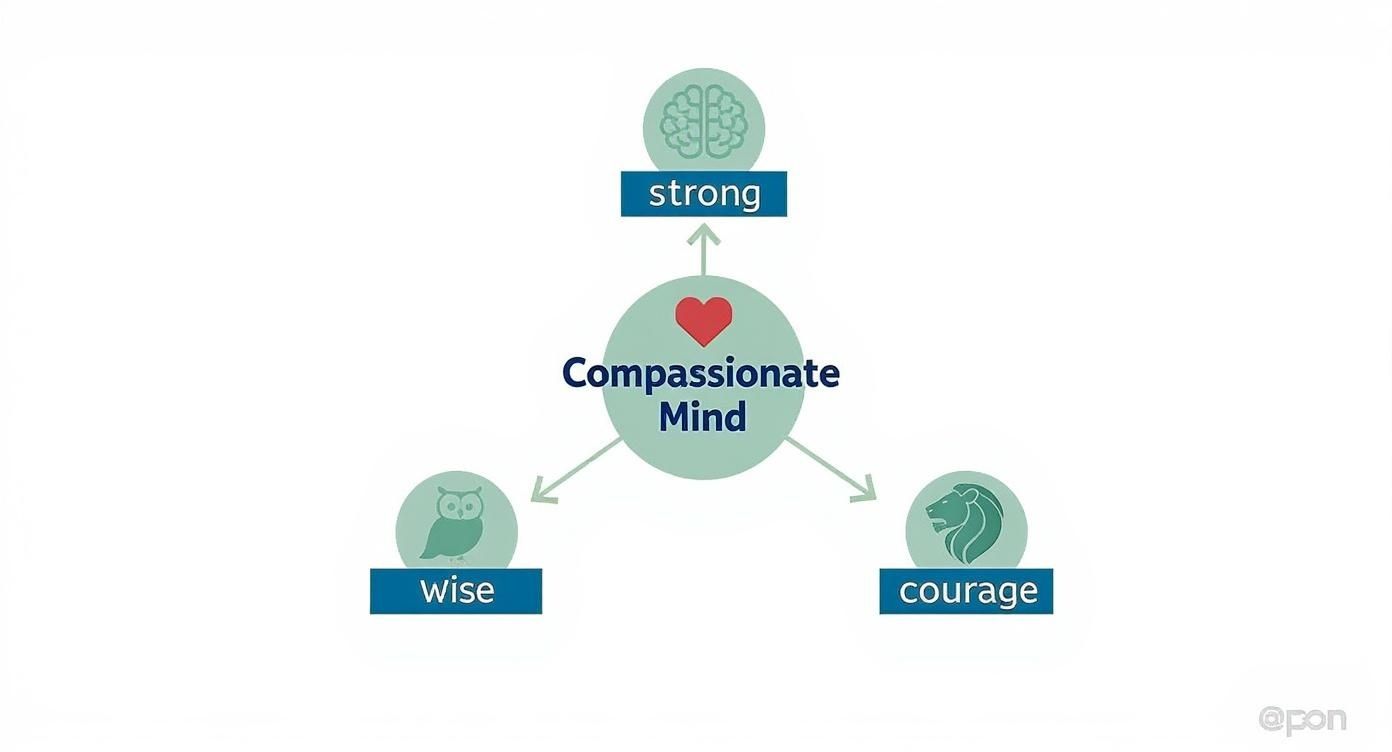
The image here really drives home the point that a truly compassionate stance isn't passive or soft. It’s a powerful combination of strength, wisdom, and courage. These are the qualities that allow us to face life's difficulties with resilience instead of turning away in fear.
The Three Flows of Compassion

When we talk about developing a compassionate mind, it's not a single action but a balanced, flowing system. Think of it less like a switch you flip and more like a circulatory system for kindness. It’s a common mistake to see compassion as a one-way street—something we just give away.
In reality, it needs to flow in three distinct and equally vital directions.
To build a truly resilient inner world, we have to get comfortable with all three flows. If we neglect one, we’re left feeling disconnected, drained, or stuck in a cycle of self-criticism. Understanding these pathways is the key to unlocking a more complete and sustainable way of being.
Giving Compassion to Others
The first flow is the one we all recognise: compassion moving outwards. This is when we notice someone else is struggling, feel moved by their difficulty, and have a genuine wish to help ease their suffering.
It’s that natural instinct to offer a kind word to a stressed-out colleague or to listen without judgement when a friend is going through a tough time. For most of us, this outward flow feels the most comfortable. It connects us to others and reinforces our shared humanity.
But here’s the catch: if this is the only direction our compassion flows, we're on a fast track to burnout. Constantly pouring from our own cup without refilling it leaves us emotionally exhausted.
Receiving Compassion from Others
The second flow is our ability to let compassion in from other people. And for many of us, this is surprisingly tricky. It means being open to accepting kindness, help, and support without brushing it off or feeling like you're being a burden.
When was the last time someone gave you a genuine compliment or offered a helping hand? Was your first instinct to accept it gracefully, or did you minimise it with a quick, "Oh, it was nothing"?
Being able to receive compassion is a skill. It requires us to feel worthy of care and to trust that others genuinely want to support us, strengthening our soothing system through connection.
Learning to let kindness in is a crucial part of the balance. It pushes back against isolation and reminds us we don't have to face life's challenges completely alone.
Turning Compassion Inward
This brings us to the third and often most challenging flow: self-compassion. This is the art of directing the same warmth, wisdom, and support you’d offer a dear friend towards yourself, especially when you're struggling, feeling inadequate, or have made a mistake.
So why is this so hard? Our brains are often wired for self-criticism. It’s a faulty, old survival strategy—a misplaced attempt to "motivate" ourselves and stay safe in the pack. We worry that being kind to ourselves is just letting ourselves off the hook.
In reality, the opposite is true. Self-compassion builds the secure emotional foundation we need to face difficulties with courage and to learn from our failures without being crushed by them.
To cultivate a truly compassionate mind, all three flows need your attention. This means practicing:
- Giving to Others: Noticing suffering and offering support, but in a way that’s sustainable.
- Receiving from Others: Allowing yourself to be cared for and accepting kindness without guilt.
- Giving to Yourself: Treating yourself with understanding and warmth, right when you need it most.
Mastering this three-way current is what transforms compassion from an occasional act into a consistent, life-affirming way of being. It’s the integrated practice that ultimately brings balance to our emotional systems and builds lasting resilience.
How to Build Your Compassionate Mind

It’s one thing to understand the theory behind the three emotional systems and the flows of compassion, but it’s in the doing that real change happens. This is where we move from knowledge to action. Building a compassionate mind isn’t a passive process; it’s a skill you can strengthen with consistent, gentle effort.
Here, we’ll walk through three foundational techniques from Compassionate Mind Training. These aren't complicated or time-consuming rituals. They are simple, powerful ways to consciously activate your soothing system, dial down your threat response, and begin to change your relationship with that inner critic.
Think of it like learning a new internal language. It might feel a bit clunky or unfamiliar at first. But with repetition, you start carving out new neural pathways, making kindness and self-support your new default response. Let's start with a technique that anchors us right here, right now, using the simple power of our own breath.
Soothing Rhythm Breathing
One of the quickest ways to tap into your soothing system is by intentionally changing the rhythm of your breath. Soothing Rhythm Breathing is a straightforward, portable technique you can use anywhere to ground yourself and send a clear signal of safety to your nervous system.
The goal is simple: breathe slowly, smoothly, and gently. You’re aiming for a rhythm that feels inherently calming and supportive. This provides a direct antidote to the short, shallow breathing that so often kicks in when we feel threatened or stressed.
Here’s how to get started:
- Find a Comfortable Position: Sit upright in a chair, feet flat on the floor, spine straight but not rigid. You can gently close your eyes or just lower your gaze.
- Slow Your Breathing: Start to breathe a little more slowly and deeply than you normally would. Focus on making the breath flow in and out smoothly, without any strain.
- Find Your Rhythm: Aim for a pace that feels comfortable for you. A good starting point is breathing in for a count of four and out for a count of six. That slightly longer out-breath is key, as it helps activate the parasympathetic nervous system—the body's "rest and digest" mode.
- Adopt a Gentle Expression: Allow a gentle, faint smile to form on your face. It's a small physical shift, but it can signal warmth and kindness back to your brain.
- Continue for a Few Minutes: Stick with this for three to five minutes, focusing completely on the soothing sensation of your breath moving through your body.
Developing Your Compassionate Self
Your compassionate self is like your ideal inner coach—an internal figure that embodies wisdom, strength, and unwavering warmth. This exercise uses visualisation to create and connect with this powerful internal ally.
This isn’t about inventing some perfect, flawless being. It’s about imagining the version of yourself you’d ideally want to be: wise, strong, caring, and completely non-judgemental.
Creating your compassionate self gives you a concrete internal resource to turn to when your inner critic is loud or you're feeling overwhelmed. It’s the wise and supportive part of you, ready to offer guidance.
To begin, use your Soothing Rhythm Breathing to get settled. Then, bring to mind the qualities you'd want in a perfect mentor. What would their voice sound like? What expression would they have on their face? Hold this image and feeling in your mind, connecting with their supportive presence.
Compassionate Letter Writing
Our final exercise, compassionate letter writing, is a potent way to directly challenge self-criticism and reframe that internal dialogue. It involves writing a letter to yourself, but from the perspective of your compassionate self, addressing a specific struggle or something you're feeling critical about.
This practice helps you step outside your own head for a moment and see your situation with the kindness you would so naturally offer a good friend. It’s a tangible way to practise turning that compassion inward.
The steps are beautifully simple:
- Identify Your Struggle: Think of something you’re currently judging yourself for—a mistake you made, a perceived flaw, or a difficult situation you're in.
- Embody Your Compassionate Self: Take a few soothing breaths and connect with the feeling of your compassionate self. Call up its wisdom, strength, and warmth.
- Write the Letter: From this compassionate perspective, write a letter to yourself. Acknowledge the pain and difficulty of the situation without judgement. Express understanding, kindness, and genuine encouragement.
- Read It Aloud: Once you’ve finished, read the letter back to yourself. Really let the kind and supportive words land.
These exercises are more than just techniques; they are invitations to cultivate a whole new way of being with yourself. UK-based research into Compassionate Mind Training has shown clear benefits, with participants reporting significant improvements in self-compassion and wellbeing, alongside reductions in self-criticism. Crucially, after an 8-week programme, these positive changes were still present at a 3-month follow-up, highlighting just how fundamental self-compassion is to our psychological health.
As you develop your compassionate mind, it's also helpful to explore skills like communicating without rage bait to foster more positive interactions with others. For those ready to dive deeper with guided practices, exploring an online self-compassion course can provide structured support for your journey.
Overcoming Common Roadblocks to Compassion
Starting the journey to build a compassionate mind often stirs up some unexpected internal resistance. This is completely normal. As you begin these practices, you might find yourself bumping up against fears, doubts, and old beliefs that seem to fight the very idea of self-kindness.
This pushback isn't a sign you're doing something wrong. It's just your brain's old wiring, particularly your threat system, doing what it has always done: trying to keep you safe with familiar (if painful) strategies like self-criticism. Think of this section as a troubleshooting guide for your mind, helping you navigate these common roadblocks with understanding and gentleness.
Debunking Common Myths About Self-Compassion
Many of us carry some deep-seated myths about what being compassionate to ourselves really means. These misunderstandings can act as powerful barriers, so let's dismantle them one by one.
- Myth 1: "Self-compassion is selfish." This is a really common worry, but true compassion is inclusive. When you build up your own inner resources of strength and care, you’re actually in a much better position to show up for others without burning out.
- Myth 2: "It's just letting yourself off the hook." This is perhaps the biggest misconception of all. Self-compassion isn't about ignoring your mistakes; it’s about creating the psychological safety you need to acknowledge them, learn from them, and take responsibility without being crushed by shame. You can explore more on how compassion helps you heal from the painful cycles of shame and self-criticism in our detailed article.
- Myth 3: "It will make me weak or lazy." Lots of people fear that if they stop being so hard on themselves, they’ll lose their motivational edge. In reality, motivation rooted in self-criticism is driven by fear, which is brittle and exhausting. Compassion, on the other hand, fuels motivation through a desire for wellbeing—a far more sustainable and resilient source of strength.
Why We Fear Losing Our Critical Edge
The fear of losing your inner critic can feel surprisingly real. For years, that harsh inner voice may have been your primary motivator, pushing you to achieve and avoid failure. It can feel like a fierce, protective guard dog.
The problem is, this guard dog often bites its owner. It creates a constant backdrop of stress and anxiety, making it impossible to feel truly at ease. The goal isn’t to get rid of the guard dog entirely, but to retrain it. By developing your compassionate mind, you're not abandoning your standards; you're cultivating a wiser, stronger, and kinder coach to help you meet them.
A compassionate mind doesn't say, "It doesn't matter that you failed." It says, "It's understandable that you're hurting because this mattered to you. Let's figure out how to move forward with wisdom and courage."
It’s all about shifting from motivation-by-fear to motivation-by-care. Interestingly, our capacity for compassion can be shaped by our environment. A 2019 national survey in Britain measured compassion across different demographics, revealing that factors like age, gender, and region can influence our compassionate tendencies. This shows just how much our surroundings can shape these internal skills.
By understanding these common fears and myths, you can meet your internal resistance not with more criticism, but with the very quality you are trying to cultivate: compassion itself. This gentle persistence is the key to moving past these roadblocks and fully committing to the practice.
Continuing Your Compassionate Mind Journey
Developing a compassionate mind isn’t a one-and-done task you can tick off a list. Think of it more as an ongoing practice, a continuous path of learning to meet your inner world with warmth, strength, and wisdom, especially when things get tough. It's about a lifelong commitment to nurturing your inner resources.
To keep this practice alive, it really helps to hold the core ideas gently in mind. Remember the delicate dance between your three emotional systems: threat, drive, and soothing. The whole point is to intentionally strengthen that soothing system. A well-tended soothing system is what helps calm our threat-based anxieties and balances our relentless, drive-based striving, bringing a much-needed sense of inner harmony.
It's the same with the three flows of compassion: giving it to others, being able to receive it, and, crucially, turning it inwards towards yourself. These aren't separate skills; they all feed each other. When you can do all three, you create a resilient, upward spiral of connection and care in your life.
Finding Further Support and Resources
As you walk this path, having a guide you can trust makes all the difference. Luckily, there are some brilliant resources out there, many coming directly from the pioneers of Compassion Focused Therapy.
Here’s a hand-picked list to help you take the next step:
- Essential Reading: The books by Professor Paul Gilbert, the founder of CFT, are the absolute best place to start. Pick up a copy of The Compassionate Mind or Living Like Crazy for profound, yet accessible, insights straight from the source.
- Trusted Organisations: The Compassionate Mind Foundation is a UK-based charity and the central hub for everything CFT. Their website is a goldmine of information, training events, and resources for anyone serious about this work.
- Finding a Therapist: If you're wrestling with a harsh inner critic, anxiety, or the weight of past trauma, working with a professional can be life-changing. It's worth looking for therapists specifically trained in Compassion Focused Therapy (CFT), as they'll have the specialised skills to guide you with real expertise.
Remember, the aim isn't perfection but practice. Every moment you choose a compassionate response over a self-critical one, you are strengthening the neural pathways of your compassionate mind and investing in your long-term wellbeing.
Here is the rewritten section, crafted to align with the provided human-written examples and instructions.
Some Common Questions That Come Up
As you start exploring what it means to have a compassionate mind, it's completely natural for some practical questions to pop up. This whole practice can challenge some very old, ingrained beliefs we hold about ourselves and what motivates us, so getting clear answers can make all the difference.
Let's look at a few of the most common queries I hear from people.
How Is Self-Compassion Different from Self-Esteem?
This is a really important one to get clear on.
Think of self-esteem like a fair-weather friend. Its presence often depends on how well you're doing – your recent successes, how you think you measure up against others. It’s conditional, which makes it incredibly fragile. It’s there when you win, but it vanishes the moment you stumble.
Self-compassion, on the other hand, is unconditional. It doesn’t give a toss about your performance or whether you’ve got things right. It's a steady, internal resource that offers you kindness precisely when you do fail or feel you’re not good enough. It meets your struggle with understanding, not judgement.
Self-esteem asks, "Am I better than others?" Self-compassion asks, "How can I be kind to myself in this moment of suffering?" This fundamental difference makes self-compassion a far more reliable source of inner strength.
Building a compassionate mind is all about nurturing this unwavering internal ally, making sure you have that support when you need it most, regardless of what's happening on the outside.
How Long Does It Take to Notice Changes?
Cultivating a compassionate mind is a practice, not a quick fix. There's no set timeline; everyone’s journey is different, shaped by their own history and how consistently they engage with the practices. It’s much more like tending a garden than flipping a switch. It needs patience and gentle repetition.
That said, you don’t have to wait years to see the benefits. Research shows that with consistent daily practice of foundational exercises, like Soothing Rhythm Breathing, many people report feeling a subtle but real shift within just a few weeks.
You might first notice a greater sense of calm, or that your inner critic is just a little bit quieter. These small changes are the first signs that you're successfully building new, kinder neural pathways.
Can These Exercises Help with Anxiety or Depression?
Absolutely. In fact, Compassion Focused Therapy (CFT), where these principles come from, was specifically designed to help people struggling with high levels of shame, self-criticism, anxiety, and depression.
By activating the body’s own soothing system, these practices directly counteract the threat-based physiology that fuels so much anxiety.
For those dealing with depression, learning to generate self-warmth and kindness provides a powerful antidote to the harsh, self-attacking thoughts that can keep low moods stuck in a loop. So yes, this guide is a brilliant place to start.
However, it's vital to know the limits of self-guided work. If you're facing severe or long-standing mental health challenges, these exercises are most effective—and safest—when practised alongside a trained therapist who can offer tailored support.
If you're ready to move beyond self-criticism and build a stronger, kinder relationship with yourself, Dr Chris Irons offers expert guidance through therapy, coaching, and professional training. Begin your journey toward a more compassionate life at https://drchrisirons.com.