Anxiety can feel like a relentless storm, leaving you feeling overwhelmed and disconnected. It might manifest as a racing heart during the day or a whirlwind of thoughts that prevent you from sleeping soundly. If you frequently struggle with nocturnal worries, learning practical ways to calm anxiety at night is paramount for achieving restorative sleep and overall peace. But what if you had a toolkit of compassionate strategies to help you find your anchor anytime, day or night?
This guide explores ten powerful self-soothing techniques for anxiety, grounded in psychological science and the principles of Compassion Focused Therapy. Each technique is designed not to fight or eliminate anxiety, but to gently guide your nervous system back to a state of safety and calm. We will move beyond generic advice, offering clear, step-by-step instructions for each method, explaining precisely why it works, and helping you discover which ones resonate most deeply with your personal needs.
Our goal is not to declare war on anxiety, but to build a kinder, more supportive relationship with your own mind. By learning to self-soothe with intention and self-kindness, you can develop the skills to navigate emotional storms with greater resilience and a profound sense of inner stability.
1. Deep Breathing Exercises
Deep breathing is a cornerstone among self-soothing techniques for anxiety because it directly influences your body's physiological stress response. When you feel anxious, your sympathetic nervous system activates its "fight or flight" mode, leading to a rapid heart rate and shallow breathing. By intentionally slowing your breath, you engage the parasympathetic nervous system, signalling to your brain and body that the threat has passed and it is safe to relax.
This simple act of conscious breathing can lower your heart rate, reduce blood pressure, and decrease levels of the stress hormone cortisol, offering immediate relief. It is a powerful, accessible tool you can use discreetly at any time, in any place.
How to Practise Deep Breathing
A well-known and effective method is Box Breathing, often utilised by first responders for its simplicity and power.
- Find a comfortable position, either sitting upright or lying down. Place one hand on your belly.
- Inhale slowly through your nose for a count of four, feeling your belly expand.
- Hold your breath for a count of four.
- Exhale slowly through your mouth for a count of four.
- Hold your breath again for a count of four before repeating.
A compassionate approach: It’s okay if your mind wanders or you can't hit the counts perfectly at first. The intention is not to achieve perfection, but to gently guide your attention back to your breath. Each breath is a small act of kindness towards your anxious self.
When and How to Use It
Use this technique: When you feel the first signs of panic, are stuck in a stressful meeting, or need to ground yourself before a difficult conversation.
Practical tips:
- Practise when calm: Build the skill when you're not in distress, so it becomes second nature.
- Focus on the exhale: Making the exhale slightly longer than the inhale can deepen the relaxation response.
- Use reminders: Set an alarm on your phone to take a few deep breaths every hour.
2. Progressive Muscle Relaxation (PMR)
Progressive Muscle Relaxation (PMR) is a highly effective self-soothing technique for anxiety that involves systematically tensing and then releasing different muscle groups. Anxiety often manifests as physical tension; PMR teaches you to recognise this tension and consciously let it go. By focusing on the profound difference between a tensed muscle and a relaxed one, you can directly interrupt your body's physical stress cycle and ground yourself in the present moment.
This mind-body practice, developed by Dr. Edmund Jacobson, provides tangible relief from the physical symptoms of anxiety. It helps reduce muscle tightness, lowers blood pressure, and promotes a state of deep physical calm, which in turn soothes the mind.
How to Practise Progressive Muscle Relaxation
This technique guides you through a full-body scan of tension and release.
- Find a quiet space where you can lie down comfortably without interruptions.
- Start with your feet. Tense the muscles in your feet and toes, curling them tightly for 5-10 seconds.
- Release the tension completely and notice the feeling of relaxation for 20-30 seconds.
- Move up your body, systematically tensing and releasing each major muscle group: calves, thighs, buttocks, abdomen, hands, arms, shoulders, neck, and face.
- Focus on the contrast between the sensation of tension and the subsequent feeling of release.
A compassionate approach: There is no "right" way to feel relaxed. Simply notice the sensations without judgement. If a muscle group is sore or injured, skip it. This practice is about listening to your body with kindness, not forcing it to perform.
When and How to Use It
Use this technique: Before bed to help with anxiety-related insomnia, during a lunch break to release accumulated stress, or whenever you feel physical tension building up.
Practical tips:
- Start small: If a full-body scan feels daunting, begin with just your hands, shoulders, and face.
- Use guided audio: Apps like Calm or Insight Timer offer guided PMR sessions that can be very helpful.
- Listen to your body: Avoid tensing any area where you have an injury or pain. Consult a doctor first if you have any concerns.
3. Mindfulness Meditation
Mindfulness meditation is a foundational self-soothing technique for anxiety that involves focusing on the present moment. Instead of fighting or suppressing anxious feelings, you learn to observe your thoughts, emotions, and bodily sensations from a distance, without judgement. This practice helps you unhook from the cycle of worry, realising that thoughts are just mental events, not facts.
By consistently practising mindfulness, you can actually change your brain's structure and activity. It strengthens neural pathways associated with emotional regulation and weakens those tied to the stress response. This means you become less reactive to anxious thoughts and better equipped to handle them when they arise. It is a gentle yet profound way to cultivate inner calm.
How to Practise Mindfulness Meditation
A simple way to begin is with a basic body scan meditation.
- Find a quiet place where you can sit or lie down comfortably.
- Close your eyes and bring your attention to your breath, noticing the sensation of each inhale and exhale.
- Direct your focus to the toes on one foot. Notice any sensations- warmth, tingling, pressure- without judging them.
- Slowly move your attention up your body, from your feet to your legs, torso, arms, and finally to your head, pausing to notice the sensations in each part.
- If your mind wanders, gently acknowledge the thought and guide your focus back to your body.
A compassionate approach: Your mind will wander; that is what minds do. Treat each distraction not as a failure, but as an opportunity to practise gently returning to the present. This act of returning is the core of the practice. Self-compassion is key to building this skill.
When and How to Use It
Use this technique: As a daily practice to build resilience against anxiety, or in moments when you feel overwhelmed by racing thoughts.
Practical tips:
- Start small: Use guided meditations from apps like Calm or Headspace for just 5-10 minutes a day.
- Establish a routine: Practise at the same time each day to make it a consistent habit.
- Find an anchor: Use your breath, a sound, or a physical sensation as a focal point to return to when your mind drifts.
- Don't strive for an empty mind: The goal is not to stop thoughts, but to change your relationship with them.
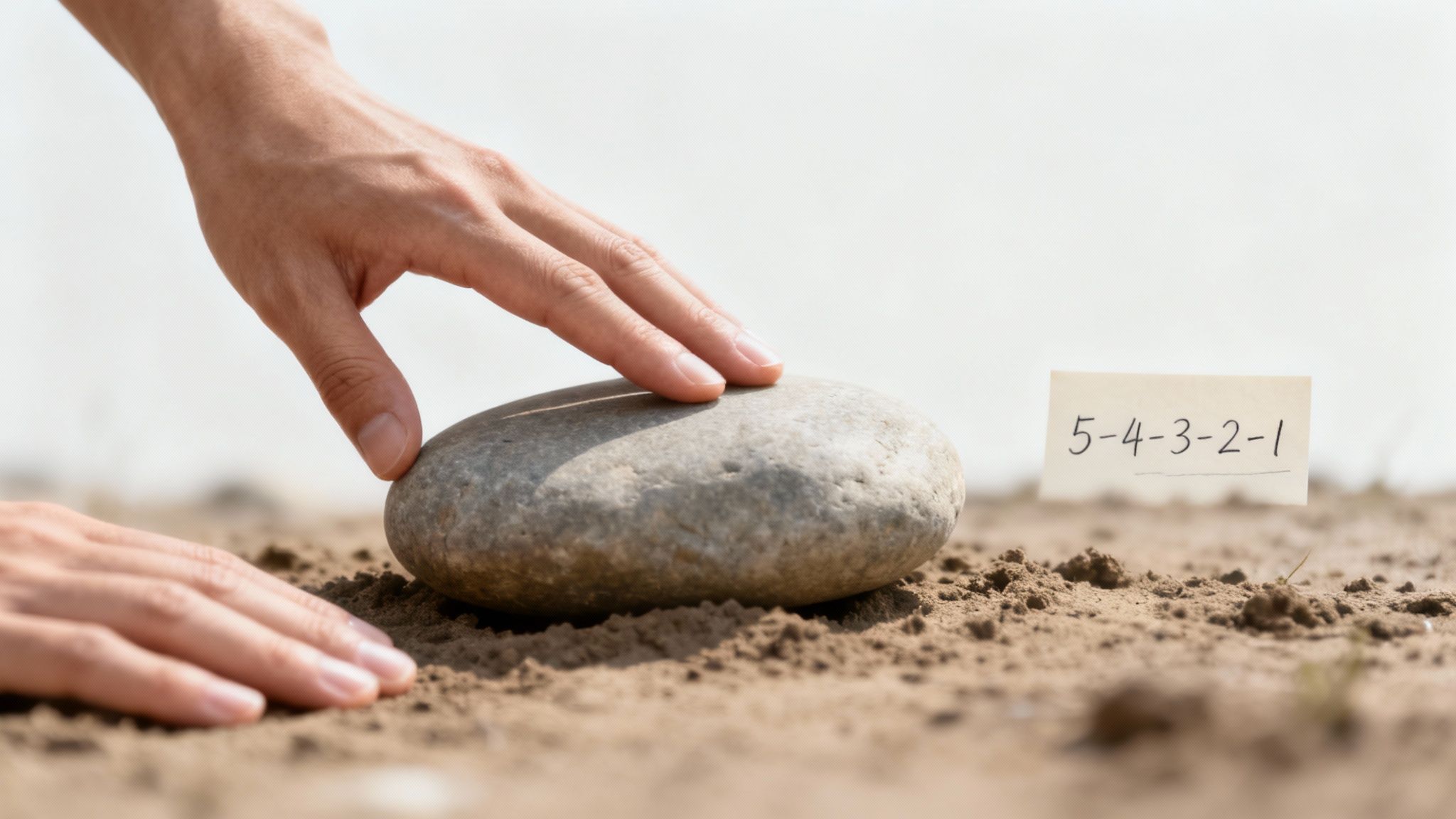
4. Grounding Techniques (5-4-3-2-1 Method)
Grounding is a powerful self-soothing technique for anxiety that pulls your focus away from distressing thoughts and anchors you firmly in the present moment. When you feel overwhelmed by panic or dissociation, your mind can feel detached from reality. Engaging your five senses acts as an immediate circuit breaker, interrupting the anxiety spiral and reconnecting you with your physical environment.
This sensory-based approach is incredibly effective because it bypasses analytical thinking and speaks directly to your body. It is widely used in trauma therapy and by emergency services to help individuals regain a sense of safety and control during moments of intense distress.
How to Practise the 5-4-3-2-1 Method
This technique guides you to notice your surroundings deliberately. Wherever you are, pause and gently identify:
- 5 things you can see: Look around and name five objects in your head or out loud. Notice their colour, shape, and texture.
- 4 things you can feel: Bring your attention to four sensations. It could be the texture of your clothes, the solid ground beneath your feet, or the smooth surface of a table.
- 3 things you can hear: Listen carefully for three distinct sounds. They might be distant traffic, the hum of a computer, or your own breathing.
- 2 things you can smell: Try to identify two scents in your environment, such as coffee, soap, or the smell of rain.
- 1 thing you can taste: Notice one taste. This could be the lingering flavour of your last drink or simply the natural taste inside your mouth.
A compassionate approach: There is no "right" way to do this. If you can't find five things or a particular sense is difficult to access, that is perfectly okay. The goal is simply to redirect your attention with curiosity, not to perform a test. Be gentle with yourself.
When and How to Use It
Use this technique: When you experience a panic attack, feel disconnected or "floaty," are caught in a flashback, or need to quickly stop overwhelming thoughts.
Practical tips:
- Practise when calm: Rehearse the steps when you are relaxed to build muscle memory, making it easier to recall during high-stress moments.
- Engage fully: Don’t just list items; truly notice the details. What shade of green is that leaf? Is the chair you're touching smooth or rough?
- Combine with touch: Enhance the grounding effect by physically planting your feet flat on the floor or pressing your palms onto a solid surface.
5. Journaling and Expressive Writing
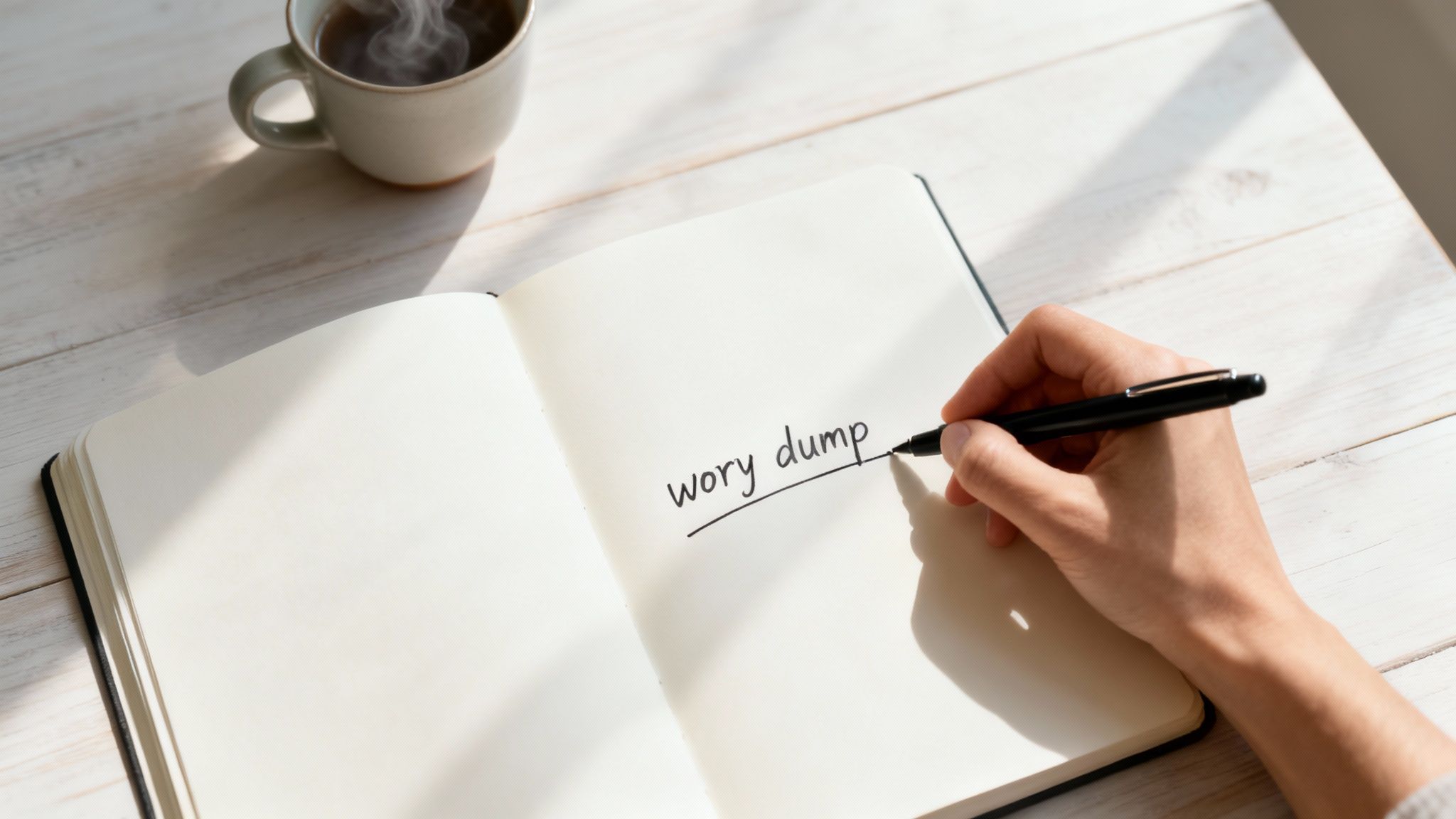
Journaling is a powerful self-soothing technique that externalises anxious thoughts and feelings from your mind onto paper. This act of expressive writing creates psychological distance, allowing you to observe your worries without being consumed by them. Research pioneered by Dr. James Pennebaker shows that writing about emotional experiences can significantly reduce anxiety and improve your overall mood.
It serves as a private, judgement-free space to process complex emotions and untangle the mental knots that anxiety often creates. By giving your worries a physical form, you diminish their power and begin to understand their patterns.
How to Practise Journaling
One simple yet effective method is the Worry Dump, designed for quick emotional release.
- Set a timer for 10-15 minutes. This creates a contained space for your worries, preventing endless rumination.
- Grab a notebook and pen, or open a digital document.
- Write continuously about everything that is making you anxious. Do not stop to edit, censor, or judge your thoughts.
- Keep going until the timer stops. It doesn’t matter if your writing is messy or nonsensical; the goal is release.
- Close the book or file, symbolising that you are setting those worries aside for now.
A compassionate approach: Treat your journal as a compassionate friend who listens without judgement. You are allowed to be scared, irrational, or angry on the page. This is your space to be completely honest with yourself, which is a profound act of self-care.
When and How to Use It
Use this technique: When your mind is racing with "what if" scenarios, before bed to clear your head for sleep, or anytime you feel overwhelmed by a specific worry.
Practical tips:
- Use prompts: If you feel stuck, start with a prompt like, "The main thing on my mind is…" or "Right now, my body feels…"
- Acknowledge patterns: Over time, you may notice recurring themes in your writing. This awareness is the first step towards addressing underlying causes of anxiety.
- Practise self-kindness: Writing can sometimes bring up difficult feelings like shame. Understanding how to work with self-criticism can make this practice even more healing. Explore how to heal from shame and self-criticism with a compassionate approach.
6. Guided Imagery and Visualisation
Guided imagery is a powerful self-soothing technique for anxiety that uses your imagination to transport you to a peaceful and safe environment. Because your brain often responds to vivid imagination similarly to how it responds to real-life experiences, creating a detailed mental sanctuary can directly activate your body's relaxation response. This mental journey helps to shift your focus away from anxious thoughts and physical symptoms.
This technique is frequently used in clinical settings, such as by patients in cancer centres to reduce pre-surgery stress or by athletes to manage performance anxiety. It effectively lowers stress hormones, slows the heart rate, and creates a profound sense of calm by providing a mental escape from immediate stressors.
How to Practise Guided Imagery
You can follow a recorded guide or create your own safe place in your mind.
- Find a quiet, comfortable space where you won't be disturbed. Close your eyes.
- Imagine a place where you feel completely safe and at ease. This could be a sun-drenched beach, a quiet forest, or a cosy room from your past.
- Engage all your senses to make the scene vivid. What colours do you see? What sounds do you hear (waves, birdsong)? What can you smell (salty air, pine trees)? What do you feel (warm sand, a soft breeze)?
- Spend several minutes exploring this place, allowing the feelings of peace and safety to wash over you.
A compassionate approach: Your safe place is yours alone; there is no right or wrong scene to imagine. If distracting thoughts arise, gently acknowledge them without judgement and guide your focus back to the sensory details of your peaceful environment.
When and How to Use It
Use this technique: Before a stressful event, when you feel overwhelmed by worry, or to help you fall asleep when anxiety is keeping you awake.
Practical tips:
- Use audio guides: Apps like Calm or Insight Timer offer a vast library of guided visualisations.
- Engage your senses: The more detailed and sensory-rich your imagery is, the more effective it will be.
- Practise regularly: Like any skill, visualisation becomes easier and more powerful with consistent practice.
7. Physical Exercise and Movement
Physical exercise is one of the most powerful evidence-based, self-soothing techniques for anxiety. It works by directly countering the body's stress response. When you feel anxious, your body is primed for action; movement provides a productive outlet for this nervous energy, helping to metabolise stress hormones like adrenaline and cortisol.
Engaging in physical activity also releases endorphins, the body's natural mood elevators and painkillers, leading to a sense of calm and well-being. Regular movement can improve sleep quality, boost self-confidence, and provide a healthy distraction from cyclical anxious thoughts, making it a cornerstone of long-term mental health management.
How to Practise Physical Movement
The best form of exercise is one you genuinely enjoy and can stick with. You don’t need an intense gym session; even short bursts of activity are beneficial.
- Choose your movement: This could be anything from a brisk walk in the park to dancing in your living room, stretching, or lifting weights.
- Start small: Aim for just 10-15 minutes to begin with. The goal is to make it an easy, achievable part of your routine.
- Pay attention to your body: Notice how your muscles feel, the rhythm of your breath, and the sensation of your feet on the ground. This brings a mindful element to the activity.
- Cool down mindfully: Finish with a few gentle stretches, taking a moment to notice any shift in your physical and emotional state.
A compassionate approach: Your body and energy levels will vary from day to day. On tough days, a gentle stretch is a victory. The goal is not to punish your body but to kindly support your mind through movement. Celebrate the effort, not the intensity.
When and How to Use It
Use this technique: When you feel restless and full of nervous energy, are caught in a loop of worry, or want to proactively boost your resilience against anxiety.
Practical tips:
- Schedule it in: Treat your movement time like an important appointment you wouldn't miss.
- Go outdoors: Exercising in nature has been shown to have additional mood-boosting benefits.
- Find a partner: Exercising with a friend can add social connection and accountability.
- Focus on feeling, not performance: Pay attention to how the movement makes you feel rather than focusing on metrics like speed or distance.
8. Aromatherapy and Essential Oils
Aromatherapy harnesses the power of scent to directly influence your brain's emotional centre. When you inhale the aroma of essential oils, the scent molecules travel through your olfactory nerves to the limbic system, which governs emotion and memory. Scents like lavender, bergamot, and chamomile can trigger a calming physiological response, making this a deeply soothing technique for anxiety.
This ancient practice provides a sensory anchor, drawing your focus away from anxious thoughts and into the present moment. It is an accessible and pleasant way to create a tranquil environment, signalling to your nervous system that it is time to rest and relax.
How to Practise Aromatherapy
One of the simplest ways to start is with an essential oil diffuser, which disperses a fine, scented mist into the air.
- Choose a calming oil such as lavender or chamomile.
- Add water to your diffuser up to the fill line.
- Add 3-5 drops of your chosen essential oil to the water.
- Turn on the diffuser and breathe in the aroma, allowing yourself to focus on the scent.
A compassionate approach: There is no "right" way to experience a scent. Simply notice what you feel without judgement. If an oil doesn’t feel calming to you, that’s perfectly okay. The goal is to find what uniquely soothes you.
When and How to Use It
Use this technique: To create a relaxing atmosphere at home, to wind down before sleep, or during a mindfulness practice like meditation.
Practical tips:
- Start simple: Begin with well-researched oils like lavender or bergamot.
- Create a personal blend: For a personalised touch, you can explore various resources like these 5 DIY Essential Oil Blends You Can Try At Home to incorporate aromatherapy into your routine.
- On-the-go relief: Keep a pre-diluted rollerball applicator in your bag to apply to your wrists when you feel stress rising.
- Patch test first: Always test a new oil on a small patch of skin (diluted in a carrier oil) to check for sensitivity.
9. Cold Water Exposure and Temperature Regulation
Using cold water is a powerful self-soothing technique for anxiety because it creates a strong physiological shift that interrupts intense emotional states. Exposing your face or body to cold water activates the mammalian dive reflex, an innate response that slows your heart rate and redirects blood flow to your core organs. This immediate physical change helps to deactivate the "fight or flight" response, effectively acting as a reset button for your nervous system.
This jolt of cold sensation pulls your focus away from spiralling thoughts and anchors you firmly in the present moment. Popularised in treatments like Dialectical Behaviour Therapy (DBT), this method offers a rapid way to regain control when anxiety feels overwhelming, providing a much-needed circuit breaker for panic.
How to Practise Cold Water Exposure
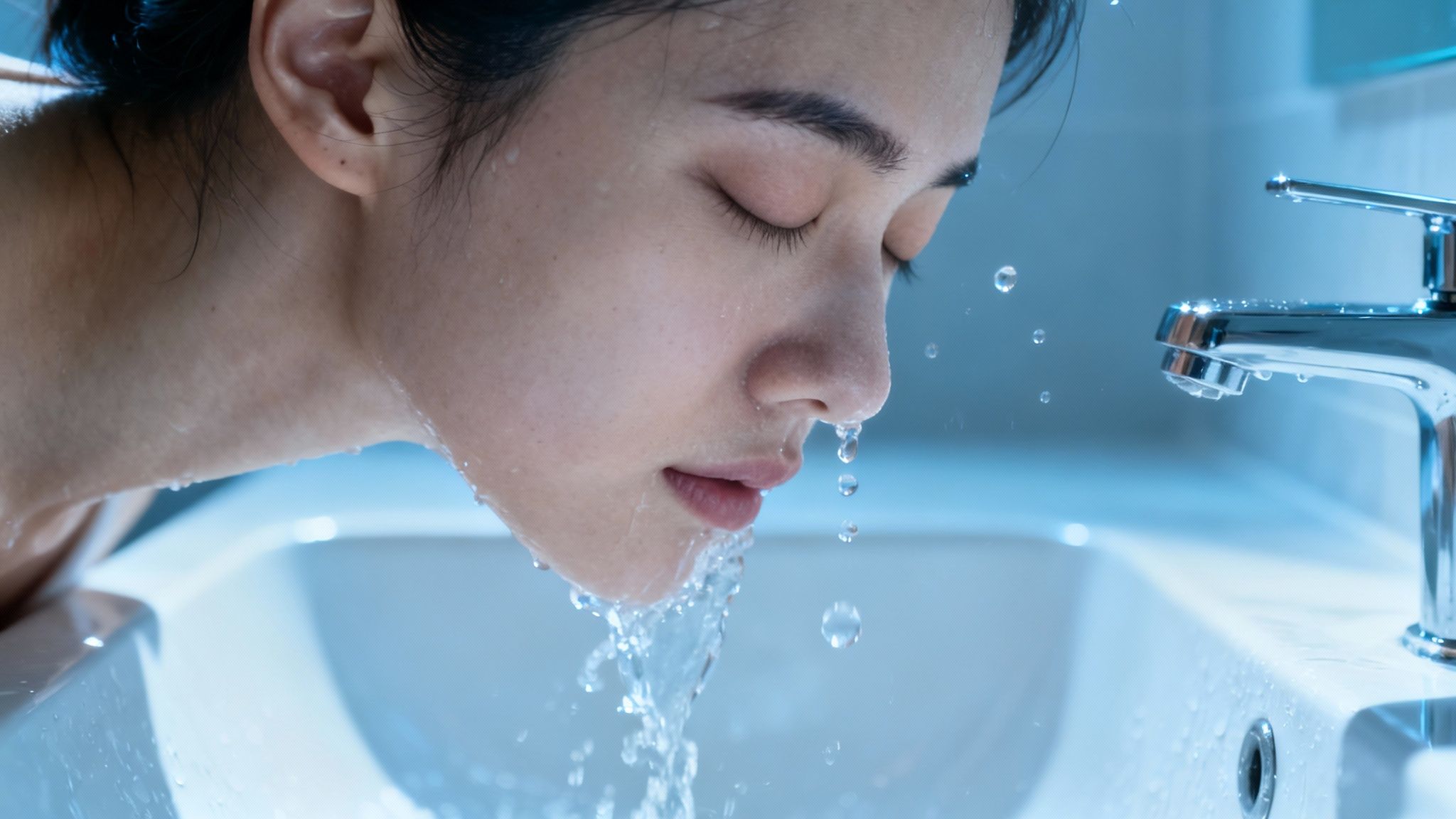
A straightforward and accessible way to start is with the Face Plunge method.
- Fill a bowl or your sink with cold water. You can add a few ice cubes for a stronger effect.
- Take a deep breath and hold it.
- Bend over and submerge your face in the cold water for 15-30 seconds. Focus on the area around your eyes and cheeks.
- Lift your head and breathe normally, noticing the shift in your body.
- Repeat if necessary until you feel a sense of calm.
A compassionate approach: This technique is intense by design. Acknowledge your bravery for trying it. Start with just splashing water on your face if a full plunge feels too much. Your willingness to engage with discomfort is an act of profound self-care.
When and How to Use It
Use this technique: During a panic attack, when you feel emotionally overwhelmed and need an immediate interruption, or when you are stuck in a loop of intense, anxious thoughts.
Practical tips:
- Start small: Begin by holding an ice pack against your face or the back of your neck.
- Safety first: Check with your doctor before trying intense cold exposure if you have a heart condition or other medical concerns.
- Combine with grounding: After the cold exposure, place your feet firmly on the floor to enhance the feeling of stability.
- Practise once when calm: Try it when you are not in distress to understand the sensation and build confidence.
10. Social Connection and Support
Anxiety often thrives in isolation, making social connection a powerful and fundamental self-soothing technique. Humans are inherently social beings, and connecting with others can directly counteract the body's stress response by increasing oxytocin (the “bonding hormone”) and reducing cortisol levels. Feeling seen, heard, and understood provides emotional validation and helps put our worries into perspective.
Engaging with a supportive community reminds us that we are not alone in our struggles. This sense of belonging is a core human need, and fulfilling it acts as a powerful buffer against the overwhelming nature of anxiety. It offers both practical support and the emotional reassurance necessary to feel safe and grounded.
How to Practise Social Connection
Building a support network is a personal journey, but a great starting point is to identify safe and trusted individuals or groups.
- Identify your core support: Think of one or two friends, family members, or a partner you feel comfortable being vulnerable with.
- Reach out proactively: Send a text, make a call, or suggest a low-key activity like a walk or a coffee.
- Explore shared interests: Join a club, a class, or a volunteer group centred around a hobby you enjoy. This creates natural connection points.
- Consider structured support: This could be a peer support group for anxiety, a 12-step programme, or professional therapy.
A compassionate approach: Reaching out when you feel anxious can be incredibly daunting. Be kind to yourself and start small. Sending a simple "thinking of you" message is a valid and courageous first step. The goal isn't to solve your anxiety in one conversation, but to gently remind yourself that connection is possible.
When and How to Use It
Use this technique: When you feel yourself withdrawing, are trapped in a cycle of negative self-talk, or feel overwhelmed by a sense of loneliness.
Practical tips:
- Schedule connection: Don't wait for a crisis. Put regular calls or meet-ups with loved ones in your diary.
- Balance online and in-person: Online communities can be a great, accessible start, but aim for in-person contact when you feel able.
- Seek professional help: A therapist can provide a safe, non-judgmental space to build trust and connection. You can find out more about therapy options to see if it’s right for you.
- Be a good listener: Support is a two-way street. Offering your presence to others also strengthens your own sense of connection.
Top 10 Self-Soothing Techniques Comparison
| Technique | Complexity 🔄 | Resources ⚡ | Expected outcomes 📊⭐ | Ideal use cases 💡 | Key advantages ⭐ |
|---|---|---|---|---|---|
| Deep Breathing Exercises | Low 🔄 (easy to learn) | Minimal ⚡ (none; portable) | Rapid physiological calming; lowers HR/cortisol — ⭐⭐⭐⭐ | Acute anxiety, commute, pre-meeting, panic onset | Immediate, discreet, evidence-based |
| Progressive Muscle Relaxation (PMR) | Moderate 🔄 (15–30 min, guided practice) | Low ⚡ (time; optional audio) | Strong reduction in bodily tension and insomnia — ⭐⭐⭐⭐ | Physical tension, sleep problems, structured relaxation sessions | Systematic body awareness; effective for sleep |
| Mindfulness Meditation | Moderate–High 🔄 (learning curve; regular practice) | Moderate ⚡ (time; apps/teacher helpful) | Long-term emotion regulation and reduced reactivity — ⭐⭐⭐⭐ | Chronic anxiety, worry, emotion regulation, prevention | Neuroplastic benefits; broad mental-health gains |
| Grounding (5-4-3-2-1) | Low 🔄 (very simple to deploy) | Minimal ⚡ (no equipment) | Immediate sensory re-orientation; reduces dissociation/panic — ⭐⭐⭐ | Panic attacks, dissociation, public settings | Fast, discreet, easy for children and adults |
| Journaling & Expressive Writing | Low–Moderate 🔄 (habit formation) | Low ⚡ (pen/notebook or app; time) | Improved insight, reduced rumination with regular practice — ⭐⭐⭐ | Processing emotions, tracking patterns, between-therapy work | Builds self-awareness; inexpensive and private |
| Guided Imagery & Visualization | Moderate 🔄 (practice to vividness) | Low–Moderate ⚡ (quiet space; recordings helpful) | Deep relaxation; creates mental safe place — ⭐⭐⭐ | Pre-event anxiety, surgery prep, sleep onset | Multi-sensory relaxation; customizable safe-place technique |
| Physical Exercise & Movement | Moderate 🔄 (planning, consistency) | Moderate ⚡ (time; optional equipment/community) | Substantial anxiety reduction; improves sleep and mood — ⭐⭐⭐⭐ | Chronic anxiety, prevention, mood improvement, social settings | Multiple health benefits; can match medication-level effects |
| Aromatherapy & Essential Oils | Low 🔄 (simple to use) | Low ⚡ (oils/diffuser; varying cost) | Variable calming effects; modest for many users — ⭐⭐ | Adjunct relaxation, spas, mild acute anxiety | Pleasant, easy to combine with other techniques |
| Cold Water Exposure & Temp. Regulation | Low–Moderate 🔄 (brief but intense; safety caution) | Minimal ⚡ (water/ice access) | Very rapid interruption of panic via dive reflex — ⭐⭐⭐ | Acute panic/distress tolerance, crisis interruption | Immediate physiological reset; highly accessible |
| Social Connection & Support | Moderate 🔄 (requires effort/vulnerability) | Moderate ⚡ (time; access to people/groups) | Strong protective effect; reduces long-term anxiety — ⭐⭐⭐⭐ | Loneliness-driven anxiety, ongoing support, crisis aid | Addresses root causes; offers emotional and practical help |
Integrating Soothing into Your Life
Navigating the turbulent waters of anxiety can feel overwhelming, but as we've explored, you are not without an anchor. This article has guided you through ten powerful self-soothing techniques for anxiety, from the deep, centering calm of diaphragmatic breathing and progressive muscle relaxation to the present-moment awareness cultivated by mindfulness and grounding exercises. Each technique offers a unique pathway back to your centre, a way to signal safety to a nervous system on high alert.
The true power of these practices lies not in their isolated use, but in their integration into the fabric of your life. Think of it less as a list of emergency procedures and more as building a compassionate relationship with yourself. The goal is not to become an expert in all ten methods overnight. Instead, the invitation is to experiment with curiosity and kindness. Which technique resonates most with you? Which one feels most accessible in a moment of rising panic? Building your personal soothing toolkit is a process of discovery.
Building Your Personalised Toolkit
To make these practices truly your own, consider these next steps:
- Start Small and Be Consistent: Choose just one or two techniques that feel most appealing. Perhaps it's the 5-4-3-2-1 grounding method or the simple act of journaling. Practise them for a few minutes each day, especially when you are feeling relatively calm. This builds the neural pathways that make the skill easier to access during times of high stress.
- Create Soothing Cues: Pair a technique with a specific time or place. For example, you might practise deep breathing for two minutes before your first morning coffee or use a specific essential oil on your wrist before a challenging meeting. These cues help create an automatic relaxation response over time.
- Track Your Progress with Compassion: Notice how you feel before and after practising a technique. Don't judge the outcome; simply observe. Some days, a technique will bring immense relief, while on others, its effect might be subtle. This is all part of the learning process. The aim is not perfection but presence.
The Courage to Be Calm
Mastering self-soothing techniques for anxiety is a profound act of self-compassion. It is a declaration that your well-being matters and that you have the internal resources to hold yourself through difficult moments. It's about moving from a state of reacting to your anxiety to responding to it with wisdom and care. This shift doesn't just alleviate momentary distress; it fundamentally changes your relationship with your own mind, fostering resilience, self-trust, and a deeper sense of inner peace.
Remember, this journey is yours alone, but you do not have to walk it by yourself. If anxiety continues to cast a significant shadow over your life, seeking professional guidance is a courageous and powerful step forward. Every effort you make to soothe your anxious mind is a testament to your strength. You are worthy of calm, and you are capable of cultivating it.
If you are looking to deepen your understanding of these practices within the evidence-based framework of Compassion Focused Therapy, explore the resources and professional support available from Dr Chris Irons. Learn how to cultivate a more compassionate mind and build lasting resilience at Dr Chris Irons.