Mindful movement meditation is simply the practice of tuning into your body’s physical sensations as you move, connecting them with how you’re feeling emotionally. It’s not about performance or hitting fitness goals. Instead, the real focus is on building a kinder, more attentive relationship with yourself. This approach helps transform everyday actions—even something as simple as stretching—into moments of genuine presence and self-compassion.
A Kinder Way to Connect with Your Body
Unlike traditional exercise, which often pushes us to focus on external achievements like speed or strength, mindful movement turns our attention inward. The goal isn't to perfect a yoga pose or run a faster kilometre; it’s to simply notice the subtle feelings in your body as you go.
This practice is a cornerstone of Compassion Focused Therapy (CFT) because it offers a direct, physical way to soothe the body's threat system.
When you're wrestling with anxiety, shame, or a harsh inner critic, your body often gets stuck in a state of high alert. Gentle, rhythmic movements can act as a powerful signal of safety to your brain, helping to down-regulate your nervous system and bring a sense of calm.
This internal shift can have profound benefits. A large study in the British Journal of Health Psychology found that just 10 minutes of daily mindful movement led to significant improvements in mental health. Participants saw a 19.2% reduction in depression symptoms and a 12.6% decrease in anxiety. It just goes to show how even brief, consistent practice can create meaningful change. You can explore the full study about these mental wellbeing benefits to learn more.
Mindful Movement vs Traditional Exercise at a Glance
It can be helpful to see the core differences between these two approaches side-by-side. One isn't inherently 'better' than the other; they simply serve different purposes.
| Aspect | Mindful Movement Meditation | Traditional Exercise |
|---|---|---|
| Primary Focus | Internal awareness and the mind-body connection. | External performance, strength, and endurance. |
| Goal | Cultivating self-compassion and emotional regulation. | Achieving fitness targets (e.g., speed, weight lifted). |
| Pacing | Self-guided and gentle, listening to the body's cues. | Often structured and goal-driven, pushing physical limits. |
| Mindset | Non-judgmental curiosity and acceptance. | Competitive and achievement-oriented. |
| Benefit | Reduces stress, calms the nervous system, builds self-trust. | Improves cardiovascular health, builds muscle, increases stamina. |
Ultimately, mindful movement is about how you move, not just that you move. It’s a shift from 'doing' to 'being'.
Shifting from Judgment to Curiosity
The real heart of this practice lies in swapping self-judgment for gentle curiosity. So, instead of thinking, "Am I doing this stretch correctly?" you might gently ask yourself, "What does this sensation actually feel like in my shoulder?" This shift is absolutely crucial for anyone who struggles with self-criticism.
By paying attention to your body without a critical lens, you begin to rebuild trust and foster a much-needed sense of safety within yourself. This process is fundamental to developing what we call the compassionate self, a core concept you can learn more about in our guide to self-compassion. It's about embodying qualities like kindness and wisdom through your physical actions.
Mindful movement meditation teaches you to listen to your body's quiet wisdom rather than the loud demands of your inner critic. It's about 'being with' your body, not just 'using' it.
This approach helps in a few key ways:
- It grounds you in the present moment, pulling you out of those anxious thought loops about the past or future.
- It cultivates non-judgmental awareness, letting you observe sensations and emotions without the pressure to immediately fix or change them.
- It activates the soothing system, which is our body's natural antidote to feelings of threat and shame.
By bringing mindful movement into your life, you aren't just exercising your body; you're training your mind to be a kinder, more supportive companion on your journey.
So, how do you actually do this?
Getting started with a mindful movement practice is much less complicated than it sounds. You don’t need any special gear or a perfectly quiet studio; all you really need is a willingness to pay attention to your own body with a bit of kindness and curiosity. The whole point is to shift out of that mental autopilot we all live on and turn simple, everyday actions into moments of genuine self-compassion.
It's a powerful way to hit the pause button on the body's threat response. When we're stuck in a loop of shame or anxiety, our bodies are primed for danger. Mindful movement gently shows our nervous system that we're safe.
This simple diagram captures the essence of it—moving from a state of threat to a sense of soothing calm.
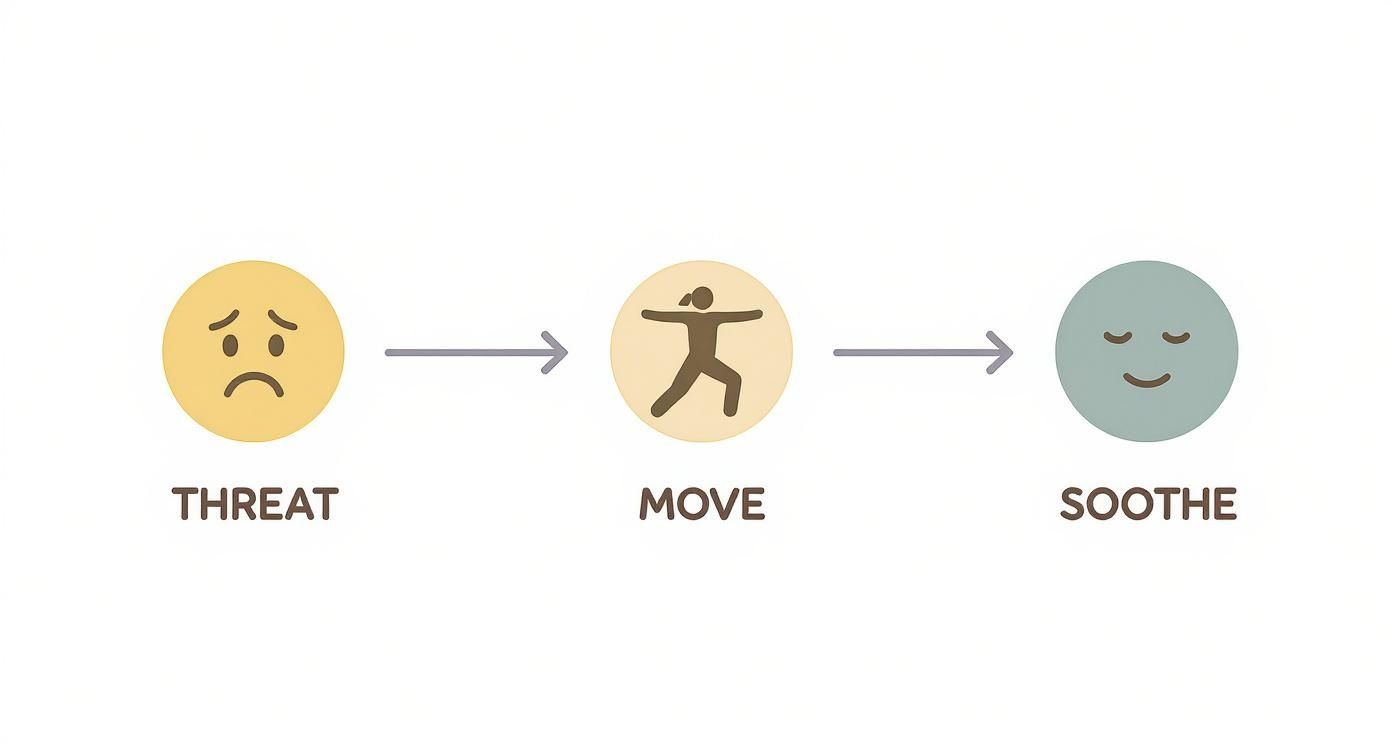
Think of that intentional movement as a bridge, guiding you away from the turbulent waters of anxiety and back to the solid ground of safety and regulation.
Mindful Walking Practice
Mindful walking is probably the easiest way to dip your toe in. You can do it literally anywhere—across a park, on your way to the shops, or even just pacing up and down your hallway. It’s not about getting somewhere; it’s about experiencing the journey of each and every step.
Here’s a simple way to begin:
- Find Your Pace: Just start walking at a speed that feels natural. There’s no right or wrong way, so forget about performing.
- Tune into Sensations: Bring your awareness right down into your feet. Can you feel your heel making contact with the ground? The way your weight rolls through the sole of your foot to your toes? The final push as you lift off?
- Feel the Rhythm: Notice the gentle swing of your arms, the rhythm of your breath. Can you feel your chest and belly expand and contract as you breathe?
- Acknowledge Distractions: Your mind will wander. That’s what minds do. When it happens, just gently and kindly bring your attention back to the physical feeling of walking. Every time you do this, you’re strengthening that muscle of awareness.
The goal isn't to empty your mind. It's about compassionately returning to your body, over and over again, each time your thoughts carry you away. Each step is an anchor to right here, right now.
Gentle Yoga for Self-Compassion
This little flow is designed to help you build a kinder, more compassionate connection with your body. It's especially helpful if you find yourself wrestling with that inner critic. The movements are slow, deliberate, and all about what feels good to you, not what a pose is “supposed” to look like.
Find a comfortable spot on the floor and give this a try.
- Child's Pose: Start on your hands and knees. Gently sink your hips back towards your heels and let your forehead rest on the floor. Take a few deep breaths right into your back, feeling it expand. Hang out here for about five slow breaths.
- Cat-Cow Stretch: Come back up to all fours. As you inhale, let your belly drop and lift your gaze (Cow). As you exhale, round your spine up towards the ceiling and tuck your chin (Cat). Just move between these two poses, letting your breath guide the movement. Be curious about the sensations.
- Gentle Seated Twist: Sit up with your legs crossed. Place your right hand on the floor behind you and your left hand on your right knee. Inhale to sit up tall, and as you exhale, gently twist to the right. Hold for three breaths, then slowly repeat on the other side. Just notice the stretch without judging it.
If you’re looking for a more structured practice that focuses on this kind of internal awareness—rather than just mindlessly cranking out reps—you might find beginner Pilates really valuable. It’s another brilliant way of understanding your body's mechanics with Pilates and connecting with yourself.
Chair-Based Mindful Movement
This one’s perfect for the office, for those with limited mobility, or for any time you just can’t get down on the floor. It really shows that you can practise this anywhere, even sitting down.
- Seated Spinal Roll: Sit tall in your chair, feet flat on the floor. On an exhale, slowly round your spine, tucking your chin towards your chest. On an inhale, gently reverse the movement, arching slightly and lifting your chest.
- Mindful Shoulder Rolls: Breathe in as you lift your shoulders up towards your ears. Breathe out as you roll them back and let them drop down. See if you can feel any tension melting away.
- Foot and Ankle Awareness: Slowly lift one foot off the floor and gently circle your ankle, first one way, then the other. Really pay attention to the subtle, intricate sensations in those small joints.
Remember, a little goes a long way. A survey by Mindful Leader found that 56.6% of people who meditate in the UK do it daily, and for 41.7% of them, sessions are just 10-20 minutes long. Many of them weave in simple movements just like these.
The key is consistency, not duration. By sprinkling these short practices into your day, you start building a profoundly more compassionate and grounded relationship with yourself.
Using Movement in Compassion Focused Therapy

It just makes sense that mindful movement would be a natural partner to Compassion Focused Therapy (CFT). After all, CFT is grounded in understanding our evolutionary wiring, particularly our three core emotion regulation systems: threat, drive, and soothing.
When you’re caught in a loop of anxiety, shame, or harsh self-criticism, it's a sure sign your threat system is working overtime. This keeps your body physically tense, your heart racing, and your mind spinning out. Mindful movement meditation gives us a direct, body-based way to push back and intentionally activate the soothing system.
Gentle, rhythmic motion is one of the quickest ways to send signals of safety to the brain, which in turn helps to settle the entire nervous system. Instead of just thinking about being compassionate, you’re physically embodying it.
Embodying the Compassionate Self
A central idea in CFT is the cultivation of our 'Compassionate Self'—that inner part of us that embodies qualities like strength, wisdom, and genuine kindness. The trouble is, these can feel like vague, abstract concepts when we're struggling. Mindful movement makes them tangible.
For instance, a slow, deliberate stretch can feel like a direct act of kindness towards a tight, sore muscle. Standing with a grounded, stable posture can help you physically connect with a sense of your own inner strength. The practice pulls compassion out of the realm of ideas and plants it firmly in lived, physical reality.
By simply paying gentle attention to your body as it moves, you are actively practising the core components of compassion: noticing suffering (like tension or discomfort), being moved by it, and then taking wise action to help (by moving in a kind, soothing way).
Clinical Notes for Therapists and Coaches
For those of us working with clients, introducing mindful movement can be a complete game-changer, especially for people who get stuck in their heads. When a client can perfectly describe compassion but just can't seem to feel it, these simple exercises can open up a whole new pathway.
Here are a few ways I integrate this into my practice:
- Start small and simple. Introduce a straightforward chair-based shoulder roll or a mindful stretch at the start or end of a session. It’s a great way to help a client get grounded in the room.
- Link it back to CFT concepts. Don't just do the movement; frame it. You could say, "Let's try a little experiment in activating your soothing system," or ask, "What would it feel like to move with strength and kindness right now?"
- Use it for in-the-moment regulation. If a client starts to become overwhelmed by a difficult emotion during a session, a brief moment of mindful movement can help them re-anchor in the present and calm their system down.
For any therapist looking to really deepen their clinical skills in this area, exploring more comprehensive training can provide a solid, structured framework. You can learn more through specialised programmes, such as our https://drchrisirons.com/on-demand-compassion-focused-therapy-training/, which offers in-depth guidance on these practices.
It's also fascinating to see how these mind-body principles are being integrated more widely, for example in the evolving landscape of physical therapy.
Navigating the Bumps in the Road
Embarking on a mindful movement practice is a genuine act of self-kindness, but let's be honest—it isn't always a smooth journey. It’s completely normal to hit a few hurdles. Instead of seeing these challenges as proof that you're 'doing it wrong', we can reframe them as opportunities to practise even deeper compassion for ourselves.

Let’s look at some of the most common difficulties people run into and explore some gentle, practical ways to work with them without adding a layer of judgment. This isn’t about forcing your way through; it’s about learning to respond with supportive wisdom.
The Wandering Mind
One of the first things you'll probably notice is just how incredibly busy your mind is. You start a gentle stretch, fully intending to focus on your body, and within seconds you're planning dinner, replaying a conversation, or stressing about your to-do list.
This isn't a mistake. It’s not a sign of failure. It's simply what minds do.
The trick is to shift your perspective. Don’t get frustrated with yourself for getting distracted. Instead, see each distraction as a chance to gently guide your attention back home to your body.
Each time your mind wanders and you kindly bring it back to the sensation of your feet on the floor or the feeling of your breath, you are strengthening your muscle of compassionate attention. This constant, gentle redirection is the practice itself.
When Difficult Emotions Surface
Mindful movement can sometimes bring difficult feelings bubbling to the surface. As you slow down and tune in, you might suddenly notice a wave of sadness, a spike of anxiety, or a pang of old shame. It can be unsettling, but it’s often a sign that you are creating a safe enough space within yourself for these feelings to finally be acknowledged.
If an emotion feels too intense, remember you are in control. You can always ease off the movement, open your eyes, or take a break. Here are a few ways to ground yourself if things feel overwhelming:
- Focus on Your Feet: Press your feet firmly into the floor. Really feel the solid ground beneath you, supporting your full weight. It’s there for you.
- Feel Your Hands: Gently press your palms together or just rest them on your legs. Notice the warmth and the light pressure of the contact.
- Name Five Things: Look around the room and softly name five things you can see. This simple act pulls your attention back to your external environment and can help dial down the intensity of an internal feeling.
Overcoming Self-Judgment
A very common hurdle is that pesky inner critic who loves to provide a running commentary on your 'performance'. Thoughts like, "Am I doing this right?" or "I'm so inflexible, this is useless" can easily hijack your practice. This is simply the old threat-system habit of self-monitoring and judgment kicking into gear.
Your task is to notice this voice without getting tangled up in its story. Just acknowledge the thought—"Ah, there’s that judging part of my mind again"—and then gently, kindly, redirect your focus back to the physical sensations of the movement itself.
The goal is not to perform a perfect stretch but to be present with your body exactly as it is right now. This compassionate approach transforms your practice from just another task to be completed into a genuine act of self-care and discovery.
Helpful Resources for Your Practice
Sticking with any new practice, including mindful movement, is so much easier when you've got the right support. Thankfully, you don't have to go it alone. There are plenty of modern tools and communities out there to help you stay on track and turn this practice into a reliable, grounding part of your life.
These resources can give you a bit of structure and guidance, which is a massive help on those days when motivation is hard to come by. The trick is to find what genuinely supports you without just adding more digital noise to your day. Let's look at a few options that I've seen work well for people.
Finding the Right Meditation App
Diving into the world of meditation apps can feel a bit much, but many of them have excellent guided sessions for mindful movement. When you're having a look around, try to go beyond the simple timers and find apps that offer specific guidance that actually connects with movement.
Here’s what to look for to make sure an app really supports your practice:
- Guided Mindful Movement: Search for sessions specifically called "mindful walking," "gentle stretching," or "body scan meditation." These are designed from the ground up to keep you connected to physical sensations.
- Offline Access: This one is crucial. Being able to download sessions means you can practise in a park or any quiet spot without needing Wi-Fi, which really helps to cut down on digital distractions.
- Customisable Timers: A good app will let you set your own timers with gentle, soft sounds for when you're practising without guidance. It lets you move at your own pace without a jarring alarm pulling you out of the moment.
For many people, an app is the perfect bridge. It takes you from first learning the practice to feeling confident enough to do it on your own. It's like having a supportive guide right there in your pocket, ready whenever you are.
If you’re specifically weaving this practice into your Compassion Focused Therapy work, using dedicated tools can make a huge difference. For instance, have a look at the features in the official CFT app. It offers exercises that are designed to line up perfectly with the principles we've been talking about, creating a much more cohesive and supportive experience.
The Value of Community
Mindfulness doesn't have to be something you do in isolation. In fact, connecting with other people on a similar journey can be incredibly encouraging. It helps to normalise your experiences and can offer you a fresh perspective when you feel a bit stuck.
Joining a local yoga or Tai Chi class is a fantastic way to get in-person guidance and build that sense of community. If that’s not an option, there are countless online groups and forums dedicated to mindfulness and self-compassion. These digital spaces are great for sharing your struggles and celebrating the small wins with people who just get it.
Finding your tribe, whether it’s in a local hall or an online forum, can truly make all the difference.
Your Questions Answered
When you're new to a practice like mindful movement, it's natural to have questions pop up. It’s all part of the journey. Let's walk through some of the most common ones I hear, so you can feel more at ease as you start exploring this gentle way of connecting with yourself.
What’s the Difference Between Mindful Movement and Regular Exercise?
The real heart of the matter comes down to intention. Think about a typical gym session or a run in the park. The focus is usually on external goals, right? Building muscle, hitting a new personal best, or improving your stamina. It's often about performance and pushing your body.
Mindful movement, on the other hand, flips that completely. The focus shifts entirely inward. Here, the goal isn't performance but presence and self-compassion. It's an invitation to slow down and simply notice what it feels like to be in your body as it moves, without any pressure or judgment. While you might get stronger or more flexible, the primary aim is to nurture your mental and emotional wellbeing.
Can I Do This if I Can't Meditate?
Absolutely. In fact, if you're someone who finds traditional seated meditation a real struggle, mindful movement could be the perfect fit for you. For many of us, trying to sit still just makes the mind race even faster, which can feel incredibly frustrating. This practice gives your mind a gentle, tangible anchor.
Instead of wrestling with a busy brain in silence, you give it something concrete to focus on—the rhythm of your breathing, the feeling of your feet on the floor, the sensation of a simple, easy stretch. It’s still a form of meditation, just one that embraces motion instead of demanding stillness.
Mindful movement is simply meditation in motion. It's an invitation to find stillness and awareness within the movement itself, making it a perfect alternative for those who find sitting still a struggle.
How Often Should I Practise?
There are no hard and fast rules, and that’s a beautiful thing. What matters far more than how long you practise for is consistency. Honestly, starting with just five to ten minutes a day can make a huge difference. The trick is to weave it into the fabric of your day, rather than seeing it as another chore.
A few ideas to get you started:
- Morning Stretch: Before you even get out of bed, take two minutes to stretch with awareness.
- Kettle Break: While you’re waiting for the kettle to boil, do a few gentle shoulder rolls, really feeling the movement.
- First Steps: As you leave the house, pay close attention to the sensation of your first few steps on the pavement.
The key is to start small and find a rhythm that feels good for you. You might find that over time, you naturally want to dedicate more time to longer sessions. The most important thing is to be kind to yourself and let go of any pressure to "get it right".
At Dr Chris Irons, we are dedicated to helping you build a kinder, more compassionate relationship with yourself. Explore our coaching and therapy services to find personalised support for your journey.