When we talk about building emotional resilience, we're really talking about learning how to navigate life's inevitable challenges without getting completely stuck. It's an active process. It means consciously calming your nervous system when you're overwhelmed, changing the tone of your inner dialogue, and learning from setbacks instead of just trying to avoid them.
This isn't some fixed trait you either have or you don't. It's a compassionate practice you can genuinely cultivate over time.
What Emotional Resilience Really Means
Let's clear up a common misunderstanding. Emotional resilience isn't about being tough, stoic, or pretending that difficult things don't affect you. In fact, it's pretty much the opposite.
True resilience is the capacity to feel and process tough emotions—disappointment, stress, sadness, you name it—and move through them without losing your sense of self. It’s the psychological skill of bouncing back from adversity, adapting to change, and actually growing stronger from the experience.
I often think of it like a tree with deep roots. When a storm rolls in, the tree bends and sways, but its deep roots keep it grounded and its flexibility stops it from breaking. A resilient person isn't immune to life's storms; they've just cultivated the inner resources to stay grounded and flexible when things get tough.
The Three Systems of Emotion
A really helpful way to understand how we can build resilience comes from Compassion Focused Therapy (CFT). This approach identifies three core emotional systems that drive our experiences:
- The Threat System: This is our brain's ancient alarm system. It’s hardwired for survival, triggering feelings like anxiety, anger, and fear to alert us to danger. While it's essential, in our modern world, it can easily become overactive and lead to chronic stress.
- The Drive System: This system is all about motivation, pursuit, and achievement. It's what gives us that buzz of excitement and vitality when we're working towards our goals. It’s crucial for getting things done, but if we rely on it too much, it can pave the way to burnout.
- The Soothing System: This is our system of contentment, connection, and calm. It's activated when we feel safe, cared for, and connected to others. Actively engaging this system is the real key to managing our threat system and recovering from stress.
The goal isn't to get rid of the threat system or to stop using our drive system. Far from it. The foundation of resilience is learning how to intentionally activate and strengthen your soothing system. When this system is well-developed, it helps bring the other two into a healthier balance. This allows you to respond to challenges with wisdom and care, rather than with panic or relentless pressure.
Ultimately, developing self-compassion is the key to activating this system, which in turn helps foster both emotional wellbeing and resilience.
The Three Pillars: Awareness, Compassion, and Action
To make this even more practical, we can break resilience down into three core pillars. These are the fundamental skills we'll be building throughout this guide.
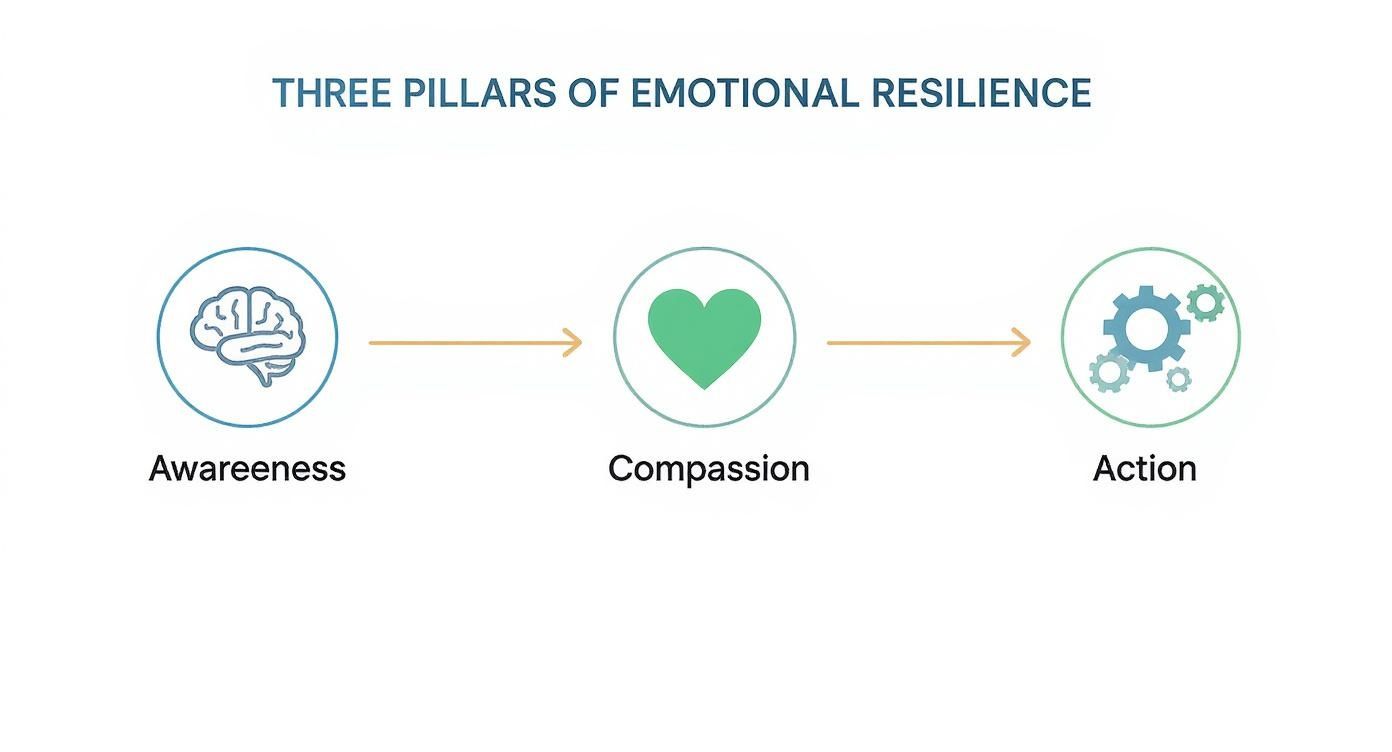
These three pillars—Awareness, Compassion, and Action—form a powerful framework for developing a more resilient mind. They work together as a continuous process.
This simple table breaks down what each pillar involves and why it's so crucial for building resilience.
The Three Pillars of Emotional Resilience
| Pillar | What It Means | Why It Matters for Resilience |
|---|---|---|
| Awareness | Noticing and acknowledging your thoughts, feelings, and bodily sensations without judgement. | You can't change what you're not aware of. This is the starting point for a conscious response. |
| Compassion | Responding to your own struggles with kindness, understanding, and a supportive inner voice. | It calms the threat system, activates the soothing system, and provides the safety needed to face difficulty. |
| Action | Taking thoughtful, wise steps based on your values, even when it's difficult. | This is where you move from insight to real-world change, building confidence and momentum. |
As you can see, resilience is a multi-faceted skill that begins with simply noticing our internal state, responding to what we find with kindness, and then taking thoughtful steps forward. It's a journey, not a destination.
Turning on Your Soothing System
Right, we've got the theory down – the three emotional systems: threat, drive, and soothing. Now it’s time to get practical. The most direct way to build genuine emotional resilience is to learn how to intentionally switch on your soothing system.
Think of it like a muscle. The more you train it, the stronger and more readily available it becomes when you really need it.
This system is your body's built-in foundation for calm, contentment, and a feeling of safety. When it’s active, it releases oxytocin, which is brilliant at counteracting the cortisol pumped out by your threat system. This isn't just a nice idea; it's a real physiological shift that directly dials down feelings of stress and anxiety.
We're going to start with some foundational exercises you can use anytime, anywhere. These aren't complicated, long-winded rituals. They're simple, potent practices designed to bring your nervous system back into balance on demand. They are the absolute bedrock of your resilience toolkit.
Master Soothing Rhythm Breathing
One of the quickest routes into your nervous system is through your breath. When you're stressed, your breathing almost always becomes shallow and quick. By consciously slowing it down, you send a direct signal straight to your brain that says, "It's safe now. You can calm down."
Soothing Rhythm Breathing is a simple but profound way to do this. Unlike some breathing exercises that can feel a bit rigid, this one is all about finding a gentle, comfortable rhythm that works for your body.
Here’s how you can practise it:
- Find a Comfortable Posture: Sit or lie down in a way that feels relaxed. You don't need to be bolt upright like a soldier; just let your body be at ease.
- Slow Down the Exhale: Gently breathe in through your nose for a count that feels natural to you – maybe three or four seconds. Then, breathe out slowly and smoothly, trying to make the exhale just a little bit longer than the inhale.
- Find Your Rhythm: The key isn't some magic number but finding a gentle, flowing rhythm. It might be breathing in for four and out for six, or in for three and out for five. The main thing is to focus on the sensation of slowing down.
- Add a Compassionate Intention: As you breathe, you can quietly say to yourself on the in-breath, "Breathing in calm," and on the out-breath, "Breathing out tension."
A Practical Tip: Look, your mind will wander – that’s what minds do! When it happens, just gently notice where it’s gone without judging yourself. Then, softly guide your attention back to the rhythm of your breath. The goal isn't to force an empty mind, but to practise returning to a calm anchor, again and again.
Just try this for one minute. Notice the subtle shift in your body. This simple act can lower your heart rate and blood pressure, making it a powerful first-aid tool for stressful moments. You can do it before a tricky meeting, when you’re stuck in traffic, or the moment you feel that familiar knot of anxiety starting to form.
Ground Yourself in the Present Moment
When anxiety takes over, our minds are usually spiralling with "what if" scenarios about the future. Grounding techniques are designed to yank your attention out of those anxious thought loops and anchor it firmly in the present moment, where things are often much safer.
A really effective one is the 5-4-3-2-1 method. It simply uses your senses to reconnect you with your immediate surroundings.
- 5: Notice five things you can actually see around you. It could be the colour of the wall, a little crack in the pavement, or the way light is hitting a plant's leaf.
- 4: Acknowledge four things you can feel. This might be the texture of your clothes against your skin, the warmth of your hands, or the solid ground beneath your feet.
- 3: Listen for three things you can hear. Perhaps it's the distant hum of traffic, the whir of a computer, or even just the sound of your own breathing.
- 2: Identify two things you can smell. This one might require you to be a bit more subtle – the scent of your coffee, a nearby perfume, or the clean air after it’s rained.
- 1: Focus on one thing you can taste. You could take a sip of water, notice the lingering taste of toothpaste, or simply become aware of the taste in your mouth right now.
This exercise is brilliant because it interrupts the panic cycle by forcing your brain to focus on concrete, neutral information. It’s a simple, discreet way to find your centre when you feel emotionally swamped.
Visualise a Compassionate Colour
Imagery is a seriously powerful tool. Our brains often respond to imagined scenarios as if they were real. The Compassionate Colour exercise uses visualisation to deliberately bring up feelings of warmth, safety, and kindness, directly stimulating your soothing system.
First, think of a colour that you associate with compassion, wisdom, and strength. There's no right or wrong answer here; it could be a warm, golden yellow, a soft, gentle blue, or a deep, earthy green. Whatever feels right for you.
Next, find a quiet moment and give this a go:
- Close your eyes and start with a few rounds of soothing rhythm breathing.
- Imagine your chosen compassionate colour filling the space all around you.
- Now, visualise this colour flowing into your body with each in-breath, as if you're breathing in pure kindness and warmth.
- Imagine the colour filling your chest, then flowing down into your stomach, and spreading out through your arms and legs.
- Let this colour fill you completely, bringing with it a sense of peace and a gentle strength.
This practice can be a real lifeline when you're feeling self-critical or overwhelmed. It's a way of offering yourself a dose of kindness without needing to find the "right" words. These kinds of practices are a cornerstone of building resilience. To go a bit deeper into actionable ways to build resilience, it's worth exploring how meditation enhances emotional resilience through very similar techniques of focused attention and awareness.
Develop Your Compassionate Inner Voice

Activating your soothing system with breathing and grounding is a huge first step. Now, it's time to turn our attention inward, to the constant dialogue running through our minds.
For so many of us, the harshest critic we will ever meet is the one living between our own ears. That inner voice can shred our confidence, magnify our mistakes, and make bouncing back from even small setbacks feel almost impossible.
Building genuine emotional resilience means learning to fundamentally change the tone of that internal conversation. It’s about intentionally cultivating a compassionate self—an inner source of warmth, wisdom, and encouragement that you can turn to, especially when life gets tough. This isn’t about letting yourself off the hook or making excuses; it's about learning to respond to your own struggles with the same kindness you’d instinctively offer a good friend.
This is a profound shift. Moving from self-criticism to self-compassion pulls you out of your threat system (the land of fear, anxiety, and shame) and into your soothing system (where you can find safety, connection, and care). It's in this psychological space that real growth can actually happen.
Noticing Your Inner Critic
Before you can change the conversation, you have to be able to hear it clearly. The inner critic is often so familiar that its voice feels like undeniable truth. The first task is simply to start noticing it without getting swept away by the current.
Think about the last time you made a mistake or felt you fell short. What did that voice in your head immediately say? Was it supportive, or did it jump straight to harsh, judgemental language?
Some classic hits from the inner critic include:
- All-or-nothing thinking: "I completely bombed that presentation. I'm useless at public speaking."
- Overgeneralisation: "I always mess things up. Nothing ever works out for me."
- Harsh labels: Calling yourself "stupid," "lazy," or "a total failure."
For now, just listen. When you catch that critical voice, simply label it in your mind: "Ah, there's my inner critic again." This small act of awareness creates a crucial sliver of distance, reminding you that these are not objective facts. They are just thoughts.
Writing a Compassionate Letter to Yourself
One of the most powerful ways to start practising a different inner voice is through compassionate letter writing. This exercise actively helps you tap into your own innate wisdom and kindness, and then intentionally direct it towards yourself when you’re struggling.
First, imagine a part of you that is deeply compassionate, wise, and supportive. This is your 'compassionate self'. Now, bring to mind something you are currently finding difficult or feeling self-critical about. It could be a recent mistake, a personal challenge, or a quality you dislike in yourself.
From the perspective of your compassionate self, write a letter to the part of you that is suffering.
- Start with understanding: Begin by acknowledging how painful or difficult the situation is. For example, "I know how disappointed you are about that feedback. It's really tough to hear that, and it makes complete sense that you feel hurt."
- Offer validation and kindness: Reassure yourself that your feelings are valid. Use a warm, gentle tone. "It's okay to feel this way. Anyone in your position would find this difficult."
- Provide a broader perspective: Gently zoom out and remind yourself of the bigger picture. "Remember, this one event doesn't define who you are. I know how much effort you put in, and you have so many other incredible strengths."
- Suggest supportive actions: What would actually be helpful right now? "Maybe for tonight, just take a break and do something you enjoy. We can figure out a plan tomorrow when you've had some rest."
This can feel quite strange and awkward at first, but it's an incredibly effective way to train your brain to generate a kinder internal response. It helps you learn how to handle the complex emotions of shame and self-criticism in a way that promotes healing and resilience.
Real-World Scenario:
Sarah made a significant error in a report for a major client. Her immediate thought was, "I'm so incompetent. They're going to think I'm a complete fraud." Her threat system went into overdrive, flooding her with shame.Later that evening, she tried the compassionate letter exercise. She wrote, "Dear Sarah, I see how much this has shaken you. It feels awful to make a mistake like that, especially on such an important project. But I also know you are diligent and care deeply about your work. This was a mistake, not a reflection of your worth. We'll figure out how to fix it."
This shift didn't erase the mistake, but it calmed her panic and allowed her to approach the problem with a clear head the next day. This is how to build emotional resilience in practice.
Using Imagery to Strengthen Your Compassionate Self
Just as we used a compassionate colour to soothe our nervous system, we can use imagery to give our compassionate self a more concrete form. This makes it much easier to call upon in moments of need.
Take a few moments to imagine your ideal compassionate figure. This could be a real person you know (like a wise grandparent), a historical figure you admire, a spiritual guide, or even something symbolic like a wise old tree or a warm, gentle light. The specific image doesn’t matter as much as the qualities it embodies for you.
Focus on these three core qualities:
- Wisdom: This figure understands the complexities of life and has a broad, non-judgemental perspective.
- Strength: They are courageous and can tolerate distress without being overwhelmed by it.
- Warmth: They are deeply caring, kind, and unconditionally accepting.
Once you have a sense of this image, spend a few minutes imagining this figure with you. What would they say to you about your current struggles? How would it feel to simply be in their presence? This practice is another way of internalising a supportive voice, making it a reliable resource you can draw upon anytime your inner critic starts to dominate the conversation.
Building Resilience in Your Professional Life

The skills we’ve been exploring—soothing your nervous system and cultivating a compassionate inner voice—aren’t just for navigating personal difficulties. In fact, the professional world is often where our threat systems are most alive and kicking, making it the perfect training ground for these resilience practices.
Think about it: high-stakes meetings, looming deadlines, and tricky team dynamics can all send our anxiety and self-doubt into overdrive. By bringing a compassionate lens to your work life, you can learn to manage these pressures without burning out.
Navigating High-Pressure Situations
Let's take a common scenario. You’re about to give a major presentation. Your heart is pounding, your palms are clammy, and that familiar inner critic is loudly listing every mistake you've ever made. That's your threat system in full flow.
Instead of trying to wrestle the anxiety into submission, try a different approach:
- Acknowledge and Soothe: First, just notice the physical sensations. Then, take a moment for some Soothing Rhythm Breathing. This sends a direct signal to your nervous system that you are safe, gently dialling down the physical symptoms of stress.
- Connect with Your Compassionate Self: Briefly call your compassionate image to mind. What would this wise, strong, and encouraging part of you say right now? Maybe something like, "Of course you're nervous. That's completely normal. You've done the work, and you know your stuff."
- Shift Your Goal: The drive system can trap us with goals like "I have to be perfect." A more compassionate intention might be, "My aim is to connect with the people in the room and share what I know clearly." This moves the goalposts from something impossible to something achievable.
This simple three-step process can shift you from a state of threat to a place of grounded confidence in just a few moments.
A Note on Workplace Stress
It's crucial to remember that you're not alone in feeling this pressure. The good news is that workplace interventions are starting to make a real difference. While the Mental Health UK Burnout Report 2025 found that 34% of UK adults have experienced burnout, the number of people who felt unable to manage stress dropped dramatically from 75% in 2024 to 56% in 2025. A key driver for this is growing openness—60% of us are now comfortable discussing stress with a manager.
Setting Compassionate Boundaries
One of the biggest culprits behind burnout is our struggle with boundaries. So often, we say "yes" to things because we're afraid of disappointing people or being seen as unhelpful. This is our threat system at play again, worried about social standing and rejection.
Compassionate boundaries aren't about being selfish. They’re about protecting your energy so you can show up and contribute in a way that’s sustainable.
- A Boundary with a Colleague: A teammate asks for last-minute help when you're already swamped. Instead of an automatic "yes," you could try: "I'd really like to help, but I absolutely have to finish the X report today. Could we look at this together first thing tomorrow morning?"
- A Boundary with Your Time: Make a non-negotiable commitment to taking a proper lunch break away from your desk. It’s not a luxury; it's essential for regulating your emotions and keeping your brain sharp.
Learning to maintain a healthy work-life balance is a fundamental part of building a resilient and sustainable career.
Case Study: A Manager’s Shift
Consider James, a team leader who was constantly overwhelmed. His inner critic had convinced him that any sign of struggle meant he was a failing manager. As a result, he worked late, resisted delegating, and shouldered all the team's stress himself.
James started to practise compassionate self-correction. Whenever he caught himself thinking, "I have to do all this myself," he would pause. He’d then reframe it from his compassionate self’s perspective: "My team is capable, and my job is to support them, not do their jobs for them. Real strength is about trusting my people."
This small mental shift was a game-changer. It allowed him to delegate more effectively, which not only lightened his own load but also empowered his team members. His work life became more manageable, and his leadership, far more effective. For any leaders wanting to explore this further, understanding how compassionate leadership coaching can help is a brilliant next step. Building emotional resilience isn't just a win for the individual; it strengthens the entire organisation.
The Power of Community and Connection
Building emotional resilience is something we often think of as an inside job, and to a large extent, it is. The inner work of soothing your nervous system and cultivating a more compassionate inner voice is foundational.
But it’s only half the story. True, lasting resilience is profoundly strengthened when it’s shared. Our connections with others act as a powerful buffer against life's storms, a vital reminder that we are not alone in our struggles.
Humans are fundamentally wired for connection. When we feel seen, understood, and supported by a community, it has a direct, calming effect on our threat system. It’s the difference between climbing a mountain in a blizzard all by yourself, versus having a team alongside you to help navigate the tricky terrain and share the load.
The Science of Social Support
This link between social connection and wellbeing isn’t just a nice, fluffy idea; it’s backed by a mountain of solid evidence. Having supportive social networks plays a crucial role in our ability to bounce back from adversity.
Just look at the data from the Office for National Statistics. They found a striking gap in perceived support between different groups. Roughly 90% of UK adults with no or mild depressive symptoms felt they could rely on others in a crisis.
That figure drops to just 70% for those with moderate to severe symptoms. This really highlights just how vital a strong support network is as a protective factor against distress. You can dive deeper into the ONS findings on social support here.
When someone we trust says, "I get it, I understand why you feel that way," it validates our entire experience. It’s a powerful signal that our reactions are normal and human, which helps to dismantle the feelings of isolation and shame that so often get in the way of building resilience.
How to Cultivate Deeper Connections
Knowing that community is important is one thing; actively building and nurturing it is another. It takes real intention and a willingness to be a little vulnerable.
Here are a few practical ways to deepen your supportive relationships:
- Practise Compassionate Listening: When a friend is struggling, our first instinct is often to jump in with solutions. Try resisting that urge. Instead, just focus on listening with warmth and without judgement. A simple question like, "That sounds incredibly tough. What's that like for you?" can be far more connecting than a piece of advice.
- Schedule Connection Time: In our busy lives, relationships can easily slide down the priority list. We have to be intentional about them. Schedule a regular walk, a weekly phone call, or a recurring coffee date. It's this consistency that builds the foundation of trust and reliability that we can lean on when things get tough.
A Note on Asking for Help
Reaching out when you're struggling is a profound act of strength and self-compassion, not a sign of weakness. It takes real courage to be vulnerable. Try framing it as an invitation: "I'm having a really tough time at the moment, and I'd really appreciate being able to talk it through with you when you have a moment."
By nurturing your connections, you are actively investing in your own emotional resilience. These relationships form a vital safety net, giving you the strength, perspective, and compassion needed to navigate whatever challenges come your way.
Of course. Here is the rewritten section, designed to sound natural, human-written, and aligned with the provided examples.
Your Questions About Emotional Resilience, Answered

As you start to put these ideas into practice, you're bound to have questions. That’s a good sign—it means you’re engaging with the process. Let’s tackle some of the most common ones I hear.
How Long Does It Take to Build Emotional Resilience?
This is probably the question I get asked most often. The honest answer? Building emotional resilience isn’t a project with a deadline; it’s an ongoing practice. Think of it like physical fitness—you don't just "get fit" and then stop for good.
The encouraging news is that you can feel small but significant benefits very quickly. Simple exercises like Soothing Rhythm Breathing can bring a sense of calm almost immediately, often within just a few days of consistent practice. These early wins are fantastic motivators.
Deeper work, like shifting a harsh inner critic you’ve had for years, naturally takes longer. We’re talking about changing ingrained habits, which might take several months of dedicated effort. And progress isn't a straight line; you’ll have great days and tougher days, and that's completely normal.
The real secret is to focus on consistent practice rather than watching the calendar. Celebrating the small victories—like noticing your inner critic without buying into its story—is where the real progress happens.
Can I Build Resilience Alone or Do I Need a Therapist?
You can absolutely get started on this journey by yourself. Self-guided exercises, like the ones in this guide, give you a powerful toolkit for developing greater awareness, compassion, and wisdom in your daily life. For many people, this is more than enough to create meaningful, positive change.
But there are definitely times when professional support can make all the difference. You might want to consider working with a therapist if:
- You're dealing with significant trauma: Processing past events is often best done with a trained professional who can help you navigate them safely.
- Your inner critic is overwhelming: If your self-critical thoughts feel relentless and are holding you back, a therapist can offer specialised strategies.
- You just feel completely stuck: If you've been trying on your own for a while without feeling like you’re getting anywhere, therapy can provide the guidance to get you moving again.
A therapist trained in an approach like Compassion Focused Therapy (CFT) offers a safe, supportive space to explore these deeper issues and provides guidance that’s tailored specifically to you. Reaching out for support isn't a sign of failure; it’s a sign of strength and a very wise step.
Is Resilience the Same as Suppressing Emotions?
This is a really important one. It's a common misunderstanding, but true emotional resilience is the absolute opposite of suppressing your feelings.
When we suppress emotions, we ignore, deny, or push them away. This strategy nearly always backfires. It’s like trying to hold a beach ball underwater—sooner or later, it’s going to pop back up, often with more force than before.
Emotional resilience, on the other hand, is the skill of turning towards your difficult emotions with curiosity and compassion. It’s about:
- Acknowledging what you’re feeling, without judging yourself for it.
- Understanding what the emotion might be trying to tell you.
- Choosing a wise, helpful response, rather than just reacting on autopilot.
It’s the capacity to feel an emotion fully, without letting it completely hijack you or dictate your next move.
At Dr Chris Irons, my work centres on helping individuals and professionals build this compassionate foundation for resilience through therapy, coaching, and training. If you feel ready to deepen your practice and transform your relationship with yourself, you can explore the support I offer at https://drchrisirons.com.