The real difference between a clinical psychologist and a therapist boils down to their depth of training and scope of practice. It's a crucial distinction.
Clinical psychologists hold a doctorate, a high-level qualification that enables them to diagnose and treat complex, often severe, mental health conditions. On the other hand, the term therapists—which includes counsellors and psychotherapists—usually refers to professionals with master's-level or diploma qualifications. Their focus is typically on helping people navigate life's challenges and emotional distress through talk therapy.
Psychologist vs Therapist: A Quick Overview
Dipping your toes into the world of mental health support can feel a bit overwhelming. You’re met with a sea of different titles and qualifications, and it's not always clear what they mean. People often use 'therapist' and 'psychologist' as if they're the same thing, but they actually represent quite different professional journeys and specialisms.
Getting a handle on these differences is the first, most important step toward finding the right person to support you.
A clinical psychologist has been through years of intensive, doctoral-level training, all centred on the scientific study of the mind and human behaviour. This rigorous education is what gives them the expertise to assess, diagnose, and treat serious and complex mental health disorders.
'Therapist', however, is more of an umbrella term. It covers a broad range of professionals, like counsellors and psychotherapists, who provide absolutely vital support for a huge array of emotional and relationship issues.

Key Professional Distinctions
One of the biggest things that sets these professionals apart is the depth of their education and how their profession is regulated. In the UK, a clinical psychologist must have a bachelor's degree followed by a doctorate in clinical psychology. It’s a legally protected title, and they have to be registered with the Health and Care Professions Council (HCPC).
The path to becoming a therapist can be more varied. Some may have degrees in counselling, while others might enter the field through specialised training courses and diplomas. You can find more details about these career paths on sites like Indeed.com.
Key Takeaway: In the UK, 'Clinical Psychologist' is a protected title by law, requiring HCPC registration. 'Therapist' isn't. This makes it incredibly important to check if a therapist is accredited by a respected professional body, like the BACP or UKCP, to be sure of their quality and ethical standards.
This divide in training naturally shapes the kind of work they do and where they do it. You're much more likely to find a clinical psychologist working in an NHS setting, helping people with conditions like severe depression, psychosis, or complex trauma. A therapist, meanwhile, is often found in private practice, supporting individuals through things like anxiety, grief, or relationship problems.
To make this a bit clearer, the table below breaks down the fundamental differences side-by-side.
Clinical Psychologist vs Therapist Quick Comparison
This quick-glance table highlights the main attributes that distinguish a clinical psychologist from a therapist (or counsellor/psychotherapist) here in the UK.
| Attribute | Clinical Psychologist | Therapist (Counsellor/Psychotherapist) |
|---|---|---|
| Primary Focus | Diagnosis and treatment of complex mental health conditions; psychological assessment. | Supporting clients through emotional, relational, and life challenges. |
| Qualifications | Doctorate in Clinical Psychology (DClinPsy) or equivalent. | Varies widely from diplomas to master's degrees in counselling or psychotherapy. |
| Regulation | Legally required to be registered with the HCPC (Health and Care Professions Council). | Often accredited by professional bodies like BACP or UKCP, but not legally required. |
| Typical Setting | NHS mental health trusts, specialist services, private practice. | Private practice, charities, schools, workplace wellness programmes. |
| Can Formally Diagnose? | Yes, a core part of their role. | No, they work with symptoms but do not provide formal diagnoses. |
Ultimately, understanding these distinctions helps you make a more informed choice about who is best equipped to help you with your specific needs.
Exploring Their Education, Training, and Credentials
On the surface, ‘clinical psychologist’ and ‘therapist’ might seem interchangeable, but they represent vastly different professional journeys. The path each takes is rooted in distinct educational philosophies and training requirements, which ultimately shapes their expertise and how they can help you. Understanding this difference is one of the first, most crucial steps in finding the right person to trust with your mental wellbeing.
A clinical psychologist's journey is a long and academically intense one, always culminating in a doctorate. It's a massive commitment, often taking 8 to 10 years from the moment they start their undergraduate degree to becoming fully qualified.
Their entire training is steeped in science and research. The goal is to produce 'scientist-practitioners'—professionals who don't just apply therapeutic techniques but have a deep, evidence-based understanding of why they work.

The Rigorous Road to Clinical Psychology
Becoming a clinical psychologist in the UK is a highly structured and incredibly competitive process. It’s a legally protected title, which means only individuals who’ve completed the mandatory training and are registered with the Health and Care Professions Council (HCPC) can call themselves one.
Here’s a snapshot of the typical route:
- Undergraduate Degree: It all starts with a bachelor's degree in psychology, which must be accredited by the British Psychological Society (BPS).
- Relevant Experience: Before they can even apply for the doctorate, they need several years of hands-on experience, often as an assistant psychologist or a research assistant.
- Doctorate in Clinical Psychology (DClinPsy): This is a demanding three-year, full-time programme. It's a blend of intense academic study, a major research thesis, and extensive, supervised clinical placements across various NHS settings.
This exhaustive training gives them advanced skills in psychological assessment, formulation (making sense of a person's difficulties), and delivering evidence-based treatments for complex mental health conditions.
The Varied Pathways for Therapists
In contrast, 'therapist' is a much broader, umbrella term. Crucially, it is not a legally protected title in the UK. This group includes professionals like counsellors and psychotherapists, and their training routes are far more diverse. Many hold master's degrees, but others may qualify through diplomas and various certificate-level courses.
Because the title 'therapist' isn't statutorily regulated, accreditation from a professional body isn't just a bonus—it's absolutely vital. Organisations like the British Association for Counselling and Psychotherapy (BACP) and the UK Council for Psychotherapy (UKCP) are key here. They maintain registers of members who meet their rigorous standards for training, supervision, and ethical practice.
This variety means the depth and focus of training can differ hugely from one therapist to another. If you're curious, you can explore the many different pathways to becoming a counsellor or therapist, some of which don't even require traditional A-levels.
Now, this diversity isn't necessarily a bad thing. It allows therapists to specialise in a wonderful array of therapeutic models, from person-centred therapy to psychodynamic approaches. It just means that, as a client, it's up to you to ask about their specific qualifications and accreditation. For professionals wanting to deepen their own practice, specialised programmes in approaches like Compassion Focused Therapy can offer advanced skills beyond their initial training. More on my own training here.
Ultimately, the fundamental difference lies in the core focus of their education. Clinical psychology training is built on a scientific model of mental health, with a strong emphasis on diagnosis and evidence-based treatment. Therapist training, while often evidence-informed, frequently places a greater weight on the therapeutic relationship and mastery of a specific style of talk therapy, preparing them to support people through a wide spectrum of life's challenges.
Comparing Therapeutic Approaches and Methods
The real difference between a clinical psychologist and a therapist often boils down to how they work. It’s here that their training really shows, shaping the tools they use and the problems they’re best equipped to solve. This isn't about one being better than the other; it’s about finding the right fit for you.
A clinical psychologist’s work is typically grounded in a scientific, diagnostic model. Their doctoral training moulds them into ‘scientist-practitioners’, which means they choose treatments based on hard evidence of what actually works for specific conditions.
They excel at using structured, evidence-based therapies to treat complex mental health disorders. This usually means a clear treatment plan, defined goals, and a way to measure whether things are improving.
The Psychologist’s Toolkit: Structured and Evidence-Based Interventions
When you work with a clinical psychologist, you’re likely to encounter highly structured and well-researched therapeutic models. These aren't just free-flowing chats; they are targeted interventions designed to create real, specific changes in your thought patterns and behaviours.
You'll often find these in their toolkit:
- Cognitive Behavioural Therapy (CBT): A cornerstone of their practice, CBT focuses on spotting and changing unhelpful thought patterns and behaviours. It’s a goal-oriented and highly effective treatment for conditions like anxiety, depression, and OCD.
- Dialectical Behaviour Therapy (DBT): An evolution of CBT, DBT is specifically built for individuals who experience incredibly intense emotions. It blends standard cognitive-behavioural techniques with concepts like distress tolerance, mindfulness, and emotional regulation.
- Psychological Assessment and Formulation: A key part of their role is a deep-dive assessment to get to the root of a person's difficulties. From this, they create a 'formulation'—a shared roadmap explaining how these problems developed and what’s keeping them going.
Real-World Scenario: Complex Trauma
Picture someone grappling with the deep-seated effects of past trauma—flashbacks, severe anxiety, and an inability to form trusting relationships. A clinical psychologist would start with a thorough assessment to see the full picture, perhaps identifying co-occurring PTSD. They might then use a structured, trauma-focused therapy like Eye Movement Desensitisation and Reprocessing (EMDR) or Trauma-Focused CBT, carefully guiding the person through a paced process to heal.
This structured approach is vital for severe and enduring mental health conditions where a clear, evidence-based path to recovery is needed.
The Therapist’s Approach: Relational and Person-Centred Methods
Therapists, a group that includes counsellors and psychotherapists, tend to draw from a broader, more diverse range of therapeutic styles. While many of their methods are evidence-informed, the focus often leans more heavily on the therapeutic relationship itself as the main engine for change.
Their work is frequently less about a formal diagnosis and more about creating a supportive, non-judgemental space to explore your inner world, relationships, and life experiences. When looking at different therapeutic approaches, you'll find a wide variety of modalities. For instance, some professionals use Solution Focused Therapy, which is a goal-oriented approach that concentrates on a person's strengths and future solutions rather than past problems.
A therapist's toolkit often includes:
- Person-Centred Therapy: This approach puts you, the client, firmly in the driver's seat. The therapist offers empathy, unconditional positive regard, and genuineness, creating a safe harbour for you to explore your feelings and discover your own solutions.
- Psychodynamic Therapy: With its roots in psychoanalysis, this therapy explores how unconscious thoughts and past experiences are shaping your behaviour, feelings, and relationships right now. It's often a deeper, more exploratory journey.
- Integrative Therapy: Many therapists identify as 'integrative', meaning they skilfully blend elements from different therapeutic models. This creates a flexible approach that’s customised to what you, the individual, actually need.
Real-World Scenario: Career-Related Stress
Think of someone feeling crushed by work stress, fighting imposter syndrome, and questioning their entire career path. A therapist using a person-centred approach would provide a warm, empathetic space to talk through these feelings without fear of judgement. The goal isn't to diagnose a 'condition' but to explore their self-perception and values, helping them figure out what a fulfilling work life looks like and empowering them to build the confidence to make their own choices.
Ultimately, the choice comes down to your unique situation. If you need a formal assessment and a highly structured treatment for a specific, complex mental health condition, the evidence-based methods of a clinical psychologist are often the best route. If you’re looking for support with life’s challenges, emotional distress, or personal growth, the relational and exploratory style of a therapist might just be the perfect fit.
Getting Help in the UK: Where to Turn?
If you're trying to find your way through the UK's mental health landscape, you're not alone. It can feel like a maze, especially when you're trying to figure out the difference between a clinical psychologist and a therapist. The reality is, the professional you see often depends on the path you take – whether you go through the NHS or seek help privately.
Let's break down how it typically works.
Within the NHS, clinical psychologists are really the bedrock of the mental health services. You’ll usually find them working in specialised teams within NHS trusts, where they handle the more complex and severe cases that need really detailed assessment and structured, evidence-based treatment. To see one, you’ll almost always need a referral from your GP.
Therapists, on the other hand, are more often found outside of this primary NHS structure. They form the backbone of private practice and are also vital in charities and workplace wellness schemes. They offer accessible support for a huge range of issues, from managing anxiety and stress to navigating difficult relationships.
The NHS vs Private Practice Route
This distinction in where you find them is really important. An NHS clinical psychologist is often dealing with cases like severe depression, complex trauma, personality disorders, or psychosis. Their doctoral-level training gives them the skills to carry out in-depth psychological assessments and deliver highly specialised therapies.
In contrast, going private to see a therapist (which includes counsellors and psychotherapists) is often a much more direct route to getting support. Many people choose this option to avoid long NHS waiting lists or to find someone who specialises in a specific approach that might not be easily available on the NHS. This path gives you a lot of choice. To learn more, it's worth reading about the different types of therapy available.
For many, this immediate accessibility is the deciding factor. While NHS services are free when you use them, the sheer demand often overwhelms the available resources, which sadly means long waits for care.
The Reality of Workforce Pressures
It's crucial to have a realistic picture of the immense pressure the NHS is under. The system is grappling with major workforce shortages, and this hits clinical psychology services particularly hard. This has a direct knock-on effect on how long you might have to wait to be seen.
A survey from the British Medical Association really brought these strains to light. It found that 44% of clinical psychologists said their workload was unmanageable or mostly unmanageable. On top of that, 57% reported a shortage of clinical psychologists in their service, and 52% felt they were simply too busy to give the quality of care they want to provide. This is all made worse by funding problems; a staggering 96% of those surveyed saw no real improvement in resources over the past two years. You can dig into the full findings in the BMA's mental health workforce survey on ACPUK.org.uk.
This critical shortage means that even with a GP referral, the wait to see an NHS clinical psychologist can be substantial. For many, this delay is a huge barrier to getting help when they need it, pushing them towards the private sector where therapists are often available much more quickly.
What we have, then, is a kind of two-tiered system. The NHS provides brilliant, expert care for the most severe cases through its clinical psychologists, but its capacity is stretched thin. At the same time, the private sector, largely made up of therapists, offers a more immediate, paid-for alternative for a wider range of difficulties. Understanding this structure helps you see why you might encounter one professional over the other and lets you choose the path that best fits your needs right now.
How to Choose the Right Professional for You
Taking that first step to seek mental health support is huge. But it’s often followed by a question that can feel just as daunting: who is the right person to help me? The choice between a clinical psychologist and a therapist isn’t about which one is better, but about who is the right fit for your specific needs, right now.
Let's move beyond the titles and get to the heart of it so you can make a confident, informed decision.
Your best starting point is an honest look at what you’re struggling with. Are you dealing with symptoms of a specific, possibly severe mental health condition? Or are you navigating a tough life chapter that calls for support and a space to talk things through?
Often, the answer to that one question is the clearest signpost you’ll get.
When to Consider a Clinical Psychologist
A clinical psychologist is usually the most appropriate choice when you suspect a complex mental health condition is at play—something that may need a formal diagnosis and a highly structured, evidence-based treatment plan. Their doctoral-level training is specifically geared for this.
Consider this route if you’re experiencing:
- Severe or Enduring Symptoms: This could be debilitating anxiety, a deep and persistent depression, symptoms of psychosis, or major struggles with emotional regulation that are seriously impacting your daily life.
- Need for a Formal Diagnosis: If you need to understand whether your experiences meet the criteria for a condition like bipolar disorder, obsessive-compulsive disorder (OCD), or post-traumatic stress disorder (PTSD), a clinical psychologist has the expertise to conduct the necessary assessments.
- Complex Psychological Assessments: They are uniquely qualified to carry out comprehensive assessments for things like learning difficulties, adult ADHD, or complex personality dynamics.
Put simply, if the problem feels clinical in nature and you need a diagnostic understanding to guide a specialised treatment, a clinical psychologist is likely the right professional for the job.
When to Consider a Therapist
A therapist, a term which includes counsellors and psychotherapists, is an excellent choice for a whole host of life’s challenges. Their work often centres on providing a supportive, relational space to explore feelings, behaviours, and life events, without necessarily needing a formal diagnostic label.
A therapist is typically a better fit for:
- Life Transitions and Stress: This includes navigating events like a bereavement, a relationship breakdown, career changes, or periods of intense stress.
- Relationship Problems: Whether it's difficulties with a partner, family members, or colleagues, a therapist can help you unpack relational patterns and find better ways to communicate.
- Personal Growth and Self-Exploration: You don’t have to be in a crisis to see a therapist. It can be a powerful space for building self-awareness, improving self-esteem, and creating a more fulfilling life.
If your goal is to find a supportive space to process experiences, gain insight into your behaviour, and learn coping strategies for life's general difficulties, a therapist is often the ideal partner for that journey.
The flowchart below offers a simplified way to visualise this decision based on your primary need.
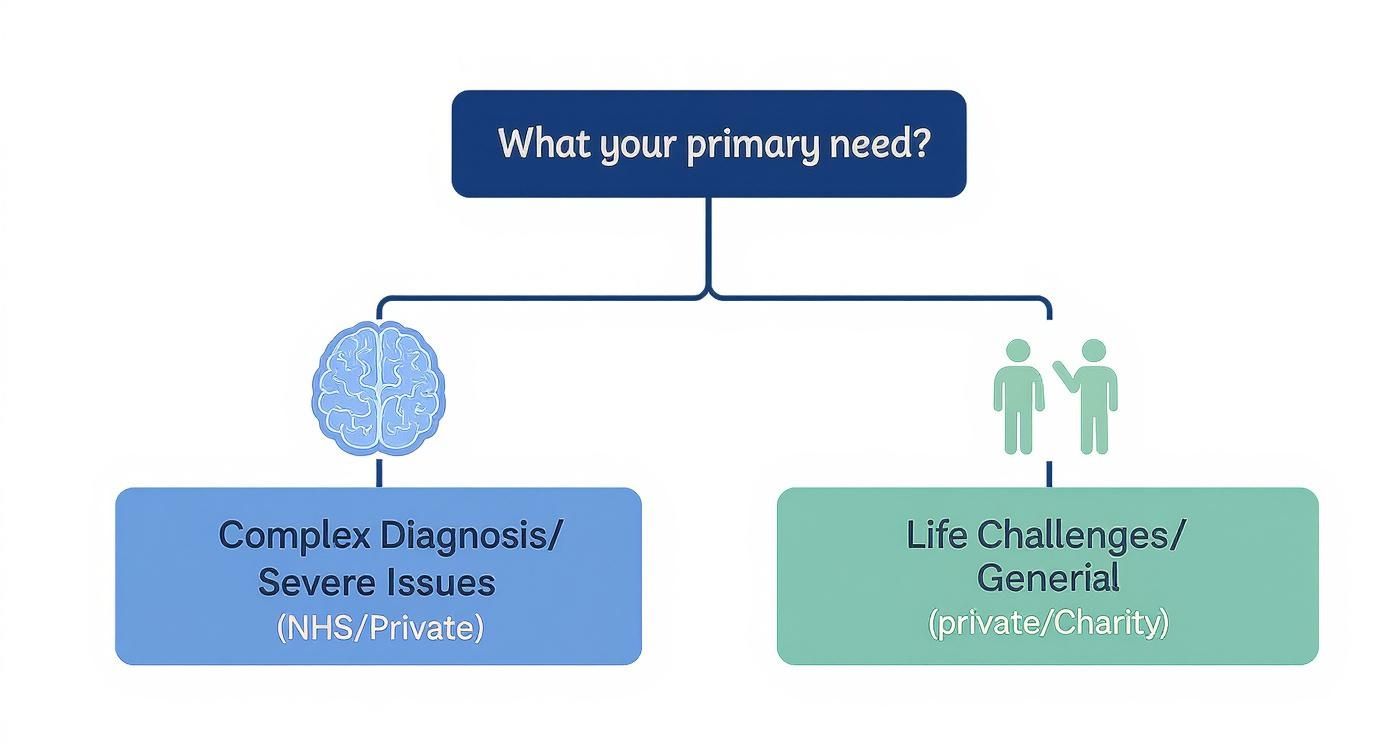
As you can see, the path tends to diverge depending on whether your core need is a formal diagnosis for a severe issue or general support for life's challenges.
Decision-Making Checklist Who Should I See?
To help bring some clarity to your thinking, run through the questions in this checklist. Your answers should give you a good sense of whether a clinical psychologist or a therapist is the better starting point for you.
| Consideration | Lean Towards a Clinical Psychologist If… | Lean Towards a Therapist If… |
|---|---|---|
| Primary Goal | You need a formal diagnosis or treatment for a specific, complex mental health condition. | You need support with life challenges, relationship issues, grief, or personal development. |
| Severity of Symptoms | Your symptoms are severe, persistent, and significantly impair your ability to function. | Your symptoms are causing distress, but you are still managing your day-to-day life. |
| Referral Source | Your GP has suggested a referral for a specialist mental health assessment. | You are self-referring to find a supportive space to talk and process your experiences. |
| Type of Support | You want a structured, evidence-based intervention for a diagnosed disorder. | You want an exploratory, relational approach focused on understanding yourself better. |
| History | You have a history of complex mental health issues or have not responded to previous therapies. | You are seeking therapy for the first time for a specific life event or general unease. |
Ultimately, there is no wrong door to knock on. Any good therapist will recognise if your needs fall outside their scope of practice and will refer you on to a clinical psychologist or psychiatrist. Likewise, a clinical psychologist can certainly help with life’s general problems.
However, using this guidance will help you start your search in the right place, saving you time and helping you connect with the professional best equipped for your unique circumstances from the very beginning.
Frequently Asked Questions
Navigating the world of mental health support often throws up a lot of practical questions. Even when you grasp the core differences between a clinical psychologist and a therapist, you might still be wondering about the real-world details: How much will it cost? Do I need to see my GP? How do I even check someone's credentials?
This section is all about giving you clear, straightforward answers to these common queries. Think of it as helping you fit the final pieces of the puzzle into place, so you can move forward with confidence.
How Do Costs and Insurance Differ in the UK?
Let's be honest, cost is a huge factor for most people. The financial side of things can look quite different when comparing a clinical psychologist and a therapist, particularly when you weigh up NHS versus private options.
Clinical psychologists working within the NHS are, of course, free at the point of use – a cornerstone of UK healthcare. The flip side, however, is that high demand and workforce pressures often mean very long waiting lists. If you decide to see a clinical psychologist privately, their fees tend to reflect their extensive doctoral-level training. You can typically expect to pay somewhere between £120 to £180 per session.
Therapists, including counsellors and psychotherapists, generally have a wider and more accessible price range in private practice, often from around £50 to £120 per session. On top of this, many brilliant charities and third-sector organisations offer low-cost or even free counselling services, which can be a lifeline for those on a tighter budget.
A quick note on insurance: many UK private health insurance policies will cover a certain number of sessions with either a clinical psychologist or a therapist. But it's absolutely crucial to check the fine print of your policy. Some insurers will require a GP referral first, and they might specify that they only cover professionals accredited by particular bodies, like the HCPC for psychologists or the BACP/UKCP for therapists.
Do I Need a GP Referral to See a Professional?
This really depends on whether you're going through the NHS or seeking help privately. The paths are quite distinct.
To see a clinical psychologist on the NHS, you'll almost always need a referral from your GP. Your doctor essentially acts as the gatekeeper to specialist mental health services, assessing your needs before referring you on to the right team.
If you're going private, however, you can self-refer to both a clinical psychologist and a therapist. There's no need to speak to your GP first. The one exception? If you're planning to use private health insurance. In that case, your insurance provider might insist on a GP referral before they'll authorise and cover the cost of your treatment.
How Can I Verify Their Credentials?
Checking a professional's credentials isn't just a good idea—it's a vital step to make sure you're getting safe, ethical, and competent care. The titles can be a bit confusing, so knowing where to look offers essential peace of mind.
For a clinical psychologist, it’s very straightforward. 'Clinical Psychologist' is a legally protected title in the UK. This means anyone using it must be registered with the Health and Care Professions Council (HCPC). You can easily search for their name on the official HCPC online register.
For a therapist (which includes counsellors and psychotherapists), the process is a little different because the title itself isn't legally protected. This makes checking their accreditation with a reputable professional body absolutely crucial. You should look for registration or accreditation with one of the main bodies:
- The British Association for Counselling and Psychotherapy (BACP)
- The UK Council for Psychotherapy (UKCP)
- The National Counselling Society (NCS)
Each of these organisations has its own searchable online register of qualified members who are all bound by strict ethical codes and standards of practice.
Can a Therapist Formally Diagnose a Condition?
This is a really common point of confusion and a key difference between the two roles. While an experienced therapist can certainly recognise the symptoms and patterns linked to various mental health conditions, they don't provide a formal diagnosis.
The formal diagnosis of complex mental health disorders in the UK is a role typically reserved for a psychiatrist (a medical doctor specialising in mental health) or a clinical psychologist. Their in-depth training in psychopathology and psychological assessment gives them the skills to make these clinical judgements.
A therapist’s focus is less on a diagnostic label and more on providing therapeutic support for the symptoms and underlying issues you're experiencing. So, if getting a formal diagnosis is your main reason for seeking help, a clinical psychologist would be the more appropriate professional to see.
For more answers to your questions, you can also explore other FAQs about therapy and the therapeutic process.
At Dr Chris Irons, I focus on helping individuals and professionals overcome self-criticism and build more compassionate, fulfilling lives through Compassion Focused Therapy. If you are struggling with anxiety, shame, or difficult emotions, I offer therapy, coaching, and training designed to help you develop a kinder relationship with yourself. Learn more about how we can work together.