To start dealing with shame and guilt, we first need to grasp one crucial difference: guilt is about what you did, while shame is about who you are.
Think of it like this. Guilt says, "I did something bad," a realisation that can actually spur you on to make amends or change your behaviour. Shame, however, is a much heavier burden. It whispers, "I am bad," leaving you feeling stuck, flawed, and completely worthless. Getting clear on this distinction is the first real, practical step you can take towards healing.
Untangling Shame From Guilt
It’s incredibly common to use the words "shame" and "guilt" as if they mean the same thing, but in reality, they're two very different emotional experiences. This mix-up often keeps us trapped because the tools needed to work with shame are not the same as those for guilt.
When you feel that sharp pang of regret after snapping at a partner, that's likely guilt. It’s a helpful, if uncomfortable, signal that your actions didn't line up with your values. Crucially, it points to a specific behaviour you can address.
Shame, on the other hand, is a deeply painful and personal blow. It doesn't just judge an action; it condemns your entire self. It’s that sinking feeling of being exposed, defective, and unworthy of belonging. This kind of intense self-focus often makes us want to hide or pull away from the very people who could help. This internal battle is a classic example of a man vs self conflict, where the struggle is entirely within.
The Core Difference: I Am Bad vs I Did Bad
The most direct way to tell these two feelings apart is to tune into your inner monologue.
What are you actually saying to yourself? Guilt focuses on what you did ("I can't believe I said that"), while shame launches a full-scale attack on your identity ("I'm such a terrible person for saying that"). This distinction isn't just semantics; it's the very foundation for moving forward.
Sadly, shame is a widespread issue, often made worse by societal pressures. A 2023 survey by Mind found that 51% of UK adults still connect mental health conditions with a sense of shame. Even more telling, 56% of people with mental health challenges reported feeling ashamed of their condition. This highlights a persistent stigma that can make the path to feeling better that much harder.
This simple image perfectly illustrates the core difference between feeling shame and feeling guilt.
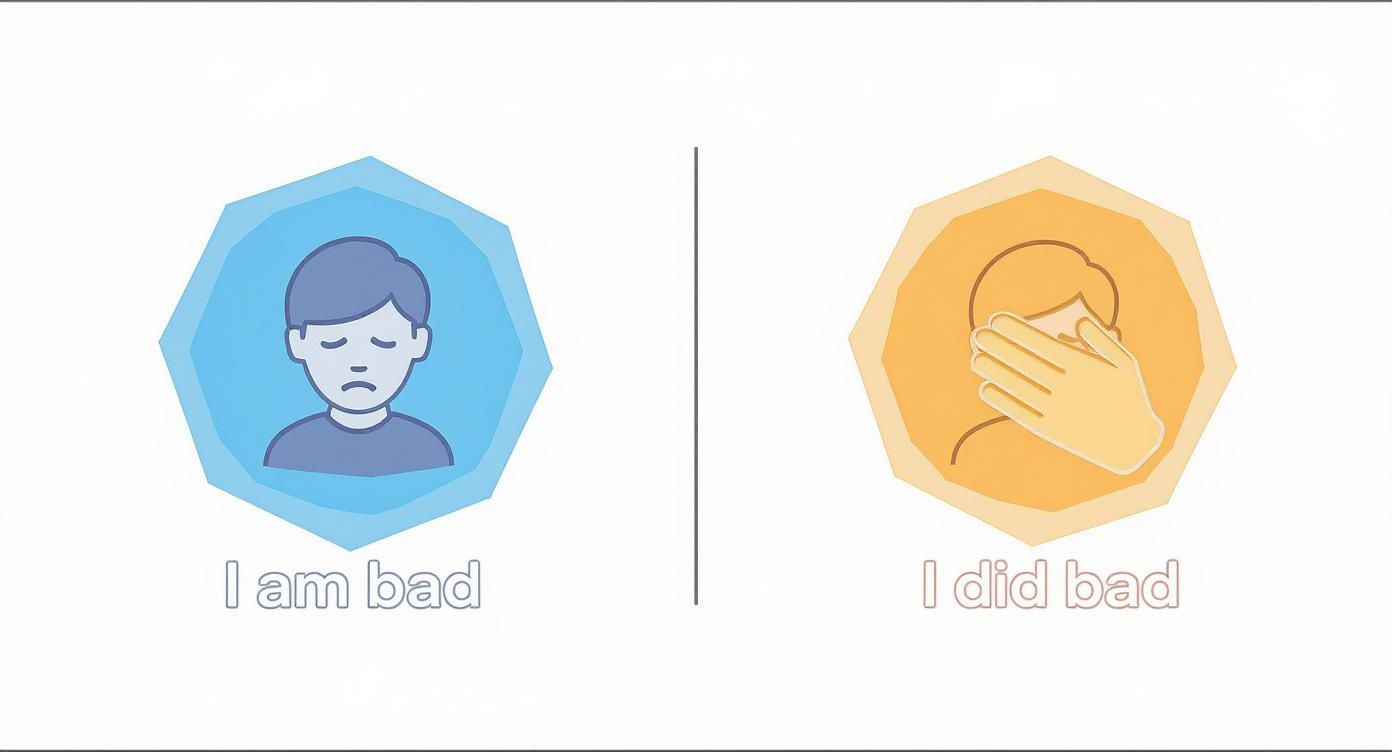
As you can see, shame takes the problem and weaves it into the fabric of your identity. Guilt, thankfully, keeps the action separate—it's a mistake you made, not a reflection of your inherent worth.
To help you get even clearer on what you're feeling, here's a quick side-by-side comparison.
Shame vs Guilt: A Quick Comparison
| Characteristic | Shame | Guilt |
|---|---|---|
| Focus | Self ("I am bad") | Behaviour ("I did something bad") |
| Urge | To hide, withdraw, disappear | To confess, apologise, repair |
| Impact | Paralyzing, isolating, destructive | Motivating, pro-social, constructive |
| Internal Voice | Critical, harsh, condemning | Regretful, self-correcting |
| Connection | Feels unworthy of connection | Worries about the impact on connection |
Seeing the differences laid out like this can be a real lightbulb moment. Once you can name what you’re experiencing, you have a much better chance of working with it effectively.
A Compassionate Approach to Healing
This is precisely where Compassion-Focused Therapy (CFT) offers such a helpful way forward. CFT isn’t about ignoring your mistakes or letting yourself off the hook. Not at all. Instead, it gives you the tools to consciously shift from a place of harsh self-criticism to one of genuine self-compassion.
The goal is to develop an inner voice that is supportive and wise rather than one that is harsh and condemning. It’s about learning to treat yourself with the same kindness you would offer a good friend who made a mistake.
By learning to activate our own innate capacity for compassion, we can begin to soothe the threat-based emotions that shame triggers in our minds and bodies. Understanding the powerful link between shame and self-criticism is a huge part of this work.
You can learn more about how Compassion-Focused Therapy can help you heal in our related guide. This approach empowers you to respond to difficult feelings with strength and understanding, laying the groundwork for true emotional resilience.
Understanding Your Three Emotional Systems
Have you ever wondered why shame and guilt feel so completely overwhelming, like an internal alarm you just can’t switch off? The reason often lies in how our brains are wired. Compassion-Focused Therapy (CFT) gives us a really helpful map for this, breaking it down into our three core emotional regulation systems.
Think of it like having three different operating modes in your brain, each built for a specific job. When shame takes over, it’s usually because one system is working overtime, completely drowning out the others. Getting to know these systems is the first, crucial step toward being able to intentionally choose a different, kinder response.

The Threat System: Your Brain’s Alarm Bell
First up is the Threat System, your internal protector. Its main job is to sniff out danger and keep you safe by triggering feelings like anger, anxiety, and disgust. This system is ancient, evolving to help our ancestors survive immediate physical threats—like spotting a predator rustling in the bushes.
But here’s the tricky part. When you make a mistake and shame floods in, your Threat System doesn't know the difference between a sabre-toothed tiger and the fear of being judged by your colleagues. It just sounds the alarm, pumping your body full of cortisol and adrenaline. This is precisely why shame can feel so physically intense and paralysing; it’s a modern-day survival response to a social or psychological threat.
When you're stuck in shame, your Threat System is in complete control. The world feels dangerous, you feel exposed, and your only instincts are to fight back (often with self-criticism), run away, or freeze completely.
Living in this high-alert state long-term isn't just exhausting; it's a major roadblock to working through shame and guilt in a healthy way.
The Drive System: Your Motivation Engine
Next, we have the Drive System. This is your motivation and reward centre, the source of feelings like excitement, ambition, and pleasure. It’s the part of you that gets you out of bed to chase goals, whether that’s nailing a project at work, training for a marathon, or planning a much-needed holiday.
Fuelled by dopamine, the Drive System gives you that satisfying buzz of accomplishment when you achieve something. While it’s absolutely essential for a fulfilling life, an overactive Drive System can cause its own problems. It can easily push you towards perfectionism, constant striving, and a deep-seated fear of failure—all of which are perfect triggers for the Threat System if things don't go to plan.
Think about it: your ambition to get a promotion (Drive System) can quickly spiral into intense shame and self-blame (Threat System) if you get some critical feedback. The two are often very closely linked.
The Soothing System: Your Source of Calm
Finally, and most importantly for our work here, is the Soothing System. This system is all about feelings of contentment, safeness, and connection. It gets activated when we feel cared for and when we care for others, releasing calming hormones like oxytocin.
This system is about being, not doing. It’s that warm feeling you get from a hug, the sense of peace you find on a walk in nature, or the gentle kindness you’d offer a friend who’s having a hard time. It gives us the calm and reassurance we need to rest and recover.
The trouble is, for many of us, this system is often underdeveloped or neglected. We might be experts at self-criticism (Threat) and striving (Drive), but we simply haven't had much practice in activating our own capacity for self-soothing.
Finding Your Balance
The key to dealing with shame and guilt isn't to eliminate your threat or drive systems—we absolutely need them. The real goal is to bring all three into balance by deliberately strengthening your Soothing System.
When you learn to consciously activate your Soothing System, you create a safe internal space from which to manage difficult emotions. It allows you to step out of the panic of the Threat System and respond to your pain with wisdom and kindness, rather than with fear and self-attack. The exercises that follow are designed to help you do exactly that.
Actionable Exercises to Build Self-Compassion
Knowing your emotional systems is one thing, but learning how to work with them is a whole different ball game. This is where we move from theory to practice. When you’re caught in a shame spiral, your Threat System is running the show, and just telling yourself to "stop it" is about as effective as yelling at the tide to turn back.
Instead, we need practical, body-based exercises that can gently activate your Soothing System. The goal is to create a sense of internal safety. The following exercises are designed to do just that. They aren't quick fixes, but rather skills you can cultivate over time, building a foundation of self-compassion to support you through the toughest moments.

Practice Soothing Rhythm Breathing
When shame hits, our breathing often becomes shallow and quick, firing off danger signals to the nervous system. Soothing Rhythm Breathing is a powerful yet simple way to counteract this physiological alarm. By deliberately slowing down your breath, you send a direct message back to your brain: you are safe.
Here's a simple script to get you started:
- Find a comfortable posture. Sit upright in a chair with your feet flat on the floor, or lie down—whatever feels most grounding for you. If it feels right, gently close your eyes.
- Slow your breath. Begin breathing a little more slowly and deeply than you normally would. Find a rhythm that feels calming, not forced. Try aiming for about five or six seconds on the inhale and five or six seconds on the exhale.
- Soften on the out-breath. As you breathe out, imagine your body softening and letting go of tension. Feel your shoulders drop away from your ears and your facial muscles relax.
- Adopt a gentle expression. Allow a slight, gentle smile to form on your lips. This isn’t about faking happiness; it's about activating the muscles associated with safeness, which can subtly shift your emotional state.
This practice works by stimulating the vagus nerve, a key part of our parasympathetic nervous system—our body's natural "rest and digest" mode. It physically calms the threat response, which in turn makes it easier to think clearly and respond with kindness.
Develop Your Compassionate Self
Dealing with shame and guilt requires more than just calming down. It involves cultivating an inner source of wisdom, strength, and warmth. The "Compassionate Self" visualisation is a core CFT practice designed to help you build this internal ally.
Your Compassionate Self is an ideal version of you—the part that embodies the qualities you’d need to be truly helpful and supportive to someone you care deeply about.
Think about the qualities you'd want in a compassionate figure:
- Wisdom: The ability to see the bigger picture with clarity and understanding.
- Strength: The courage to face difficult emotions without being overwhelmed.
- Warmth: A genuine sense of care, kindness, and non-judgement.
- Commitment: The dedication to stick with yourself through difficult times.
Once you have a sense of these qualities, you can begin the visualisation. Find a quiet space, use your Soothing Rhythm Breathing to settle yourself, and then imagine this compassionate version of you. What do they look like? How do they stand or sit? What is their facial expression like? Spend a few minutes just bringing this image to life in your mind.
This isn't about creating a separate person; it's about recognising that these qualities of wisdom, strength, and warmth already exist within you. You can explore how self-compassion is the key to emotional well-being and resilience in more detail to really understand its profound impact.
Tips for When It Feels Difficult
Let’s be clear: building self-compassion is a practice, not a performance. There will be times when it feels awkward, inauthentic, or even impossible. This is completely normal, especially when shame is intense.
- When your inner critic is loud: Acknowledge the critical voice without buying into its message. You might say to yourself, "I hear you, inner critic, but right now I'm choosing to practice kindness."
- If your mind wanders: That’s okay. Gently guide your attention back to your breath or your compassionate image. Mind-wandering is part of the process, not a sign of failure.
- If you feel nothing: Don't try to force it. The intention to be compassionate is what matters most. Simply going through the motions is a powerful first step.
These feelings are particularly common when dealing with shame born from public humiliation, which can deeply wound our sense of belonging and safety. Research has highlighted just how widespread this experience is; a systematic review with UK data found that approximately 34.9% of people experience public humiliation, which is strongly linked to adverse mental health outcomes like anxiety. You can read more about these findings on the impact of public humiliation and mental health. The key is to respond to these intense feelings with the very compassion you are trying to cultivate.
Creating a Plan for Lasting Emotional Resilience
Dealing with a sudden wave of shame is one thing, but truly changing your relationship with these tough emotions for good? That’s about building long-term emotional resilience. This doesn't require a massive life overhaul. It’s more about weaving small, consistent habits of compassion into the fabric of your everyday routine.

The goal here is to shift from just reacting to shame to proactively cultivating an inner environment of kindness and strength. Over time, these small actions build a powerful internal resource you can draw upon when your inner critic inevitably starts shouting. Remember, the focus isn't on perfection; it's on patient, consistent effort.
Building Your Personal Compassion Toolkit
Think of this as creating a personal first-aid kit for your emotional health. When you feel overwhelmed, you won’t have to scramble for what to do; you’ll have a set of go-to strategies ready and waiting. The most effective toolkit is one that’s personal to you, filled with practices that genuinely resonate.
Here are a few ideas to get you started:
- Mindful Self-Talk Phrases: Get a few simple, kind phrases ready to deploy. Instead of the usual "I'm such an idiot," you could practice saying, "This is a moment of suffering. It's okay to feel this way," or "I made a mistake, and I can learn from this."
- Compassionate Journaling Prompts: Journaling gives you a safe space to process feelings without judgement. Keep a list of prompts on hand for when you feel stuck. Try asking: "What would my compassionate self say to me right now?" or "What strength can I draw on to get through this?"
- Soothing Touch: It sounds simple, but placing a hand over your heart or gently holding your own arm can activate your body's soothing system. It’s a discreet and powerful way to offer yourself comfort, wherever you are.
Of course, a big part of this plan involves looking after your foundational health. Medically-sound lifestyle changes are crucial for improving overall mental wellbeing. A solid base of good sleep, nutrition, and movement makes all the emotional work you're doing that much more effective.
Weaving Practice Into Your Week
Let’s be honest: the biggest barrier to building new habits is usually feeling like we just don't have enough time. The key is to start small—so small it feels almost too easy. A two-minute breathing exercise every single day is far more powerful than an hour-long session you only manage once a month.
The goal is consistency, not intensity. Small, repeated actions are what rewire neural pathways and build lasting resilience. It’s about planting a new tree today, even if you wish you’d started ten years ago.
To give you an idea of what this could look like, here is a sample plan showing how you might integrate these practices into a busy week. Use it as a starting point and adapt it to fit your own life.
Sample Weekly Compassion Practice Plan
| Day | Morning (5 mins) | Afternoon (2 mins) | Evening (10 mins) |
|---|---|---|---|
| Monday | Soothing Rhythm Breathing | Compassionate self-talk check-in | Journal: "What was one challenge today & how did I handle it with kindness?" |
| Tuesday | Compassionate Self visualisation | Mindful moment: Notice 3 things you can see, hear, and feel. | Read one page from a book on self-compassion. |
| Wednesday | Soothing Rhythm Breathing | Practice soothing touch while the kettle boils. | Journal: "What is one kind thing I can do for myself tomorrow?" |
| Thursday | Compassionate Self visualisation | Compassionate self-talk check-in | Listen to a short guided meditation for calm. |
| Friday | Soothing Rhythm Breathing | Reflect on one small win from the week. | Journal: "What wisdom can I take from this week into the next?" |
This isn't about adding more to a never-ending to-do list. It’s about finding tiny pockets of time to intentionally care for yourself.
Navigating Roadblocks With Kindness
Even with the best of plans, you’re going to hit roadblocks. Your inner critic will get loud, you’ll forget to practice, or you'll have a day where shame feels completely all-consuming. This isn’t a failure. It is a completely normal part of learning to work with these emotions.
How you respond to these moments is the real practice.
- Acknowledge the Critic: When that harsh inner voice pops up, just notice it. You could even name it: "Ah, there's my inner critic again, trying to protect me in its own clumsy way."
- Recommit Gently: If you miss a day (or a whole week) of practice, resist the temptation to beat yourself up. That just adds another layer of shame. Simply acknowledge it and start again. The next breath is always a new opportunity.
- Celebrate Small Wins: Did you catch yourself in a self-critical spiral and choose a kinder thought instead? That’s a huge victory. Acknowledging your progress, no matter how small it seems, is what reinforces the new habit.
Building resilience is a journey, not a destination. By creating a toolkit, integrating small practices, and responding to setbacks with the very compassion you're trying to cultivate, you lay the foundation for a much stronger, kinder relationship with yourself.
Knowing When to Seek Professional Support
While the self-compassion tools in this guide can be powerful, there are times when they just aren't enough. Recognising this isn't a sign of weakness—it's a sign of strength.
Sometimes, feelings of shame and guilt aren't just fleeting reactions to a mistake. They can become deeply tangled up with bigger challenges like past trauma, depression, or anxiety. If that's the case, self-help strategies can feel like trying to fix a deep wound with a small plaster. What you really need is expert care to help you heal properly from the inside out.
Signs It’s Time to Reach Out
It’s often hard to know when to take that next step. We can easily fall into the trap of telling ourselves we should be able to handle it alone. But certain signs are red flags, indicating that shame and guilt are taking a serious toll on your well-being and it's time to bring in professional support.
Think about reaching out if any of this sounds familiar:
- The feelings are constant and overwhelming. You feel trapped in a cycle of shame or self-blame that just seems to colour most of your days.
- It’s impacting your daily life. Your work, your relationships, or even your ability to simply enjoy things are suffering because of these emotions.
- You're using unhealthy ways to cope. You find yourself turning to avoidance, substance use, or other harmful behaviours just to numb the pain.
- Physical symptoms are showing up. Persistent shame and stress can easily manifest as fatigue, sleep problems, or changes in your appetite.
- You feel isolated and hopeless. The feeling that you are fundamentally flawed is so strong that you’ve started to withdraw from others and can’t see a way out.
These experiences can be especially potent in younger people. A large-scale 2004 UK study, for instance, found that shame and guilt are significant emotional responses linked to behavioural disorders in children, often influencing long-term patterns of self-blame and avoidance. You can find more details in these findings on childhood emotional responses and behavioural disorders.
Finding the Right Support in the UK
Taking that first step to find a therapist can feel daunting, but there are some excellent resources available in the UK to guide you. The most important thing is finding a qualified professional and a therapeutic approach that feels right for you.
Your GP is always a good first port of call. They can have an initial chat with you and refer you to NHS mental health services.
Reaching out for help is an act of self-compassion. It's about recognising that you deserve to feel better and are willing to take the necessary steps to make that happen.
If you decide to go down the private therapy route, several professional bodies are there to ensure therapists are properly trained and accredited:
- The British Association for Counselling and Psychotherapy (BACP): Their directory is a great tool for searching for accredited counsellors and psychotherapists in your area.
- UK Council for Psychotherapy (UKCP): This is another key organisation for finding highly qualified therapists who meet rigorous training standards.
It’s also worth knowing that different types of therapy can be particularly helpful for shame and guilt. Compassion-Focused Therapy (CFT), which underpins this guide, is designed specifically to work with these difficult feelings. Another approach, Eye Movement Desensitisation and Reprocessing (EMDR), can be incredibly effective if the shame is rooted in traumatic experiences.
Exploring your options will help you make an informed choice. Learning more about the types of therapy available can empower you to find a path that truly supports your needs on the journey toward healing.
Common Questions About Shame and Guilt
As you start to bring these compassionate practices into your daily life, it's completely normal for questions and sticking points to pop up. This work is a deeply personal journey, and it’s natural to wonder if you’re "doing it right" or if what you’re feeling is just part of the process.
This section tackles some of the most frequent questions we hear from people just like you. Think of it as a handy reference to support you when you hit those inevitable bumps in the road.
Is It Possible to Completely Eliminate Shame?
This is such an important question, and the short answer is no—nor would we want to. The goal isn't to become some kind of superhuman who is immune to a natural emotion like shame. Instead, the real work is about fundamentally changing your relationship with it.
Think of your shame like a powerful, roaring fire. For years, you might have tried to fight it by throwing more fuel on it in the form of self-criticism. Compassion-focused practice is about learning how to sit a safe distance from that fire, understanding its heat without getting burnt, and eventually learning how to calm the flames.
The aim is to reduce shame's power and stop it from running your life. By responding with kindness instead of criticism, you take away its fuel source, allowing it to die down on its own.
Over time, you learn that shame is just a visitor, not a permanent resident in your mind.
What if I Feel I Deserve to Feel Ashamed or Guilty?
This is an incredibly common feeling, and when you're in its grip, it feels undeniably true. It's often the voice of your inner critic, screaming that if you let go of self-punishment, you're somehow letting yourself "off the hook" for a mistake.
Compassion-Focused Therapy (CFT) offers a different way of looking at this. It helps us understand that your inner critic probably developed as a misguided attempt to protect you—perhaps to stop you from making the same mistake again, or to beat others to the punch with judgement. It’s a clumsy, and often harmful, protective strategy.
The exercises in this guide are designed to help you build a new inner voice, one that is wise, supportive, and strong. This isn't about ignoring responsibility. Far from it. When we learn from our mistakes with kindness and self-respect, we create far more meaningful and lasting change than self-punishment could ever achieve.
How Long Does It Take to See a Difference?
There’s no magic timeline, I'm afraid. Everyone’s journey is unique and depends on all sorts of things, including your past experiences. Building this kind of emotional resilience is a gradual process, a bit like strengthening a muscle you haven't used in a long, long time.
That said, some people notice small but significant shifts within a few weeks of consistent practice. These early signs often look like:
- Catching the inner critic faster. You begin to notice those self-critical thoughts as they arise, rather than just automatically accepting them as fact.
- A shorter "rebound" time. Shame might still knock you down, but you find you can get back on your feet a little quicker than before.
- Moments of spontaneous self-kindness. You might catch yourself naturally offering yourself a kind word after a minor slip-up, almost without thinking.
The key here is consistency and patience. Make sure you celebrate these small wins along the way; they are the real building blocks of lasting change.
Can These Exercises Make Me Feel Worse at First?
Occasionally, yes, they can. When you first start turning towards difficult feelings with compassion, it can feel surprisingly emotional or uncomfortable. For many people, it might be the very first time they've ever offered themselves kindness in the face of pain, and that can bring a lot of stored-up emotion to the surface.
This is often a sign that you're touching on something tender that truly needs healing. The most important thing is to go gently with yourself.
If the feelings become overwhelming, it's perfectly okay to:
- Take a break from the exercise completely.
- Shorten the practice time to just a minute or two.
- Focus on a grounding sensation, like the feeling of your feet on the floor.
If the distress feels too intense or hangs around for a while, it might be a good sign that now is the right time to seek professional support. A good therapist can guide you through the process safely and effectively.
At Dr Chris Irons, we specialise in helping individuals and leaders navigate the complex worlds of shame, self-criticism, and emotional well-being through Compassion Focused Therapy. If you're ready to build a kinder, more resilient relationship with yourself, explore our therapy, coaching, and training options. You can learn more about how we can support you by visiting our website.