That nagging inner voice, the one that insists you’re not good enough? It's exhausting, isn't it? If you're hearing it, you're definitely not alone. The best way to stop being hard on yourself isn't just to wish the voice away; it's to actively build self-compassion. Think of it less as a vague, fluffy idea and more as a practical, everyday skill you can actually learn. It’s a habit you can choose to change, one compassionate thought at a time.
The Unseen Weight of Your Inner Critic
Constant self-criticism often feels completely automatic, like it's just the default setting in your brain. This internal monologue is a deeply ingrained habit, often tangled up with our brain's old survival instincts and then cranked up to eleven by modern pressures to appear perfect. It’s the unseen weight that makes every challenge feel heavier and every mistake seem catastrophic.
But what if that harsh voice isn't the real you? What if it’s just a misguided protective mechanism, an old pattern that’s long past its sell-by date? Just acknowledging this possibility is the first step toward lifting that weight. This guide will give you a clear path, with actionable strategies to help you understand your inner critic, challenge its stories, and start building a much kinder relationship with yourself.
Why Self-Compassion Is Your Strongest Tool
Learning to be less critical isn’t about letting yourself off the hook or making excuses. Far from it. It's about giving yourself the support you actually need to thrive. Motivation that comes from self-criticism is fuelled by fear, and it's a fast track to burnout and anxiety. Motivation from self-compassion, on the other hand, comes from a genuine desire to grow and be well, which makes it infinitely more sustainable.
The benefits of making this shift are huge. In fact, developing self-compassion is one of the most effective ways to quiet that inner critic. One trial with over 1,000 UK adults found that a six-week self-compassion programme led to a 28% reduction in self-critical thoughts and a 22% improvement in overall mental wellbeing. This approach is so powerful because it gets to the root cause, rather than just papering over the symptoms. If you're curious, you can find out more in the Centre for Mental Health's report on wellbeing.
Recognising the Critic's Voice
So, how does this inner critic actually show up day-to-day? It’s often incredibly subtle, weaving itself into your thoughts so seamlessly that you mistake its voice for objective truth.
Does any of this sound familiar?
- Perfectionism: The belief that anything less than perfect is a total failure.
- Procrastination: Putting tasks off, not because you're lazy, but because you're terrified the final result won't be good enough.
- Ruminating on Mistakes: Replaying a small error over and over in your mind for hours, maybe even days.
- Discounting Positives: Brushing off compliments or achievements as just "luck," rather than something you've earned.
This critic is often the engine behind things like imposter syndrome, which is why it's so important to learn how to overcome imposter syndrome at work and recognise its quiet, corrosive impact.
The goal isn't to silence your inner critic completely—frankly, that's often impossible. The real goal is to change your relationship with it, transforming it from a harsh judge into a distant, much less powerful voice.
By understanding how shame and self-criticism operate, you can begin to heal with the tools of compassion-focused therapy. This guide will show you how to start lifting that unseen weight, one compassionate step at a time.
Understand Why Your Brain Is So Critical
If you feel like you’re constantly beating yourself up, you’re not alone. And it’s not a personal failing. That harsh inner voice feels like a reflex because, in many ways, it is. It's a throwback, a direct result of how our brains evolved over millennia.
Think about it: our minds were shaped to keep us safe from very real, physical threats—sabre-toothed tigers, not a poorly worded email or an awkward moment at a party. This is a core idea in Compassion-Focused Therapy (CFT), often called the 'tricky brain' phenomenon. Your brain is wired for survival, with a threat-detection system that's always on high alert. The problem is, it can't always tell the difference between a predator and a project deadline, kicking off the same fight-or-flight response for both.
Your Three Emotional Systems
To really get why we're so hard on ourselves, it helps to understand the three main emotional systems that are constantly running in the background, guiding our feelings and actions. Each one was crucial for our ancestors' survival and still pulls the strings today.
They are:
- The Threat System: This is your internal smoke alarm. Its job is to spot danger and protect you. It does this by activating feelings like anxiety, anger, and disgust to get you ready to act. Self-criticism is a huge trigger for this system, keeping you trapped in a state of high alert.
- The Drive System: This is your get-up-and-go engine. It’s what motivates you to hunt for resources, chase goals, and find success. It rewards you with feelings of excitement, pleasure, and anticipation to keep you moving forward.
- The Soothing System: This is your safe harbour. It’s linked to feelings of contentment, connection, and calm. This system is all about rest, recovery, and feeling secure.
When you're constantly berating yourself, you're essentially living in your threat system. That inner critic keeps the alarm bells ringing, flooding your body with stress hormones. This makes it almost impossible to access the calm and safety of your soothing system. Learning how to stop being hard on yourself is all about intentionally shifting gears—moving out of threat mode and into a more balanced, soothed state.
That inner critic isn't the 'real you'—it's more like a misguided bodyguard. It's an outdated survival instinct trying to keep you safe by pointing out your flaws before anyone else can. Seeing it this way helps take the sting out of its words.
Mapping Your Inner Critic
Recognising this voice as a glitchy protective strategy, rather than the absolute truth, is the first real step towards dialling it down. Instead of fighting it, we can get curious and start to observe it. This is where we begin to 'map your critic'—to understand its habits, its triggers, and what it’s really afraid of.
The following diagram shows exactly how the inner critic works. It creates a draining cycle of exhaustion and low mood that can only be broken by activating your compassionate side.
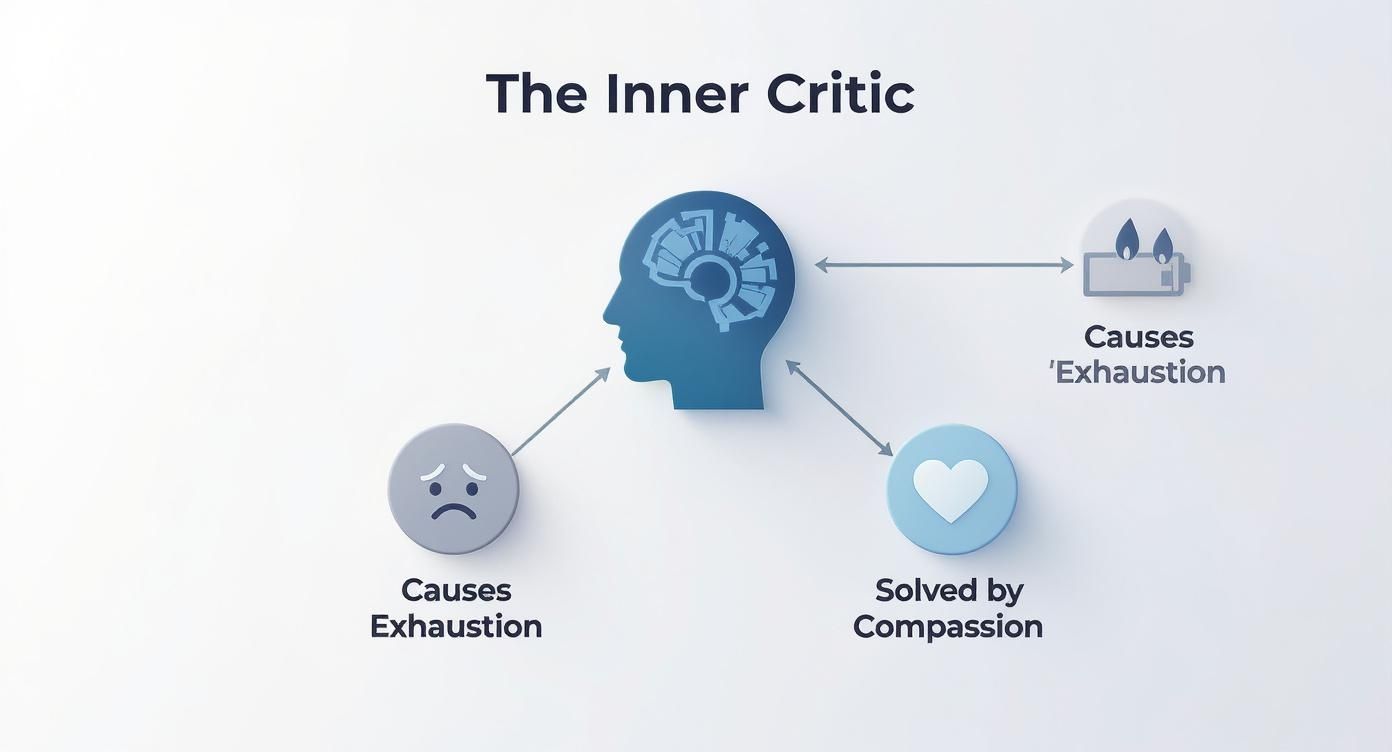
As you can see, the critic isn't a motivator; it’s a massive drain on your mental and emotional fuel tank. This is precisely why a compassionate approach isn't just a 'nice-to-have'—it's essential for your wellbeing.
To map your own critic, just start paying attention to its messages. When does it show up? What gets it going?
Give this a try:
- Pinpoint the Trigger: Think of a time you felt that familiar sting of self-criticism. What just happened? Did you get some feedback, make a mistake, or start comparing yourself to someone on social media?
- Catch the Exact Words: What did the critic actually say? Write down the phrases verbatim. Was it something like, "You're such an idiot," or "You always mess this up"? Pay attention to its tone, too. Is it harsh, sarcastic, or fearful?
- Dig for the Fear: Now, ask yourself: "What is this voice trying to protect me from?" More often than not, the critic is terrified of failure, rejection, or being seen as inadequate.
By mapping its behaviour, you start to see your inner critic not as an all-knowing judge, but as a predictable, almost boring pattern. It becomes a source of information about your deepest fears, not a source of truth about who you are. This awareness is the foundation for building a much kinder, more supportive relationship with yourself.
Build Your Self-Compassion Toolkit
Understanding why your inner critic is so loud is a massive step forward. But knowing is only half the battle. Now, we need to move from insight into action. This is where we get practical and start building the skill of self-compassion—not as some fluffy idea, but as a muscle you can actively strengthen with consistent practice.
Learning how to stop being hard on yourself means consciously creating a new inner voice. Think of it as cultivating an internal ally who can stand up to the critic with warmth, strength, and wisdom. The goal isn’t to wage war on the critic or silence it completely; it’s about turning up the volume on a kinder, more supportive alternative. These tools are designed to help you do just that.

Cultivate Your Compassionate Self
Your 'Compassionate Self' is the part of you that embodies the qualities you'd want in a perfect mentor or coach: wise, strong, warm, and completely non-judgemental. It’s an inner resource you can intentionally develop and call upon when your threat system kicks into high gear.
I'll be honest, this can feel a bit strange or even fake when you first try it. That’s completely normal. The key is to just practise, even for a few minutes each day.
Here's a simple visualisation to get you started:
- Find a comfortable, dignified posture. Sit in a way that feels both grounded and alert. Take a few slow, deep breaths to help your body settle.
- Imagine your ideal compassionate qualities. Ask yourself: what would I need most when I'm struggling? Is it wisdom? Strength? Warmth? Unconditional acceptance?
- Visualise these qualities as a being. This could be an image of you at your very best, a wise figure from a story, or even just a feeling of warm light. Focus on the feeling this image brings up. What's its facial expression like? Its tone of voice?
- Breathe into that feeling. Imagine you are breathing these compassionate qualities right into your body, letting them fill you up. The aim is to create a tangible, felt sense of this supportive presence within you.
This exercise isn't just wishful thinking; it actually helps create new neural pathways, making compassion a more accessible and automatic response over time. To dive deeper into the practice of self-compassion, Dr. Chris Irons offers some fantastic resources and insights.
Practise Compassionate Letter Writing
One of the most powerful ways to shift your perspective is to get out of your own head. Compassionate letter writing is a structured exercise that helps you treat yourself with the same kindness you would so easily offer to a dear friend.
When that inner critic is screaming, it’s because you’re completely tangled up in self-judgement. This exercise creates just enough distance, allowing you to tap into the wisdom and kindness you already have for others and turn it back towards yourself.
How to Write Your Letter
Find a quiet moment with a pen and paper or a new document on your screen.
- First, name the struggle. Think about something you've been judging yourself for lately. Maybe it was a mistake at work, a social interaction you keep replaying, or something you dislike about your appearance. Really let yourself acknowledge the pain this self-criticism is causing.
- Write from a friend's perspective. Now, imagine a deeply wise and compassionate friend is writing a letter to you about this exact issue. What would they say? How would they frame it with kindness?
- Bring in our common humanity. This friend would probably remind you that everyone messes up, that being imperfect is simply part of being human. They wouldn't single you out as uniquely flawed.
- Offer kind, constructive thoughts. What gentle, supportive suggestions might this friend offer? The advice should come from a place of genuine care, not a harsh desire to "fix" you.
Here’s what that might look like:
"Dear [Your Name], I heard you were feeling really down about that presentation. I know how much work you put in, and it's completely understandable to feel so disappointed. Please remember that one tough meeting doesn't define your worth or your skill. Everyone has off days. Be gentle with yourself tonight."
Once you've written the letter, put it away for a bit. Come back to it later and read it slowly, really letting the kind words sink in. This practice directly counters the harsh narrative of your inner critic by offering a tangible, compassionate alternative.
Building this toolkit is a core part of your overall well-being. Understanding why wellness activities matter gives you the bigger picture of how these small, consistent actions protect your mental health. These exercises aren't quick fixes; they are the foundational practices for building lasting inner resilience.
Here is the rewritten section, designed to sound completely human-written and natural, following all your requirements.
How to Reframe Critical Thoughts in Real Time
Catching your inner critic in the act is a game-changer. It’s one thing to notice you’re self-critical, but it’s another thing entirely to interrupt that harsh voice as it’s speaking. This is where the real work begins.
The trick is to create a tiny bit of space between the critical thought and your gut-punch emotional reaction. In that brief pause, you have an opportunity to step in and offer a different perspective. This isn’t about slapping on a fake smile or forcing positive thinking. It’s about finding a view that’s simply more balanced and fair.
Ask Better Questions
When that familiar critical voice starts up, you need a way to question its authority, fast. Having a few go-to questions in your back pocket can stop a negative spiral before it takes hold. The idea is to shift out of the harsh judge role and into the shoes of a kind friend or even just a neutral observer.
Next time a critical thought pops up, try asking yourself one of these:
- What would I say to a friend in this exact situation? It’s amazing how much more kindness and common sense we offer to others than we do to ourselves.
- What’s a more balanced, fair way of looking at this? This question is a gentle nudge to remind yourself that your first, critical thought is probably an extreme one. It pushes you to find the middle ground.
- Is this thought actually helpful right now? Let’s be honest, the answer is almost always a resounding no. Framing it this way helps you dismiss the thought as unhelpful noise, not some profound truth you must obey.
Using these questions over and over again builds a new mental habit. Think of it like carving a new path in a forest. The more you use the compassionate path, the weaker the old self-critical trail becomes.
Connect the Dots Between Thoughts and Actions
Those critical thoughts aren’t just harmless chatter. They have real-world consequences. A thought like, "I'm going to completely bomb this presentation," can very quickly lead to you avoiding it altogether. That fear of not being perfect can make it feel much safer to just not start.
Your inner critic has a clever trick: it convinces you its harshness is what keeps you motivated and safe. In reality, it often creates the very outcomes you’re trying to avoid—like failure or procrastination—by paralysing you with anxiety.
It’s also crucial to remember that we aren’t living in a vacuum. External pressures can crank up the volume on our inner critic. Social and environmental stress are powerfully linked to self-criticism. For instance, researchers from the University of Derby found that a staggering one in five children and young people in England had a probable mental health issue, with self-criticism being a major vulnerability.
And it doesn’t stop in childhood. With 23% of the UK’s working-age population reporting high levels of anxiety, it's clear our internal world is heavily influenced by external stress. If you're interested in the research, you can learn more about the development of the Child Self-Criticism Scale.
Run Small, Safe Experiments
The single best way to prove your inner critic wrong is with cold, hard evidence. Your critic loves making catastrophic predictions about what will happen if you’re not perfect. The good news is, you can challenge these predictions with small, safe behavioural experiments.
This isn’t about taking massive, terrifying leaps. It’s about gently testing the critic’s rigid, black-and-white rules.
Here are a few ideas to get you started:
- Make a tiny, intentional mistake. Send an email to a trusted colleague with a small, inconsequential typo in it. Your critic might scream that they’ll think you're incompetent. Just watch what actually happens. My bet? Nothing at all.
- Submit 'good enough' work. If you're a perfectionist who polishes things endlessly, try submitting a piece of work when it’s 80% perfect instead of spending hours on that final 20%. You’ll probably discover the outcome is just as good, and you’ll get your time back.
- Practise saying "no." If your critic tells you that you must always say "yes" to be liked, try politely declining a small, low-stakes request. This directly challenges the belief that setting a simple boundary will lead to rejection.
Each little experiment gives you concrete proof that your critic’s fears are completely overblown. This kind of real-world evidence is far more powerful than just telling yourself to think differently. You’re actively showing yourself that a kinder, more flexible way of being is not only possible but much more effective.
Navigating Setbacks Without Self-Blame
Let’s be realistic: learning to quieten that inner critic isn't a straight line to self-compassion nirvana. Some days, that old, familiar voice will feel louder and more convincing than ever. That’s not a sign you’ve failed; it’s a sign you’re human. The real work is in preparing for those moments.
When you hit a bump in the road—you miss a deadline, say the wrong thing, or just have a genuinely bad day—the goal is to respond with a bit of grace, not to default to harsh self-judgment. This is where self-compassion becomes a true superpower.

View Mistakes as Data, Not Drama
Our inner critic has a real flair for the dramatic. It loves to take one simple mistake and spin it into a five-act tragedy, using it as irrefutable "proof" of our deepest insecurities—that we're incompetent, unlovable, or doomed to fail.
The trick is to reframe these moments. A mistake is just information. It’s data. It tells you what didn't work, what you might need to learn, or where you could use a bit more support. It says absolutely nothing about your inherent worth.
Let's say you forgot an important meeting at work.
- The Drama (The Critic's Take): "I'm so disorganised and unreliable. My boss must think I'm a complete idiot. I can't be trusted with anything important."
- The Data (The Compassionate Take): "I missed that meeting. The data shows my current calendar system isn't cutting it. I need to find a better way to track my appointments."
Can you feel the difference? One path spirals into shame and anxiety. The other leads to a practical, non-judgemental solution. By treating setbacks as data, you drain them of their emotional power and turn them into real opportunities for growth.
Create Compassionate Scripts for Setbacks
When you’re stuck in a self-critical thought loop, thinking clearly feels impossible. This is where having a few pre-prepared, compassionate scripts can be a lifesaver. These are just gentle, realistic phrases you can use to talk yourself through a tough moment, exactly as you would for a good friend.
Think of them as your personal fire extinguishers for that inner critic.
Here are a few ideas for common scenarios:
- When you make a mistake at work: "Okay, that didn't go as planned. It’s frustrating, but everyone makes mistakes. What can I do to fix this, and what can I learn from it for next time?"
- After an awkward social interaction: "I’m feeling a bit awkward about what I just said. But I was just trying to connect. It's okay to be imperfect in conversations—that's how real connection happens."
- When you don’t meet a personal goal: "I’m disappointed I didn’t manage that today. But beating myself up won't help. What made it so difficult, and what’s a smaller, kinder step I can take tomorrow?"
The goal here isn't to pretend you're not disappointed. It’s about acknowledging the feeling without letting the critic pile a layer of shame on top. You’re validating your own experience while refusing to engage in self-blame.
True resilience isn't about never falling down. It's about how you treat yourself when you're on the ground. It’s about picking yourself up with kindness instead of kicking yourself while you’re down.
Practise Self-Forgiveness
Forgiveness can feel like a big, loaded word, but in this context, it’s really quite simple. It means actively choosing to let go of the self-blame you're carrying over a past mistake. It's a conscious decision to stop punishing yourself for being human.
Self-forgiveness doesn't mean you're excusing the mistake or pretending it didn't happen. It’s about recognising that holding onto all that shame and criticism is only hurting you now. It’s like trying to move forward while dragging a heavy anchor behind you.
A simple practice for this is to place a hand on your heart, take a deep breath, and say to yourself, "I'm sorry you went through that. I forgive you." It might feel a bit strange at first, but repeating this acknowledges the pain and gives yourself permission to finally move on. This is where the real work happens. It's how you build a foundation of lasting self-worth.
When to Seek Professional Support
The strategies in this guide are powerful tools for building a kinder relationship with yourself. But let's be honest, sometimes self-help isn't quite enough. There are times when a harsh inner critic is tangled up with deeper mental health challenges, and reaching out for professional support is a sign of profound strength, not weakness.
Learning how to stop being hard on yourself is a journey, and having an experienced guide can make all the difference. If your self-criticism feels completely overwhelming, or if it’s tied to a persistent low mood, crushing anxiety, or thoughts of self-harm, it may be time to speak with a professional.
Signs It Might Be Time for Support
Knowing when to take that next step can be tricky, especially when you're already feeling down. In fact, your inner critic might even try to convince you that you don't deserve help or that your problems aren't "bad enough."
Here are a few clear signs that professional support could make a real difference:
- Your daily life is impacted. Is the self-criticism getting in the way of your work, your relationships, or your ability to simply enjoy things you used to love?
- Self-help strategies aren't cutting it. You've genuinely tried the exercises and techniques, but that negative inner voice is still just as loud and persistent.
- You feel isolated or hopeless. A feeling that you're totally alone in this struggle or that things will never get better is a huge red flag.
- You're leaning on unhealthy coping habits. If you find yourself turning to things like substance use, overeating, or self-harm to manage how you feel, it's crucial to seek help.
Taking the First Step
Making that first move can feel daunting, but it’s often simpler than you might think. A great starting point is usually a conversation with your GP, who can talk you through your options and make referrals through the NHS.
Alternatively, you can look for a private therapist who specialises in approaches like Compassion-Focused Therapy (CFT), which is designed specifically to work with shame and self-criticism. Seeking out CFT therapy can give you a structured, supportive space to build these vital skills with an expert.
It's a sad reality that stigma still prevents so many people from getting the help they deserve. This reluctance, often fuelled by the very self-criticism we're trying to overcome, can unfortunately make things worse over time.
Research highlights this gap all too clearly. A report by Priory Group found that while about one in eight UK adults with a mental health issue gets treatment, a staggering 35% of young adults with difficulties do not seek help. For many, the biggest barrier is the perceived stigma. You can read more about these UK mental health statistics and see just why speaking up is so vital.
Remember, you don't have to carry this weight alone. Trusted UK resources like Mind and the NHS offer confidential information and support lines. Taking that first step to find help is one of the most compassionate things you can ever do for yourself.
Of course, as you start exploring this, it’s only natural for some questions and doubts to pop up. This is a totally new way of relating to yourself, after all, and feeling a bit uncertain is just part of the process. Let's walk through some of the most common worries people have when they're learning to quieten that harsh inner voice.
But Won’t I Lose My Motivation?
This is the big one, isn't it? It’s the number one fear I hear from people. But the research—and my experience—shows the complete opposite is true.
When your motivation comes from a place of self-criticism, it’s really being fuelled by fear. That’s a fast track to anxiety and burnout. Self-compassion, on the other hand, sources motivation from a genuine desire to be well and to grow. It’s a much more sustainable, and frankly, kinder way to live.
Think of it as swapping out a harsh inner critic for a supportive inner coach. That coach still wants you to succeed and will push you, but they do it with encouragement. This builds resilience and actually makes you more willing to take on challenges, not less.
What if These Exercises Just Feel Fake?
That’s completely normal. Honestly, expect it. If you've spent years, maybe even a lifetime, practising self-criticism, your brain is literally wired for it. Learning self-compassion is a bit like learning a new language—it’s going to feel awkward and clunky at first.
The trick is to just notice that awkwardness without judging it, and simply keep going. Start small. Even one minute a day is a win. Over time, as you forge new mental habits, these practices will begin to feel much more authentic. I promise.
How Can I Possibly Be Compassionate After a Huge Mistake?
Self-compassion isn't about letting yourself off the hook or ignoring responsibility. It’s about learning to handle failure without drowning in a sea of shame.
The first step is to simply acknowledge the pain, the regret, or the embarrassment you feel, without immediately launching into an attack on yourself. Then, gently bring to mind our shared humanity: every single person makes big, messy mistakes. It’s part of the deal of being human.
From there, you can ask a more helpful question: "What can I do to learn from this and repair any harm I've caused?" This mindset empowers you to take responsibility from a place of strength, rather than being paralysed by self-blame.
If you find that self-criticism is consistently holding you back, working with a professional can offer the dedicated guidance you need. As a leading voice in Compassion Focused Therapy, Dr Chris Irons offers therapy and coaching designed to help you build a kinder, more resilient relationship with yourself. You can explore how to start your journey at https://drchrisirons.com.