Before we can even begin to work with shame, we have to get one thing straight: feeling shame isn't a personal failing. It’s a universal human emotion, hardwired into us for a reason. The trick is learning to spot it, understand its job, and most importantly, distinguish it from guilt. Once you see it for what it is, you can start to meet it with compassion instead of more self-judgement.
Understanding the Roots of Shame and Why It Hurts

Let's be clear from the get-go: experiencing shame doesn't mean you're flawed, weak, or broken. It simply means you're human.
Shame is an ancient, primal emotion that evolved to keep our ancestors safe. It served as a powerful signal that we might be at risk of social rejection—of being cast out from the tribe. Thousands of years ago, that was a virtual death sentence.
That's why it feels so intensely painful and isolating today. It’s our internal alarm system screaming, "You are not worthy of connection!" The feeling can be all-consuming, making us want to shrink, hide, or disappear entirely.
The Critical Difference Between Shame and Guilt
Figuring out how to deal with shame means first separating it from its close cousin, guilt. They often show up together, but they are fundamentally different emotions with very different impacts on our well-being.
Guilt says, “I did something bad.”
Shame says, “I am bad.”
This distinction is everything. Guilt focuses on a specific behaviour, something that can be changed, repaired, or learned from. Shame, on the other hand, attacks our core identity—our very sense of self-worth. It makes the problem feel permanent and inescapable.
Let’s look at this more closely.
Shame vs Guilt: Understanding the Difference
| Characteristic | Shame | Guilt |
|---|---|---|
| Focus | "I am bad." (Focus on the self) | "I did something bad." (Focus on the action) |
| Impact | Paralyzing, isolating, leads to hiding | Motivates apology, repair, and change |
| Outcome | Destructive, lowers self-worth | Constructive, can lead to personal growth |
| Internal Message | "I'm flawed/unlovable." | "I made a mistake." |
Recognising this difference is the first real step toward healing. Guilt can actually be a constructive emotion, prompting us to apologise, make amends, and learn. But shame is destructive. It traps us in a vicious cycle of self-criticism and paralysis, convincing us that we are the problem. You can explore more about how Compassion-Focused Therapy can help you heal from shame and self-criticism, which is a key part of this process.
Why Shame Flourishes in Silence
Shame absolutely thrives in secrecy and silence. It’s a master of convincing us that we’re the only ones who feel this way, creating a profound sense of isolation. Often, the roots of deep-seated shame can be traced back to experiences like childhood trauma in adults, which can profoundly shape self-perception and leave us vulnerable to these feelings long-term.
Here in the UK, our cultural emphasis on maintaining a "stiff upper lip" can make things even trickier. Expressing vulnerability is often seen as a sign of weakness, which only intensifies feelings of shame and forces people to hide their struggles.
This is especially true when it comes to mental health. The persistent stigma creates a fertile ground for shame to grow, stopping so many people from seeking the support they desperately need.
The statistics paint a stark picture. A recent report revealed that one in five adults (20.2%) in England lives with a common mental health problem. More alarmingly, 51% of UK adults believe there is still a fair amount of shame associated with mental health conditions, and over half of those experiencing mental ill health (56%) still feel ashamed themselves.
So, the first and most powerful step you can take is to normalise this feeling for yourself. Acknowledge that what you’re experiencing is valid and, believe me, shared by countless others. Just by bringing it into the light, even only for yourself to begin with, you start to loosen its grip.
How to Pinpoint Your Personal Shame Triggers
If we're going to work with shame, we first need to become a bit of a detective in our own emotional world. Shame often feels like a sudden, overwhelming wave that comes out of nowhere, doesn't it? But it's almost always activated by a specific shame trigger—a situation, a thought, a memory, or even a physical sensation that kicks off that familiar, awful feeling of being flawed and exposed.
Learning to spot these triggers is the first, most crucial step in taking back control. It creates a tiny but powerful pause between the trigger and your usual reaction, giving you just enough space to respond with self-compassion instead of spiralling into self-criticism. Your triggers are entirely unique to you, but they do tend to cluster around some very common themes.
Where Shame Tends to Hide
While the specifics are deeply personal, many shame triggers fall into predictable categories. You can think of these as the general areas where your inner critic loves to hang out, just waiting for an opportunity.
- Social moments: Feeling awkward at a party, saying what feels like the "wrong" thing, or just thinking someone is judging you can be incredibly powerful triggers.
- Work and performance: This could be anything from making a mistake at work and receiving critical feedback to not getting a promotion or feeling like you're falling behind your peers.
- Relationships: Triggers here can pop up from conflict with a partner, feeling disconnected from your family, or the heavy belief that you've let a friend down.
- Money worries: Struggling with debt, comparing your financial situation to others, or feeling unable to provide for yourself or your family is a huge, and very common, source of shame.
Body image is another incredibly potent arena for shame, particularly here in the UK. The research really highlights just how deeply these feelings can shape our behaviour and even our health.
For instance, a 2025 survey showed that women are almost 30% more likely than men to avoid showing a body part they're self-conscious about in public. What's even more concerning is that they're nearly 50% more likely to feel embarrassed revealing body parts during medical checks, which can lead to dangerous delays in getting care. These aren't just isolated feelings; statistics from the Mental Health Foundation show that a staggering one in five UK adults felt shame about their body in the past year. You can learn more about how body confidence impacts health behaviours from the full survey.
Your Guided Journaling Exercise
Okay, let’s move from those general categories to your own specific experience. This journaling exercise is designed to help you gently pinpoint your personal shame triggers with curiosity, not judgment. Find a quiet moment, take a few deep breaths, and let's explore this together.
The goal here isn't to re-live the pain. It’s about observing the pattern from a safe distance.
Key Insight: By getting your shame patterns out of your head and onto paper, you create the psychological distance you need to see them clearly. You shift from being in the feeling to becoming an observer of the feeling.
Journaling Prompts to Uncover Your Triggers
Set aside 15-20 minutes and just write freely. Don't worry about censoring yourself.
- Recall a recent shame moment. Think back to the last time you felt that hot, sinking feeling of shame. When was it? What was happening right before you felt it? Be as specific as you can about the setting, the people, the actions.
- What was the external trigger? What happened out in the world? Did someone say something specific? Did you see something online? Was it a particular event, like a job interview or a family dinner?
- Listen to your inner critic. What were the exact thoughts that raced through your mind? Write down the words your inner critic actually used. Was it saying things like, "You're so stupid," "Everyone thinks you're a failure," or "You'll never get it right"?
- Notice the physical sensations. Where did you feel the shame in your body? Was it a tightness in your chest? A knot in your stomach? A hot flush spreading across your face? Shame is a full-body experience, and mapping its physical signature can help you recognise it earlier next time.
- Look for the patterns. As you do this exercise over time, what recurring themes start to pop up? Do your triggers often involve public speaking, authority figures, or comparing yourself on social media?
Doing this exercise helps you build a map of your own internal landscape. Each trigger you identify becomes a known quantity—something you can prepare for and decide to meet with a different, kinder response. This self-awareness is the bedrock for every other strategy we'll explore.
Building a Compassionate Mindset to Counter Shame
Spotting your triggers is a huge first step, but what comes next is where the real power lies: actively building a new, kinder way to respond to yourself. To really get a handle on shame, we need a method for dialling down its harsh, critical inner voice. This is exactly where the principles of Compassion-Focused Therapy (CFT) come into play, giving us a practical framework for calming our threat-based minds and generating genuine self-support.
CFT helps us understand that our brains are running on three core emotional systems. Each one evolved for a different job, and shame has a nasty habit of hijacking one of them.
-
The Threat System: This is our built-in alarm bell. Its job is to sniff out danger and keep us safe by firing up feelings like anxiety, anger, and, you guessed it, shame. When we’re in a shame spiral, this system is in complete overdrive, constantly scanning for any hint of social rejection.
-
The Drive System: Think of this as our engine. It’s what motivates us to chase after goals, find resources, and pursue things that bring us a sense of achievement or excitement.
-
The Soothing System: This is our internal safe harbour. It’s tied to feelings of calm, connection, and contentment. When we activate it, our bodies release oxytocin, helping us feel secure, grounded, and cared for.
Shame essentially traps us in the threat system, kicking off a relentless cycle of self-attack and fear. The key to breaking free isn't to pretend the threat doesn't exist, but to learn how to intentionally switch on our soothing system. It’s about building a compassionate home base from which we can face life’s difficulties.
Introducing Your Compassionate Self
One of the most powerful practices in CFT is the idea of creating a “compassionate self.” Think of this as consciously cultivating an inner ally—the ideal version of you that embodies all the qualities you need most when you're struggling. This isn't just a bit of wishful thinking; it's a mental training exercise that literally forges new neural pathways in your brain.
Your compassionate self is wise, strong, warm, and completely non-judgemental.
This version of you understands that suffering is part of the human deal and that making mistakes doesn’t make you a bad person. It has the strength to sit with distress without getting overwhelmed and the wisdom to offer supportive, helpful guidance.
To get started, just take a moment to imagine this version of yourself.
- What would their facial expression look like? Maybe it’s calm, with kind eyes.
- What about their tone of voice? Perhaps it's gentle and steady.
- How would they hold themselves? Likely with a confident, open, and grounded posture.
By simply visualising these qualities, you start to create a tangible mental resource you can call on anytime. This inner figure becomes the voice you can learn to use when speaking to the part of you that feels ashamed.
Crafting a Compassionate Dialogue
Right, let’s put this into practice. The next time you feel a shame trigger go off, instead of letting your inner critic have the microphone, you can consciously hand it over to your compassionate self. The goal here is to offer validation and kindness, not to argue with the shame or try to squash it down.
The core message of self-compassion isn't, "It's okay because you're perfect." It's, "It's okay that you're not perfect. You are human, and you are worthy of kindness precisely in these moments of struggle."
Let’s say you’ve made a mistake at work and you’re instantly flooded with that hot, sinking feeling of shame. Your inner critic might start screaming, "You're so incompetent! Everyone's going to find out you're a fraud."
Your compassionate self, however, would respond very differently. In that calm, steady voice you imagined, it might say something like:
- "This feels absolutely awful, and it makes complete sense that you feel this way. It’s really painful to make a mistake, especially at work."
- "I know you're feeling scared right now. Let’s just take a breath together. This feeling will pass."
- "You are not broken for feeling this. This is just a difficult moment, and I am right here with you."
See the difference? This isn't about empty platitudes or faking positivity. It's about meeting your own pain with warmth and genuine understanding, which is the absolute bedrock of emotional resilience. As you keep practicing this, you’ll discover that self-compassion is the key to emotional well-being and resilience, giving you a stable internal anchor to hold onto when things get tough.
The image below gives a great visual of how different things—thoughts, places, memories—can act as common triggers that fire up our threat system.
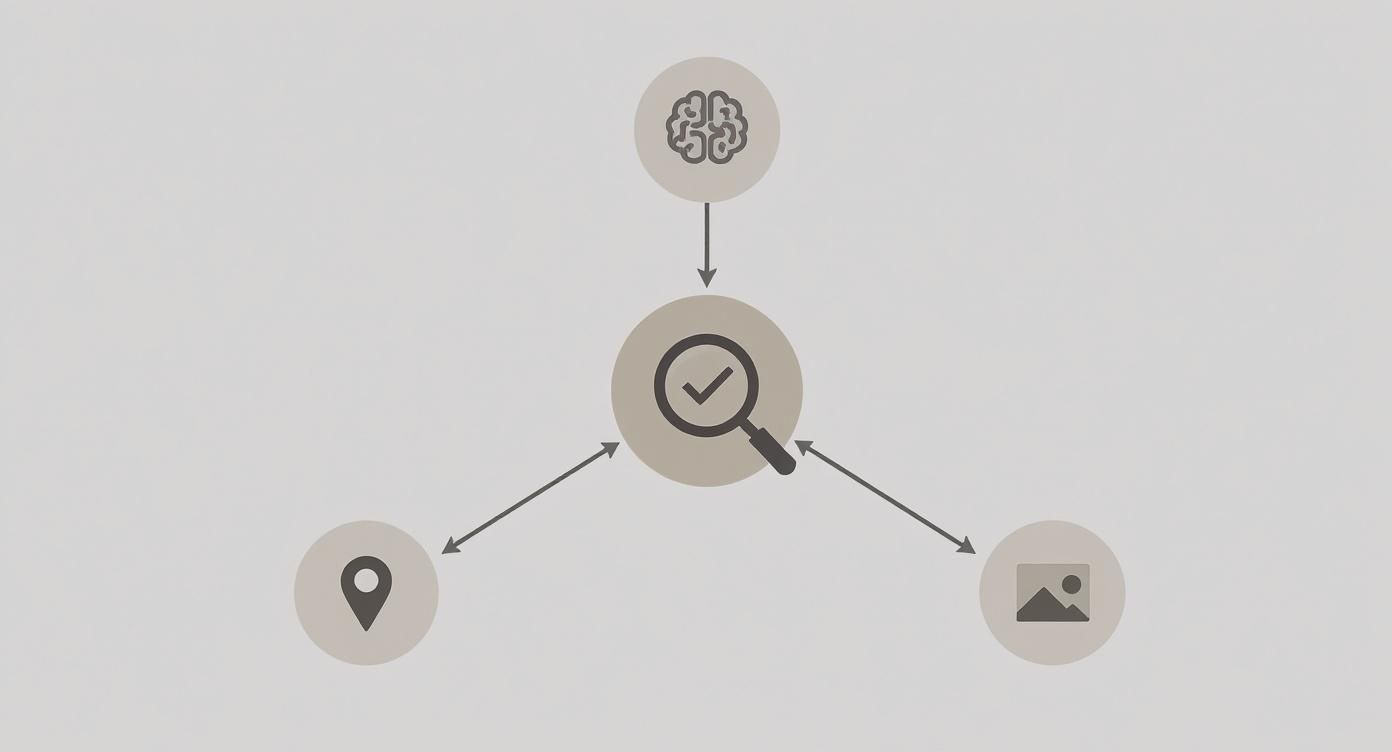
Seeing these triggers laid out helps us realise that shame often comes from specific, identifiable sources, rather than being some random, all-consuming force. Building this compassionate mindset is our most important tool for learning to respond to these triggers in a new, much healthier way.
Right, so we've explored the theory behind shame and how to build a compassionate mindset. That's the foundation. Now, let's get practical and translate that understanding into things you can actually do the moment shame shows up.
This is your toolkit. These are the concrete actions you can take to soothe your threat system and bring kindness to yourself exactly when you need it most.
And don't worry, these aren't complicated, time-consuming rituals. They are simple, evidence-based practices you can weave into your life—whether you're at your desk, on the tube, or in the middle of a tough conversation.

The Self-Compassion Break
Think of this as your go-to, in-the-moment rescue remedy. The Self-Compassion Break is a brief mindfulness practice designed to pull you out of a shame spiral using three core components of self-compassion. It's quick, surprisingly powerful, and you can do it anywhere without anyone knowing.
Let's imagine a classic scenario: you're in a team meeting and someone asks you a direct question. Your mind goes completely blank. The moment passes, but you can feel your cheeks burning and that familiar inner voice starts its tirade: "You absolute idiot. Everyone here thinks you're incompetent now."
Instead of letting that voice hijack your brain, you can discreetly take a Self-Compassion Break. Here’s how it works:
-
Acknowledge the Pain: First, just notice the emotional sting without judging it. You could say to yourself, "This is a moment of suffering," or even just, "Wow, this hurts." This simple step validates your experience instead of trying to push it away.
-
Recognise Our Common Humanity: Next, gently remind yourself that you aren't alone in this feeling. Try something like, "Suffering is just part of life," or "Everyone feels like this sometimes." This is a direct antidote to shame's favourite lie: that you are uniquely and irreparably flawed.
-
Offer Yourself Kindness: Finally, bring in some warmth. Place a hand over your heart if you can and say, "May I be kind to myself in this moment," or "May I give myself the compassion I need."
This three-step process is a powerful circuit-breaker. It acknowledges your pain, connects you to others, and introduces a kind response, all in about 30 seconds.
Writing a Compassionate Letter
When you have a bit more time and a quiet space, writing a compassionate letter to yourself can be a profoundly healing exercise. It helps you step outside your own head, externalise your feelings, and approach them with the same warmth and wisdom you'd offer a close friend.
Start by thinking of something that’s causing you shame right now—maybe a recent argument, a mistake at work, or a feeling that you're just not measuring up.
Now, imagine a dear friend came to you, heartbroken over this exact same situation. What would you say? You wouldn't call them a failure or tell them they were worthless. You'd offer comfort, perspective, and unconditional support.
Key Insight: We are often far kinder and wiser when comforting others than we are with ourselves. This exercise borrows that external perspective and directs it inward.
Make sure your letter touches on these points:
- Empathy for how difficult and painful the situation feels.
- Reminders of your good qualities, strengths, and times you've coped before.
- Perspective, acknowledging that all humans are imperfect and make mistakes.
- Unconditional acceptance of yourself, flaws and all.
For example, if you feel ashamed about a financial struggle, your letter might begin: "My dearest friend, I'm so sorry you're going through this. I know how stressful and scary this feels, and it makes perfect sense that you're feeling down. Please remember that your worth has absolutely nothing to do with your bank balance."
By writing this letter, you're actively rehearsing the voice of your compassionate self, making it a stronger, more familiar, and more accessible resource for the future.
Finding a Physical Soothing Gesture
Shame isn't just a thought; it's a full-body experience. It fires up our sympathetic nervous system—the "fight or flight" response—which is why it can feel so physically intense and overwhelming. A brilliantly simple way to counteract this is to use physical touch to activate your parasympathetic nervous system, which brings on a state of "rest and digest."
This is all about using supportive, gentle touch to calm your body, which in turn helps to calm your mind.
You just need to find a gesture that feels genuinely comforting to you. There's no right or wrong here; it's about what your system responds to.
Examples of Soothing Gestures
- Hand on Heart: Gently place one or both hands over the centre of your chest. Notice the warmth and the gentle pressure.
- A Gentle Hug: Cross your arms and give yourself a gentle squeeze, as if you were giving a friend a comforting hug.
- Cupping Your Face: Gently cup your face in your hands, the way a loving parent might soothe a child.
- Stroking Your Arm: Slowly and gently stroke one forearm, from elbow to wrist.
The next time you feel that hot flush of shame, try pairing your chosen gesture with a kind phrase. For instance, placing a hand over your heart while silently saying, "It's okay, I'm right here with you," sends a powerful signal of safety to your brain and body, helping you feel more grounded and less swept away by the feeling.
Sometimes, when you're in the thick of it, it helps to have a quick-reference guide. The table below summarises a few simple techniques you can pull out of your back pocket when a shame spiral hits.
Quick Self-Compassion Techniques for Shame Spirals
| Technique | Best Used When… | Goal |
|---|---|---|
| Soothing Rhythm Breathing | You feel physically agitated or anxious. | To calm the nervous system and slow your heart rate. |
| The Self-Compassion Break | You're caught in a moment of self-criticism. | To interrupt the spiral with mindfulness, common humanity, and kindness. |
| Soothing Physical Gesture | Shame feels overwhelming and disorienting. | To ground yourself in your body and signal safety through touch. |
| Compassionate Reframe | Your inner critic is loud and repetitive. | To gently challenge the shame-based thought and offer a kinder perspective. |
Think of these as your first-aid kit for shame. They don't erase the feeling, but they can stop it from taking over completely, giving you the space you need to breathe and reconnect with your compassionate self.
When to Seek Professional Support for Shame
The self-compassion exercises and mindset shifts we’ve explored are powerful tools for learning how to live with shame. For many people, they provide a solid foundation for building a kinder, more supportive relationship with themselves.
But it's also crucial to recognise when shame is simply too heavy a burden to carry alone.
Reaching out for professional support isn't a sign that these strategies have failed you. Far from it. It's a courageous and proactive step toward deeper healing. It’s an acknowledgement that some wounds, particularly those tangled up with our past, need the skilled, supportive presence of a trained professional to help us navigate them safely.
Signs It Might Be Time to Talk to Someone
So, how do you know when it’s the right time to seek help? While there’s no single, definitive answer, certain signs suggest that shame is having a significant and persistent negative impact on your life.
It might be time to consider reaching out if you notice:
- A persistent low mood or depression: You feel a constant sense of hopelessness, sadness, or emptiness that just won't lift.
- Severe social withdrawal: Shame is pushing you to avoid friends, family, or activities you once enjoyed, leading to a growing sense of isolation.
- An impact on daily functioning: Your ability to work, study, or manage day-to-day responsibilities is being seriously hampered by feelings of worthlessness.
- Shame linked to trauma: If your shame is rooted in past traumatic events, working with a therapist provides a safe container to process these experiences. For those whose shame is rooted in traumatic experiences, especially if it's leading to conditions like PTSD, understanding PTSD treatments becomes absolutely vital.
- Unhealthy coping mechanisms: You find yourself relying on alcohol, drugs, overworking, or other behaviours to numb or escape from the pain of shame.
Acknowledging that you need support is an act of profound self-compassion. It's choosing to honour your pain by giving it the care and attention it deserves, rather than continuing to struggle in silence.
Finding the Right Support in the UK
Navigating the mental health landscape can feel daunting, but there are excellent resources available. The trick is finding the right type of support for you.
In the UK, the shame surrounding mental health and body image often stops people from taking this crucial step. Statistics show that while approximately 1 in 4 adults in England experiences a mental health problem each year, a staggering 22% of people cite stigma as the biggest barrier to getting help.
Tragically, research has also found that 13% of adults have experienced suicidal thoughts because of concerns about their body image. This really underscores the severe, life-threatening consequences of unaddressed shame.
Different Types of Therapy for Shame
Not all therapy is the same. Here’s a quick look at some approaches that are particularly helpful for working with deep-seated shame:
- Counselling: This offers a supportive, confidential space to talk through your feelings and experiences. It's a brilliant starting point for exploring the impact of shame on your life with a trained, non-judgemental listener.
- Compassion-Focused Therapy (CFT): As we've been exploring, CFT is specifically designed to help people who struggle with high levels of shame and self-criticism. It teaches practical skills to develop self-compassion and soothe the brain’s threat system. You can find out more about therapy options that specialise in this powerful approach.
- Eye Movement Desensitisation and Reprocessing (EMDR): This is a highly effective therapy for shame that is rooted in trauma. It helps the brain process and integrate traumatic memories that may be "stuck," reducing their emotional power and intensity.
Your GP is an excellent first port of call. They can discuss what you're going through, recommend local NHS services (like IAPT – Improving Access to Psychological Therapies), and help you decide on the best path forward.
Taking that first step is often the hardest, but it opens the door to building a life no longer defined by shame.
Your Questions About Shame Answered
As you start to get to grips with shame, it’s completely normal to have questions. We’re often exploring new concepts and practices that can feel a bit unfamiliar, even strange, at first. Let's tackle some of the most common ones that crop up, clearing the way so you can move forward with confidence.
Can Shame Ever Be a Helpful Emotion?
It's a fair question, especially given how intensely painful it can be. It’s worth remembering that shame has evolutionary roots. Its original job was to help us stay connected to our social groups by flagging when we might have broken a rule and risked being pushed out. In small, manageable doses, it can still do that – prompting a bit of useful reflection or motivating us to repair a relationship we value.
But the kind of chronic, toxic shame we're talking about here is a different beast entirely. This is the shame that attacks our whole sense of self, whispering that corrosive message: "I am bad." This type is deeply harmful and gets in the way of any kind of growth.
Our goal isn't to get rid of shame altogether—that's not realistic. It's about building the inner resources to work with it without letting it swallow you whole.
The aim is to transform its paralysing effect into an opportunity for growth and reconnection, rather than letting it convince you to hide away.
What if I Find It Difficult to Feel Self-Compassion?
Honestly, this is one of the most common hurdles people face. If you've spent years living with a loud, powerful inner critic, the idea of being kind to yourself can feel awkward, inauthentic, or even impossible.
The key thing to remember is that self-compassion is a skill you learn, not a personality trait you either have or you don't. Think of it like building a muscle; it takes practice, and it feels weak at first.
If directing kindness inwards feels too big of a leap, don't force it. Try starting from the outside-in.
- Begin externally: Think about a good friend who was in your exact situation. What would you say to them? What tone of voice would you use? Now, can you try offering just a little of that to yourself?
- Use imagery: You could also create a "compassionate image." This involves imagining an ideal figure—it could be real or imagined, human or animal—who embodies wisdom, strength, and unwavering kindness. Then, you can visualise them offering you the compassion and support you need.
Start small. A gentle hand on your heart during a stressful moment at work. A quiet, kind thought. It's all about practice, not perfection. Over time, these small actions start to build new neural pathways in your brain, making self-kindness feel more natural and much easier to access.
How Is This Different from Just Boosting My Self-Esteem?
This is a brilliant question because the two ideas are often muddled, but they are built on completely different foundations.
Self-esteem is often conditional. It’s usually based on our successes, our achievements, and how we stack up against others. This makes it pretty fragile—it soars when we get praised and plummets the moment we face criticism or failure.
Self-compassion, on the other hand, is unconditional. It’s about offering yourself kindness simply because you are a human being who is worthy of it, regardless of your latest win or loss. It doesn’t disappear when you mess up.
You can think of it like this:
- Self-esteem asks, "Am I good enough?"
- Self-compassion offers warmth and support precisely at the moment you feel you aren't good enough.
This is what makes self-compassion a much more stable and reliable source of inner strength. It's there for you in the tough times, providing a solid anchor when you're caught in the storm of worthlessness that shame kicks up. It doesn't depend on you being perfect; it only depends on you being human.
At Dr Chris Irons, I specialise in helping people overcome self-criticism and manage difficult emotions like shame using Compassion Focused Therapy. If you are ready to build a kinder, more fulfilling life, you can learn more about personal coaching and therapy options on my website.