A compassion focused therapy course is essentially a structured training programme designed to help you cultivate the skills of compassion—both for yourself and for other people. It gives you practical, hands-on tools to work with common human struggles like shame and that relentless inner critic, helping you build genuine emotional resilience and a much kinder inner world.
So, What's the Real Purpose of a Compassion Focused Therapy Course?
At its heart, a CFT course is a form of mental training. Think of it like learning any new physical skill, but for your mind. Developed by Professor Paul Gilbert, this approach moves beyond just talking about our problems and focuses on actively cultivating a compassionate mindset.
The core idea is to learn how to work with our evolved, and often "tricky," brains. We’re naturally wired for threat detection, which is great for survival, but it also means we can easily get stuck in painful cycles of self-doubt and criticism.
This kind of training isn’t just for therapists. It’s designed for anyone looking to build a more supportive and robust internal foundation. Whether you’re a healthcare professional wanting to deepen your practice or someone simply seeking personal growth, a CFT course offers a clear, structured path.
The main aims usually boil down to:
- Understanding Your Mind: You learn why we have self-critical thoughts from an evolutionary perspective. This alone can be a game-changer, as it helps to de-personalise feelings of shame.
- Developing Emotional Resilience: The goal is to build your capacity to soothe yourself and manage difficult emotions without feeling completely overwhelmed by them.
- Cultivating a Kinder Inner Voice: This is about actively training your mind to respond to life’s inevitable setbacks with encouragement and warmth, rather than harshness.
Why Is This So Relevant Today?
Let's face it, modern life constantly pings our innate threat systems, leading to ever-present stress and anxiety. A compassion focused therapy course tackles this head-on by teaching you how to intentionally engage your mind's soothing system.
You learn very practical exercises—like specific breathing techniques, guided imagery, and focused attention practices—that are designed to calm your nervous system and promote feelings of safety, connection, and contentment. This isn't just theory; it’s a tangible, evidence-based approach that has gained serious traction, especially in clinical settings.
Over the last decade, CFT has been increasingly adopted within UK National Health Service (NHS) services. Group-based courses have become one of the most common ways to deliver it. In fact, one review found that over 72% of CFT interventions were conducted in groups, highlighting just how effective they can be for improving mood and overall well-being.
Before we dive into the nuts and bolts, here’s a quick look at what a typical foundational course covers.
Table: Key Components of a CFT Course
This table breaks down the fundamental elements and skills you can expect to develop in a well-structured compassion focused therapy course.
| Core Component | Learning Objective | Example Exercise |
|---|---|---|
| Evolutionary Model | Understand the "tricky brain" and why we struggle with self-criticism. | Mapping out your own threat, drive, and soothing systems. |
| Three Flows of Compassion | Develop compassion for others, from others, and for oneself. | A guided meditation on receiving kindness from a compassionate figure. |
| Soothing System Activation | Learn to calm the nervous system and manage difficult emotions. | Soothing Rhythm Breathing: slowing down the breath to a gentle pace. |
| Compassionate Mind Training | Cultivate an inner compassionate self to counter the inner critic. | Writing a compassionate letter to yourself about a current difficulty. |
| Working with Shame | De-personalise and reduce the impact of shame and self-blame. | Using compassionate imagery to meet a shamed part of yourself with warmth. |
These components form the bedrock of the training, giving you a solid toolkit to start making real changes in how you relate to yourself and your experiences.
Who Actually Delivers This Kind of Training?
Good-quality, reputable courses are almost always led by experienced psychologists and accredited therapists who have undergone extensive, specialised training in CFT themselves. For instance, you can find a whole range of CFT training options for professionals and the public at https://drchrisirons.com/training/, all led by experts in the field.
It’s also worth noting how the delivery of these courses is evolving. Many providers are now exploring the benefits of using interactive video for training or educational content, which can make the learning experience far more dynamic and accessible.
Ultimately, whatever the format, the goal is always the same: to equip you with the skills to foster a compassionate mind, creating a more balanced, resilient, and connected way of living.
Exploring the Core Concepts of CFT Training
To get the most from a compassion focused therapy course, it helps to first get your head around the foundational ideas. These aren't just abstract theories; they're practical frameworks that get to the heart of why we feel and think the way we do. It’s a bit like learning the basic mechanics of an engine before you get behind the wheel.
A central idea you’ll meet early on is the concept of the 'tricky brain'. This is a really accessible way of understanding that our minds are the product of millions of years of evolution. Our brains weren't designed for modern life, let alone modern happiness. They were designed for one thing: survival.
This evolutionary heritage means we are all wired with a powerful negativity bias. Think about it: our ancestors who were hyper-alert to threats—a rustle in the grass, a sudden change in the weather—were the ones who survived to pass on their genes. As a result, our brains today are brilliant at spotting danger, but that very same system can easily get stuck in loops of anxiety, worry, and harsh self-criticism.
The Three Emotional Regulation Systems
CFT breaks down this 'tricky brain' concept even further by mapping our emotional experiences onto three core systems. Grasping how these systems work, and more importantly, how to bring them into balance, is a cornerstone of any good compassion focused therapy course.
-
The Threat System (The Brakes): This is our oldest, most reactive system. Its job is to detect danger and protect us using feelings like anxiety, anger, and disgust. It’s like a car’s emergency brake – absolutely essential for safety, but if it's constantly engaged, we end up feeling stressed, on edge, and exhausted.
-
The Drive System (The Accelerator): This system is all about motivation, pursuit, and achievement. It gives us hits of positive feelings like excitement and pleasure when we chase and get resources, goals, or status. It’s the accelerator that moves us forward, but being stuck in this gear 24/7 leads to burnout, frustration, and that constant feeling of not being good enough.
-
The Soothing System (The Cruise Control): This system is connected to feelings of contentment, safeness, and connection. It comes online when we feel cared for, settled, and not under any threat. For many of us, this system is often underdeveloped. It's like the car's cruise control; it lets us rest, digest, and just be. CFT puts a huge emphasis on strengthening this system to bring the other two into a healthier balance.
A core insight from CFT is that many mental health difficulties arise from an imbalance in these systems—typically an overactive threat system and an underdeveloped soothing system. The training is designed to correct this imbalance.
The image below shows how a CFT course essentially acts as a form of mind training, with the goal of building practical skills, resilience, and a kinder relationship with ourselves.
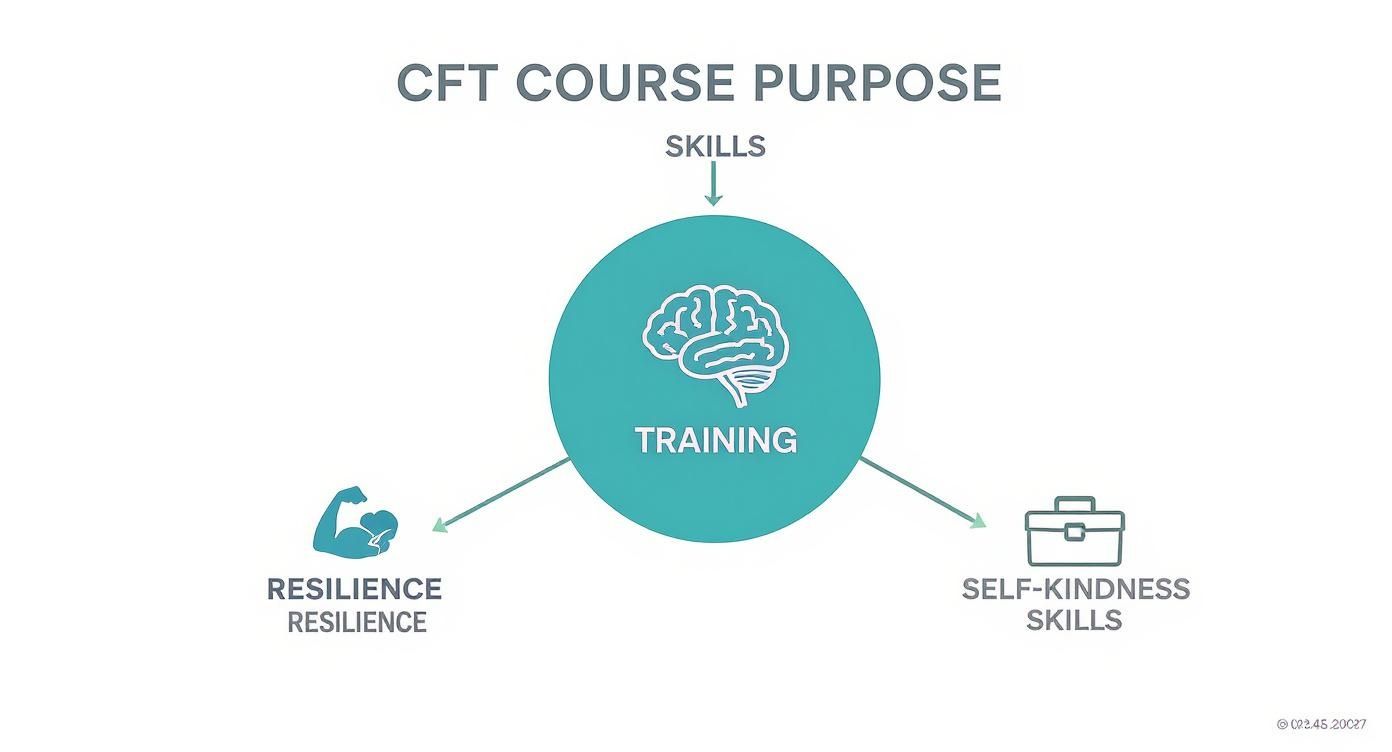
It’s a great reminder that the point isn't just to reduce distress but to actively cultivate these positive mental capacities from the ground up.
Mastering the Three Flows of Compassion
Finally, developing a compassionate mind isn't a one-way street. A crucial part of any CFT training involves learning to work with what we call the 'three flows of compassion'. To find real emotional balance, we need to be able to move fluidly between all three.
-
Compassion for Others: This is our ability to be sensitive to the suffering of other people and have a genuine wish to help them.
-
Receiving Compassion from Others: This flow is all about being able to accept kindness, care, and support from others without it triggering feelings of suspicion, unworthiness, or shame.
-
Self-Compassion: This is the capacity to be sensitive to our own suffering and to respond to our mistakes and setbacks with the same kindness and understanding we'd offer a good friend.
Most of us find one or two of these flows come more naturally than others. For instance, it might feel easy to show compassion for a friend going through a hard time, but almost impossible to allow that same care for yourself. A comprehensive compassion focused therapy course gives you the exercises and insights needed to strengthen whichever flows feel weakest, helping you build a more robust, flexible, and truly compassionate mind.
A Look Inside a Typical CFT Course Curriculum

Stepping into a compassion focused therapy course is less like opening a textbook and more like being handed a map and a compass for your own mind. A good curriculum isn’t just a jumble of theories; it's a carefully structured journey that builds practical, real-world skills from the ground up, turning abstract ideas into tools you can use right away—whether that’s with clients or for yourself.
The whole thing is sequenced very intentionally. The first modules usually explore the 'why' behind our mental struggles, digging into the evolutionary model of the mind and our three core emotion regulation systems. This is so important. It gives you a framework for understanding that difficult feelings like shame or self-criticism aren't personal failings but common human experiences, hardwired into our biology. It’s a powerful way to depersonalise suffering and sets the stage for everything that comes next.
In many ways, the principles are similar to those used when experts learn how to create an engaging online course curriculum. It's not about just dumping information on you; it’s about building your competence and confidence one layer at a time.
From Theory to Hands-On Practice
Once that foundation is solid, the course makes a decisive shift into experiential, hands-on work. This is where you move from intellectually understanding your 'tricky brain' to actively training and cultivating your compassionate mind. The real focus becomes mastering the core exercises that are the beating heart of CFT.
This transition from 'knowing' to 'doing' is where the magic happens. It’s one thing to read about the theory, but it’s another thing entirely to feel its impact directly.
Here are some of the key skills you’ll be getting your hands dirty with:
- Soothing Rhythm Breathing: You’ll learn specific breathing patterns designed to activate the body's parasympathetic nervous system. This is a game-changer for dialling down our threat system and creating a physiological sense of safety and calm.
- Compassionate Imagery: This involves guided practices where you create and connect with an ideal compassionate figure. It’s about cultivating feelings of warmth, strength, and wisdom, learning to access this inner resource whenever you need it.
- Therapeutic Letter Writing: A wonderfully effective tool for tackling the inner critic. The course guides you through writing compassionate letters to yourself, helping you externalise and challenge that critical voice while strengthening your compassionate one.
A key outcome of a robust CFT curriculum is not just knowing what to do, but having the confidence to apply it. The modules are designed to build this competence, moving from simple exercises to more complex applications in real-world scenarios.
To give you a clearer picture, here’s a common structure you might find in a foundational CFT course:
Typical Foundational CFT Course Structure
| Module Focus | Key Topics Covered | Primary Skill Gained |
|---|---|---|
| Foundations & The Tricky Brain | Evolutionary psychology, the three emotional systems, role of threat. | Depersonalising shame and self-criticism. |
| Introducing the Compassionate Self | The three flows of compassion, defining compassion attributes. | Understanding the qualities of compassion. |
| Body-Based Practices | Soothing rhythm breathing, mindful body scans, grounding techniques. | Activating the body’s soothing system. |
| Working with the Mind | Compassionate imagery, developing your ideal compassionate figure. | Cultivating an inner source of support. |
| Challenging the Inner Critic | Compassionate thought records, therapeutic letter writing. | Developing a strong, compassionate inner voice. |
| Applying CFT to Real Life | Formulation, working with shame, addressing fears of compassion. | Integrating CFT into daily challenges. |
This modular approach ensures you're not overwhelmed but instead build your skills and understanding in a steady, manageable way.
Structuring and Applying Your Knowledge
As you move through the course, the focus naturally broadens to application. You'll learn how to formulate a client's difficulties through a CFT lens—understanding how their struggles might stem from an overactive threat system or an underdeveloped capacity for self-soothing. It’s a skill that takes you beyond just managing symptoms to addressing the root causes of their distress.
And if you’re doing the course for your own growth, this is where you apply that same logic to your own life patterns. You begin to see your struggles not as character flaws but as perfectly understandable responses to your life story and your brain's wiring. Honestly, for many people, that shift in perspective is incredibly liberating.
A great example is the 8-Week Compassionate Mind Training course run by Dr Chris Irons, which guides participants through this journey week by week, allowing the skills to really sink in.
The final modules typically tie everything together. You’ll explore how to navigate common roadblocks, like fear or resistance to compassion, and build a plan to keep your practice going long after the course is over. The whole point is to leave you feeling fully equipped and empowered to make a compassionate mind an ongoing part of your life.
Who Gets the Most Out of CFT Training?
The beauty of a compassion focused therapy course is that its principles ripple out far beyond the therapy room. While it's a game-changer for clinicians, its core skills are really just fundamental human skills. This makes it incredibly relevant for anyone looking to build resilience, deepen relationships, or lead with more empathy.
This isn't training for just one type of professional. It’s for anyone who works with people or is simply looking to work more skilfully with their own mind. From therapists and coaches to senior leaders and people on a personal growth journey, the impact is surprisingly broad. Let's dig into who stands to gain the most.
Mental Health Practitioners and Clinicians
For therapists, psychologists, counsellors, and social workers, adding CFT to your clinical toolkit is a direct and powerful move. Many therapeutic models are fantastic at helping clients identify and challenge tricky thoughts, but CFT provides a crucial missing piece: a way to actively cultivate an inner sense of safeness and self-soothing.
This becomes absolutely vital when you're working with clients bogged down by high levels of shame, self-criticism, and trauma. These struggles are so often rooted in an overactive, hair-trigger threat system.
- Deeper Client Engagement: CFT gives you a non-blaming framework. It helps clients see that their struggles are not their fault, which immediately lowers the shame and makes them far more willing to dive into the therapeutic work.
- Effective Tools for Trauma: For clients with histories of neglect or abuse, CFT offers a gentle yet powerful way to build the inner resources they might not have developed earlier in life. It’s about building from the ground up.
- Reduced Therapist Burnout: The principles of compassion aren't just for the client. As practitioners, we learn to apply self-compassion to our own work, which is a lifeline for managing the emotional toll of this profession and heading off burnout.
Helping Professionals and Leaders
The benefits don't stop at the clinic door. Anyone in a role that involves supporting, managing, or caring for others can find immense value here. Think of nurses, doctors, coaches, teachers, and business leaders. In these high-stress environments, fostering compassion can change everything.
For instance, a qualitative study of NHS staff in the UK who took part in CFT groups found the intervention was overwhelmingly beneficial. Participants reported big improvements in self-compassion and a reduction in self-criticism, proving its real-world impact in demanding jobs. You can read more about the effects of CFT interventions for healthcare staff here.
The core skills learned in CFT—managing threat responses, building rapport, and fostering psychological safety—are directly transferable to leadership and team management, creating healthier and more productive work environments.
By integrating these skills, professionals can:
- Enhance Communication: Understand how threat-based emotions can hijack conversations and learn to communicate with greater empathy and skill.
- Prevent Burnout: Develop concrete self-compassion practices to manage the chronic stress that's baked into so many helping professions.
- Foster Compassionate Cultures: Leaders can use CFT principles to create workplaces where psychological safety is a priority, leading to better innovation and genuine employee well-being.
Individuals on a Personal Growth Journey
You don’t need to be a professional to benefit from a compassion focused therapy course. Many people enrol purely for their own development. They're looking for a structured way to build a kinder, more resilient relationship with themselves. If you've ever wrestled with a harsh inner critic, feelings of inadequacy, or anxiety, this kind of training can be life-changing.
The course essentially gives you a user's manual for understanding your own 'tricky brain' and provides practical, daily exercises to retrain it.
It’s a proactive approach to mental wellness, equipping you with the tools to navigate life’s challenges with more strength and grace. The goal is to shift from being your own worst critic to becoming your own strongest ally, which fundamentally changes how you experience yourself and the world.
How to Choose the Right CFT Course

Choosing the right compassion focused therapy course is a big decision, and rightly so. The quality of your training will directly shape your understanding and, more importantly, your ability to apply these profound skills in a meaningful way.
With options popping up everywhere, from weekend workshops to comprehensive diplomas, it’s vital to look past the marketing slogans and really dig into the substance of what’s being offered. Getting this right means your time and money are well spent, on a programme that genuinely matches your goals—whether personal or professional.
You’re looking for a course that doesn't just skim the surface of the concepts, but one that is authentic, evidence-based, and truly supportive of your own learning journey.
Evaluate the Trainer's Expertise and Background
This is probably the single most important factor. A great CFT trainer doesn't just know the theory; they live and breathe it. When you’re looking at a course, make it a priority to investigate who is actually leading it.
Look for trainers who are accredited psychologists or therapists with deep, specialised experience in Compassion Focused Therapy. Have they trained directly with the founder, Professor Paul Gilbert, or other senior figures in the field? What’s their track record of actually using CFT with clients?
An experienced trainer like Dr Chris Irons brings years of both clinical application and teaching to the table. This depth of experience is invaluable. It means they can guide you through the tricky nuances of the model, field complex questions, and create a learning environment that feels both safe and effective.
A trainer with a solid background ensures the material is delivered with the integrity and depth it deserves. It’s the difference between a real education and just a summary of exercises.
Examine the Curriculum and Its Evidence Base
Not all CFT courses are built the same. A high-quality curriculum should be thorough, well-structured, and anchored firmly in the evidence-based model developed by Professor Gilbert. It needs to cover the key theoretical pillars, like the evolutionary model of our 'tricky brain' and the three emotional regulation systems.
But here’s the crucial bit: the course must have a strong experiential component. CFT isn’t something you can grasp just by reading a book; you have to feel it and practise it. The curriculum should set aside plenty of time for hands-on exercises, guided practices, and moments for personal reflection.
- Core Skills Focus: Does the course explicitly teach and give you time to practise core skills like Soothing Rhythm Breathing, Compassionate Imagery, and Therapeutic Letter Writing?
- Structured Progression: Is there a logical flow? Does it build from foundational concepts to more advanced applications in a clear, manageable way?
- Scientific Grounding: Does the provider connect the training back to the established research? A robust framework is key to its effectiveness.
This focus on an evidence-based, skills-first curriculum ensures you’re learning the model as it was intended, for the greatest possible benefit.
Consider the Course Format and Level of Support
How a course is delivered can make or break your learning experience. You need to think about what format truly fits your life, learning style, and existing commitments.
- Online vs In-Person: Online courses give you fantastic flexibility, while in-person training creates a unique, immersive group dynamic.
- Duration and Intensity: Do you learn best in a short, intensive burst like a weekend workshop? Or would a longer-term programme, maybe an 8-week course, give the concepts more time to sink in?
- Live vs Self-Paced: Live sessions offer that immediate interaction with the trainer and your peers, whereas self-paced modules let you fit the learning around your own schedule.
Finally, look beyond the course itself and see what kind of ongoing support is available. A good compassion focused therapy course provider doesn't just wave goodbye after the last session. They build a community.
Check if there’s access to supervision, peer support groups, or follow-up resources. This kind of ongoing support is invaluable for helping you properly integrate CFT into your life or professional practice long after the training ends.
Your Next Steps in Compassionate Mind Training
So, you've now got a much clearer map of what a compassion focused therapy course actually looks like on the inside. As you can see, it's so much more than a collection of relaxation techniques. It’s a carefully structured, evidence-based way to actively retrain your brain for greater resilience, kindness, and emotional balance.
The whole journey is really about building a powerful inner ally rather than staying locked in a constant battle with an inner critic.
This kind of training gives you the tools to understand the mind's evolutionary wiring – why it does what it does – and then skilfully work with it, not against it. You learn how to dial down your threat system and intentionally cultivate feelings of safety, soothing, and contentment. It's this process that builds a genuine foundation of inner strength, which can fundamentally change how you show up for life's inevitable challenges.
If there’s one core takeaway, it’s this: compassion is a skill. And like any skill, from learning an instrument to a new sport, it requires practice, a bit of patience, and the right guidance to develop it effectively. When you put in the work, you see lasting changes in your well-being.
Taking Action Today
Feeling a spark of inspiration to get started? The good news is, you don’t have to wait. The path to a more compassionate mind is surprisingly accessible, and there are a few simple, concrete things you can do to start exploring it right now.
Here’s a practical way to move forward:
- Explore the Foundations: Before diving into a full course, why not familiarise yourself with the core concepts? Books, talks, and guided meditations from trusted experts like Professor Paul Gilbert or Dr Chris Irons can be a brilliant, gentle entry point.
- Look at Course Outlines: When you start looking at courses, check how they're structured. A reputable provider will always be transparent, clearly outlining their modules, what you’ll learn, and the evidence their training is built on.
- Think About Your Learning Style: Be honest with yourself about what will work best for you. Is it a self-paced online workshop you can dip into? A more structured multi-week programme? Or an immersive in-person retreat?
To see what professionally guided options look like, you can browse the full list of CFT courses offered by Dr Chris Irons. There are options designed for both personal development and professional training for therapists. Making an informed choice is your first empowered step.
Common Questions About CFT Courses
Stepping into a new way of learning, especially one as personal as Compassion Focused Therapy, naturally brings up a few questions. You might be curious about who it's for, what the time commitment looks like, or simply what the experience will be like. Let's walk through some of the most common queries we hear.
Do I Need a Background in Psychology to Get Started?
That's a great question, and the answer really depends on what you're looking for.
If you're interested in an introductory workshop or a course geared towards personal growth, then no, you absolutely don't need any prior clinical training. These programmes are designed to be accessible to everyone, no matter your professional background.
On the other hand, for more advanced, practitioner-level training aimed at therapists, a background in mental health (like psychology, counselling, or social work) is usually a must. The best advice is to always check the specific prerequisites on the course description—it'll tell you if it's the right fit for your experience.
What’s the Difference Between a Workshop and a Full Course?
The main differences really boil down to depth, time, and the level of skill you walk away with.
- Workshops: Think of these as a taster session. They're usually shorter—maybe a single day or a weekend—and give you a brilliant introduction to the core ideas and a chance to try out key exercises.
- Full Courses: A multi-week or diploma-level programme is a much deeper dive. These are structured to build your skills step-by-step, giving you more time to practise, reflect, and really weave the material into your life or clinical work. An 8-week course, for example, gives the concepts time to land and become second nature.
Is an Online CFT Course as Good as an In-Person One?
Both have their strengths and can be incredibly effective, but they offer different kinds of experiences. Live online courses, especially when led by an experienced trainer, can create a powerful sense of community. You get that direct interaction, the ability to ask questions, and receive feedback in real-time, all with fantastic flexibility.
Of course, some people thrive in the immersive environment of an in-person course. It really comes down to your personal learning style, where you are, and what your schedule allows. Many people find the convenience of a well-run online compassion focused therapy course makes it not just a practical choice, but an equally potent one.
Here's the thing to remember: the quality of the trainer and the thought put into the curriculum are far more important than the format. An expert-led online course will always be more valuable than a poorly structured in-person one.
Can CFT Help With Issues That Seem Hard to Treat?
This is where things get really interesting. CFT was originally developed to help people wrestling with high levels of shame and self-criticism—feelings that often sit at the very heart of many long-standing mental health challenges.
The research is showing promise in areas once thought to be highly resistant to change. For instance, studies on CFT-based programmes with young people in the justice system who have psychopathic traits have shown significant reductions in those traits. It suggests the approach can make a real difference even with very complex presentations. It’s not a magic wand, but its focus on building a sense of inner safety and soothing makes it a powerful and hopeful approach for a wide range of human struggles.
At Dr Chris Irons, we offer a range of courses designed for both personal development and professional training. If you feel ready to build a kinder, more resilient relationship with yourself, take a look at our expertly guided programmes.