It’s easy to use the words compassion and empathy interchangeably, but they actually point to two very different, though related, human experiences.
Think of it like this: empathy is feeling the rain with someone who's caught in a storm. Compassion is handing them an umbrella. Empathy is our ability to feel with someone, to sense what they are feeling. Compassion, on the other hand, is the desire to act on that feeling to help ease their suffering.
The Crucial Difference Between Feeling and Acting
Many of us feel that what the world needs now is more empathy. Yet, there seems to be a disconnect. A 2023 YouGov survey revealed that 51% of UK adults believe society has become less empathetic over the past year, while just 12% think it’s increased. This suggests a growing gap between our wish for connection and what we're actually experiencing day-to-day.
This is precisely where understanding the line between empathy and compassion becomes so important. Empathy is the starting block – it’s the emotional bridge that connects us to another person’s experience. When a friend is grieving, that pang of sadness you feel in your own chest? That’s empathy.
But empathy on its own can be a heavy load. It can lead to what we call ‘empathic distress’ or burnout. If we’re constantly absorbing the difficult feelings of others without an outlet or a way to help, it’s easy to become completely overwhelmed.
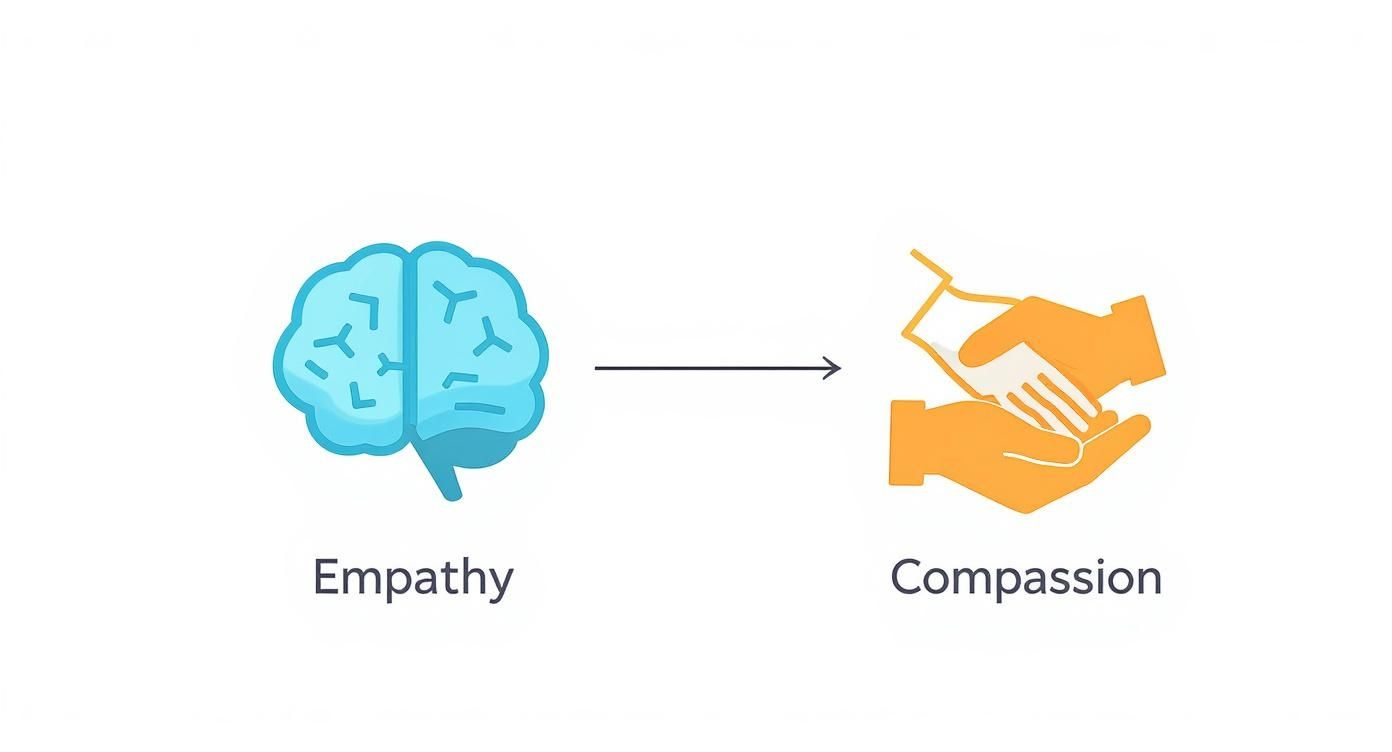
This simple diagram captures it perfectly. The cognitive and emotional understanding of empathy (the brain) can be the very thing that sparks the supportive action of compassion (the helping hands).
Empathy vs Compassion at a Glance
To make this distinction crystal clear, here’s a quick breakdown of how these two concepts stack up against each other.
| Attribute | Empathy | Compassion |
|---|---|---|
| Core Nature | A shared feeling | A caring response |
| Primary Focus | Feeling with someone | Acting to help someone |
| Motivation | Emotional resonance | Desire to alleviate suffering |
| Potential Risk | Can lead to burnout or distress | Promotes well-being & connection |
| Metaphor | Mirroring another's pain | Offering a helping hand |
This table shows that while empathy is about connection, compassion adds a layer of intention and action that protects us while helping others.
From Empathic Overwhelm to Compassionate Action
Compassion is the active, constructive response that empathy can inspire. It brings wisdom and a genuine desire to help into the equation, turning a shared feeling into real, meaningful support. So, instead of just feeling your friend’s grief alongside them, compassion is what motivates you to bring them a hot meal, listen without offering unsolicited advice, or just sit with them in comfortable silence.
"Compassion is not a relationship between the healer and the wounded. It's a relationship between equals. Only when we know our own darkness well can we be present with the darkness of others." – Pema Chödrön
This isn’t just a subtle tweak in vocabulary; it’s a powerful strategy for our own emotional sustainability. By consciously shifting towards compassion, we can engage with others' suffering without being swallowed by it. It’s a way to protect our own mental health while still showing up for the people we care about in a genuine and effective way.
This proactive stance is just as crucial when we turn inward. Developing a compassionate inner voice is a cornerstone of resilience. In fact, learning how self-compassion is the key to emotional well-being is about learning to treat yourself with the same kindness you’d offer a dear friend in need.
Ultimately, we need both. They just play different roles:
- Empathy is the mirror. It reflects another person's emotional world, letting us connect with their experience on a deeply personal level.
- Compassion is the engine. It takes that reflection and transforms it into a warm, caring impulse to support them and ease their burden.
Grasping this distinction is the first, vital step towards building stronger relationships, nurturing our own resilience, and helping to create a kinder, more connected world.
The Brain Science of Feeling and Helping
Have you ever watched a friend get upset and felt that same pang of distress yourself? Or seen a moving story on the news and felt your own eyes well up? That powerful, almost instant connection isn’t magic; it’s a product of some seriously sophisticated wiring in your brain. Getting to grips with what’s happening in there is key to navigating the worlds of compassion and empathy.

When we feel a rush of empathy, a specific network in our brain lights up, particularly regions like the anterior insula and the anterior cingulate cortex. These are the very same areas that process our own feelings, like pain or sadness. So when we see someone else suffering, these circuits fire as if we’re the ones going through it.
This incredible phenomenon is often linked to mirror neurons. Think of these as the brain’s internal mimicry system. They are a fascinating class of brain cells that fire both when we perform an action and when we watch someone else do it. They’re how we understand what others are feeling and intending to do—not by thinking it through, but by simulating their experience in our own minds.
The Mirror of Empathy
This neural mirroring is the very foundation of affective empathy—that is, the ability to feel what another person is feeling. It's an almost automatic response that creates a direct, visceral link between us. It’s why a baby might burst into tears when they hear another baby cry, or why you might physically flinch watching an athlete take a hard fall.
But this powerful connection has a dark side. Because empathy activates the brain’s own pain matrix, being constantly exposed to others’ distress can lead straight to empathic burnout. When we just keep absorbing the suffering around us without any way to process it, our brains can become completely overwhelmed.
This is a huge challenge for therapists, caregivers, doctors, and anyone in a helping profession. They feel the pain of others so deeply and so often that it can lead to:
- Emotional exhaustion: That feeling of being totally drained, with nothing left to give.
- Depersonalisation: A sense of detachment from the people you’re trying to help, almost like you’re watching from a distance.
- A reduced sense of accomplishment: The feeling that your efforts don’t make a difference anymore.
Essentially, if we stay stuck in a state of pure empathy, we risk drowning right alongside the person we’re trying to save. Our brain’s brilliant attempt to connect can, paradoxically, make us want to withdraw completely just to protect ourselves.
The Compassionate Shift
This is where the neuroscience of compassion offers a much more sustainable path. While empathy is about feeling with someone, compassion is the warm intention to help them. This isn't just a word game; it corresponds to entirely different patterns of brain activity.
Neuroscientific studies have shown that when people are trained in compassion meditation, their brain’s response to suffering changes dramatically. Instead of firing up the pain and distress circuits tied to empathy, compassion lights up a whole different set of neural pathways.
A key finding from research is that compassion activates areas of the brain associated with love, affiliation, and reward, such as the ventral striatum and the medial orbitofrontal cortex. This creates a positive, energising feeling rather than a draining one.
This "compassionate shift" is profound. It moves us from a state of distressed mirroring to one of warm, motivated action. Instead of being floored by someone else’s pain, we feel a sense of care and a genuine desire to help—which, it turns out, is an inherently rewarding experience for the brain.
From Pain to Prosocial Motivation
Think of it as the difference between two mindsets. Empathy says, "I feel your pain," and our brain responds by creating a shadow of that pain inside us. Compassion, on the other hand, says, "I see you are in pain, and I want to help," which triggers the brain networks linked to problem-solving and positive emotion.
This neurological separation is precisely why compassion is a renewable resource, while unchecked empathy can lead to burnout. Compassion gives us the resilience to face suffering—in others and ourselves—without getting consumed by it. By understanding this brain science, we can learn to intentionally shift into a compassionate response, turning our well-intentioned feelings into sustainable, helpful action.
How Compassion Transforms Healthcare
In the high-pressure world of healthcare, it’s easy to see how the human touch might get lost amidst clinical procedures and targets. But within the UK’s healthcare system, something important has shifted. Compassion and empathy have moved from being seen as ‘soft skills’ to being recognised as vital for patient safety and well-being. This wasn't a gentle evolution; it was a necessary revolution, sparked by critical failures that laid bare the devastating cost of care without connection.
The Francis Report, a watershed inquiry into major failings in patient care, forced the sector to face a difficult truth: a lack of compassion wasn't a minor oversight, but a systemic breakdown that led to profound suffering. This realisation kickstarted a movement to weave compassionate care into the very DNA of the NHS.
You can see this change just by looking at the language used in professional circles. In the 1980s, you’d find only 6 references to ‘compassion’ in the British Nursing Index. Fast forward to 2010–2019, and that number rocketed to 1,645, with a significant jump in 2013—the same year the final Francis Report landed.

What Compassionate Care Looks Like
So, what does this actually look like on a hectic ward or in a busy GP’s surgery? It’s not about grand gestures. It’s about small, powerful actions that completely change the patient experience.
It’s the doctor who, instead of rushing through a consultation, pauses, makes eye contact, and says, "I can see you're worried. What’s really on your mind?" It’s the nurse who doesn't just administer medication but takes an extra moment to straighten a patient's pillow, quietly restoring a sense of dignity.
These aren’t just random acts of kindness; they are clinical interventions. They build trust, ease anxiety, and even help people stick to their treatment plans. When patients feel truly seen and heard, they open up, sharing vital information they might otherwise have kept to themselves.
Compassionate care is the recognition that behind every chart and diagnosis is a human being experiencing vulnerability, fear, and uncertainty. It is the commitment to meeting that humanity with skill, warmth, and respect.
This philosophy is at the heart of approaches like Compassion Focused Therapy (CFT), which gives clinicians a structured way to build these qualities. In fact, if you're interested, you can read about how https://drchrisirons.com/dr-chris-irons-leading-the-way-in-compassion-focused-therapy/. CFT offers tools not just for improving patient care, but also for helping healthcare professionals cope with the intense emotional load of their jobs, heading off the burnout that can come from empathy without support.
Embedding Compassion into Medical Training
To make this change last, the way we train doctors and nurses has been completely re-thought. The focus now extends far beyond technical proficiency to actively develop the relational side of medicine.
Future clinicians are now taught through methods like:
- Role-playing scenarios: Trainees get to practice difficult conversations, like breaking bad news, with actors who help them navigate the emotional complexities.
- Reflective practice: Students are encouraged to journal and discuss the emotional side of their work, building crucial self-awareness and resilience.
- Patient shadowing: Learners follow a patient's entire journey, giving them a powerful, unfiltered look at what it’s like to be on the receiving end of care.
This systematic approach proves that compassion isn't just an innate gift for a lucky few—it's a skill that can be taught, measured, and developed. By making it a core competency, we create a healthcare culture that truly values both patient outcomes and staff well-being. To see what this looks like in action, you can explore insights on the power of a compassionate and innovative team in healthcare. The evidence is clear: building compassion into our health service isn't just the right thing to do; it's the smartest thing to do.
Right, so we can talk about the warm glow of compassion or that little spark of connection we call empathy, but how on earth do you actually measure something like that? It sounds a bit like trying to weigh a feeling, doesn't it?
But scientists have come up with some rather clever ways to bring these deeply personal experiences into the world of concrete data. What this shows us is that compassion and empathy aren't just fuzzy, feel-good ideas. They are skills we can measure, with real, predictable, and positive effects.
By turning a subjective experience into objective data, we get a much clearer picture of what helps these qualities grow and what their true impact is on our behaviour and well-being.
From Self-Reports to Seeing it in Action
One of the most straightforward ways to measure these qualities is, well, to just ask people. Researchers use carefully designed questionnaires called self-report scales. Now, these aren't your average online quiz; they are scientifically validated tools, tested over and over for reliability and accuracy. They’re designed to help people reflect on their own tendencies toward compassion and empathy in different situations.
Of course, researchers know there can be a gap between what we say we’d do and what we actually do when the moment comes. To get a fuller picture, they often pair these surveys with behavioural experiments, creating scenarios where they can observe compassion in action. It's this combination that gives us a powerful, multi-layered view.
Measuring compassion and empathy isn't about judging who is 'good' or 'bad'. Instead, it’s about understanding the underlying psychological processes so we can learn how to cultivate these essential human qualities more effectively in ourselves and our communities.
The Tools of the Trade
Psychologists have a whole toolkit for looking at these qualities. Each method offers a unique lens, and when you put them all together, you start to build a really detailed understanding of how compassion and empathy work.
Here are a few of the key approaches they use:
- Validated Questionnaires: Tools like the Compassionate Love Scale for Humanity ask people to rate statements like, "I tend to feel compassion for people, even when I do not know them." This gives us quantitative data on a person's general disposition.
- Behavioural Tasks: In a controlled lab setting, someone might be given an unexpected chance to help. This could be anything from donating a bit of their payment for taking part in the study to a charity, or being asked to spend extra time helping another participant who seems to be struggling.
- Physiological Monitoring: We can also look at what's happening in the body. Researchers can track things like heart rate variability and brain activity. It turns out that certain patterns are consistently linked to a state of calm, connected compassion, which is quite different from the agitated state of personal distress.
A review from 2023 really highlighted the diverse range of tools out there, noting that here in the UK, self-report scales are very widely used. But crucially, it also found that almost a quarter of studies (24.4%) used objective behavioural measures—like seeing if someone actually offers help to a person in distress—to assess compassion in real-time. You can dig into the full scope of these methods in the detailed research findings on compassion and empathy.
By using these methods, science is confirming what many of us feel intuitively: compassion isn't just a fleeting emotion. It is a tangible, observable force with the power to shape our actions and, ultimately, improve our world.
Building Your Self-Compassion Toolkit
It’s often said that true compassion for others begins at home – with the compassion we show ourselves. Think about it: before we can effectively offer an umbrella to someone caught in a downpour, we first have to learn how to shelter ourselves from our own internal storms. Building a solid foundation of self-compassion isn't selfish; it's the essential groundwork for creating the emotional resilience we need to support others without completely draining our own reserves.
This toolkit is designed to help you do just that – to cultivate a kinder, more supportive inner voice. It’s structured around the three core pillars of self-compassion: self-kindness, a sense of common humanity, and mindfulness. By working with these ideas, you can begin to shift the most important relationship you have – the one with yourself – from one of criticism to one of genuine care.

Embrace Self-Kindness Instead of Judgment
The first pillar, self-kindness, is all about treating yourself with the same warmth and understanding you’d naturally offer a good friend. When we mess up or fall short, our default reaction is often a barrage of harsh self-criticism. Self-kindness is the practice of consciously replacing that inner critic with a voice of gentle support.
Imagine a friend calls you, distraught after making a mistake at work. You wouldn’t dream of saying, "Well, you're a complete failure." You'd offer comfort, perspective, and encouragement. Self-kindness is simply about turning that same compassionate response inward.
This isn’t about ignoring your flaws or letting yourself off the hook. It’s about motivating yourself with encouragement rather than fear, which research shows is a far more effective and sustainable way to grow.
"Self-compassion is a way of relating to ourselves kindly—embracing ourselves as we are, flaws and all." – Dr. Kristin Neff
For a deeper dive into cultivating this kinder inner dialogue, this excellent How to Develop Self-Compassion: A Practical, Evidence-Based Guide offers a wealth of valuable insights.
Recognise Your Common Humanity
The second pillar is common humanity. This is the simple, yet profound, recognition that suffering and personal imperfection are just part of the shared human experience. When we fail or feel pain, our first instinct is often to feel intensely isolated, as if we’re the only one who has ever struggled this way. That feeling of separation just pours salt on the wound.
Common humanity is the perfect antidote to that isolation. It’s the gentle reminder that everyone makes mistakes. Everyone feels inadequate sometimes. Everyone experiences pain. Realising that these struggles connect you to the rest of humanity, rather than separating you from it, can completely change your perspective.
This shift helps to normalise what you're going through. Instead of asking, "What's wrong with me?", you can start to think, "This is a difficult moment for a human being. How can I care for this person?"
Cultivate Mindful Awareness
The final pillar is mindfulness. In this context, it means taking a balanced approach to our difficult emotions, so that they are neither suppressed nor exaggerated. It’s about observing our thoughts and feelings just as they are, without getting caught in the drama or judging ourselves for having them.
Without mindfulness, we can easily become fused with our thoughts. A single negative thought like, "I failed that presentation," can quickly spiral into a core belief like, "I am a failure." Mindfulness creates a small pocket of space between you and your thoughts, allowing you to see them without letting them define you.
This practice gives you the clarity to see your situation for what it is, without all the added baggage of self-criticism. It lets you acknowledge your pain without being consumed by it, which is the crucial first step toward responding with kindness.
Your Self-Compassion Toolkit
Of course, understanding these concepts is one thing; putting them into practice is what truly builds the skill. The table below offers a few simple, practical exercises you can use to strengthen each pillar of self-compassion in your daily life.
| Component of Self-Compassion | Goal | Simple Exercise |
|---|---|---|
| Self-Kindness | To replace self-criticism with a warm, supportive inner voice. | The Compassionate Friend Letter: Write a letter to yourself from the perspective of an imaginary, unconditionally loving friend, addressing a specific struggle you are facing. |
| Common Humanity | To feel connected to others in your struggles rather than isolated. | Connecting Phrases: When you feel you've made a mistake, repeat phrases like, "This is a moment of suffering," "Suffering is a part of life," or "Many other people feel this way." |
| Mindfulness | To observe your feelings without judgment or exaggeration. | The Self-Compassion Break: Place a hand over your heart, notice the feeling of pain without judgment, and offer yourself kind words like, "May I be kind to myself." |
Remember, these exercises aren't about eliminating pain. They're about fundamentally changing how you relate to it. By consistently practising these small actions, you're building new, kinder neural pathways. For those who want to explore these skills in a more structured way, an online self-compassion course can provide invaluable guided support.
Building this toolkit gives you the inner strength to not only navigate your own challenges but also to show up for others with greater compassion and empathy.
Putting Compassion Into Practice in Your Daily Life
Knowing what compassion and empathy are is one thing; actually weaving them into the fabric of your life is where the real magic happens. This isn't about grand, dramatic gestures. It's about the small, deliberate, and consistent choices we make every day—choices that create a positive ripple effect in our personal and professional worlds.
Think of this as your roadmap for action. It’s about consciously choosing to bring compassionate awareness into the moments that matter, whether you're navigating a tricky conversation at home or trying to create a more supportive team at work.
Compassion in Leadership
If you're in a leadership role, bringing compassion to your team is a seriously powerful way to build trust and psychological safety. This goes beyond simple empathy—it's not just understanding that an employee is stressed, but taking supportive action. It means creating a culture where vulnerability is met with respect, not judgement.
Here are a few simple, actionable ways to lead with compassion:
- Listen to Understand, Not Just to Reply: In meetings, instead of just waiting for your turn to speak, really tune in to what the other person is saying. Try asking clarifying questions like, "So, what I think I'm hearing is… is that right?" This simple act validates their contribution and makes them feel genuinely heard.
- Check In with Real Intention: Ditch the generic "How are you?" Instead, ask specific, open-ended questions like, "What support do you need this week to feel successful?" This shows you genuinely care about their well-being and their growth.
- Model Self-Compassion: When you make a mistake, own it. Talk openly about what you learned from it. This shows everyone that being imperfect is a normal part of work and encourages your team to take healthy risks without fearing blame.
Compassion in Personal Relationships
In our closest relationships, empathy is what helps us connect with a partner's or a friend's feelings during a fight. But compassion? That's what helps us navigate the conflict constructively. It’s the shift from a "me vs. you" mentality to an "us vs. the problem" approach.
The goal of compassionate communication isn't to win an argument, but to understand and preserve the connection. It’s about prioritising the long-term health of the relationship over the short-term need to be right.
This really comes down to pausing before you react. When you feel that surge of defensiveness rising, just take a breath. Try to get curious about the unmet need hiding behind your loved one's words. This small act of turning towards their pain, rather than away from it, can completely defuse the tension and open the door to finding a solution together.
By consciously embedding these small acts of compassion and empathy into our daily interactions, we do more than just improve our own lives. We contribute to a wider culture of kindness and connection, creating a positive impact that extends to our families, workplaces, and communities.
Frequently Asked Questions
Digging into the differences between compassion and empathy often brings up some really practical, important questions. How do we actually sit with someone else's pain without it completely swallowing us whole? And how can we offer support that feels genuine but is also sustainable for us? Let's tackle a few of the most common queries that come up.
Can Compassion Lead to Burnout?
This is a massive concern for many people, especially those in caring professions. But the worry usually comes from mixing up compassion with something else: empathic distress.
If you're constantly just feeling another person's pain—that unchecked, raw empathy—then yes, emotional exhaustion is a real risk. True compassion, however, is a different beast entirely. It lights up different parts of the brain, the ones associated with warmth, care, and a motivation to help. It's an experience that tends to energise rather than drain.
Think of compassion as a protective buffer. It lets you stay present and witness suffering without having to absorb it yourself. It’s the crucial shift from "I feel your pain" (empathy) to "I see you're in pain, and I want to help" (compassion). Nailing this distinction is the key to sidestepping burnout and building real, long-term resilience.
We often talk about ‘compassion fatigue’, but I think that’s a misnomer. What people are usually experiencing is empathic distress fatigue. The solution isn't to care less; it's to find a more sustainable, compassionate way of caring.
How Can I Be Compassionate Without Being Taken Advantage Of?
Another common fear is that being compassionate means you have to be a doormat. This just isn't the case. Real compassion is fused with wisdom and healthy boundaries. It’s about being able to see clearly what's yours to do and, just as importantly, what isn't.
Wise compassion isn't about giving and giving until you're completely empty. It absolutely includes the ability to say "no." That "no" doesn't come from a place of coldness or selfishness; it comes from a place of self-respect and a clear-eyed understanding of your own limits. This kind of discernment is vital for your own wellbeing and for the health of your relationships.
Are People Born with Compassion or Can It Be Learned?
While it’s true that some people seem to have a more naturally kind disposition, the really good news from neuroscience is that compassion is a skill. It can be intentionally developed and strengthened. Just like you'd go to the gym to build a muscle, you can train your brain to become more compassionate.
A few practices are particularly brilliant for this:
- Mindfulness Meditation: This helps build the awareness you need to respond to suffering with clarity instead of just reacting to it.
- Loving-Kindness Meditation: This is an active practice of wishing well for yourself and for others, which directly strengthens the neural pathways for care and warmth.
- Self-Compassion Exercises: Learning to be kind to yourself is foundational. It builds the inner resources you need to be able to extend that compassion outwards to others.
Through consistent practice, anyone can strengthen their capacity for both compassion and empathy.
At Dr Chris Irons, I specialise in helping individuals and leaders develop these essential skills through Compassion Focused Therapy and coaching. If you are ready to build a kinder relationship with yourself and others, explore how my services can support your journey.