Waking up to a racing heart, a tight knot in your stomach, and a flood of worries is an exhausting way to start the day. It’s a feeling that’s all too familiar for many of us—that transition from sleep to wakefulness triggers a wave of anxiety that can cast a shadow over the entire day.
This isn’t just in your head; it’s rooted in our biology.
Why Mornings Can Feel So Hard
Our bodies have a natural rhythm. Each morning, they produce a surge of the stress hormone cortisol, a process known as the Cortisol Awakening Response (CAR). This is actually a good thing—it’s designed to help us wake up and feel alert.
But when you're already prone to anxiety, this natural hormonal spike can feel less like a gentle nudge and more like a blaring alarm bell. It can launch your mind straight into “what-if” scenarios and worst-case outcomes before you’ve even had a chance to properly wake up. Add in the constant ping of notifications and a looming to-do list, and it’s a recipe for feeling overwhelmed.
Meditation Isn’t What You Think It Is
This is exactly where a morning meditation practice can make a real difference. It’s easy to get caught up in the idea that meditation is some esoteric practice that requires a perfectly silent room and a completely empty mind. But in reality, it's much simpler and more practical than that.
Think of it less as 'emptying your mind' and more as 'anchoring your mind'.
Meditation acts as a circuit breaker for those anxious thought loops that spin out of control. By intentionally shifting your focus to something neutral—like the sensation of your breath moving in and out, or the feeling of your feet on the floor—you interrupt the mental chaos.
This simple act of redirecting your attention achieves a few crucial things:
- It gently activates your parasympathetic nervous system, shifting your body out of a 'fight or flight' state and into a calmer 'rest and digest' mode.
- It creates a little bit of mental space, giving you a moment to notice your anxious thoughts without immediately getting swept away by them.
- It builds self-awareness, helping you start to recognise the patterns of morning anxiety as they arise, which is the first step to changing your relationship with them.
Building a Buffer of Calm for Your Day
The goal here isn't to eliminate anxiety forever—that's an unrealistic expectation. Instead, the aim is to change how you relate to it. Just a few minutes of meditation in the morning provides a crucial buffer between you and the day's demands.
It’s a deliberate choice to begin your day from a place of relative calm, rather than from a place of immediate reactivity.
This practice is also an incredibly powerful way to build self-compassion, a vital skill for navigating anxiety. By taking this time just for you, you’re sending a powerful message of care to yourself. You can learn more about how this works by exploring the key to emotional well-being and resilience.
This isn't just a nice idea; there's a growing body of evidence to back it up. Let's take a look at a quick summary of how this practice directly helps calm that morning rush of anxiety.
How Morning Meditation Calms Anxiety
| Benefit | How It Helps Your Morning |
|---|---|
| Regulates Cortisol | Helps manage the morning cortisol spike, preventing it from spiralling into a full-blown anxiety response. |
| Reduces Reactivity | Creates a calm "buffer," so you start the day feeling centred instead of immediately reacting to stress. |
| Quiets Mental Noise | Interrupts the cycle of worrying thoughts, giving your mind a chance to settle before the day's demands kick in. |
| Grounds You in the Present | Pulls your focus away from future worries and into the physical sensations of the here and now. |
With anxiety levels on the rise in the UK, finding practical tools is more important than ever. A 2023 survey by the charity Mind found that 62% of respondents who practised meditation reported a significant reduction in their morning anxiety symptoms. This highlights just how effective a simple, consistent habit can be in changing the tone of your entire day.
Your Flexible Meditation Toolkit for Any Schedule
One of the biggest hurdles I see people face when starting a meditation practice isn’t a lack of interest; it's the nagging belief that they just don't have the time. We’ve all got this image in our heads of what meditation should look like: a long, silent ritual on a special cushion in a perfectly quiet room. But when you're trying to manage the chaos of morning anxiety, that ideal isn’t just impractical—it’s completely unnecessary.
Real, lasting change comes from being flexible. It’s about building a toolkit of practices you can turn to whether you’ve got sixty seconds before the kettle boils or fifteen minutes of peace before the rest of the house wakes up. This way, meditation becomes less of a rigid chore and more of an adaptable ally, ready to meet you exactly where you are.
The trick is to let go of the need for perfection and just embrace what’s possible in the moment. The goal isn’t some lofty state of blissful emptiness. It’s simply about gently grounding your awareness, even if it's just for a few breaths.
This visual really captures the power of using meditation to interrupt that all-too-familiar cycle of morning anxiety.
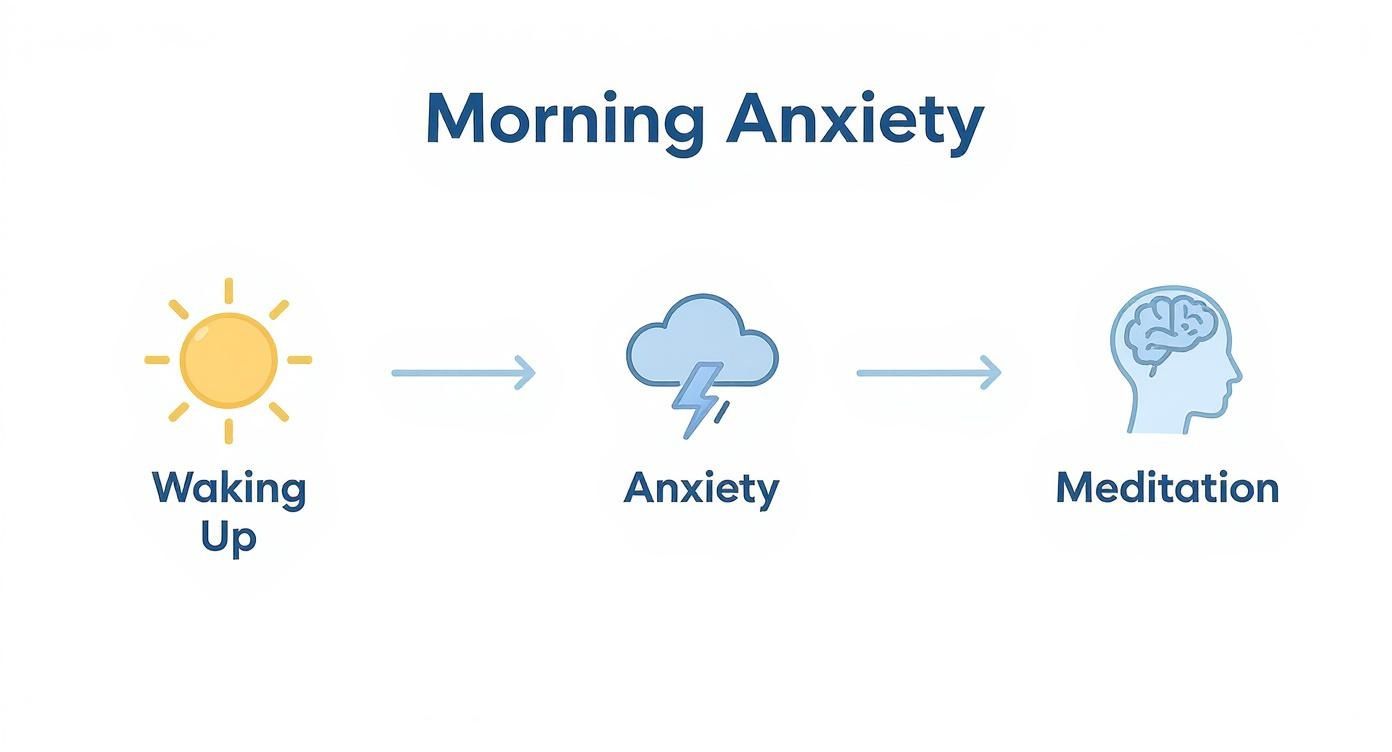
As you can see, meditation acts as a crucial intervention. It creates a deliberate pause between the trigger (waking up) and the reactive spiral of anxious thoughts that can so easily take over.
The 1-Minute Emergency Reset
Think of this as your go-to for those moments of intense overwhelm. It’s designed to be done anywhere, anytime. Seriously. Standing in the kitchen, sitting in your car before you head into work, or even at your desk before you dare to open your emails. Its real power is in its simplicity and immediacy.
The point here isn’t to magically solve your anxiety, but to act as a circuit breaker. When your nervous system is firing on all cylinders, this quick grounding exercise can interrupt the panic signal and pull you back into the present moment.
Here’s a simple script you can say to yourself:
"Okay, I feel that anxiety bubbling up. I’m just going to pause for one minute. First, I’ll plant my feet firmly on the floor. Really feel the ground beneath me—it's solid, it's stable. Now, one slow, deep breath in through my nose… and a long, slow breath out through my mouth. Let's do one more like that—a slow inhale, and an even slower exhale. I am right here, right now. I am safe in this moment."
This technique is surprisingly effective because it hits two key anxiety triggers:
- Physical Grounding: Actually feeling your feet on the floor activates a sensory connection to the present. It yanks your awareness out of those future-worries and back into your body.
- Breath Regulation: That long exhale directly signals to your vagus nerve that it's safe to stand down. It helps your body shift from a 'fight or flight' state into a much calmer one.
This is your portable anchor. With a bit of practice, it becomes a skill that teaches your brain a new, much faster pathway to calm.
The 5-Minute Grounding Body Scan
When you have a little more time up your sleeve, a five-minute body scan can be incredibly powerful for reconnecting with yourself, especially when you feel scattered or disconnected. Morning anxiety often shows up physically—a tight chest, a clenched jaw, shoulders up around your ears. A body scan helps you notice this tension without judging it and gently invites it to release.
This isn’t about forcing yourself to relax. It's more about bringing a kind, curious awareness to what's happening in your body, just as it is. You can do this sitting in a chair, or even before you get out of bed.
A Simple 5-Minute Guided Practice
- Settle In (30 seconds): Get comfortable. Close your eyes if that feels okay, and just take three gentle, easy breaths.
- Focus on Your Feet (1 minute): Bring all of your attention down to your feet. What do you notice? Warmth, coolness, the pressure against the floor or your bedsheets? You don't need to change a thing, just notice.
- Travel Up Your Legs (1 minute): Slowly guide your awareness up through your ankles, calves, and thighs. Just observe any feelings of tightness, tingling, or maybe nothing at all, without getting tangled up in a story about it.
- Scan Your Torso (1 minute): Now, shift your attention to your stomach, chest, and back. Can you feel the gentle rise and fall with your breath? If you find tension, just acknowledge it with a sense of kindness. No need to fight it.
- Relax Your Shoulders, Neck, and Face (1 minute): Let your awareness travel up to your shoulders—a classic spot for holding stress. See if you can soften them just a little. Then move to your jaw, the tiny muscles around your eyes, and your forehead. Let go of any clenching.
The body scan is a cornerstone of mindfulness. It trains your mind to stay present and helps you build a more compassionate relationship with your body, which is so often the first place we register anxiety.
The 15-Minute Compassionate Awareness Practice
When your morning allows for it, a longer 15-minute practice can help you work more deeply with the underlying patterns of anxiety—especially that harsh inner critic that loves to fan the flames. This practice blends mindfulness with the core principles of Compassion-Focused Therapy (CFT), helping you cultivate a kinder, more supportive inner voice.
This is not about slapping on a layer of forced positive thinking. It’s about acknowledging your distress with warmth and offering yourself the same support you’d give to a dear friend. It can be helpful to create a soothing atmosphere for this one. For some, exploring tools like aromatherapy candles for meditation and focus can add another layer of sensory calm to the routine.
Here’s a way to structure this compassionate practice:
- Arrival and Grounding (3 minutes): Start by settling into your posture and bringing your focus to your breath. Notice the simple rhythm of your inhales and exhales, letting each breath help you arrive fully in this moment.
- Acknowledging Anxiety with Kindness (5 minutes): Gently bring to mind the feeling of morning anxiety. Instead of bracing against it or pushing it away, see if you can meet it with gentle curiosity. You might silently say to yourself, "Ah, anxiety is here. This feels really difficult."
- Offering Compassionate Phrases (5 minutes): Now, gently offer yourself a few phrases of kindness. These aren't empty affirmations; they're expressions of your intention to be an ally to yourself. Choose whatever resonates, maybe something like:
- "May I be kind to myself in this moment."
- "This is a moment of struggle; suffering is part of being human."
- "May I give myself the compassion that I need right now."
- Return to the Breath (2 minutes): To close, just let the phrases go and return your focus to the simple, physical sensation of your breath. Feel it anchoring you before you open your eyes and move into your day.
This kind of practice directly counters the self-criticism that so often goes hand-in-hand with anxiety ("Why can't I just cope?"). It’s about building an inner resource of strength and resilience. If you're interested in exploring these ideas further, resources like the CFT-based app from Dr Chris Irons offer guided exercises that can help you develop a more compassionate mindset in your daily life.
By having these three distinct options—the 1-minute reset, the 5-minute scan, and the 15-minute compassionate practice—you build a toolkit that’s robust, flexible, and perfectly suited to the unpredictable nature of our modern mornings.
The Science Behind a Calmer Morning Routine
Understanding why a simple meditation for morning anxiety works so well can be a huge motivator. It’s not just wishful thinking; it’s about intentionally working with your body’s own chemistry and wiring. Once you grasp the science, the practice stops feeling like a vague "should" and becomes a practical, empowering tool you can actually use to reshape your morning.
At its core, morning anxiety is often a physiological event long before it becomes a mental one. Your nervous system simply gets stuck in high gear. Meditation, particularly practices that focus on the breath, gives you a direct way to downshift.
This all comes down to your autonomic nervous system, which has two main branches. You’ve got the 'fight or flight' system (the sympathetic one), which is responsible for flooding you with adrenaline and cortisol when you feel under threat. Then there's the 'rest and digest' system (the parasympathetic), which brings a sense of calm and safety. A long, slow exhale is one of the fastest ways to manually flick the switch on this calming system, sending a clear signal to your brain and body that you're safe.
Your Brain's Natural Window of Opportunity
Interestingly, our minds seem to be naturally primed for this kind of positive work in the morning. A large-scale study from University College London discovered that our self-reported mental wellbeing is typically at its peak right after we wake up. People tend to report the lowest levels of anxiety and the highest levels of happiness first thing, with these feelings often dipping as the day wears on.
This creates a brilliant strategic window. It’s the perfect time to practise meditation when our minds are most receptive to building positive mental habits. You can read the full research about these mental wellbeing findings to dig deeper.
What this research really highlights is that a morning meditation isn't just about putting out fires; it’s a proactive strategy. You're taking advantage of a natural peak in your mental state to build a foundation of calm that can help buffer you against whatever stresses pop up later in the day. It’s about setting a positive trajectory from the moment you open your eyes.
By meditating in the morning, you are essentially harnessing your brain's most resilient and positive state to build a resource of calm that you can draw upon for the rest of the day.
Quieting the Inner Critic with Compassion
Anxiety isn't just a physical sensation, is it? It’s often fuelled by a harsh inner critic that whispers worries and worst-case scenarios. This is where the principles of Compassion-Focused Therapy (CFT) become incredibly helpful. CFT helps us understand that we have different emotional systems, including a threat system (where anxiety lives) and a soothing system.
A morning meditation, especially one focused on compassion, is a direct way to stimulate that soothing system. It’s about intentionally generating feelings of warmth, kindness, and support for yourself, just as you would for a good friend who is struggling.
This isn't about ignoring the anxiety but changing your relationship with it. Instead of meeting anxious feelings with more self-criticism ("Why am I like this? I need to get it together!"), you learn to meet them with kindness. This has a profound neurological effect, helping to dial down your threat response and quieten the anxious chatter.
Here’s what this might look like in practice:
- Acknowledging the struggle: Simply noticing "Ah, anxiety is here. This is hard," without adding any judgement.
- Activating warmth: Placing a hand over your heart to bring in a physical sense of comfort and care.
- Offering kind phrases: Silently repeating phrases to yourself, like, "May I be kind to myself in this moment."
By consistently practising this, you are literally rewiring your brain’s default response to distress. You're training it to activate a soothing, supportive network rather than an anxious, critical one, which is what makes meditation such a fundamental skill for lasting anxiety relief.
Navigating Common Meditation Roadblocks

Starting a morning meditation practice is a profound act of self-kindness, but let's be honest, it isn't always easy. Hitting a few bumps in the road is completely normal. In fact, these challenges aren't signs you're failing; they are the practice.
The goal isn't to float away into some perfect, blissful state every single time you sit. It's about learning how to meet your own mind and body with patience and gentle curiosity, especially on the days it feels most difficult.
Let's walk through some of the most common hurdles and explore how you can work with them compassionately.
What to Do When Your Mind Won’t Stop Racing
One of the first things people realise when they try to sit quietly is just how incredibly busy their mind actually is. Thoughts about the day ahead, replaying old conversations, or an endless to-do list can feel relentless. It’s so tempting to get frustrated and think, "I'm doing this wrong!"
But a busy mind isn't a problem to be solved; it's an opportunity to practise. The real "work" of meditation is simply noticing when your mind has wandered and gently, without any judgement, guiding it back to your anchor, like the feeling of your breath.
Think of it like training a puppy. You wouldn't scold it for wandering off; you would just gently lead it back. Each time you notice your mind has drifted and you bring it back, you are strengthening your focus and self-awareness—that's a success.
Instead of fighting the thoughts, try this:
- Label them. Silently say to yourself, "thinking," or "worrying." This creates just enough distance to help you see them as passing mental events, not facts.
- Return gently. Soften your focus and kindly redirect your attention back to the physical sensation of your breath in your body.
- Repeat endlessly. You might have to do this dozens of times in a five-minute session. That’s perfectly okay. That is the practice.
How to Handle Physical Restlessness and Fidgeting
Sometimes, the biggest challenge isn't a racing mind but a restless body. You might feel an overwhelming urge to shift your position, scratch an itch, or just get up and do something else. This physical agitation is often just anxiety showing up in the body.
Forcing yourself to stay perfectly still can backfire, making you feel even more trapped. Instead of battling your body, give yourself permission to work with that energy.
- Try a walking meditation. If sitting still feels absolutely impossible, take your practice on the move. Walk slowly and deliberately, paying full attention to the sensation of your feet connecting with the ground. This can be a powerfully soothing way to handle morning anxiety.
- Focus on the body. Use a body scan technique. Instead of fighting the restlessness, bring a curious awareness directly to it. What does that fidgety energy actually feel like in your hands or legs?
- Allow for small movements. It's fine to mindfully adjust your posture. The key is to do it with intention rather than reacting unconsciously to every twitch.
When You Feel Like It Isn't Working
It's so easy to start meditating with high expectations, hoping for immediate relief from morning anxiety. The reality is that progress is rarely a straight line. Some days will feel calm and focused, while others will feel like a struggle from start to finish.
The benefits of meditation are cumulative. They build slowly over time, often in subtle ways you might not even notice at first. The most important thing you can do is release the pressure for any single session to feel a certain way.
Remember that just showing up is the victory. Every single time you sit, even for one minute on a difficult day, you're reinforcing a new, kinder habit. You are teaching your nervous system a different way of responding to stress and cultivating a better relationship with yourself—which is the ultimate antidote to anxiety's harsh inner critic.
Taking Mindfulness Beyond Your Morning Practice

A dedicated morning meditation is a fantastic way to set a calm and intentional tone for your day. But its real power is unlocked when you learn to carry that sense of presence with you long after you’ve left the cushion.
The goal isn't just to manage anxiety for ten minutes after waking up. It’s about building a more resilient and compassionate mindset that you can tap into anytime, anywhere. This means weaving little moments of mindfulness into the fabric of your daily life, transforming potentially stressful situations into opportunities to ground yourself.
Transform Your Commute into a Mindful Journey
For many of us, the daily commute is a prime-time anxiety trigger. It's so easy to let your mind race with worries about the day ahead. Instead, why not reclaim this time as a moment of practice? You don't need to close your eyes or sit in a specific posture; it's just about shifting your awareness.
Next time you’re on your way to work, try one of these:
- Pick one sense and stick with it: Just tune into the sounds around you. Don't label them as good or bad—simply notice the hum of the engine, the distant chatter, or the rhythm of the train on the tracks.
- Check in with your body: Feel the gentle vibration of the car or the sensation of your hands on the steering wheel. Notice the feeling of your feet on the floor.
- Observe thoughts without getting hooked: When an anxious thought pops up—"Oh, there's that worry about my meeting"—just acknowledge it. Then, gently guide your attention back to your chosen sense.
This simple act of redirection stops anxious thoughts from spiralling out of control, creating a valuable buffer of calm before you've even arrived.
The Mindful Coffee Break
A short break during a hectic day can be an incredibly powerful reset. But instead of scrolling through your phone, which often just adds to the mental noise, try using your coffee or tea break as a five-senses grounding exercise. It’s a simple, discreet way to bring mindfulness into your workday.
Bring your full attention to the experience. Really notice the warmth of the mug in your hands, the rich aroma, the subtle flavours on your tongue. This small ritual pulls you out of your head and into the present moment, offering a tangible way to interrupt the cycle of stress.
Looking for other ways to sustain that morning calm? There are many powerful mindfulness techniques for anxiety relief you can explore. It's all about finding these little pockets of awareness that, when practised consistently, add up to a huge shift in your resilience to anxiety.
Integrating These Practices with Professional Support
Talking about these informal mindfulness practices with a therapist or coach can make them even more effective. A professional can help you tailor these techniques to your specific anxiety triggers and show you how to weave them into other therapeutic approaches, like Compassion-Focused Therapy.
Sharing what works and what doesn't provides valuable feedback, allowing you to fine-tune your approach. If you’re looking to build a more supportive inner voice, exploring a structured program like an online self-compassion course can give you the tools to turn these brief moments of mindfulness into a lasting habit of self-kindness.
When you combine your personal practice with guided support, you create a robust, holistic strategy for managing anxiety—not just in the morning, but throughout your entire life.
Frequently Asked Questions
When you’re just starting out with meditation for morning anxiety, it’s only natural for questions to pop up. It can feel a bit uncertain at first, but don't worry, that's part of the process. Let’s walk through some of the most common queries I hear, so you can feel clear and confident as you begin.
The goal here isn't to add more rules, but to demystify the practice and show you just how powerful and accessible this tool can be.
How Soon Will I Feel a Difference in My Morning Anxiety?
This is the big question, isn't it? The honest answer is that everyone's journey looks a little different. Some people tell me they feel a subtle shift—a little more breathing room around their anxious thoughts—after just one or two sessions. For others, the real, noticeable benefits start to click into place after a couple of weeks of consistent practice.
The key thing to remember is that consistency is far more important than duration. A dedicated five-minute practice every single morning will do more for you than one long, haphazard session a week. You're not trying to erase anxiety overnight; you're building a new, more aware relationship with it, one morning at a time.
Think of it as training. This gradual process teaches your nervous system a new, calmer way to respond to the stresses of the morning.
Do I Need a Perfectly Quiet Space or Special Gear?
Absolutely not. This is probably the biggest myth out there, and it stops so many people before they even start. A quiet, peaceful spot is lovely, of course, but it’s definitely not a must-have. Life is rarely silent, and learning to find a bit of inner stillness amidst the everyday chaos is a genuinely useful skill.
You can do this almost anywhere. I've had clients practise:
- In their parked car for a few minutes before heading into the office.
- On the train during their commute, maybe with some headphones on.
- At the kitchen table with a cup of tea before the rest of the house wakes up.
You don't need special cushions, fancy blankets, or expensive apps. Your own breath and your willingness to just show up for yourself are the only tools you truly need. Remember the 1-minute 'Emergency Reset' we talked about? It was designed precisely for those moments when you have neither quiet nor privacy.
What If Trying to Meditate Makes My Anxiety Worse?
This is such a common and understandable fear. When you finally stop rushing around and sit still, you're giving your mind its first real chance to notice what’s already there—that low-level hum of anxiety that's been buzzing under the surface all along. It’s not that meditation is creating more anxiety; it’s simply turning up the volume on your awareness of it.
If sitting still feels like too much at first, please don't force it. Try something more active, like a gentle walking meditation where you just focus on the feeling of your feet on the floor. Be kind to yourself. Start with just 60 seconds of quiet breathing. You can always build from there as you get more comfortable.
Can I Use a Meditation App with These Techniques?
Yes, of course. Guided meditation apps can be a fantastic support, especially when you're just getting started and appreciate a bit of structure. The core ideas in this guide—things like breath awareness, body scans, and offering yourself some compassionate words—are the very building blocks of countless guided practices you'll find on them.
An app can offer a soothing voice and a clear path to follow, which is incredibly helpful when your mind feels all over the place. At the same time, it’s empowering to know that the fundamental skill of paying attention is something you can do all on your own, anytime, anywhere, with no technology required.
At Dr Chris Irons, my work is centred on helping people like you build a kinder, more compassionate relationship with themselves. If you feel ready to move beyond self-criticism and find lasting ways to manage anxiety, I invite you to explore my CFT therapy and coaching services.