Before you can start to untangle the knot of shame or guilt, you first need to know which thread you’re pulling. It’s the essential first step. Guilt whispers, “I did something bad,” a message that, while uncomfortable, can point us toward making things right. Shame, however, is a much harsher critic. It screams, “I am bad,” a core belief that can leave you feeling isolated and stuck in a cycle of self-criticism.
First, Understand the Difference Between Shame and Guilt
To navigate this tricky emotional landscape, you need a reliable map. And while we often use the words ‘shame’ and ‘guilt’ interchangeably, they are worlds apart. Treating them as the same is a bit like using a hammer when you need a screwdriver – you'll likely do more harm than good.
Guilt is what we call an adaptive emotion. It’s focused on a specific behaviour. Think of that sinking feeling you get after snapping at a colleague or forgetting a friend’s birthday. It’s not pleasant, but it’s purposeful. It’s a signal that you’ve strayed from your own values, and it motivates you to apologise, make amends, or simply do better next time. In this sense, guilt can be a healthy, pro-social force that helps us maintain our relationships and our own sense of integrity.
Shame is a different beast entirely. It’s a deeply painful and often debilitating emotion that targets your very sense of self. It doesn’t just tell you that you’ve made a mistake; it concludes that you are the mistake. This feeling often triggers an intense urge to hide, to withdraw, to simply disappear. Where guilt can lead to repair, shame often leads to paralysis, leaving you feeling flawed, exposed, and utterly unworthy of connection.
Identifying Your Emotional Response
Knowing the difference in theory is one thing, but spotting it in the heat of the moment is what really counts. The next time that heavy feeling descends, ask yourself: is this discomfort tied to a specific action I took, or is it a sweeping judgment of my entire character?
- Guilt sounds like: "I feel terrible for lying about why I was late." "I really should have called my mum back sooner." "That comment I made earlier was unkind."
- Shame sounds like: "I'm such a liar; I can't be trusted." "I'm a terrible son for not calling." "I'm just a horrible person."
See the pattern? Guilt focuses on the "what," while shame attacks the "who." This distinction is the linchpin for learning how to respond effectively.
To help clarify this, I've put together a quick comparison table. It’s a handy cheat sheet for those moments when you're struggling to identify what you're feeling.
Quick Guide Distinguishing Shame from Guilt
| Characteristic | Guilt (Helpful) | Shame (Harmful) |
|---|---|---|
| Focus | On a specific behaviour ("I did something bad") | On the entire self ("I am bad") |
| Internal Voice | Self-correcting, remorseful | Self-critical, attacking, contemptuous |
| Motivation | To confess, apologise, repair, or change | To hide, withdraw, deny, or blame others |
| Feeling | Tension, regret, remorse | Feeling small, worthless, exposed, powerless |
| Outcome | Can strengthen relationships and personal growth | Can lead to isolation, depression, and destructive behaviours |
Hopefully, this table makes the distinction crystal clear. Pinpointing whether you're in a guilt or shame state is the first step toward finding the right path forward.
Below is a simple decision tree that visualises this process, showing how we arrive at these two very different emotional destinations.
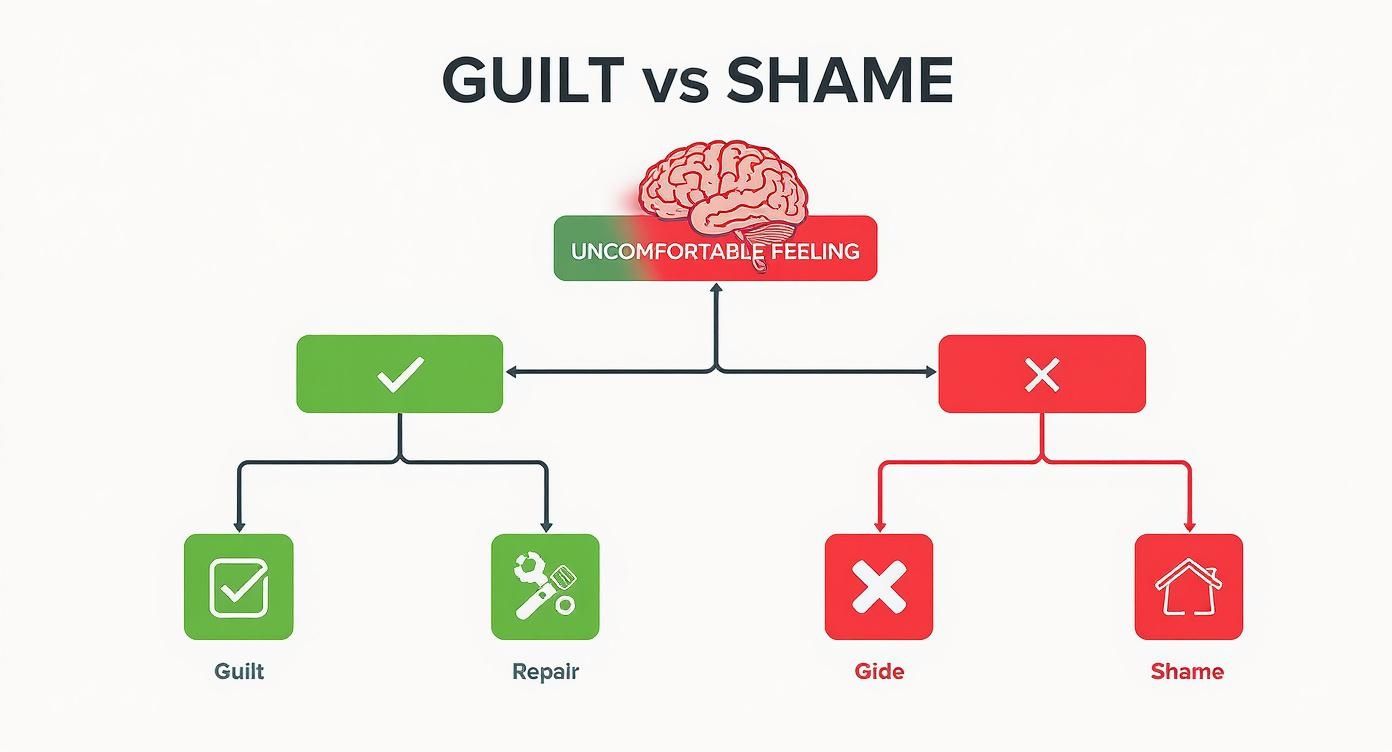
As you can see, guilt flows from evaluating a behaviour and leads towards repair. Shame, on the other hand, stems from judging your core self and leads to an urge to hide.
Why This Distinction Matters So Much
Learning to separate guilt from shame isn’t just a mental exercise; it’s a crucial act of self-preservation. When you can correctly identify your feeling as guilt, a path toward action and self-forgiveness opens up. You can see a way forward.
Shame, however, keeps you trapped. It weaves a narrative of personal defectiveness that feels impossible to escape. This internalised feeling of being "bad" can take a heavy toll on our mental wellbeing.
This is especially relevant here in the UK, where the stigma around mental health can still be a powerful force. Research from the charity Mind reveals that 51% of the UK population believes there is still significant shame associated with mental health conditions. Even more tellingly, over half of the people currently experiencing mental ill health (56%) report feeling ashamed of their condition. You can dig into the full findings on mental health shame in the UK on Mind's website.
This data really brings it home: shame is a major barrier, stopping people from reaching out for the support they need and deserve. Learning to identify and address it is a courageous first step in breaking that cycle. By recognising shame for what it is—a powerful and painful emotion, but not a true measure of your worth—you can begin to dismantle its power over you.
Why Shame Feels So Overwhelming

Shame doesn't just feel bad; it can feel all-consuming. It's that tidal wave of emotion that seems to wash over your entire sense of self. If you've ever felt that intensity, you're not alone, and there's a powerful biological reason for it. Getting to grips with this science is often the first real step in learning how to manage shame and guilt without being swept away by them.
This powerful emotion is deeply wired into our brain’s most ancient survival systems. You have to think of your brain as having evolved over millions of years with one primary goal: keeping you safe. For our ancestors, safety wasn't just about avoiding sabre-toothed tigers; it was about staying connected to the tribe. Social rejection could literally be a death sentence.
The Brain's Built-In Alarm System
Shame evolved as our social alarm bell. It’s the brain’s way of screaming, "Warning! You've just done something that could get you kicked out of the group!" This is precisely why shame feels so public and exposing, even when no one else knows what happened. It trips our most primitive threat response.
Drawing from the model used in Compassion-Focused Therapy (CFT), we can think of our emotional world as being regulated by three main systems:
- The Threat System: This is our survival-focused system, constantly scanning for danger and activating our fight, flight, or freeze response. It's fuelled by hormones like adrenaline and cortisol, creating feelings of anxiety, anger, and disgust.
- The Drive System: This is our motivational engine, pushing us to seek out resources, achieve goals, and pursue rewards. It’s associated with feelings of excitement and pleasure, driven largely by dopamine.
- The Soothing System: This is our contentment and connection hub. It’s activated by feelings of safeness, kindness, and belonging, releasing calming hormones like oxytocin. It allows us to rest, digest, and feel connected.
Shame essentially hijacks the threat system, kicking it into overdrive. When you feel shame, your brain isn't really distinguishing between a minor social slip-up and a life-threatening danger. It just registers "THREAT" and floods your body with stress hormones. This makes rational, clear-headed thought incredibly difficult.
This is exactly why shame can feel so paralysing. Your brain is essentially locking you into a threat response, making you want to fight back (blame others), run away (avoid the situation), or just freeze up (shut down completely).
Recognising this biological reality can be incredibly freeing. It depersonalises the whole experience. It’s not that you're weak or broken; it’s that your ancient, well-meaning brain is doing the very job it was designed to do—even if it's in a painful and often unhelpful way.
How Shame Keeps You Stuck
When the threat system is constantly lit up by shame, it throws the other two systems completely out of balance. It becomes nearly impossible to access your drive system—your motivation and energy just evaporate. At the same time, your soothing system gets shut down, making it incredibly hard to feel safe, calm, or connected to others.
This creates a vicious cycle. Shame triggers the threat response, which makes you feel isolated and unsafe, which in turn fuels more feelings of shame. You get trapped in a loop of self-criticism and fear.
Understanding that shame is a biological process—an overactive alarm system—is a crucial shift in perspective. It moves you from self-blame ("What's wrong with me?") to a more compassionate curiosity ("My threat system is activated right now. How can I soothe it?"). This is the foundation for loosening shame's grip and starting to treat yourself with the kindness you need to heal.
Right, so we've looked at the theory. Now it's time to shift from understanding to doing. Let's get into some hands-on practices designed to calm your nervous system and dial down that threat response.
These aren't about forcing yourself to feel positive. Instead, we're tapping into your mind's natural capacity for soothing and safeness.
https://www.youtube.com/embed/Atfp4pvJq2g
Try a Compassionate Imagery Practice
A great place to start is by bringing to mind a compassionate figure. This isn't about conjuring a perfect being; it can be anyone—real or imagined, someone you know, a historical figure, or even a version of your future self.
The key is to imagine a presence that is wise, strong, and deeply kind. Focus on what it would feel like to be in their presence and allow their warmth and compassion to fill you.
- Give your compassionate figure a name that feels safe and nurturing.
- Imagine the sound of their voice—perhaps it's gentle, warm, and full of understanding.
- Picture their facial expression—a soft gaze that offers comfort, not judgement.
- Invite them to offer you a few words of kindness and reassurance.
An inner compassionate mentor can loosen shame's grip and help you cultivate a kinder relationship with yourself.
Anchor Your Soothing System with Colour
Another powerful yet simple technique is to use colour. Think of a colour that you personally associate with calm, warmth, or support. There's no right or wrong answer here; it’s entirely personal.
Now, visualise this hue gently washing over you, bringing with it a sense of warmth and safety. Colours can be powerful triggers for memories of comfort, like the golden glow of sunlight or the soft blue of a favourite blanket.
- You might be drawn to warm tones, like a soft yellow for optimism or a gentle pink for care.
- Or maybe cool shades feel more calming, such as a pale blue for peace or a mint green for renewal.
- You could even imagine a gradient, watching one soothing hue gently blend into another.
This isn't just a nice idea. Research with UK nursing students found that while shame was a strong predictor of worsening mental health, self-compassion acted as a crucial protective buffer. Read the full study on PMC.
What to Do When You Get Stuck
It's completely normal to run into a few hurdles. Your mind might feel too busy, or you might find self-doubt or distraction creeping in. That’s okay. The goal isn't perfection.
When you notice your mind wandering, just gently guide it back.
- Pause and acknowledge where your attention has drifted, then simply return your focus to the exercise.
- If self-critical thoughts pop up, try labelling them as “just thoughts” to create a bit of distance and reduce their power.
- Keep it short and sweet. Setting a timer for just 3–5 minutes can make the practice feel much more manageable.
If you're keen to go deeper into these skills, we have a whole article dedicated to this. Check it out here: The key to emotional well-being and resilience.
Weaving These Exercises into Your Day
The real magic happens when you start integrating these practices into your daily life. You don't need to set aside an hour; a quick imagery or colour pause between tasks can be enough to reset your emotional state.
Even two minutes can give your soothing system a much-needed boost and weaken shame's hold.
- Take a moment for a compassionate colour check-in before a difficult conversation.
- Use your compassionate imagery during a stressful commute or while waiting in a queue.
- Jot down a few notes about the figure or colour you used and notice any shift in how you feel.
With a bit of practice, you'll build up a reservoir of self-kindness that you can draw on whenever you need it. Soon, activating your soothing system will become second nature when shame or guilt flares up.
Consistent practice literally rewires your brain's soothing system, empowering you to meet shame and guilt with kindness instead of fear.
Keeping a Compassionate Journal
A journal can be a brilliant way to track your progress and notice patterns over time. It doesn’t need to be an essay—just a few notes can make a huge difference.
Start each entry by jotting down the exercise you used and the feelings that came up. You could use simple prompts like, “What did my inner mentor say today?” or “Which colour felt most soothing, and why?”
Make a note of any shifts in physical tension, your overall mood, or your capacity for self-kindness before and after the practice.
- Date each entry and note the time of day to help you spot patterns.
- Rate your sense of calm on a scale of 1–10 to measure your progress.
- If you notice self-criticism popping up, write a short, self-compassionate note to yourself.
Over a few weeks, your journal becomes a map of your journey, showing you tangible proof of how compassion can counter shame. It also helps you identify triggers, so you can pre-emptively reach for these soothing practices when you need them most.
A Quick Comparison of the Exercises
| Exercise | Key Focus | Time Commitment |
|---|---|---|
| Compassionate Imagery | Building an inner mentor | 5–10 min |
| Compassionate Colour | Anchoring calm with a hue | 3–7 min |
| Daily Pause | A quick reset in the moment | 2–3 min |
This little table can help you pick the right practice for the right moment. Experiment with both and see which one helps you access that sense of calm more easily.
The more you practise, the more accessible these exercises become. You're turning moments of shame into opportunities for kindness.
Change Your Inner Dialogue with Compassionate Self-Talk

The exercises we've covered so far are fantastic for settling your nervous system, but let's be honest: shame has a very loud, persistent voice. That internal narrative, your inner critic, can sneak in and undo all your hard work by drip-feeding you a constant stream of harsh judgements. Truly learning how to handle shame and guilt means we have to go to the source and start reshaping this self-talk.
Think of a relentless inner critic as shame’s closest ally. It’s the voice that replays your mistakes on a loop, magnifies your flaws until they're all you can see, and tries to convince you that you are fundamentally not good enough. To genuinely heal, you have to learn how to shift this internal conversation from one of self-punishment to one of self-understanding.
This isn’t about plastering over the negativity with forced positivity. It’s about cultivating a wiser, kinder internal voice that can offer some much-needed perspective, balance, and support when you need it most.
Challenge Your Thoughts with Compassion
A really practical way to start is with what we call Compassionate Thought Challenging. This is all about catching those self-critical thoughts in the act and gently—but firmly—questioning whether they’re actually true or even helpful. Instead of accepting them as gospel, you start to see them for what they are: just thoughts, and often pretty distorted ones at that.
The next time you catch that harsh voice piping up, just pause. Try working through these steps:
- Catch the Thought: First, get it down on paper. What are the exact words your inner critic is using? Something like, "I completely messed up that presentation. I'm so incompetent."
- Question the Evidence: Now, ask yourself: is this 100% true? Was the entire presentation a disaster, or were there actually parts that went well? Am I incompetent in every area of my life, or have I had successes?
- Find a Kinder Perspective: Imagine what a compassionate friend would say. They’d likely offer a far more balanced view, wouldn't they? Maybe something like, "Okay, one part of the presentation felt a bit shaky, but you recovered brilliantly, and the client seemed happy with the main points. Everyone has off-moments; it doesn't define your overall competence."
A single thought is not a fact. By questioning our inner critic, we create the space needed to introduce a kinder, more realistic narrative. This simple act of pausing and questioning can break the automatic cycle of self-criticism.
Practising this consistently weakens the critic’s power over time. It's important work. Think about it: public humiliation is an extreme form of external shame, and we know from research it can lead to severe mental health issues. Studies have even found a significant link between humiliation, shame, and conditions like PTSD, which just highlights how damaging these critical voices can be—whether they come from outside or within.
Rewrite Your Story with Compassionate Letter Writing
Another incredibly powerful technique is Compassionate Letter Writing. This exercise is designed to help you step outside your own head for a moment and tap into a kinder perspective by writing to yourself as if you were a wise, caring friend.
Find a quiet moment with a pen and paper. Bring to mind a situation that's currently making you feel shame or guilt. Now, start writing a letter to yourself about it, but from the point of view of someone who loves you unconditionally.
If you're stuck, here are a few prompts to get you started:
- Acknowledge the pain: "Dear [Your Name], I know you're feeling really down about…"
- Validate your struggle: "It makes total sense that you feel this way because…"
- Remind yourself of your strengths: "I know you're a person who tries their best, and I've seen you handle so much…"
- Offer a balanced perspective: "While you wish things had gone differently, remember that…"
- End with kindness: "Please be gentle with yourself. You are worthy of kindness."
This can feel a bit strange or even awkward at first, but it’s a direct way to practise generating self-compassion. To help foster a more compassionate inner voice, you might also find resources like self-love affirmation cards can be a great support, offering daily reminders of your inherent worth.
Putting It All Together: A Real-World Example
Let's walk through how these techniques could transform a real-life shame spiral.
The Shaming Thought:
"I lost my temper with the kids again this morning. I'm a terrible parent."
Compassionate Thought Challenging in Action:
- Catch it: "I'm a terrible parent."
- Question it: Is that 100% true? "No, I'm not always a terrible parent. Yesterday, we had a lovely time at the park. Right now, I'm just exhausted and stressed."
- Reframe it: "I had a difficult morning and I reacted poorly. I am a stressed parent who made a mistake, and I can apologise and try to do better this afternoon."
Compassionate Letter Writing Snippet:
"Dear me, I know you feel awful about this morning. It's so hard when you're tired and the kids are being challenging. Losing your temper doesn't make you a bad parent; it makes you a human being under a lot of pressure. Remember to take a few deep breaths. You love your children fiercely, and one difficult morning doesn't change that."
By consistently using these techniques, you are actively retraining your brain. You're building a new neural pathway—one of self-compassion—that will become stronger and more automatic with time, giving you a powerful antidote to shame and guilt.
Taking Action to Reclaim Your Life from Shame
Shame absolutely thrives on silence and isolation. It’s a cunning emotion that convinces you to pull away from the very people and activities that could help you feel better, creating a painful self-fulfilling prophecy of worthlessness. To really get a handle on shame, you need to gently push back against its rules—not with brute force, but with courageous, compassionate action.
This is where we can use something called behavioural experiments. These aren’t about making huge, terrifying leaps. Instead, they’re small, manageable steps designed to test out the predictions that shame makes. Shame might be whispering, "If you admit you're struggling, everyone will reject you," or "Don't even bother trying that hobby again; you'll just fail." Your mission, should you choose to accept it, is to gather a bit of real-world evidence to see if that's actually true.
The goal isn't to wait for the shame to magically vanish before you start living again. It's about taking action while the feeling is there, proving to yourself, one small step at a time, that your shame-based fears don't get the final say.
Design Your Compassionate Experiment
First, think of one specific thing that shame has been stopping you from doing. Maybe it's sending a text to a friend you've lost touch with, signing up for a class, or just offering an opinion in a meeting. The key is to pick something that feels just a little bit outside your comfort zone, not something that feels completely overwhelming.
Once you have your action, you're going to frame it like a scientist running an experiment.
- Shame’s Prediction: "If I text my friend to reconnect, they’ll just ignore me because I’ve been such a bad friend."
- Your Experiment: "I'm going to send a simple, low-pressure text to my friend and just see what happens."
- A Manageable First Step: You could draft something like, "Hey, I know it's been a while. I've been going through a bit of a tough time, but I was thinking of you and would love to catch up when you have a moment. No pressure at all."
See the shift? This approach turns the action from a pass/fail test of your worth into a simple exercise in gathering information. You're just a curious observer of your own experience, testing a hypothesis.
Manage Anxiety While Taking Action
Stepping out from under shame’s shadow will almost certainly kick up some anxiety. That threat system we talked about earlier will likely start flashing its warning lights. This is completely normal and expected. The trick is to have a few grounding techniques up your sleeve to help soothe your nervous system in the moment.
Before you take your chosen action, give one of these a try:
- The 5-4-3-2-1 Method: Get present by noticing five things you can see, four things you can physically feel (the chair under you, the texture of your shirt), three things you can hear, two things you can smell, and one thing you can taste.
- A Jolt of Temperature: Hold a cold glass of water or splash a little cool water on your face. That sudden change in temperature can be surprisingly effective at interrupting an anxious thought spiral.
Taking compassionate action isn't about being fearless; it's about acting with courage despite the fear. Grounding techniques give you the stability you need to move forward.
By taking these small, deliberate steps, you actively start to rebuild your confidence. You create new experiences that directly contradict shame’s old, tired story. You begin to learn from experience that vulnerability can lead to connection, not rejection, and that trying something new is an act of self-care, not just another opportunity to fail.
For those looking for a more structured path to build these skills, exploring an in-depth programme can be a brilliant next step. You can learn more about building a compassionate mindset through structured training like the 8-week Compassionate Mind Training course. Each experiment you run, no matter how small, is a powerful act of taking your life back from shame.
When Is It Time to Seek Professional Support?
Self-help strategies are fantastic tools, and you can make incredible progress on your own. But sometimes, the weight of shame or guilt is just too heavy to carry alone.
Reaching out for professional support isn’t a sign of failure; it’s an act of profound self-awareness and strength. It’s recognising that you deserve a dedicated space and an experienced guide to help you navigate these tricky emotional waters.

If shame is constantly chipping away at your self-worth, making you pull back from people you love, or turning everyday life into an uphill battle, it might be time to talk to someone. These feelings have a nasty habit of getting tangled up with anxiety and depression, making it really tough to see a way out by yourself.
Telltale Signs You Might Need a Helping Hand
Think about reaching out if you find yourself consistently grappling with any of these:
- A persistent, gut-wrenching feeling that you are fundamentally flawed or worthless.
- A noticeable pattern of social withdrawal, where you actively avoid friends, family, or colleagues.
- Symptoms of depression or anxiety that are messing with your work, your sleep, or your general sense of wellbeing.
- Being completely stuck on a past event, unable to move forward because of overwhelming guilt.
The right kind of therapy can offer the safety and structure you need to truly begin to heal. For example, learning how Compassion-Focused Therapy can help you heal from the grips of shame and self-criticism can be a game-changer.
Understanding the power of timely support after trauma really underscores just how vital professional guidance can be in these moments. Taking that step to find help is one of the most courageous and compassionate things you can do for yourself.
Got Questions About Shame and Guilt?
It's only natural to have questions when you're navigating such powerful emotions. Getting to grips with the subtleties can make a world of difference in how you approach shame and guilt, so let's clear up a few common sticking points.
"Can Shame Ever Be a Good Thing?"
Honestly, not really. While guilt can be a helpful nudge, motivating us to make amends when we've done something wrong, shame is a different beast entirely. It’s generally a harmful, corrosive emotion.
Shame attacks our very sense of self-worth, leaving us feeling deeply flawed and alone. Guilt says, “I did something bad,” but shame’s toxic whisper is, “I am bad.” This distinction is absolutely critical. Shame pushes us to hide and withdraw, whereas guilt can spur us toward constructive action. The aim isn't to get rid of all difficult feelings, but to learn how to transform that unhelpful shame into genuine self-compassion and a healthier way of getting back on track.
"How Long Before These Compassion Exercises Actually Start Working?"
This is one of those "how long is a piece of string?" questions because it really does vary from person to person. Some people feel a flicker of relief the very first time they try a practice. For others, it might take a few weeks of consistent effort before they notice a real, lasting shift.
The secret is consistency, not intensity. Think of it like gently training a muscle. Your compassionate self gets stronger over time with regular, gentle practice. The most important thing is to be patient with yourself through the process.
"But What If I Feel Like I Don't Deserve Self-Compassion?"
I hear this so often, and it's an incredibly common and understandable feeling, especially when shame has deep roots. In fact, this resistance is often a symptom of the shame itself. The key is to start small.
You don't have to jump straight to feeling overwhelming love for yourself. Instead, try simply acknowledging how tough your situation is with a kind, neutral thought. You could just say to yourself, "This is a moment of suffering."
The goal isn't to force a feeling that isn't there. It's about gently, slowly, shifting your internal response from harsh self-criticism to a place of simple, gentle awareness.
If you're looking for guidance on this journey, Dr Chris Irons offers therapy, coaching, and resources grounded in Compassion-Focused Therapy to help you build a kinder relationship with yourself. Explore how we can support you at https://drchrisirons.com.