Dealing with imposter syndrome isn't about just "thinking more positively." It’s about learning to recognise those feelings of being a fraud, gently challenging them with the reality of your competence, and—crucially—sharing what you're going through with people you trust. It's a process, one that helps you slowly but surely internalise your own successes and build confidence that feels real.
What Imposter Syndrome Is and Why It Feels So Common
Have you ever been in a meeting, staring at your own name on a presentation slide, and felt a cold knot of dread in your stomach? That little voice whispers, “You don’t belong here. Any minute now, they’re all going to find you out.”
That persistent, sinking feeling of being a fraud, even when you have a track record of accomplishments to prove otherwise, is the heart of imposter syndrome. It's not a clinical diagnosis you'd find in a manual, but it's a powerful and very real internal experience that fuels a huge amount of anxiety and self-doubt.
It's an exhausting way to live, constantly bracing for impact. Maybe you chalk up a promotion to good timing. You tell yourself that a successful project was really down to your colleague's input. A lovely compliment? They're just being polite. This habit of explaining away your own skills and successes creates a vicious cycle where no achievement ever lands. It never feels truly yours.
The Core Components of This Feeling
Feeling a bit out of your depth when you're learning something new is completely normal—that's just part of growing. Imposter syndrome is different. It’s a deeply rooted belief that you are fundamentally less capable or intelligent than everyone seems to think you are.
This tends to show up in a few key ways:
- Discounting Praise: You just can't seem to absorb positive feedback. You might dismiss it as luck, or worse, believe the person giving it simply doesn't know the "real," incompetent you.
- Fear of Exposure: There’s a constant, low-grade fear that one tiny mistake will be the final piece of evidence that exposes you as a complete fake.
- Perfectionistic Tendencies: To avoid being "found out," you might over-prepare to an exhausting degree, or procrastinate because the pressure to be flawless is just too much.
- Difficulty Accepting Success: Instead of feeling pride when you accomplish something, your main emotion is relief. Phew. You got away with it one more time.
These feelings are often tangled up with much deeper emotions. Getting to the bottom of how these thoughts make you feel is a vital first step, because it's often shame and self-criticism that give imposter syndrome its power. You can learn much more about how compassion-focused therapy can help you heal from shame and self-criticism in our detailed guide.
You Are Not Alone in This Experience
If any of this is sounding familiar, the most important thing to know is just how common it is. The very nature of imposter syndrome makes you feel isolated, like you’re the only one harbouring this secret, but the data tells a completely different story.
UK research has found that between 50% and 62% of adults have felt like an imposter at some point. It hits younger generations particularly hard, with a massive 86% of adults aged 18-34 reporting these feelings. The data also suggests women are nearly twice as likely as men to experience it. You can see the full breakdown of these UK imposter syndrome statistics to understand just how widespread this is.
Here’s the great paradox: imposter syndrome most often affects high-achievers. The very people who are objectively competent and successful are the ones most likely to feel like they are faking it.
To help you start putting a name to these feelings, it can be useful to see the signs laid out clearly.
Common Signs of Imposter Syndrome
This table breaks down some of the most common thoughts, behaviours, and feelings that come with imposter syndrome. See if any of these resonate with you.
| Symptom Category | Common Examples |
|---|---|
| Thought Patterns | "I just got lucky." "If I make a mistake, everyone will know I'm a fraud." "They're going to realise I'm not as smart as they think." |
| Behavioural Signs | Overworking to compensate for perceived shortcomings. Avoiding new challenges or opportunities for fear of failure. Hesitating to ask for help, believing it will reveal your incompetence. |
| Emotional Responses | Persistent anxiety and worry about performance. Feeling of shame when receiving praise. A sense of isolation and being disconnected from your own success. |
Simply recognising these patterns in yourself is the first, most powerful step toward dismantling them. By understanding what imposter syndrome really is—and seeing just how many other capable people share the exact same struggle—you can begin to move from a place of self-doubt toward one of self-compassion.
Pinpointing Your Triggers in the Workplace
To really get a handle on imposter syndrome, you first need to become a bit of a detective in your own professional life. These feelings rarely just appear out of thin air; they’re almost always sparked by specific situations, pressures, or even people. Recognising these catalysts is the first, most crucial step toward disarming them.
Think back to the last time that familiar wave of self-doubt washed over you. Was it when your manager dropped a high-stakes project on your desk? Or maybe it was in the five minutes before you had to present your team's quarterly results. These moments are your triggers.
For many of us, the trigger isn't a single event but a recurring pressure. The sheer anxiety of receiving feedback, even when you know it’s constructive, can feel like a personal indictment of your entire professional worth. Starting a new role, surrounded by unfamiliar acronyms and established experts, can make you feel like a child playing dress-up.
By paying close attention to when these feelings surface, you’ll start to see a pattern—your personal imposter cycle.
Common Catalysts for Self-Doubt
While your triggers can feel deeply personal, you'd be surprised how many are shared experiences in the modern workplace. You might feel a surge of inadequacy when comparing your own messy work-in-progress to a colleague's polished final product, completely forgetting you never get to see their own behind-the-scenes struggles.
Here are some of the most common workplace triggers I see:
- Public Speaking or Presentations: The pressure of being the centre of attention can ignite that deep-seated fear of being scrutinised and finally "found out."
- Receiving Critical Feedback: Even helpful, well-intentioned criticism can be twisted by your inner critic into definitive proof of your incompetence.
- Starting a New Project: Staring at a blank page or a brand-new challenge can feel completely overwhelming, making you question if you even have the skills to begin.
- Being Praised or Recognised: A promotion or a public shout-out can, ironically, trigger the most intense feelings of fraudulence. It suddenly raises the bar of perceived expectations—a bar you feel you'll never be able to meet.
These external events often hook into our internal patterns. If you have a perfectionistic streak, for example, any task that feels less than flawless can trigger a crushing sense of failure. If you're someone who fears asking for help, being stuck on a problem can feel incredibly isolating and only confirms your belief that you don't really belong.
The infographic below shows just how common these feelings are across different groups. It’s a powerful reminder that you're not alone in this.
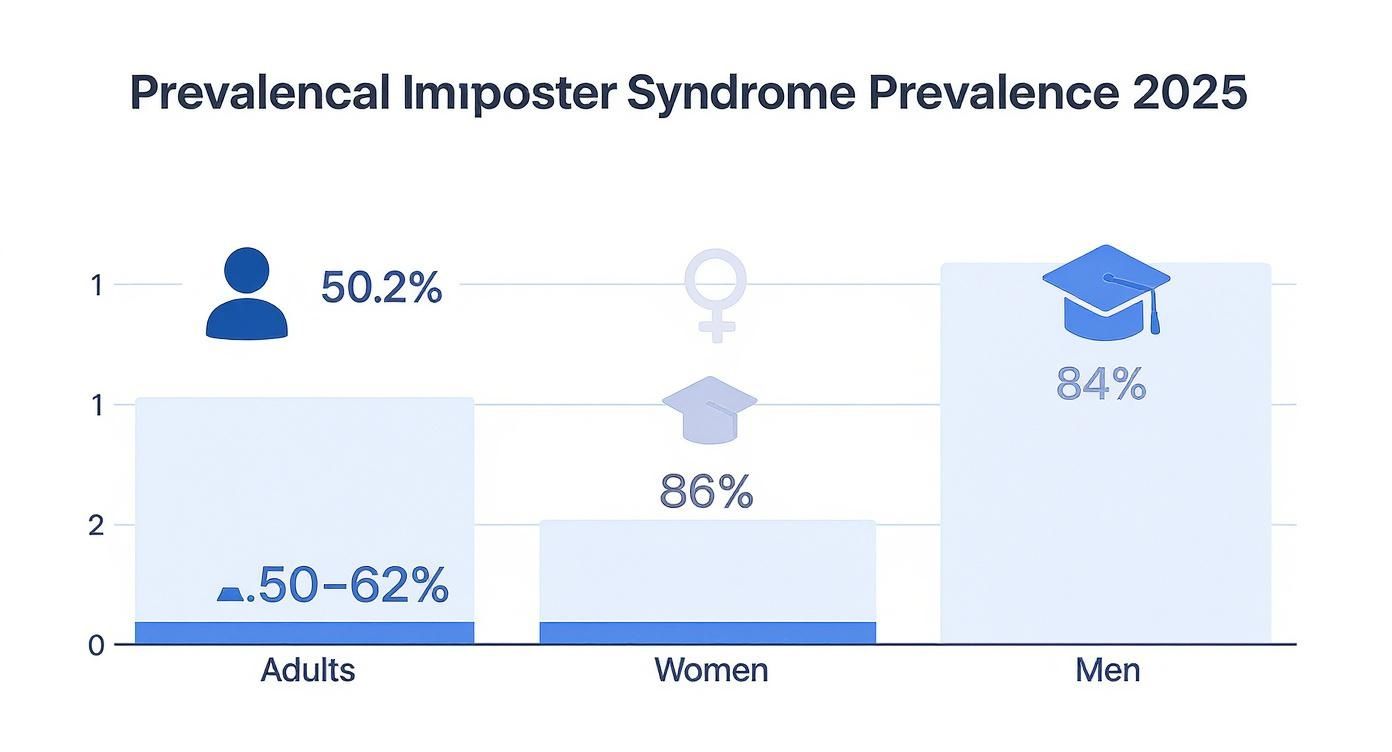
This data really highlights that while a huge number of adults experience these feelings, they are particularly acute for younger professionals and women, underscoring just how widespread this struggle is.
A Look at UK Workplace Triggers
Understanding the most common triggers helps to normalise the experience, taking away some of its power. Research into UK workplaces paints a really clear picture of what tends to set off these feelings.
This table breaks down some of the most prevalent triggers and their consequences.
Common UK Workplace Triggers and Their Impact
| Workplace Trigger | Percentage of People Affected | Resulting Impact on Work |
|---|---|---|
| Comparing yourself to others | 53% | Increased procrastination, avoiding challenges |
| Working on high-pressure projects | 37% | Working longer hours to "prove" worth |
| Receiving negative feedback | 35% | Reduced confidence, fear of future feedback |
| Starting a new job or role | 35% | Hesitation to ask questions, social withdrawal |
As you can see, the single biggest trigger, affecting 53% of people, is the simple act of comparing yourself to others at work. This is followed by working on high-pressure projects (37%) and the dual triggers of receiving negative feedback and starting a new job (both at 35%).
These external pressures lead to very real consequences: a staggering 63% of people report increased procrastination, and 57% end up working longer hours just to try and compensate. You can explore more about the specific triggers and impacts in UK workplaces in the full study.
The crucial insight here is that your triggers are not random. They are predictable responses to specific pressures. By identifying them, you take away their element of surprise and begin to reclaim your power.
Try this: start a small, private log. The next time you feel that familiar sense of being an imposter, just jot down what happened. Who were you with? What was the task? What was the specific thought that popped into your head?
Over time, you’ll build a clear map of your personal triggers. This map is the essential first step before you can start to challenge them.
Right, you understand the triggers, but what do you do when that all-too-familiar voice of self-doubt starts its monologue in your head? This is where we get practical. The aim isn't some fluffy "think positive" mantra, but to actively, intentionally, and compassionately reframe that inner dialogue using cold, hard evidence.
It all boils down to learning how to separate what you feel from what is objectively true. Imposter syndrome is an incredibly powerful feeling, I get it. But feelings aren't facts. By building a more balanced and realistic internal narrative, you can start to dial down the volume on that negative self-talk that's been running the show.
Separate Facts from Feelings
The first, and honestly most powerful, technique is to consciously pull apart your emotional reaction from the objective reality of a situation. You get a piece of glowing feedback, and your gut reaction is, "They're just being nice. If only they knew how much I struggled." That's a feeling. The fact? You received positive feedback on your work. Period.
Here’s how you can start putting this into practice:
- Catch the thought: The second you feel that sinking sensation of being a fraud, just pause. What’s the exact thought? Maybe it's, "I completely fluked that presentation."
- Name the feeling: What emotion is tied to that thought? Is it anxiety? Fear? A wave of shame? Give it a name.
- Hunt for the facts: Now, play detective. Look for the objective evidence. The fact is: "I delivered the presentation. People seemed engaged, and a few colleagues even came up with insightful questions afterwards."
This isn't about telling your feelings to get lost. Not at all. It's about acknowledging them without letting them rewrite history. Many people I work with find Cognitive Behavioural Therapy (CBT) incredibly helpful for challenging these automatic negative thoughts. Exploring some CBT workbook resources can be a brilliant first step in building this skill.
The very heart of imposter syndrome is allowing subjective feelings of inadequacy to completely overshadow objective evidence of your competence. Your first job is to become a more neutral observer of your own mind.
Create an Evidence Log
I often call this a "brag file," and it's a concrete collection of your successes you can turn to when your mind is trying to sell you a story about being a failure. This has nothing to do with arrogance; it’s about creating a factual counter-narrative to the fiction your inner critic loves to spin.
Your evidence log can be a simple document on your computer, a physical notebook, or even a dedicated folder in your email inbox. The only rule is to update it regularly.

So, what goes in your Evidence Log?
- Positive Feedback: Screenshot or copy-paste those lovely emails from clients, your manager, or colleagues who've praised your work.
- Metrics of Success: Did you help boost sales by 10%? Did you create a new process that saved the team five hours a week? Write. It. Down.
- Challenges Overcome: Jot down projects that felt impossible at first but that you managed to complete. Describe the problem, the steps you took, and the successful outcome.
- Skills You've Learned: Make a note of that new software you finally mastered, a certification you earned, or a complex skill you painstakingly developed.
The next time your brain whispers, "I'm not qualified for this," you can pull out your evidence log and review the hard data that proves otherwise. It’s a surprisingly powerful way to fight back against feelings with indisputable facts.
Use Scripts to Reframe Negative Self-Talk
Sometimes, in the heat of an imposter-syndrome spiral, you need a ready-made response. Having a few go-to reframes can be a total lifesaver. The goal is to consciously shift from a language of luck, dismissal, and apology to one of ownership and quiet competence.
Think of these as pre-written comebacks for your inner critic.
| Instead of This Thought… | Try This Reframe… |
|---|---|
| "I just got lucky." | "My hard work and preparation put me in a position to seize this opportunity." |
| "I hope no one finds out I don't know what I'm doing." | "It's okay to be learning. Everyone has to figure things out. Asking questions is a sign of competence." |
| "This is too hard. I'm going to fail." | "This is challenging, which is different from impossible. I'm capable of tackling difficult things. I'll just break it down." |
| "They're going to regret hiring me." | "I was hired based on my skills and experience. My job is to contribute and keep growing, not to be perfect." |
Practising this kind of reframing is like building a muscle. Over time, it gets easier and more automatic. It also helps cultivate a much kinder, more supportive inner voice. Developing this inner ally is a cornerstone of building resilience, and it’s something we explore in depth when we discuss how self-compassion is the key to emotional well-being and resilience.
By consistently applying these techniques, you're not just putting a plaster on imposter syndrome. You are actively rewiring the neural pathways that created it in the first place. You're teaching your brain a new, more accurate, and much kinder way to see yourself and all that you've accomplished.
Using Action to Build Real Confidence
Changing your internal monologue is a powerful place to start, but the real, lasting change happens when you prove your new beliefs are true. This is where action comes in.
Taking small, deliberate steps into the very situations your imposter syndrome dreads is what builds genuine, durable confidence. It’s about creating new experiences that directly contradict the old story.
We’re not talking about leaping into your biggest fear headfirst. Instead, we’ll use a gentle but surprisingly effective method called behavioural experiments. Think of these as low-risk, real-world tests designed to challenge a specific imposter belief and gather direct evidence about what actually happens.
Imagine your imposter belief is a scientific hypothesis. For example: "If I ask my colleague for help on this report, they will think I'm incompetent and lose respect for me." A behavioural experiment is how you test that hypothesis in a controlled, safe way.
Designing Your First Behavioural Experiment
The key here is to start small and safe. The goal isn't to trigger overwhelming anxiety, but to gently push the edges of your comfort zone and observe the real, often surprisingly non-catastrophic, results. A huge part of tackling imposter syndrome is learning how to build self-confidence and develop a more resilient sense of self-worth from the ground up.
Here’s a simple framework to design your own experiment:
- Identify the Belief: What’s the core fear? Let's stick with our example: "Asking for help shows weakness and incompetence."
- Create a Testable Prediction: What do you really think will happen? Be specific. "My colleague Sarah will look annoyed, give a short answer, and then avoid including me in future project discussions."
- Design a Low-Stakes Experiment: How can you test this safely? "I'll ask Sarah for 10 minutes of her time to get her input on one specific section of the report I'm finding tricky."
- Observe the Outcome: Pay attention to what actually happened. "Sarah was happy to help. She shared a useful resource, we had a good chat, and later that day she asked for my opinion on something she was working on."
- Update Your Belief: Based on the evidence, what’s a more balanced conclusion? "Asking for specific input from a trusted colleague can be a collaborative and positive experience. It doesn't mean I'm incompetent."
This process systematically dismantles the fear-based fiction your brain has created and replaces it with real-world, factual evidence.
The most powerful moments of growth occur just outside our comfort zone. Behavioural experiments are your structured, safe way of stepping into that space and proving to yourself that you are more capable than you feel.
Embracing Self-Compassion During the Process
Let's be honest: stepping into discomfort, no matter how small, can feel incredibly vulnerable. This is where self-compassion becomes your most vital tool. It’s the supportive inner voice that helps you navigate the anxiety of trying something new.
Without self-compassion, a small setback can feel like a catastrophe, confirming all your worst fears. With it, a mistake becomes a learning opportunity, not a final verdict on your worth.
Here are a few ways to practise self-compassion as you conduct your experiments:
- Acknowledge the Discomfort: Before you start, just say to yourself, "This feels a bit scary, and that's okay. It's totally normal to feel this way when I'm challenging a long-held belief."
- Use Supportive Self-Talk: If you feel that familiar knot of anxiety during the experiment, lean on a simple, kind phrase. Something like, "It's okay, I can handle this," or "This feeling will pass."
- Practise Post-Experiment Kindness: Regardless of the outcome, treat yourself with warmth. If it went well, celebrate the win! If it felt awkward or didn't go as planned, resist the urge to self-criticise. Try saying, "That was brave of me to try. What did I learn from that experience?"
This isn’t about being perfect; it's about being present and kind to yourself through the messy, real process of growth. It is the practice of showing up for yourself, especially when you feel unsure.
Practical Scripts for Your Inner Ally
Sometimes, in the heat of the moment, it's hard to find the right words. Having some pre-prepared phrases can be incredibly helpful when your inner critic pipes up during an experiment. Think of them as scripts for your new, compassionate inner ally.
When you're hesitating to start an experiment:
- "This feels uncomfortable, but that’s a sign that I'm growing. I'm choosing courage over comfort right now."
If the experiment feels difficult in the moment:
- "I'm just gathering information. There's no pass or fail here. I'm strong enough to handle this feeling."
After the experiment, regardless of the outcome:
- "I'm proud of myself for taking that step. Every attempt is a success because it teaches me something new."
By pairing courageous action with consistent self-compassion, you create a powerful upward spiral. Each small action builds a little more confidence, and each act of self-kindness gives you the resilience to take the next step. This is how you slowly but surely build a sense of self-worth that is based not on fleeting feelings, but on a solid foundation of your own lived experience.
Building a Support Network That Actually Helps
Imposter syndrome absolutely thrives in isolation. When you keep that nagging feeling of being a fraud locked away, it grows, convincing you that you’re the only person on earth who feels like this. Breaking that silence is one of the most powerful things you can do.
You really don't have to carry these feelings by yourself. In fact, just sharing what you're going through is often the first step towards realising how common—and how baseless—so many of these fears are. This isn't about confessing your 'flaws'; it's about connecting with people you trust who can offer a much-needed dose of reality and validation.

It’s an experience that lands differently depending on where you work. Research shows some fascinating variations across UK industries. People in creative arts and design, for instance, report an incredibly high rate of 87%. This is followed closely by intense fields like law at 74%, and marketing, advertising and PR at 72%.
On the flip side, property and construction workers report the lowest rate at just 29%. It’s a stark reminder of how much our workplace culture can either feed or starve these feelings. You can dig into more of these UK industry-specific findings in the full report.
How to Talk to Your Manager or Mentor
Opening up to a senior figure can feel incredibly intimidating, I know. But a good manager or mentor can be one of your best allies in this. The trick is to frame the conversation constructively, focusing on your development rather than just offloading your anxieties.
Think of it as asking for guidance. You don't even have to use the words "imposter syndrome" if they don't feel right. Focus on the behaviours it's causing.
You could try a prompt like this:
"I've noticed I sometimes hold back from leading new projects because I'm worried I don't have all the answers straight away. I'm keen to grow in this area and would love your perspective on how I can build my confidence when taking on a new challenge."
This works so well because it:
- Gets specific: It points to a real-world behaviour (hesitating on new projects).
- Is forward-looking: It's all about growth, not complaining.
- Invites collaboration: You're positioning them as a coach, not a judge.
For Leaders Fostering Psychological Safety
If you're in a leadership role, you have an enormous part to play in creating an environment where these feelings struggle to take root. Your aim is to build psychological safety—that shared belief that it's okay for team members to take interpersonal risks.
It means people feel they can ask questions, admit they've made a mistake, or pitch a wild idea without being shut down or humiliated. This is the ultimate antidote to the isolation imposter syndrome feeds on.
Here are a few practical things you can do:
- Model vulnerability: Be open about your own learning curve and challenges. When you share a time you felt out of your depth, you make it normal for everyone else.
- Give specific, evidence-based feedback: Forget "Great job." Instead, try, "The way you handled that difficult client question with such calm and expertise was really impressive." This ties their success to a tangible action, making it much harder for them to dismiss.
- Reframe mistakes as learning opportunities: When things don't go to plan, lead a blameless debrief. Focus on "What can we learn from this?" not "Whose fault was this?"
A genuinely supportive environment doesn't just happen; you have to build it, brick by brick. For leaders who want to cultivate a more resilient and compassionate team culture, exploring leadership coaching can provide the necessary tools and frameworks. You can find out more about coaching for leaders and how to develop these vital skills.
Ultimately, whether you're the one seeking support or the one providing it, the goal is the same. It’s to shape a culture where celebrating successes is natural, and asking for help is seen not as a weakness, but as the strength it truly is.
Got Questions? We Have Answers
It's natural to have questions when you're navigating something as tricky as imposter syndrome. Let's tackle some of the most common ones that come up.
Is It Possible to “Cure” Imposter Syndrome for Good?
It’s tempting to think of imposter syndrome as an illness we can cure, but that’s not quite how it works. Most experts agree it’s not something you eradicate completely. A more helpful way to see it is as something you learn to manage.
Think of it less like getting rid of a virus and more like building psychological muscle. You’re developing the skills and self-awareness to notice when those fraudulent feelings creep in, and crucially, you're learning how to stop them from running the show.
Even the most accomplished people I've worked with admit to feeling a pang of it now and then, especially when they’re stepping into a new role or facing a big challenge. The real difference is that they’ve learned not to let that feeling derail them. The goal isn't to silence your inner critic forever—that's probably impossible—but to turn the volume way down.
When Is It Time to Get Professional Help?
If imposter syndrome is starting to seriously get in the way of your life, that's a clear sign to consider seeking professional support. A fleeting moment of self-doubt is one thing; it's another thing entirely when that doubt dictates your choices.
It might be time to reach out to a therapist if you notice:
- Constant anxiety: You’re always on edge about your performance, even when you’re getting good feedback.
- Avoiding opportunities: You’re turning down promotions or new projects you actually want, just because you’re terrified of being "found out."
- Chronic overworking: You're trapped in a cycle of working relentless hours to prove your worth, leading to burnout and taking a toll on your health.
- Your wellbeing is suffering: The feelings of inadequacy are bleeding into your personal life, affecting your relationships, your sleep, or your general mental health.
Seeking professional help isn’t a sign of failure. It's a proactive, powerful step toward reclaiming your confidence and wellbeing. Think of it as an investment in yourself.
A therapist who is skilled in approaches like Cognitive Behavioural Therapy (CBT) or, even better, Compassion Focused Therapy (CFT), can provide a structured, supportive space. They'll help you get to the root of the beliefs fuelling your imposter syndrome and work with you to build personalised strategies that actually work.
How Can I Help a Colleague Who Seems to Be Struggling?
Supporting a colleague who you think is dealing with this requires a gentle and sensitive touch. Your aim is to open a door for them, not to diagnose or try to fix them.
A great first step is simply to normalise the experience. You could share a relevant article or mention a time when you felt completely out of your depth on a project. This sends a subtle signal that it's a safe topic to talk about. Please, avoid saying things like, "You sound like you have imposter syndrome."
When they do well, give them specific, evidence-based praise. Instead of a quick "Good job," try something like, "The way you analysed that data for the presentation was incredibly insightful. It really clarified the key takeaways for the whole team." This connects their success to a tangible skill, making it harder for their inner critic to dismiss.
If they do decide to open up to you, your most important job is just to listen and validate what they’re feeling. Simple phrases like, "That sounds really tough," or "I can totally understand why you'd feel that way," are far more powerful than jumping in with, "Don't be silly, you're brilliant!"
Ultimately, the best thing any of us can do is help build a team culture where admitting you don't know something or asking for help isn't just accepted, but encouraged. That helps everyone.
At Dr Chris Irons, we believe that developing a kinder, more compassionate relationship with yourself is the key to overcoming self-criticism and building a fulfilling life. If you're ready to move beyond imposter syndrome, explore our Compassion Focused Therapy and coaching services.