Dealing with workplace anxiety often starts with simply acknowledging it's there. It's about recognising that racing heart before a big meeting, the knot in your stomach when you see an email from your boss, or the constant, nagging worry about your performance. These aren't just minor stresses; they are signals. And the moment you start listening to them, you can begin to take small, practical steps to get back on solid ground.
What Workplace Anxiety Actually Feels Like

Let’s get real for a moment—workplace anxiety is so much more than just "feeling stressed." It's a persistent, sometimes overwhelming, sense of dread tied directly to your job.
Physically, it can show up as a tight chest during team calls or sleepless nights spent replaying a minor mistake over and over. Emotionally, it might look like uncharacteristic irritability with colleagues, a constant fear of being judged, or that sinking feeling of being an imposter who’s about to be found out.
These feelings are incredibly common and often a direct response to the pressures of modern work culture: sky-high expectations, impossible deadlines, and the feeling that you need to be 'on' 24/7.
The Scale of the Issue
If you feel like you're the only one, the numbers tell a very different story.
In the UK during 2023/24, an estimated 776,000 workers were suffering from work-related stress, depression, or anxiety. This mental health crisis resulted in a staggering 16.4 million working days being lost, which accounts for 54% of all sick days.
The reality is that what you're feeling is not a personal failure but a shared, widespread experience. Realising this is often the first, most powerful step toward managing it.
Common Triggers vs Hidden Symptoms of Workplace Anxiety
Workplace anxiety isn’t always a full-blown panic attack. More often, it’s a slow burn—a series of smaller, corrosive experiences that build up over time. Getting to the root of it means learning to spot both the obvious triggers and the more subtle ways it shows up in your behaviour.
To help with this, I've put together a quick comparison of the common causes versus the less obvious symptoms they can create.
| Common Triggers (The Cause) | Hidden Symptoms (The Effect) |
|---|---|
| Unrealistic Deadlines: The constant pressure to deliver more in less time. | Procrastination: Delaying tasks not from laziness, but from a fear of not doing them perfectly. |
| Micromanagement: Feeling constantly scrutinised and untrusted by a manager. | Physical Ailments: Frequent headaches, stomach issues, or general fatigue with no other clear cause. |
| Conflict with Colleagues: Navigating difficult team dynamics or office politics. | Social Withdrawal: Avoiding team lunches or after-work events you once enjoyed. |
| Fear of Redundancy: Job insecurity creating a baseline of constant worry. | Over-preparation: Spending excessive hours perfecting a simple email or presentation due to fear of criticism. |
Seeing the link between the cause and the effect can be a lightbulb moment. It helps you see that your actions (or inactions) aren't character flaws; they're coping mechanisms.
The feeling that you don't truly deserve your success can be a significant driver of anxiety. If this resonates with you, it might be helpful to learn more about the link between anxiety and imposter syndrome in our detailed guide.
By validating these real-world scenarios, we can move past generic advice. That knot in your stomach when your boss schedules an "unexpected chat"? It's real. The sheer exhaustion from masking your anxiety all day? Completely valid. Acknowledging this reality is the foundation for building the practical coping strategies we’ll explore next.
Get a Grip with In-the-Moment Techniques

We’ve all been there. A critical email lands in your inbox, or you’re blindsided by a performance review reminder, and suddenly, anxiety floods your system. It can feel like you’ve lost all control – your heart pounds, your thoughts spiral, and focusing on anything else becomes impossible.
In these moments, you need practical tools that work right now, discreetly, right at your desk. These techniques are designed to interrupt the anxiety cycle. They work by pulling your attention away from the racing thoughts and grounding you firmly back in the present, giving your nervous system a chance to calm down.
Anchor Yourself with Grounding Exercises
Grounding is simply the practice of reconnecting with the physical world when your mind is lost in worry. One of the most effective and subtle methods I’ve come across is the 5-4-3-2-1 technique. It’s powerful because it forces your brain to focus on your senses, which is a fantastic way of putting the brakes on a spiral.
The best part? You can do this without anyone even noticing. Just pause and mentally tick off:
- 5 things you can see: Your computer monitor, a pen on your desk, the colour of a colleague's jumper, a plant in the corner, the light hitting the wall.
- 4 things you can feel: The texture of your desk, the fabric of your chair against your back, the warmth of your mug, your feet planted firmly on the floor.
- 3 things you can hear: The hum of the air conditioning, distant chatter, the click of your own keyboard.
- 2 things you can smell: The faint scent of coffee from the kitchen, the soap on your hands from your last wash.
- 1 thing you can taste: The lingering taste of your morning tea or a mint.
By the time you finish, you’ll likely find your breathing has slowed and the intensity of the anxiety has dropped a few notches. This sensory focus acts as a circuit breaker for those overwhelming thoughts.
Master Your Breath to Calm Your Nerves
When we get anxious, our breathing becomes shallow and rapid, which basically tells our brain we’re in danger. The fastest way to send a message of safety back to your nervous system is to consciously change your breathing pattern.
Box breathing is an excellent tool for this, especially before a daunting meeting or during a stressful call. It’s incredibly simple and effective.
- Breathe in slowly through your nose for a count of four.
- Hold your breath for a count of four.
- Exhale slowly through your mouth for a count of four.
- Hold your breath again for a count of four.
Repeat this cycle four or five times. The steady, predictable rhythm helps regulate your heart rate and quieten your mind.
This deliberate control over your breath is a powerful reminder that even when your thoughts feel chaotic, you can still influence your body's response. It’s a small but significant act of regaining command.
Challenge Your Thoughts with Cognitive Reframing
Anxiety loves to catastrophise—to jump straight to the worst-case scenario. A crucial part of dealing with workplace anxiety is learning to question and reframe these automatic negative thoughts. You can't always stop them from popping up, but you absolutely don't have to accept them as truth.
The goal isn’t to pretend everything is perfect, but to find a more balanced and realistic perspective.
Think about this common scenario: You make a mistake on a project report.
- Anxious Thought: "This is a disaster. My boss is going to think I'm incompetent, and I'll probably get fired."
- Reframed Thought: "I made an error, which is frustrating, but it happens. I can correct it and explain what happened. This is a chance to learn, not a catastrophe."
It helps to have a few go-to reframing phrases. Just switching "I can't handle this" to "I can handle this one step at a time" can shift your entire mindset from being overwhelmed to being capable. This small cognitive shift empowers you to face challenges with a more constructive outlook, dialling down the power anxiety has over you in that moment.
Build Your Long-Term Resilience to Workplace Stress
https://www.youtube.com/embed/MumyOgZmOdY
While those in-the-moment techniques are lifesavers when anxiety spikes, the real game-changer is building a foundation of resilience. The goal isn’t to become immune to stress—that’s impossible—but to fundamentally change your relationship with it so those spikes become less frequent and a lot less intense.
It’s a shift from just reacting to stress to proactively cultivating your mental wellbeing. Think of it as tending to your inner environment, making it a place of support and understanding rather than threat and self-criticism. This is exactly where the principles of Compassion-Focused Therapy (CFT) can be incredibly powerful for tackling workplace anxiety.
Adopt a Compassionate Inner Voice
Workplace anxiety often has a powerful accomplice: a harsh inner critic. You know the one. It’s the voice that blows mistakes out of proportion, constantly predicts failure, and tells you you’re not good enough. CFT teaches us how to cultivate a compassionate inner voice to stand up to that bully.
Think about it: if a colleague you genuinely liked made a mistake, you'd probably offer them encouragement, right? You'd be supportive. A compassionate inner voice is simply about learning to offer that exact same kindness to yourself.
This isn't about letting yourself off the hook. It’s about motivating yourself with encouragement instead of fear. A compassionate mindset accepts that struggling is just part of being human, especially in a demanding job.
“When we are in a threat-focused mindset, our thinking becomes rigid, our attention narrows, and we are more likely to engage in self-criticism. In contrast, when we cultivate a compassionate mindset, we activate feelings of safeness, connection, and reassurance.”
This change in your internal monologue is the cornerstone of long-term resilience. It reframes challenges from threats you need to fear into opportunities you can grow from. To go a bit deeper on this, it's worth exploring how self-compassion is the key to emotional well-being and resilience.
Practical Exercises to Cultivate Self-Compassion
Developing this new inner voice takes practice. It’s a skill you build over time, not an overnight fix. Here are a couple of simple exercises you can weave into your workday to start strengthening your self-compassion muscle.
The Mindful Self-Compassion Break
This is a quick, discreet exercise you can do right at your desk whenever you feel that wave of overwhelm rising. It has three simple parts:
- Acknowledge the struggle: Just say to yourself, silently, "This is a moment of stress," or "This is really hard right now." This simple act validates what you're feeling without any judgment.
- Recognise common humanity: Remind yourself, "Struggling is a part of life," or "Lots of people feel this way in their jobs." This is crucial for feeling less isolated in your anxiety.
- Offer yourself kindness: Place a hand over your heart or on your arm—a simple, grounding gesture of comfort—and say, "May I be kind to myself," or "May I give myself the compassion I need."
Write a Compassionate Letter to Yourself
After a really tough day at work—maybe you got some harsh feedback or felt like you bombed a presentation—take ten minutes to write a letter.
But here’s the trick: imagine you're writing to a dear friend who just went through the exact same day. What would you say to them? You’d likely be understanding, supportive, and point out their strengths. Write that letter, but address it to yourself. This exercise is a brilliant way to step outside your own head and practice a compassionate perspective.
Changing Your Response to Stressors
When you consistently practice these techniques, you slowly start to rewire your automatic response to workplace triggers. Instead of a mistake instantly setting off your threat system (panic, self-blame, racing heart), it begins to activate your soothing system (self-reassurance, rational problem-solving).
Let’s play out a scenario. Imagine you get an email with some unexpected critical feedback.
- Old Threat-Based Response: Your heart pounds. Your inner critic screams, “See, you messed up again! You’re going to get fired.” You then spend the rest of the day on high alert, unable to focus.
- New Compassion-Based Response: You feel that initial pang of disappointment. But then you take a breath and tell yourself, “Okay, this feedback is tough to hear, but it's not a verdict on my entire worth. Let me take a moment to understand it and see what I can learn.”
This shift doesn't magically erase the sting of the feedback, but it stops it from spiralling into a full-blown anxiety attack. You’re building a stronger foundation to handle whatever comes next with more confidence and less turmoil. For a wider view on this, this practical guide to mental health at work has some excellent strategies.
How to Talk to Your Manager About Your Anxiety
The very idea of telling your boss you’re struggling with anxiety can be enough to send your heart rate sky-high. It’s a deeply personal conversation, and it’s completely normal to worry about being misunderstood, judged, or seen as incapable.
But here’s the thing: when handled thoughtfully, this chat can be a major turning point. It can shift from something you dread into a genuinely constructive conversation that makes your working life so much better. The secret is to frame it around a shared goal: helping you do your best work, sustainably. This isn't about admitting a weakness; it's about proactively managing your wellbeing so you can keep contributing in a meaningful way.
Laying the Groundwork for a Productive Chat
Before you even book that meeting, a little prep work goes a long way. Seriously, don’t skip this part. Walking in with a clear plan will not only boost your confidence but also keep the conversation focused and professional. Just diving in without a clear purpose can end up feeling vague and unhelpful for both of you.
First, get really specific about what’s going on. A general statement like "I'm feeling anxious" is hard for a manager to know what to do with. Instead, try to connect the dots between your feelings and what’s happening at work.
- Pinpoint your triggers: Does your anxiety flare up when you’re hit with last-minute projects on a tight deadline? Is it the pressure of leading team meetings? Or is it the feeling of a workload that’s just consistently overwhelming?
- Identify the impact: How is this actually affecting your work? Think in concrete terms. For example, "When I'm dealing with constant high-pressure deadlines, I find it really hard to focus, which means I’m spending extra time double-checking everything to avoid mistakes."
- Brainstorm solutions: This is key. Come to the table with a few reasonable ideas for adjustments. This shows you’re not just highlighting a problem, but you’re already thinking about solutions. It could be anything from asking for clearer communication on project timelines, finding a quieter spot to work when you need to focus, or suggesting a system to break down huge projects into smaller, more manageable stages.
Doing this homework completely changes the dynamic. You're no longer just someone with a problem; you're a proactive team member ready to collaborate on a solution. It’s empowering for you and gives your manager something tangible to work with.
Structuring the Conversation for Success
Okay, you've done your prep. Now, how do you actually structure the chat? Having a simple mental roadmap can stop you from getting flustered or going off-track. Remember, you don't need to share every single personal detail—just what’s relevant to your work and the support you need.
Here’s a simple, effective way to guide the conversation:
- Set the tone: Start by reinforcing your commitment to your role. Something like, "I really enjoy my work here and I'm committed to doing my best. I'd like to talk about something that's been getting in the way of that recently."
- State the issue clearly: Briefly explain what’s been happening, using those specific examples you prepared. For instance, "I've been experiencing periods of anxiety, especially when juggling back-to-back deadlines, and I've noticed it's impacting my focus."
- Propose solutions: Now’s the time to bring in your ideas. You could say, "I've found that having a clearer overview of the week's priorities really helps me manage my workload and reduces that feeling of pressure. Would it be possible to have a quick check-in on Mondays to set those priorities?"
- Open the floor for collaboration: End by inviting them into the conversation. A simple, "I’d love to hear your thoughts on this," shows you see this as a partnership.
Before you jump into the conversation, it can be helpful to have a clear idea of what to aim for and what to steer clear of.
Conversation Planner Do's and Don'ts
| Do This | Avoid This |
|---|---|
| Focus on specific work-related impacts (e.g., "I find it hard to concentrate in open-plan areas"). | Using vague, emotional language (e.g., "I'm just really stressed out all the time"). |
| Come prepared with potential solutions (e.g., "Could I use a quiet room for two hours a day?"). | Expecting your manager to have all the answers or read your mind. |
| Keep it professional and solution-oriented. Frame it as a way to improve your performance. | Oversharing personal details that aren't relevant to the workplace adjustments you need. |
| Request a private, dedicated time to talk. Don't try to have this chat in a busy hallway. | Apologising for your feelings. You're managing a health condition, not admitting a fault. |
| Follow up in writing. A brief email summarising what you discussed can be really helpful. | Assuming the first conversation is the last. This might be an ongoing dialogue. |
By keeping these points in mind, you can guide the conversation towards a positive, practical outcome.
By framing the conversation this way, you’re not just presenting a problem; you're taking ownership and leading the charge to find a workable solution. It’s a mark of professionalism and self-awareness.
It can also help to understand what your manager might be thinking. Knowing a bit about tips for managers to reduce performance review anxiety can demystify their side of the desk and make the whole process feel less intimidating.
Of course, not every manager is well-equipped for these conversations. This is a real issue, especially for younger people in the workforce. Recent UK surveys found that 48% of workers aged 18–24 have felt stressed due to unpaid overtime, and confidence in talking to a manager about mental health has plummeted in this group. These stats point to a real gap in supportive leadership that can make opening up feel even harder. Discover more insights about workplace mental health trends in the UK.
If your manager doesn’t seem receptive, don’t lose hope. You still have other avenues, like speaking with HR. The whole point of this conversation is to open a door—a door to a more supportive and sustainable way of working for you.
Create Your Personal Workplace Anxiety Action Plan
You've started spotting the signs of anxiety and have a few go-to techniques to pull yourself back from the edge. That's a huge step. Now, let’s take that insight and build something more structured—a proactive strategy for looking after yourself at work.
Think of this as your personal roadmap for navigating workplace anxiety. It’s not a one-and-done document you write and then forget about. It's a living guide, something you can turn to when you feel overwhelmed, helping you take clear, decisive action instead of getting lost in a spiral of worry.
Identify Your Unique Triggers
The first part of any good plan is self-awareness. Generic advice is a decent starting point, but a plan built around your specific situation is where the real power lies. You need to get brutally honest about what, exactly, throws you off balance at work.
Have a think about the last few weeks. What moments or situations consistently left you feeling drained, on edge, or completely overwhelmed?
- Was it the sudden pressure of a last-minute deadline landing on your desk?
- The vague, undefined nature of a new project?
- The challenging dynamic of a particular team meeting?
- That unspoken expectation to be online and available after hours?
Jot these down without judgement. The more specific you can be, the better. Instead of a general note like "meetings," try something like, "Presenting my weekly update in the Monday morning team meeting." This level of detail is gold because it tells you exactly where to focus your energy and your coping strategies.
Build Your Go-To Coping Toolkit
Once you know your triggers, the next step is to match them with your most effective coping strategies. This is your personal toolkit, filled with the techniques that genuinely work for you.
For each trigger you’ve listed, write down one or two actions you can take. You can pull from the techniques we’ve already discussed, or add others you know help you settle your mind.
- Trigger: An unexpected, urgent task from my manager drops into my inbox.
- Coping Strategy: I'll use the box breathing technique for a solid two minutes before I even start. I'll consciously reframe the thought from "I'll never get this done" to "I can handle this one step at a time."
- Trigger: The fear of speaking up in a large, formal meeting.
- Coping Strategy: Before the meeting starts, I’ll quickly do the 5-4-3-2-1 grounding exercise. I’ll also prepare one key point I want to make beforehand, giving me a clear focus.
This isn't just about making lists. It’s about creating a conscious, deliberate link between a specific problem and a practical solution. It gives you back a sense of control by providing a pre-planned response, so your mind is less likely to go blank when anxiety kicks in.
Establish and Uphold Your Boundaries
A huge part of managing workplace anxiety comes down to setting—and protecting—firm boundaries. Without them, burnout isn't a risk; it's an inevitability. Boundaries are simply the lines you draw to protect your time, your energy, and your mental health.
Your action plan should have a section dedicated to these non-negotiables. These are the rules you set for yourself and, when needed, communicate to others.
Here are a few ideas to get you started:
- Digital Boundaries: I will not check work emails between 7 p.m. and 8 a.m.
- Workload Boundaries: When a new task is added to a full plate, I will politely ask, "Thanks for this. To make sure I get it done right, could you help me clarify priorities against my current tasks?"
- Time Boundaries: I will take a full, uninterrupted lunch break away from my desk at least three times a week.
Writing these down makes them real. It turns vague intentions into solid commitments.
Outline Your Steps for Seeking Support
Finally, your plan needs to map out how and when you’ll reach out for more support. Knowing your next steps in advance removes the pressure of trying to figure it all out when you’re already feeling underwater.
This part of your plan can be as simple as a few bullet points.
- Internal Support: If my anxiety is consistently affecting my work for two weeks, I will schedule a chat with my manager using the framework we talked about.
- Professional Support: I’ll contact my company’s Employee Assistance Programme (EAP) or book an appointment with my GP if my physical symptoms (like poor sleep or constant headaches) don't improve.
This infographic breaks down how you might prepare for that conversation with your manager into a simple, three-step flow.
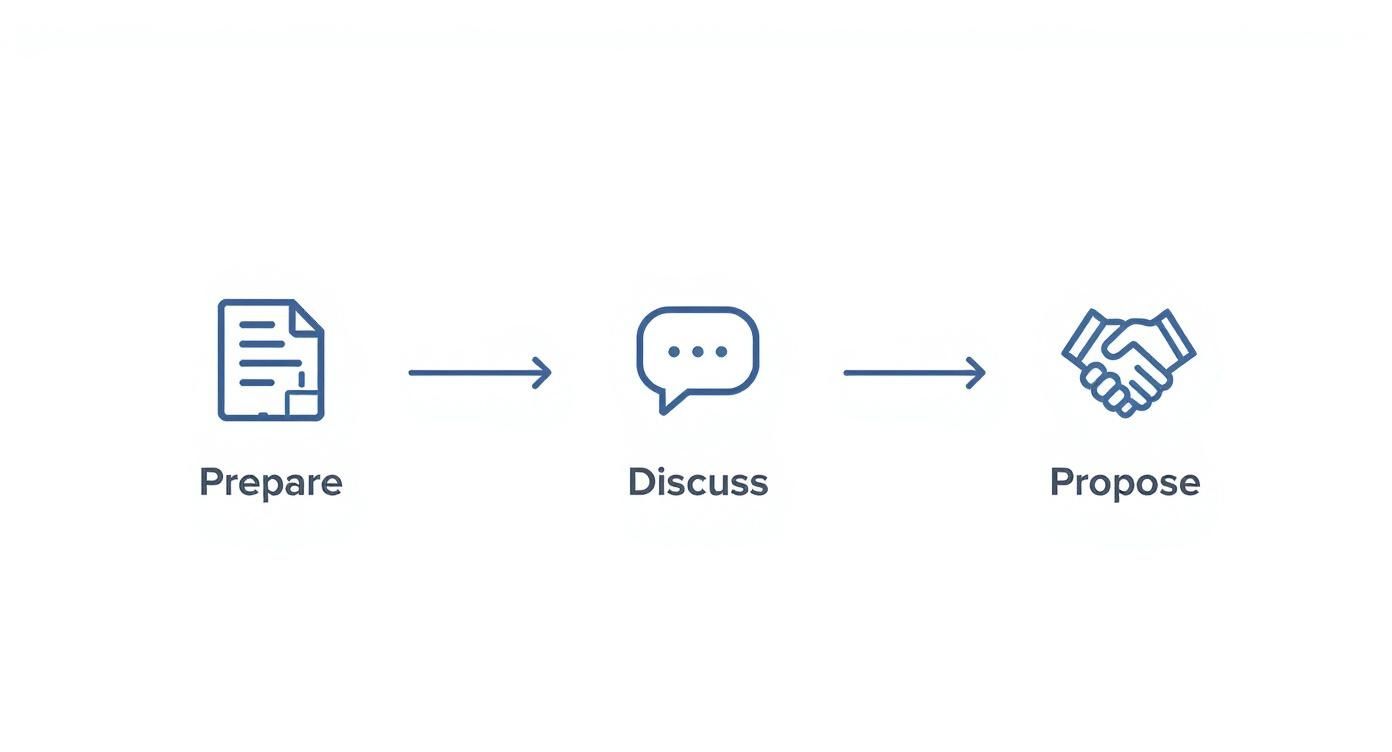
As you can see, a successful conversation is built on a foundation of good preparation, a clear discussion, and collaborative problem-solving. It helps turn what feels like a daunting task into a manageable process—which is exactly what your entire action plan is designed to do.
Knowing When Professional Support Is the Next Step
Self-help strategies and your own personal plan are brilliant tools for getting a handle on workplace anxiety. They give you a real sense of control over daily pressures and help you build up your resilience over time. But it's just as important to be honest with yourself and recognise when those efforts, as valuable as they are, just aren't cutting it on their own.
Reaching out for professional support isn’t a sign that you've failed. Far from it. It's a proactive and genuinely courageous move towards taking your health seriously. Think of it as acknowledging that you deserve to feel better, and sometimes, bringing in an expert guide is the smartest way to find the path forward.
Clear Signs It’s Time to Seek Help
Knowing when to bring in extra support is key. If you find your anxiety is constantly getting in the way of you doing your job, if the physical side of it is getting worse, or if the coping tools that used to work no longer give you any relief, it might be time for something more structured.
Does any of this sound familiar?
- Your work is suffering. No matter what you try, your focus, productivity, or the quality of what you produce is consistently taking a hit.
- Physical symptoms are getting worse. You're dealing with constant headaches, stomach problems, terrible sleep, or a sense of fatigue that never seems to lift.
- You're pulling away from people. You find yourself actively dodging colleagues, skipping team socials, or dreading meetings you used to handle just fine.
- It’s spilling into your home life. The stress from work is seeping into everything, negatively impacting your relationships, your downtime, and your general happiness.
If you’re nodding along to these points, that’s a clear signal to start looking at your options for professional help. The knock-on effect of unmanaged workplace anxiety is huge, not just for us as individuals but for the wider economy. The Health and Safety Executive (HSE) found that work-related stress, anxiety, and depression account for roughly 17.1 million lost working days in the UK each year. With so many people feeling their workplace isn't doing enough, taking personal action is vital.
Seeking help is about adding a powerful new tool to your wellbeing toolkit. It’s a strategic choice to invest in your long-term health, giving you the skills and support to thrive, not just survive, in your professional life.
Navigating Your Support Options
The good news is there are several very accessible ways to get the support you need. The right one for you will depend on your specific situation, but just knowing what the main routes are can make the whole process feel less daunting.
For many, the first port of call is their GP. A doctor can properly assess what's going on, rule out any other medical issues, and refer you to NHS mental health services if needed. Another fantastic and often overlooked resource is your company's Employee Assistance Programme (EAP). These are confidential programmes that usually offer a certain number of free counselling sessions.
If you’re looking for more specialised support, private therapy is another avenue. This route often gives you more choice over the therapist you see and the type of approach they use, like Compassion Focused Therapy. You can explore different types of therapy and find a qualified professional to get started.
Got a Question? Let's Clear Things Up
When you're trying to get your head around workplace anxiety, a lot of specific questions tend to pop up. It's completely normal. Let's tackle a couple of the most common ones I hear, so you can get some clarity on where you stand and what your next steps might be.
"Isn't This Just Stress?" The Stress vs. Anxiety Question
It's easy to mix these two up because they often feel similar, but there’s a crucial difference.
Think of workplace stress like this: you have a massive deadline breathing down your neck. You feel the pressure, you're running on adrenaline, but once that project is submitted, there's a huge sigh of relief. The feeling eases off because the cause is gone. Stress is usually tied to a specific, external trigger.
Workplace anxiety, on the other hand, hangs around. It’s a more persistent, internal feeling of dread or worry that can stick with you even when there’s no obvious pressure point. You might find yourself constantly worrying about making a mistake, dreading Monday morning on a Friday night, or just feeling overwhelmed by it all, long after a tough project has finished.
"Could I Lose My Job Over This?"
This is a big one, and a completely valid fear. The good news is, in the UK, you have protection. If your anxiety has a significant and long-term negative impact on your day-to-day life, it can be considered a disability under the Equality Act 2010.
This means your employer has a legal duty to make 'reasonable adjustments' for you. They can't just dismiss you because you have anxiety.
The key here is communication. You need to go through the proper channels – talking to your manager or HR, formally asking for support if you need it. Of course, if performance becomes a major issue and reasonable adjustments haven't helped, dismissal could eventually be on the table, but it's not the starting point.
Your mental health is protected. Instead of fearing the worst, try to focus on opening up a conversation about your needs. It’s all about working together to find a way forward that feels sustainable for you, not about hiding the struggle.