Combating the Financing of Terrorism (CFT) is the global, coordinated effort to choke off the financial oxygen that terrorist activities need to survive. If you think of a terrorist plot as a raging fire, CFT is the strategy of cutting off its fuel supply—the money required to plan, equip, and execute an attack.
Unpacking Counter-Terrorist Financing
At its heart, what is CFT is a web of laws, regulations, and investigative tactics all designed to spot, disrupt, and ultimately dismantle the financial networks propping up terrorism. These aren't just abstract rules buried in textbooks; they're very real, practical defences that protect our national and global security. The entire point is to make it as difficult as humanly possible for terrorist organisations to raise, move, and use their funds.
This mission demands constant vigilance from both governments and the private sector. It all works on a simple but powerful principle: by following the money, authorities can uncover hidden plots, map out dangerous networks, and, with any luck, prevent attacks before they happen.
The Pillars of an Effective CFT Strategy
A truly effective strategy doesn't rely on a single solution. Instead, it’s built on several key pillars that work in concert to create a robust defence against this type of financial crime. These components are designed to ensure that financial institutions and other regulated businesses are active, willing participants in the fight.
Here are the core elements:
- A Strong Legal Framework: This starts with passing and enforcing specific laws that make terrorist financing a serious crime. It gives authorities the power they need to investigate and prosecute offenders. In the UK, the Terrorism Act 2000 is a cornerstone of this legal foundation.
- Proactive Regulation and Supervision: It’s not enough to just have laws on the books. Government bodies, like the Financial Conduct Authority (FCA) here in the UK, set the rules and actively supervise businesses to make sure they're meeting their CFT obligations.
- International Cooperation: Terrorist networks don’t respect borders, so our response can't either. Collaboration between countries is absolutely essential. Organisations like the Financial Action Task Force (FATF) are crucial here, setting global standards to ensure the international response is coordinated and effective.
"Effective anti-money laundering and combating the financing of terrorism (AML/CFT) policies and measures are key to the integrity and stability of the international financial system and member countries’ economies."
It’s impossible to talk about CFT without mentioning its close cousin, Anti-Money Laundering (AML). Terrorist financing often uses the very same shadowy channels as money laundering, so a solid grasp of modern Anti-Money Laundering (AML) solutions is vital for a complete picture. Both disciplines are about protecting the financial system from abuse, but their focus is slightly different. AML is about tracking where dirty money came from, whereas CFT is about tracking where the money, clean or dirty, is going to be used.
Key Aspects of Combating the Financing of Terrorism (CFT)
To get a quick sense of how these different elements fit together, the table below summarises the core components of the UK's approach to CFT.
| Component | Description |
|---|---|
| Legislation | Foundational laws like the Terrorism Act 2000 and the Proceeds of Crime Act 2002 which criminalise terrorist financing and related activities. |
| Regulatory Oversight | Bodies such as the Financial Conduct Authority (FCA) and HM Treasury set standards and supervise financial institutions to ensure compliance with CFT regulations. |
| Financial Intelligence | The UK Financial Intelligence Unit (UKFIU), part of the National Crime Agency, receives and analyses Suspicious Activity Reports (SARs) to identify potential threats. |
| Global Standards | Adherence to international recommendations from the Financial Action Task Force (FATF) to ensure the UK's measures are aligned with global best practices. |
| Sanctions Regimes | Implementing financial sanctions against designated individuals, groups, and entities to freeze their assets and prevent them from accessing the financial system. |
| Public-Private Partnership | Collaboration between law enforcement, government agencies, and the private sector (e.g., banks) to share information and improve detection methods. |
This multi-faceted approach ensures that there are defences at every level, from international policy down to the day-to-day operations of a local bank branch.
The Evolution of the UK’s CFT Framework
To really get to grips with what CFT is today, it helps to look at how the UK's defences against financial crime have been pieced together over the years. The country's counter-terrorist financing (CFT) framework didn’t just appear out of thin air; it’s a layered system, built up over decades in response to new threats and shifting global standards.
This evolution has been steered by crucial bits of legislation, like the Sanctions and Anti-Money Laundering Act 2018, which gave the UK more power to impose sanctions on its own terms. At the same time, international directives have played a massive part in shaping our domestic policy and the compliance hoops businesses have to jump through.
Distinguishing AML and CFT Goals
A really important part of this backstory is understanding the subtle but critical difference between money laundering and terrorist financing. While the methods can look similar, their end goals are worlds apart, which is why each needs its own specific regulatory focus.
- Anti-Money Laundering (AML): This is all about the source of the money. The goal here is to stop criminals from hiding where their cash came from, preventing them from making "dirty" money look clean.
- Combating the Financing of Terrorism (CFT): This, on the other hand, is focused on the destination of the funds. The aim is to stop money—whether it came from a legitimate job or a criminal enterprise—from being used to fund terrorist acts.
This distinction is vital. It explains why CFT rules often demand a completely different type of scrutiny. A small, perfectly legitimate-looking transaction might barely register from an AML perspective, but it could be the final piece of the puzzle for funding a terrorist plot.
Building a Modern Defence
The UK's approach has constantly had to adapt to these unique challenges. This infographic breaks down the core process used to tackle terrorist financing threats as they pop up.
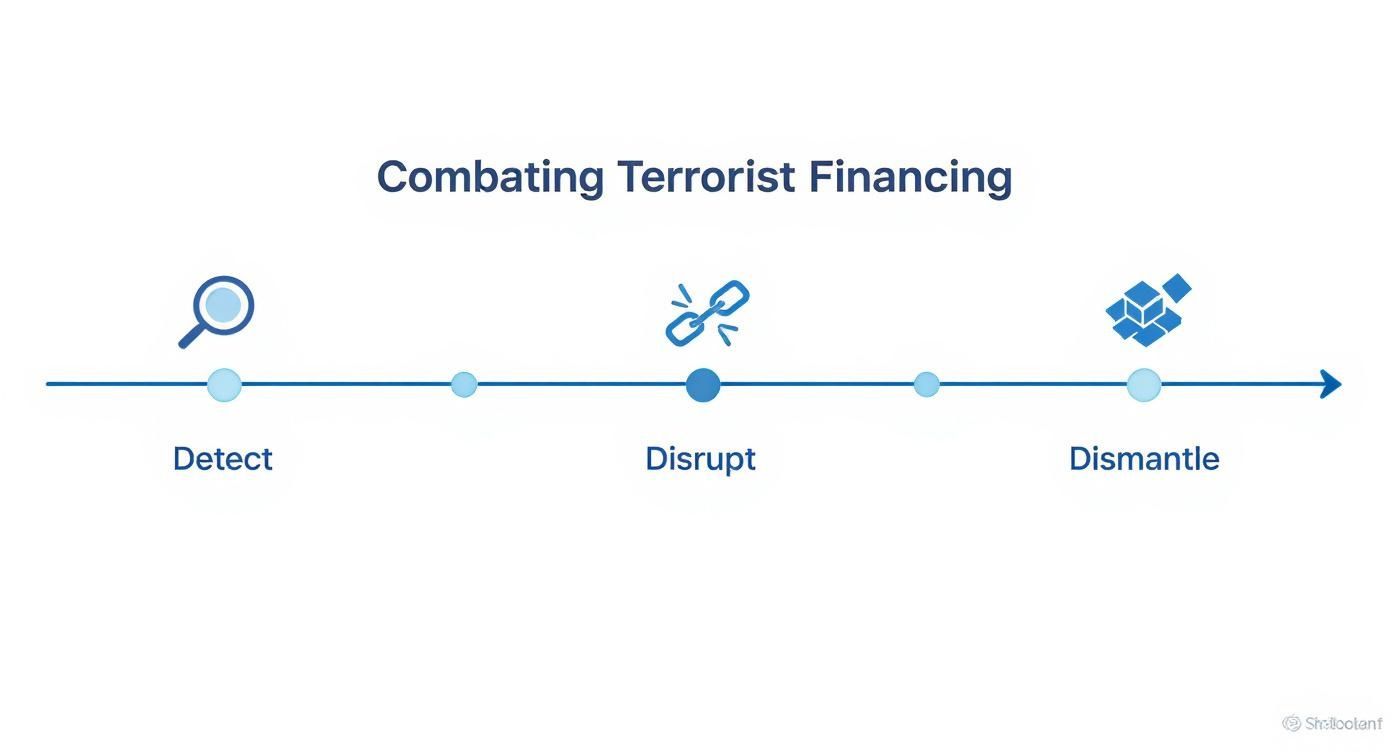
As you can see, it's a strategic, three-stage approach that moves from spotting the initial signs right through to completely dismantling the financial support networks.
The CFT regime itself is part of a much wider anti-money laundering framework that has grown up over almost thirty years. The UK brought in its first money laundering regulations nearly three decades ago, and they've been tweaked and refined ever since. A major update was the 5th Anti-Money Laundering Directive, which became UK law in January 2020. This pulled more sectors into the regulatory net and tightened the rules on checking and declaring who really owns a company. You can dive deeper into this regulatory history by reading the full review of the UK's Money Laundering Regulations.
This constant reinforcement of the law shows just how committed the UK is to creating a hostile environment for illicit finance, which in turn forces regulated businesses to be more vigilant than ever before.
By tracing this evolution, you can see how the current framework is designed to be both tough and agile, providing a multi-layered defence that protects the integrity of the UK’s entire financial system.
When people hear about “Combating the Financing of Terrorism” (or CFT), their minds often jump straight to huge, multinational banks and shady offshore accounts. While those institutions are certainly a massive part of the picture, the reality, especially here in the UK, is much broader.
Think of it less like a single line of defence and more like a nationwide neighbourhood watch for our economy. It’s not just the police officer on the beat who keeps the area safe; it's every resident noticing when something isn't quite right. In the same way, CFT compliance relies on a whole host of professionals who handle money or provide services that could, unfortunately, be exploited.

The Regulated Sectors on High Alert
The UK's approach is to cast a deliberately wide net, making sure that any potential channels for terrorist financing are watched closely. This means if you work in certain fields, you're legally required to have solid CFT checks in place and to report anything that seems suspicious.
So, who’s on this front line? It’s a surprisingly diverse group:
- Estate and Letting Agencies: Property is a classic way to move large sums of money. Agents have a duty to verify where the funds for a sale or high-value rental are coming from.
- Law Firms and Accountants: These professionals are often the gatekeepers. They set up companies, manage client funds, and oversee complex transactions, putting them in a prime position to spot red flags.
- High-Value Dealers: Any business selling luxury items like art, jewellery, or high-end cars for cash payments over €10,000 has to do their homework on who is buying.
- Cryptoasset Businesses: The world of digital currency can offer a degree of anonymity, which makes the sector a high-risk area. As a result, firms operating here must follow very strict AML/CFT rules.
- Casinos and Gambling Agencies: With huge amounts of cash flowing quickly, gambling platforms are an obvious target for those looking to launder money or move illicit funds.
This isn't just a random list. The UK's framework is designed to align with international standards set by the Financial Action Task Force (FATF), and it's grown significantly over the years. Today, it covers around 10 different sectors, including those above plus others like trust providers, auction platforms, and art market participants. If you want a deeper look, you can explore the full coverage of the UK's regulatory structure to see just how comprehensive it is.
The Role of Supervisory Bodies
Of course, these businesses aren't just left to their own devices. A network of 25 designated AML/CFT supervisors exists to enforce the rules, provide guidance, and make sure firms are actually doing what they're supposed to do.
The big name here is the Financial Conduct Authority (FCA), which watches over thousands of financial services firms. But it's not a one-man show. Professional bodies like the Solicitors Regulation Authority (for lawyers) and HMRC (which supervises accountants and estate agents, among others) play a vital supervisory role in their respective fields.
This setup means the expertise is specific to each sector. The ultimate aim is to create a robust, interlocking system across the country, where every regulated professional knows their part in protecting the UK’s national security and making our financial system a truly hostile place for terrorists.
Core CFT Procedures Every Business Must Implement
Knowing what CFT is and actually putting it into practice are two different things. To bridge that gap, businesses need to weave a series of core procedures into their daily operations. These aren't just bureaucratic boxes to tick; they are the practical, on-the-ground actions that build a strong defence against terrorist financing.
Think of it like the security checks you go through at an airport. Each step is carefully designed to spot a potential threat before it can do any harm.
It all starts with a simple but powerful principle: Know Your Customer (KYC). Put simply, this is the job of verifying that a client is who they say they are. It’s the business equivalent of a passport check before someone boards a flight. This fundamental step is all about stopping bad actors from using fake identities to get into the financial system in the first place.

Going Deeper with Due Diligence
While KYC confirms an identity, Customer Due Diligence (CDD) takes it a level deeper. CDD is all about understanding the nature of your client’s business and how they operate. It means asking the right questions to build up a clear picture of their financial habits.
Some key questions you’d ask during the CDD process include:
- What’s the purpose of this account or business relationship?
- Where do their funds and wealth come from?
- What do their typical transactions look like?
Getting this information helps you establish a baseline of what’s normal for each client. That baseline is absolutely vital because without knowing what’s normal, you have no chance of spotting what’s suspicious.
The whole framework hangs on a risk-based approach. This just means you apply tougher checks to clients who seem to pose a higher risk. A local, low-risk business might only need standard CDD. But a high-risk client working across several countries would face Enhanced Due Diligence (EDD), a far more intensive investigation.
The Role of Continuous Monitoring
CFT compliance isn’t a one-off task you complete and forget about. It's an ongoing process of being vigilant, and this is where transaction monitoring comes in. It's critical for businesses to implement robust Anti-Money Laundering (AML) transaction monitoring systems to catch illicit financial activities as they happen. These systems work in the background, automatically flagging behaviour that deviates from a client's established profile.
This could be a sudden, unusually large transaction that doesn't make sense, a messy web of international transfers, or any activity involving high-risk countries. This continuous oversight is what turns a static compliance policy into a dynamic, active defence.
By combining initial identity verification with a deep understanding of customer behaviour and ongoing monitoring, businesses create a powerful, multi-layered shield against financial crime.
Ultimately, if your business spots activity that feels suspicious, you have a legal duty to do something about it. This means filing a Suspicious Activity Report (SAR) with the UK Financial Intelligence Unit (UKFIU). A SAR is a confidential heads-up to the authorities, giving them the crucial intelligence they need to investigate potential threats. It’s this final step that turns abstract rules into a clear, actionable process that directly contributes to national security.
How Global Cooperation Shapes CFT Efforts
Terrorist financing is a borderless problem. It’s a threat that simply can’t be tackled by one country acting in isolation.
Illicit funds snake their way through the global financial system, crossing continents in the blink of an eye. This stark reality means that any national strategy, like the one here in the UK, is just one piece of a much larger, interconnected puzzle. For our domestic efforts to have any real teeth, they have to link up with a coordinated global response.
This is where the Financial Action Task Force (FATF) steps in. You can think of the FATF as the world’s standard-setter for fighting financial crime. It's an inter-governmental body that develops and promotes the policies needed to protect the global financial system from money laundering, terrorist financing, and the funding of weapons of mass destruction.

The FATF 40 Recommendations
The FATF’s most powerful tool is its set of 40 Recommendations. These aren’t just gentle suggestions; they represent the accepted international standard for getting to grips with financial crime. They form the very basis for a coordinated response across the globe, providing a complete framework of measures countries should put in place.
Some of the key areas covered include:
- Criminalising Terrorist Financing: Making sure countries have robust laws to prosecute offenders.
- Customer Due Diligence: Requiring banks and other institutions to truly know who their customers are and understand what they're doing.
- Record-Keeping: Mandating that businesses keep detailed transaction records to help investigators connect the dots.
- Reporting Suspicious Transactions: Forcing firms to flag unusual activity to their national financial intelligence units.
These recommendations directly shape the laws and regulations in member countries, including the UK. When the UK government refines its CFT framework, it's often to bring it in line with the latest FATF standards. This ensures our national defences stay sharp and in step with global best practice. It’s this collaborative approach that creates a unified front, making it so much harder for terrorist financiers to find and exploit weak links in the international system.
"A country’s CFT efforts are amplified exponentially when they harmonise with a global standard. It turns isolated national policies into a cohesive, interlocking worldwide defence, leaving fewer places for illicit funds to hide."
The sheer scale of the threat makes this kind of international cooperation non-negotiable. The numbers speak for themselves. In 2020 alone, the world witnessed over 10,000 terrorist attacks – a chilling reminder of why nations invest so heavily in their CFT infrastructure. The FATF’s 40 recommendations are the blueprint for this global effort, establishing the core principles that every national AML/CFT regime should be built on. You can discover more insights about this coordinated international strategy on idnow.io.
Ultimately, every single compliance measure—from a high-street bank in London running a customer check to a small law firm filing a suspicious activity report—feeds into this much larger mission. It’s about protecting not just one country's financial system, but the integrity and stability of the entire interconnected global economy.
Answering Your Questions About Compassion Focused Therapy
When you’re first exploring a new kind of therapy, it’s only natural to have a lot of questions. Let's clear up some of the most common queries I hear about Compassion Focused Therapy to give you a better sense of how it all works.
Isn't This Just a Form of Mindfulness?
That's a great question, and one that comes up a lot. While CFT certainly uses mindfulness practices, they are two different things. Think of mindfulness as a foundational skill – the ability to be present and aware of your thoughts and feelings without judgement. It's a vital tool in the toolbox.
CFT takes that tool and uses it for a very specific purpose: to actively cultivate compassion. We don't just notice our difficult thoughts; we learn to meet them with warmth, strength, and a genuine desire to help ourselves.
So, in short:
- Mindfulness helps us notice the storm.
- CFT teaches us how to be a strong, caring anchor within it.
Do I Have to Be Religious or Spiritual for It to Work?
Absolutely not. CFT is grounded in evolutionary psychology, neuroscience, and attachment theory – it's a science-based approach through and through.
The compassion we cultivate in CFT isn't tied to any particular belief system. It’s about tapping into the very human capacity for care that we're all born with. It's the same kind of motivation that drives a parent to soothe a crying child or a friend to support another in need. We’re simply learning how to turn that supportive instinct inwards.
While some people find that CFT complements their spiritual or religious beliefs, the therapy itself is secular. It’s all about working with the brain you have to create a more supportive inner world, regardless of your personal beliefs.
Is It Only for People Who Are Very Self-Critical?
CFT is incredibly powerful for people who struggle with a harsh inner critic, but its benefits are much broader. It can be a huge help for anyone dealing with feelings of shame, anxiety, depression, or the lingering effects of trauma.
Really, at its heart, CFT is for anyone who finds themselves caught in painful emotional loops. If you feel stuck, overwhelmed by difficult feelings, or disconnected from yourself and others, CFT offers a path toward feeling safer, more connected, and more at peace with yourself.